How to Choose a Plumber: License, Insurance, Pricing and Red Flags
How to Choose a Plumber
Finding a dependable plumber requires balancing speed with verification, especially during an active leak or emergency. Protecting your property from costly repairs starts with hiring a vetted professional who meets state licensing standards, carries full coverage, and stands behind their work in writing.
The 5-Step Short Answer
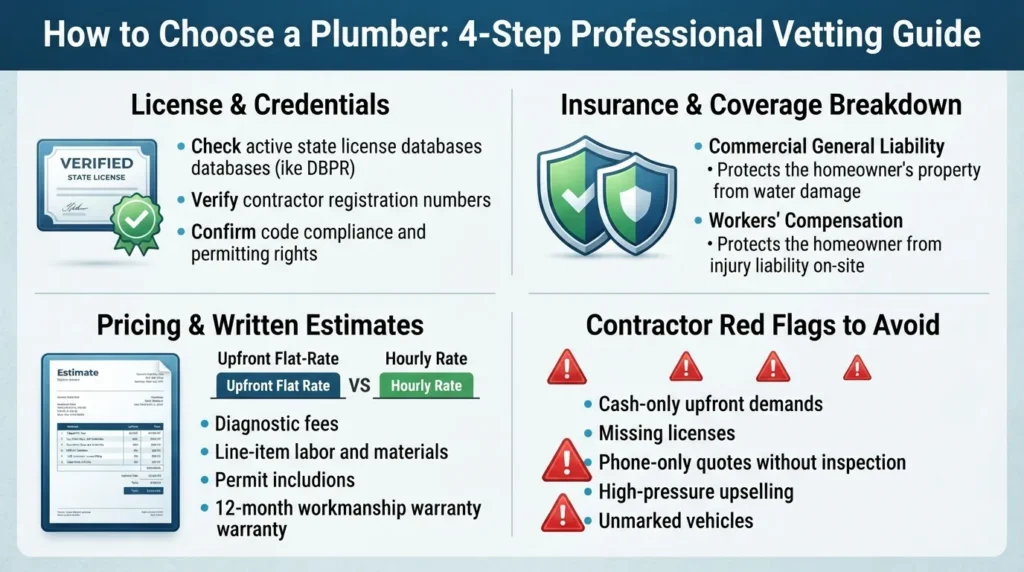
Verify Licensing: Confirm active credentials through your state or local licensing board database.
Confirm Insurance: Ensure the business maintains both commercial general liability insurance and workers’ compensation coverage.
Check Reviews & Referrals: Evaluate verified customer feedback, local neighborhood recommendations, and long-term ratings across trusted review platforms.
Compare Written Estimates: Request itemized, flat-rate, or hourly quotes detailing labor, parts, and potential contingency costs.
Get a Workmanship Warranty: Secure a written guarantee covering both installation labor and replacement parts for at least 12 months.
Why Choosing the Right Plumber Matters
Hiring an unlicensed or unvetted individual carries financial risks that extend far beyond an initial service fee. Substandard pipe fittings, incorrect drain slopes, or improper gas line connections frequently result in hidden water damage, toxic mold growth, and structural rot that can cost tens of thousands of dollars to remediate.
Improper plumbing installations also lead to frequent system failures, requiring repeat emergency service calls that disrupt your household. Moreover, unpermitted work often invalidates home insurance claims, leaving property owners entirely liable for subsequent water or structural damage caused by contractor negligence.
Selecting a fully certified, high-quality specialist guarantees that all repairs comply with local building codes, protecting your property value and ensuring long-term operational safety.
Who This Guide Is For
This framework is designed for homeowners, residential landlords, and commercial property managers who need clear guidelines for selecting a trustworthy contractor—whether handling routine pipe maintenance or urgent mainline backups. If you need immediate assistance from a licensed local team, explore our plumbing services in Miami to schedule a comprehensive diagnostic inspection today.
Start by Defining Your Plumbing Situation
Hiring criteria shift dramatically based on whether you are dealing with a property-threatening crisis or planning a home renovation. Defining the exact nature of your plumbing issue upfront determines how quickly you must hire, what pricing structures apply, and which contractor credentials matter most.
Real-World Case Note: During an emergency call out to a residential property, a homeowner delayed operating their main water shut-off valve for 20 minutes while searching for local repair crews online. That short delay allowed over 100 gallons of pressurized water to submerge their drywall and hardwood flooring, increasing the total restoration cost from a minor pipe repair to over $12,000 in water damage remediation.
Is This a Plumbing Emergency?
A true plumbing emergency poses an immediate threat to your health, safety, or structural property integrity. In these scenarios, immediate stabilization takes priority over extensive contractor research.
Common Emergency Scenarios: A major burst pipe, severe sewage backing up into shower drains, a total loss of running water, or gas-related water heater malfunctions.
Actions in the First 5 Minutes: Locate and turn off your main water shut-off valve immediately to cut supply and stop active flooding.
Immediate Next Step: If you have active flooding or health hazards and need help right now, call our emergency plumber for immediate 24/7 dispatch.
Urgent but Not an Emergency
Urgent issues require prompt, professional attention within 24 to 48 hours to prevent them from escalating into catastrophic failures. However, they allow enough time to check licensing, read verified reviews, and secure quotes.
Typical Urgent Issues: Pinhole pipe leaks, slow-running main line clogs, continuously running toilets, or small water heater drips.
Proactive Action: Turn off localized fixture shut-off valves under the affected sink or toilet to isolate the problem.
Next Step: Suspect a hidden leak behind your drywall or beneath your slab? Learn about our non-invasive leak detection and repair services before minor seepage causes hidden mold growth.
Planned Projects
Planned plumbing projects focus on long-term system performance, energy efficiency, and aesthetic property upgrades. Because time is on your side, you can thoroughly vet contractors, compare multiple detailed proposals, and review past project portfolios.
Project Types: Kitchen and bathroom remodels, whole-home repiping, tankless water heater upgrades, or sewer line replacements.
Vetting Focus: Look for dedicated project managers, explicit warranties on parts and labor, and proven experience pulling municipal building permits.
How Your Situation Changes What You Should Look For
Evaluating contractors based on the urgency of your scenario prevents overpaying for routine work or hiring unequipped technicians during a crisis.
| Situation | Priority Criteria | Time to Decide |
| Emergency | Fast response time, 24/7 availability, active insurance, clear after-hours rates | 5 – 15 Minutes |
| Urgent Repair | Same-day service windows, transparent diagnostic fees, solid local reviews | 1 – 24 Hours |
| Planned Project | Detailed line-item estimates, specialized project experience, written warranties, permitting expertise | 1 – 4 Weeks |
Verify the Plumber’s License and Insurance
Verifying trade credentials and insurance policies is the single most critical step in protecting your property and finances before work begins. Hiring an unlicensed contractor forfeits statutory consumer protections, exposes you to severe liability, and often results in unpermitted installations that violate municipal codes.
Our licensed technicians are happy to show proof of license and insurance on request.
Why a Plumbing License Matters
A active state license proves that a contractor has met mandatory competency standards, logged thousands of verified hours of supervised field training, and passed rigorous trade examinations.
Legal Compliance & Permitting: Only licensed plumbers can pull required municipal permits, ensuring all work complies with updated local building codes.
Safety & Accountability: State boards mandate strict adherence to health codes to prevent water contamination and structural gas hazards.
Regulatory Oversight: Working with a licensed professional provides consumer recourse through state regulatory boards in the event of contractual disputes or substandard work.
How to Check a Plumber’s License in Florida
Verifying a contractor’s standing takes under two minutes through official state databases. Follow this step-by-step process before signing any service contract:
Obtain the License Number: Request the contractor’s license number directly (in Florida, plumbing licenses typically begin with “CFC” for certified plumbing contractors or “RMC” for registered contractors).
Access the Portal: Visit the official Florida DBPR license search portal managed by the Construction Industry Licensing Board.
Check License Status: Input the license number or business name to verify that the status displays as “Current, Active”.
Review History: Check the expiration date and review the record for open complaints, administrative actions, or past board discipline.
Verify Local Requirements: Check municipal or county registration boards, as local jurisdictions frequently require secondary local competency licenses or county-level business tax receipts.
Liability Insurance vs. Workers’ Compensation
Never allow a contractor onto your property without confirming both commercial general liability and workers’ compensation coverage.
| Coverage Type | What It Protects & What Happens Without It |
|---|---|
| Commercial General Liability |
|
| Workers' Compensation |
|
How to Request a Certificate of Insurance
Always request a Certificate of Insurance (COI) sent directly from the contractor’s insurance agency before major work starts.
Simple Request Script:
“Please ask your insurance agent to issue an official Certificate of Insurance (COI) naming me/my business as the certificate holder showing active General Liability and Workers’ Compensation coverage before we start.”
An authentic COI must list the insurance carrier, policy numbers, effective policy dates (confirming it has not expired), and minimum coverage limits (typically $1,000,000 per occurrence for general liability).
Licensed, Bonded, and Insured: What Each Term Means
Understanding contractor terminology helps you evaluate real protection levels:
Licensed: The contractor has passed state trade exams, met legal qualifications, and holds official authorization from the state or local licensing authority to perform plumbing work.
Insured: The business maintains active general liability and workers’ compensation policies to pay for property damage or physical injuries occurring on the job site.
Bonded: The contractor holds a surety bond that financially protects the consumer if the business fails to complete the job, abandons the project, or fails to pay subcontractor bills.
Check Reviews, Referrals, and Reputation
Evaluating a plumber’s reputation requires looking beyond simple star ratings. Real social proof lies in recurring patterns of customer experiences, clear problem resolution, and genuine recommendations from trusted local sources.
How to Read Online Reviews the Smart Way
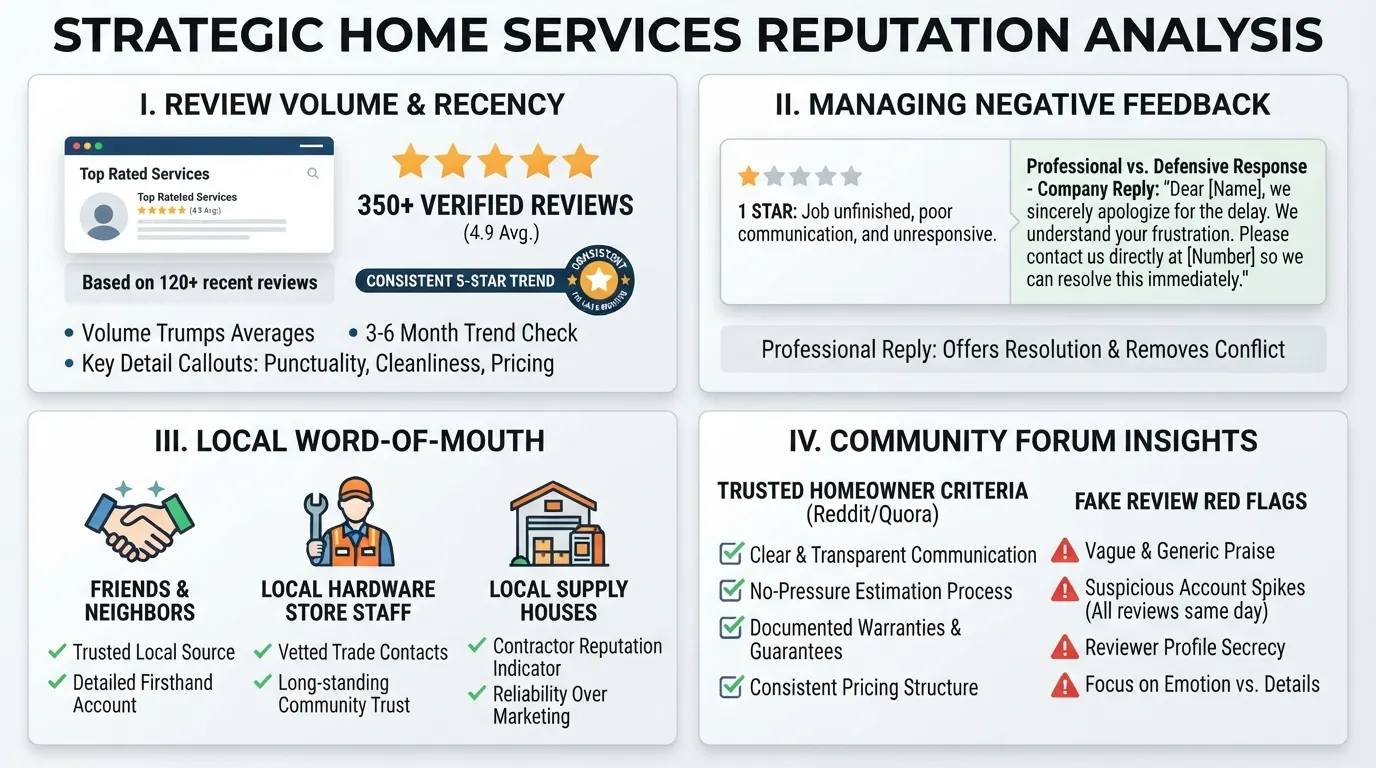
High overall star averages can mask recent service quality drops or inflated feedback campaigns. Evaluating review volume, frequency, and specific feedback patterns gives a far more accurate picture of performance on Google reviews, Yelp, and the Better Business Bureau.
Focus on Recent Trends: Prioritize reviews left over the last 3 to 6 months to assess current staffing quality and customer service standards.
Evaluate Total Volume: A 4.8-star rating backed by 300+ detailed customer reviews is significantly more reliable than a perfect 5.0 score based on only 12 entries.
Look for Specific Detail: Valued feedback describes the actual problem, the technician’s punctuality, clear pricing discussions, and how cleanly the work area was left.
Pay Attention to How a Company Responds to Negative Reviews
Every busy service company occasionally encounters customer dissatisfaction. How leadership handles complaints publicly reveals their accountability and commitment to customer satisfaction.
Professional plumbing contractors respond promptly with calm, polite tone, avoiding defensive arguments or finger-pointing. They offer concrete steps to resolve issues off the platform (e.g., providing a direct manager’s phone number), demonstrating that they honor their warranties and take responsibility for their work.
Ask Neighbors, Friends, and Local Hardware Store Staff
Word-of-mouth recommendations from local sources remain one of the most reliable ways to find a top-tier local plumber.
Neighborhood social platforms and personal networks yield honest accounts of local service calls. Additionally, staff at independent local hardware stores or supply houses interact daily with local tradespeople; they know which contractors purchase high-quality fittings, run licensed operations, and maintain a reputation for reliable work.
What Homeowners on Reddit and Quora Commonly Recommend
Homeowners across online community forums consistently share practical criteria for identifying trustworthy tradespeople. Core community advice includes:
Clear Communication: Hire technicians who take the time to explain the root cause of an issue using plain language rather than confusing technical jargon.
No High-Pressure Sales: Avoid contractors who use aggressive scare tactics to upsell unnecessary fixture replacements during routine service calls.
Upfront Terms & Warranties: Favor specialists who provide firm, upfront pricing estimates and stand behind their repairs with a documented labor warranty.
Signs of Fake or Unhelpful Reviews
Identifying manipulated online feedback protects you from hiring predatory operators who use fake ratings to rank higher for searches like “plumbers near me.”
Generic Vague Praise: Short reviews stating only “Great job!” or “Best service ever!” repeated across multiple user profiles without mentioning specific plumbing work.
Suspicious Account Activity: Profiles with no avatar, no prior local review history, or accounts that leave identical positive reviews for companies in entirely different states.
Review Clustering: Sudden influxes of dozen 5-star ratings over a few days, especially following a series of detailed 1-star complaints.
How Much Should a Plumber Charge? Understanding Quotes and Pricing
Understanding how plumbing contractors structure their fees protects you from unexpected costs and predatory billing. While competitors often offer generic advice to “get multiple estimates,” knowing how to evaluate hourly structures, diagnostic fees, and line-item estimates ensures you pay a fair price for quality work. Not sure what your job will cost? Book a visit for an upfront estimate.
Hourly Rate vs. Flat-Rate Pricing
Plumbers typically bill using one of two pricing models. Each model offers distinct advantages depending on the scope and predictability of the project.
| Pricing Model | Pros | Cons | When It Makes Sense |
| Hourly Rate | • Fairer for quick, straightforward troubleshooting. • You only pay for active labor time. | • Risk of high bills if unexpected complications arise. • Harder to budget in advance. | Minor leaks, quick valve replacements, or simple inspections. |
| Flat-Rate Pricing | • Guaranteed total cost before work begins. • No penalty if the job takes longer than expected. | • Often includes a built-in safety margin for the contractor. • Less flexible for open-ended exploratory work. | Water heater installs, main line replacements, or toilet installations. |
Service Call and Diagnostic Fees Explained
Most reputable contractors charge a dispatch or diagnostic fee (typically ranging from $75 to $200) to cover travel expenses and technician time required to inspect your system.
What It Covers: A professional diagnosis of the problem, a safety assessment, and a formal repair proposal.
Credit Toward Repairs: Many professional companies will waive or apply this diagnostic fee directly toward the cost of the repair if you approve their estimate on the spot. Always clarify this policy before booking.
What a Good Written Estimate Should Include
A professional plumbing quote should leave zero room for ambiguity. Avoid contractors who provide vague verbal estimates or incomplete scratchpad notes.
Itemized Labor & Materials: Clear breakdown of working hours, specialized parts, and pipe materials required.
Permit & Disposal Fees: Inclusion of municipal permit costs and old fixture disposal fees.
Timeline & Schedule: Expected start date, estimated completion time, and daily work windows.
Warranty Terms: Explicit coverage duration for both replacement parts and labor.
Site Cleanup: A guarantee that the workspace will be cleared and sanitized upon completion.
Why You Should Get 2–3 Written Estimates
Obtaining multiple bids allows you to compare proposals “apples-to-apples” and protects against overpricing. When evaluating quotes from different local contractors, compare them against a standardized matrix:
| Company | Labor Cost | Materials | Fees & Permits | Warranty | Timeline |
| Company A | [Amount] | [List Brand/Quality] | [Included/Extra] | [Duration] | [Days] |
| Company B | [Amount] | [List Brand/Quality] | [Included/Extra] | [Duration] | [Days] |
| Company C | [Amount] | [List Brand/Quality] | [Included/Extra] | [Duration] | [Days] |
Why Phone-Only Quotes Are Risky for Major Jobs
Reputable plumbers rarely provide firm pricing over the phone for complex projects. Without physically inspecting pipe corridors, corrosion levels, access points, or code compliance issues, phone estimates are often lowball figures designed to hook you before hidden fees appear on the final invoice.
What Drives Plumbing Cost Ranges
Because plumbing repairs vary wildly based on property age and system design, final pricing is driven by three main factors:
Accessibility & Labor Intensity: Exposed pipes under a sink cost significantly less to repair than buried main lines beneath concrete slabs or behind tiled walls.
Material Quality: Commercial-grade brass valves, PEX piping, and heavy-duty water heaters command higher material costs but offer vastly superior longevity.
Code Compliance Requirements: Upgrading older systems to meet current municipal building codes often requires secondary updates like pressure-reducing valves or backflow preventers.
Watch: How to compare plumbing quotes
Red Flags: How to Tell If a Plumber Is Ripping You Off
Spotting dishonest contractors early saves you from unnecessary repairs, inflated invoices, and substandard workmanship. Recognizing the warning signs of a plumbing scam helps separate predatory operators from trusted professionals.
What We’ve Seen in the Field:
Our technicians frequently arrive on service calls where previous unvetted operators claimed a customer’s cast-iron drain line was entirely collapsed and demanded $8,000 for immediate trenchless replacement. Upon running our diagnostic camera, we discovered the line only required a simple hydro-jetting service valued at a fraction of that quote. Always demand visual camera proof before approving major line replacements.
8 Warning Signs of a Dishonest or Unqualified Plumber
Watch out for these critical red flags before allowing any contractor to begin work on your property:
Refusal to Show Credentials: The technician cannot or will not provide an active state license number or certificate of insurance upon request.
Suspiciously Low Quotes: Bids that come in at half the price of competitors often signal bait-and-switch pricing or the use of cheap, non-compliant parts.
Demanding Large Cash Upfront: Requesting payment in full or massive cash deposits before work begins or materials arrive.
Refusing a Written Estimate: Providing only verbal pricing or vague cost guesses instead of an itemized paper or digital contract.
High-Pressure Upselling: Using scare tactics to force immediate approval for expensive, unneeded whole-house repiping or fixture replacements.
Vague Explanations: Giving evasive answers when asked about specific labor hours, pipe materials, or code compliance.
No Workmanship Warranty: Refusing to back up repairs with a written labor and parts guarantee.
Unmarked Vehicles & Gear: Arriving in an unmarked personal vehicle with no company uniform, proper identification, or standard trade tools.
Watch: More Tips for Choosing the Best Plumber [00:30]
Common Upselling Tactics to Watch For
Predatory plumbing operators often rely on psychological pressure to maximize invoice totals during emergency calls.
Be cautious of technicians who claim minor joint corrosion requires replacing an entire plumbing stack, or those who push chemical drain cleaners while charging premium diagnostic fees. A trustworthy expert addresses only the specific failure point and explains any secondary recommendations without demanding immediate authorization.
How a Good Plumber Behaves
Professional plumbing specialists prioritize consumer education and transparency. A reliable contractor will:
Take the time to thoroughly explain the exact mechanical root cause of the failure.
Physically show you the damaged valve, split pipe, or worn washer.
Present multiple repair options ranging from cost-effective patches to permanent replacements.
Patiently answer all questions regarding pricing, timelines, and municipal code requirements.
What Regulators and Experts Recommend If You Think You’ve Been Overcharged
If you suspect you have been scammed or heavily overcharged, take immediate, structured steps to protect your consumer rights:
Request an Itemized Invoice: Demand a detailed breakdown separating exact labor hours, part serial numbers, and administrative fees.
Get a Second Opinion: Have another licensed contractor inspect the completed work to verify whether the billed repairs were actually performed correctly.
File a Formal Complaint: Submit a complaint with the state licensing board (such as the Florida DBPR) or the Better Business Bureau if the contractor refuses to resolve fraudulent or substandard work.
Questions to Ask a Plumber Before You Hire
Interviewing a plumbing contractor before signing a contract clarifies expectations, prevents unexpected expenses, and ensures your project meets professional standards. Having a structured list of questions ready helps you separate qualified specialists from inexperienced operators.
10 Essential Questions to Ask
Before authorizing any repair or installation, ask these core questions to evaluate the contractor’s credentials and workflow:
Are you fully licensed and insured? (Verify active trade status and coverage limits.)
Can I see proof of your license and certificate of insurance? (Request physical or digital documentation.)
Do you charge by the hour or use flat-rate pricing? (Clarify how labor costs are calculated.)
Is there a service call or diagnostic fee, and is it credited toward repairs? (Understand upfront travel costs.)
Will you provide a detailed written estimate before starting work? (Avoid verbal-only pricing agreements.)
Who will actually perform the work—employees or subcontractors? (Ensure vetted technicians handle your property.)
How long will the project take from start to finish? (Establish clear delivery timelines.)
Do you handle pulling required municipal building permits? (Confirm local code compliance.)
What workmanship warranty do you offer on parts and labor? (Secure long-term protection guarantees.)
Do you clean up the work area and haul away debris when finished? (Clarify post-repair property restoration.)
Watch: How to Choose a Reliable Plumber | Expert Tips for Finding the Best Plumber [00:12]
What a Good Answer Sounds Like
Evaluating contractor responses reveals their professionalism and transparency:
Credentials: A trustworthy contractor readily provides license numbers and has their insurance agency email a certificate directly to you.
Pricing: They explain whether flat-rate or hourly pricing applies and clearly state whether diagnostic fees go toward the final repair bill.
Accountability: They outline specific warranty terms in writing and confirm that background-checked employees—not unvetted temporary laborers—will service your home.
Questions to Ask for Emergency Calls
When dealing with an urgent plumbing failure, time is critical, so narrow your initial questions to immediate operational details:
“What is your guaranteed arrival window?”
“What are your after-hours dispatch and labor rates?”
“What accepted payment methods do you require on-site?”
Copy-and-Paste Phone Script
Quick Phone Script:
“Hi, I need a plumber to help with [describe issue]. Before we schedule an appointment, could you confirm that your company is fully licensed and insured in our area? I also want to make sure you provide a written, itemized estimate before starting any work, and that your repairs come with a workmanship warranty. Could you walk me through your diagnostic fees and typical arrival times?”
Why a Workmanship Warranty Matters
A comprehensive warranty provides financial protection and peace of mind after a repair is completed. While parts can occasionally suffer from manufacturing defects or installation failures, a strong guarantee ensures that the plumbing contractor—not the homeowner—covers the cost of necessary corrections.
Our Workmanship Guarantee:
We back our installation and repair services with a full 12-month parts and labor warranty. If a component fails or an installation requires adjustment within one year of service, our team will inspect and repair the issue at zero additional cost to you. (Note: Please verify specific coverage details with your service representative prior to project authorization).
Workmanship Warranty vs. Manufacturer Warranty
Understanding the difference between installation guarantees and equipment coverage ensures you know who is responsible if a system fails:
Workmanship Warranty: Issued directly by the plumbing contractor. It covers errors related to installation quality, improper fittings, assembly mistakes, or poor craftsmanship.
Manufacturer Warranty: Provided by the equipment maker (e.g., water heater or fixture brand). It covers internal component defects, structural tank failure, or premature part degradation, but usually excludes installation labor costs.
What a Strong Warranty Looks Like
Not all guarantees offer equal protection. A high-quality warranty includes explicit terms that protect your investment:
Combined Parts and Labor Coverage: The guarantee covers both replacement hardware and the physical labor required to reinstall it.
Clear Timeframes: Standard industry benchmarks offer at least 12 months of complete coverage, with major system repipes or sewer line installations extending up to 5 to 10 years.
Documented Terms: Complete warranty parameters are provided in writing on the final invoice or contract, rather than relying on verbal assurances.
Questions to Ask About Warranty Coverage
Before approving major repairs, clarify the exact terms and limits of the contractor’s coverage:
“Does this guarantee cover both replacement parts and the technician’s labor fees?”
“What specific actions or lack of maintenance would void this warranty?”
“What is the exact process and contact procedure for filing a warranty claim?”
“Is this warranty transferable if I sell the property during the coverage period?”
Get It in Writing
Verbal promises regarding satisfaction guarantees or lifetime repairs are difficult to enforce if a dispute arises later. Always insist on receiving a physical copy or digital PDF of your itemized estimate and invoice that clearly details the exact warranty duration, covered components, and claims process before making your final payment.
Choosing the Right Plumber for Your Specific Job
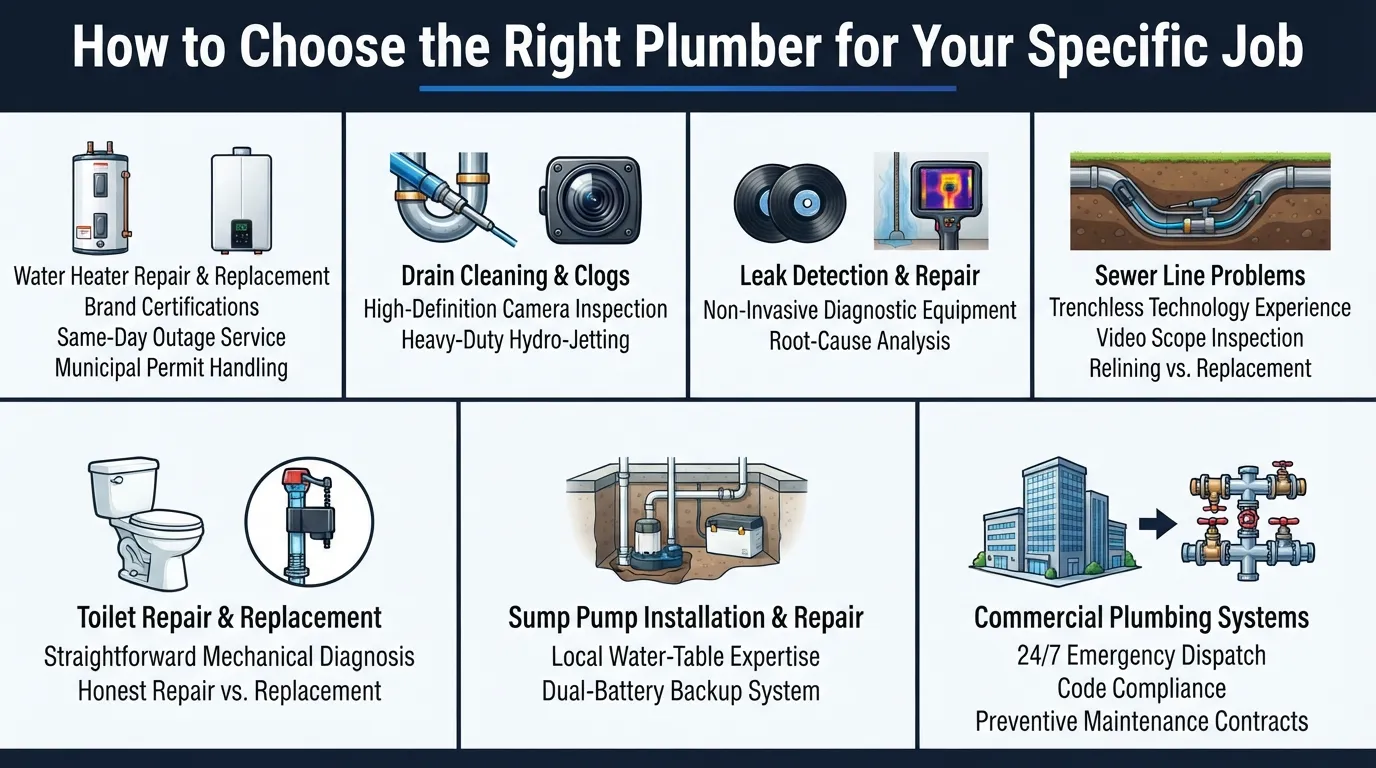
Plumbing systems involve distinct sub-specialties, requiring specific diagnostic equipment and specialized trade experience. Matching your project needs to a contractor with verified expertise in that exact area ensures safer, faster, and more cost-effective repairs.
Water Heater Repair and Replacement
When evaluating contractors for water heater replacement or repair, choose a team experienced with both traditional tank units and high-efficiency tankless water heater models. The contractor should hold brand certifications, provide same-day service during outages, and handle all required municipal building permits. Explore our certified water heater services to restore hot water quickly.
Drain Cleaning and Clogs
Effective drain cleaning requires more than basic snaking, which often provides only a temporary fix for heavy blockages. Look for specialists equipped with high-definition video camera inspection tools and heavy-duty hydro-jetting equipment to clear grease, roots, and scale completely. Schedule an inspection through our advanced drain cleaning solutions today.
Leak Detection and Repair
Pinpointing concealed pipe leaks behind walls or beneath concrete foundation slabs requires specialized diagnostic tools. Select a specialty plumber using non-invasive leak detection equipment—such as acoustic sensors and thermal imaging—to locate the leak without unnecessarily damaging your property. Learn about our precise leak detection and repair services.
Sewer Line Problems
Major main line backups require deep technical knowledge of trenchless technology and local soil conditions. Choose a team that conducts thorough video camera inspections to accurately determine whether point repairs, pipe relining, or full replacement is necessary. Discover our non-invasive sewer line services for long-term main line protection.
Toilet Repair
Routine toilet repair should begin with an accurate, straightforward assessment of whether replacing worn internal components will resolve the issue or if a full fixture replacement is the better value. Trustworthy technicians offer practical advice rather than pushing unnecessary upgrades. View our efficient toilet repair options for reliable home service.
Sump Pump Installation and Repair
Protecting basements and lower levels from groundwater flooding requires specialized equipment designed for local water-table conditions. Look for technicians who install reliable primary pumps paired with dual-battery backup systems to ensure continuous operation during severe weather power outages. Review our high-capacity sump pump services before the next storm season.
Commercial Plumbing
Commercial properties require specialized code compliance, large-scale system capacity, and rapid emergency response to prevent business downtime. Select a contractor equipped for commercial plumbing, 24/7 emergency calls, and custom preventive maintenance contracts to keep your facility operational. Partner with our dedicated commercial plumbing team for ongoing system management.
Your Plumber Hiring Checklist
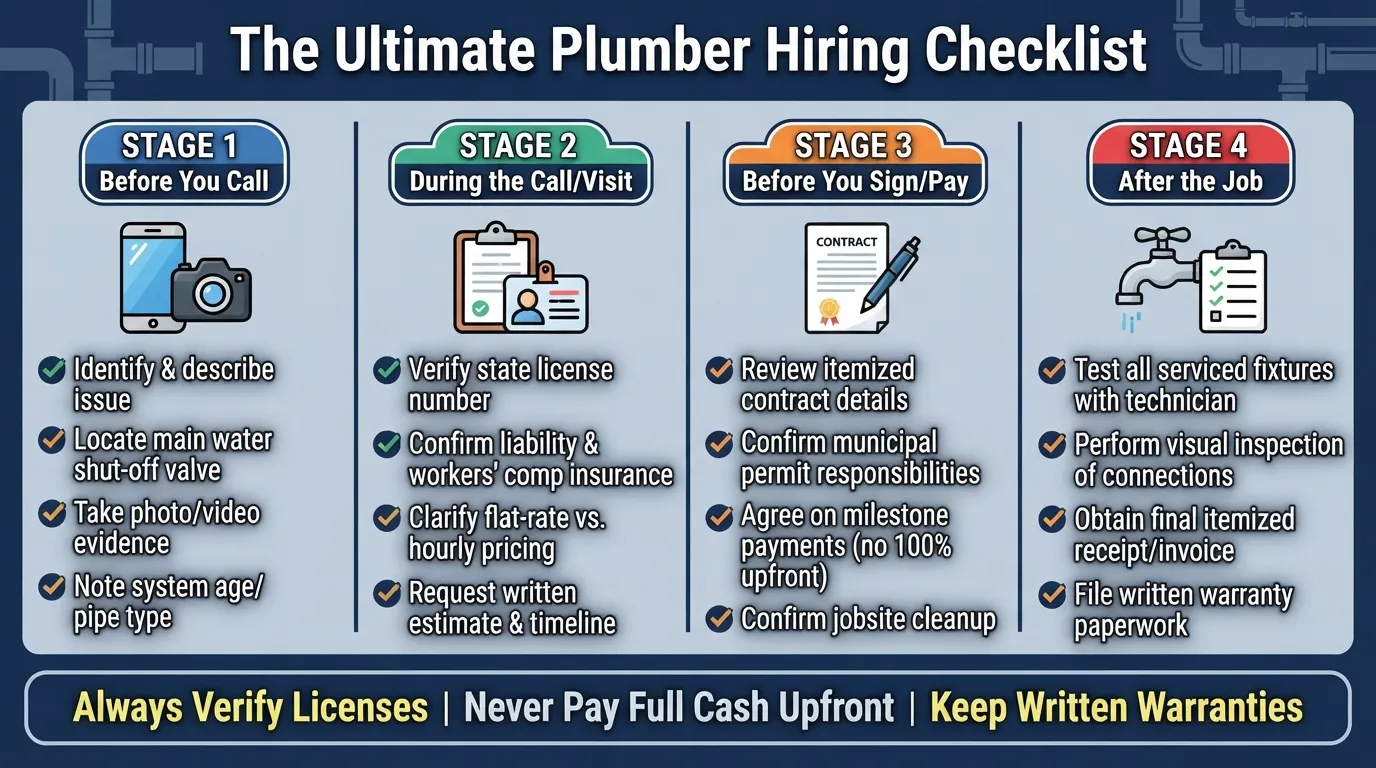
Having a clear, step-by-step checklist keeps you organized and protects your home when hiring a contractor. Use this interactive checklist to stay in control of the hiring process from the initial call to final inspection.
Before You Call
Taking a few moments to assess the issue helps contractors give you more accurate diagnostic information right from the start.
Identify and Describe the Problem: Note where the leak or clog is located, how long it has been occurring, and any unusual sounds or odors.
Locate the Shut-Off Valve: Find the main water valve or local fixture shut-off to stop active flooding if necessary.
Take Photos and Video: Document the affected fixtures, visible leaks, water damage, or model numbers on equipment for reference.
Gather Initial Info: Note down the age of the system or pipe material if known (e.g., copper, PVC, cast iron).
During the Call or Visit
Use this phase to evaluate contractor professionalism, verify credentials, and confirm pricing details before approving work.
Verify Licensing: Request their state trade license number and confirm active status through official state databases.
Confirm Insurance: Ask for proof of both general liability insurance and workers’ compensation coverage.
Discuss Pricing Structure: Clarify whether the project uses flat-rate or hourly pricing and ask about diagnostic fees.
Request a Detailed Estimate: Ensure the contractor provides an itemized written quote covering labor, parts, and contingency costs.
Establish a Timeline: Confirm estimated start times, completion windows, and whether technicians are background-checked employees.
Ask About Warranties: Confirm what guarantees cover both replacement parts and installation labor.
Before You Sign or Pay
Never authorize major work or release final payments without reviewing official documentation and terms.
Review the Written Contract: Check that all verbal promises, scope of work, and total pricing are explicitly written down.
Verify Municipal Permits: Confirm who is responsible for pulling required building permits for structural or line replacements.
Clarify Payment Terms: Agree on clear milestone payments; never pay 100% of the project cost upfront or in cash.
Confirm Cleanup Responsibilities: Ensure the contractor is responsible for hauling away old fixtures and clearing debris.
After the Job
Perform a thorough walk-through and save all project records to protect your property long term.
Test All Serviced Fixtures: Run water, flush toilets, and check for leaks or pressure drops while the technician is present.
Conduct a Visual Inspection: Ensure the work area is clean, fittings are secure, and no damage was left behind.
Obtain an Itemized Invoice: Request a final receipt detailing exact labor hours, installed part numbers, and diagnostic fees.
Store Warranty Paperwork: Keep your written estimate, final invoice, permit approvals, and warranty terms in a safe place.
What Plumbers Wish Homeowners Knew
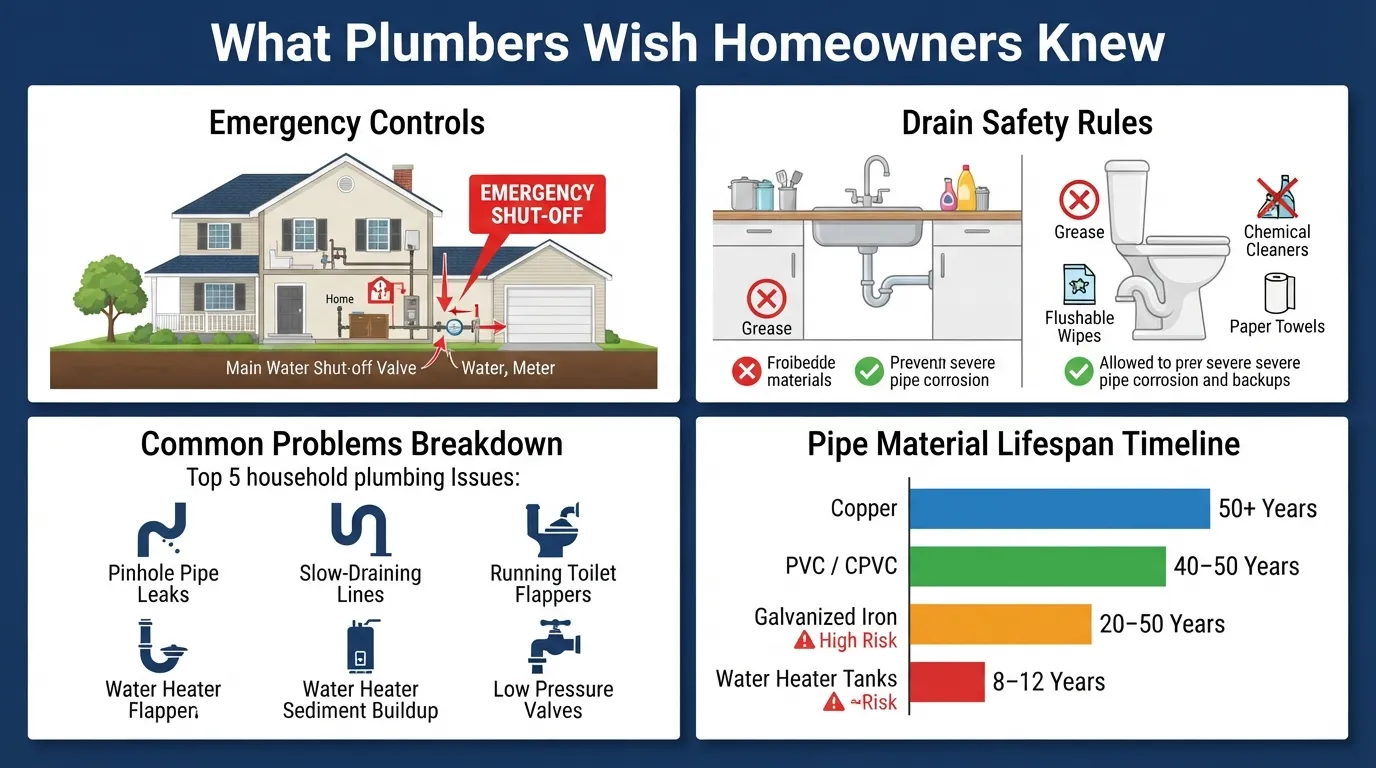
Experienced field technicians see the same preventable home disasters week after week. Taking a proactive approach to basic care, recognizing early warning signs, and knowing your home’s layout can save thousands of dollars in emergency restoration fees.
Tips From Our Lead Field Technicians:
“Chemical drain cleaners are one of the main causes of pipe corrosion we see in old lines. They turn small clogs into full pipe replacements by eating through the brass and copper fittings.” — Senior Service Technician
“Never use flushable wipes. Regardless of what the packaging claims, they do not dissolve like toilet paper and are the single largest contributor to residential sewer backups.” — Master Plumber
“If your water pressure suddenly drops across all fixtures, check your water meter or pressure reducing valve before assuming you have a main line leak.” — Diagnostic Specialist
Know Where Your Main Water Shut-Off Is
Every homeowner should locate their main shut-off valve before an emergency happens. During a severe supply line burst, turning off the water within 60 seconds prevents thousands of gallons of high-pressure water from destroying floors, insulation, and drywall.
Ensure all household members know where the valve is located—typically where the main water line enters the home, near the water meter, or in a garage utility area—and test that it turns smoothly once a year.
Don’t Ignore Small Leaks and Slow Drains
A minor water drip under a sink or a slow-draining tub might seem like a small inconvenience, but ignoring these early signs often leads to severe structural issues:
Hidden Moisture & Rot: Pinhole leaks behind walls create ideal conditions for dangerous mold spores and rot wood framing out of sight.
System Pressure Line Stress: Constant slow leaks keep water lines under continuous pressure differentials, accelerating joint fatigue.
Complete Main Blockages: A slow drain indicates buildup along pipe walls (grease, hair, or mineral scale) that eventually traps solids, creating a total blockage.
What Shouldn’t Go Down Your Drains or Toilets
Drains and toilet branch lines are engineered specifically to transport human waste, toilet paper, and greywater. Disposing of improper materials down kitchen sinks or toilets damages plumbing stacks and municipal sewer mains.
Kitchen Drains: Never pour fats, oils, or grease down the sink; they solidify inside cold pipes into dense blockages. Keep fibrous foods (celery, corn husks, onion skins) and coffee grounds out of garbage disposals.
Toilets: Avoid flushing paper towels, facial tissues, feminine hygiene products, dental floss, or wipes (even those labeled “flushable”). These items do not break down in water and catch on pipe joints.
The Most Common Plumbing Problems
Understanding the most frequent home plumbing failures helps you spot issues early and schedule preventive maintenance before a complete system breakdown occurs:
Leaking Pipes & Fixtures: Caused by elevated water pressure, pipe corrosion, or worn seals, leading to wasted water and structural dampness.
Clogged Drains: Caused by organic buildup, hair, or foreign objects in branch lines that require professional drain clearing.
Running Toilets: Caused by worn flapper valves, faulty fill valves, or misaligned float mechanisms, wasting up to 200 gallons of water per day.
Water Heater Failures: Caused by sediment buildup along heating elements, failing anode rods, or internal tank corrosion.
Low Water Pressure: Caused by mineral scale buildup inside aging lines, hidden main leaks, or failing pressure-reducing valves.
How Often Should Plumbing Be Replaced?
Plumbing fixtures and piping materials degrade over time due to mineral exposure, water chemistry, and operational pressure. Knowing expected lifespans helps you plan for system updates:
Copper Pipes: 50+ years (durable, but susceptible to pinhole corrosion from aggressive acidic water).
PVC & CPVC Pipes: 40–50 years (resistant to corrosion, commonly used for drain stacks and main supply line updates).
Galvanized Iron Pipes: 20–50 years (outdated material prone to severe internal rust, mineral clogging, and joint leaks; full replacement recommended).
Water Heaters: 8–12 years for tank systems; 15–20 years for tankless models (requires routine flushing and anode rod replacement).
Toilets & Faucets: 10–15 years for mechanical internal valves; ceramic fixture bodies can last several decades with proper care.
Frequently Asked Questions
How do I choose a good plumber?
Choose a good plumber by verifying their active state license, checking for commercial general liability and workers’ compensation insurance, reading recent verified customer reviews, requesting itemized written estimates, and confirming they offer a written workmanship warranty on parts and labor.
How do I choose a reliable plumber near me?
To find a reliable plumber near me, search local licensing databases to confirm active credentials, look for companies with consistent 4+ star reviews across Google and BBB, ask neighbors for personal referrals, and ensure they offer transparent pricing with clear response windows.
How do I find a reliable and affordable plumbing service?
Find a reliable and affordable plumbing service by gathering 2 to 3 written flat-rate estimates, comparing overall value rather than choosing the lowest bid, asking if diagnostic fees are applied toward repairs, and choosing contractors who provide upfront pricing without hidden charges.
How can I tell if a plumber is good?
A good plumber demonstrates clear communication, shows up on time in a branded vehicle, presents proof of license and insurance, thoroughly explains the root cause of the issue using plain language, provides a detailed written estimate before starting, and backs their work with a warranty.
What are the key traits of a good plumber?
Key traits of a top-tier plumber include technical trade expertise, active state licensing, complete insurance coverage, clear upfront pricing, strong problem-solving skills, punctual service, clean job site restoration, and a dedication to customer satisfaction backed by written guarantees.
How much does a plumber usually charge?
Plumber charges vary by scope and urgency. Minor drain clearing and fixture repairs typically cost between $150 and $350. Standard water heater installations or line repairs range from $500 to $2,500, while complex main sewer line replacements can cost $4,000 to $10,000+.
Should I always get multiple quotes?
Yes, you should get 2 to 3 written quotes for any non-emergency or major plumbing project. Comparing multiple itemized bids allows you to evaluate pricing structures, material quality, proposed timelines, permit inclusions, and warranty coverage across different local specialists.
Why should I hire an experienced plumber?
Hiring an experienced plumber ensures that your repairs comply with current building codes, prevent catastrophic water damage, and utilize proper materials. Experienced specialists diagnose root causes quickly, hold proper insurance, pull necessary municipal permits, and protect your property value long-term.
Is it okay to hire an unlicensed plumber to save money?
No, hiring an unlicensed plumber exposes you to severe financial and legal risks. Unlicensed work frequently leads to substandard repairs, code violations, property damage, and voided homeowner insurance claims. Furthermore, if an uninsured worker is injured on your property, you may be held liable.
Conclusion and Next Steps
Selecting the right plumbing specialist protects your home, safeguards your health, and prevents unexpected repair expenses down the road. Taking a systematic approach to verifying credentials, reading verified local feedback, and securing detailed written quotes ensures your plumbing system remains safe, reliable, and compliant with local building codes.
Key Takeaways
Verify Credentials: Confirm active state licensing and check for full commercial general liability and workers’ compensation coverage.
Review Reputation: Look for consistent recent review patterns on trusted platforms and seek local neighborhood referrals.
Get Written Quotes: Request itemized, transparent estimates detailing labor, materials, permit fees, and warranties before authorizing work.
Demand Warranties: Ensure the contractor backs their work with a written workmanship guarantee covering both parts and labor.
Know Your System: Locate your main water shut-off valve immediately to mitigate flooding damage during an active plumbing emergency.
Ready to Hire a Licensed Local Plumber?
If you need a reliable, fully certified team for routine maintenance, fixture upgrades, or specialized diagnostics, our expert technicians are here to help. Contact us today to receive a transparent upfront quote and schedule service at a time that works best for your household.
Book Now
Have a plumbing emergency? Call our emergency plumber team for immediate 24/7 dispatch.
Main Services
Related Posts
Need a Plumber in Miami?
Schedule service online or speak directly with the EZ Plumbing team.
Owner-Led Local Service
Know who is behind the business before you request service. The owners, contact line and Miami service pages are published clearly.
- Named business owners
- Direct phone and social channels
- Local Miami service information
Clear Help Before You Book
Review the relevant service page, contact the team directly and use the booking page when you are ready—without relying on vague claims.
- Service-specific information
- Direct questions before scheduling
- Clear online booking route