Pipe Bursting: What It Is and How It Works
What Is Pipe Bursting?
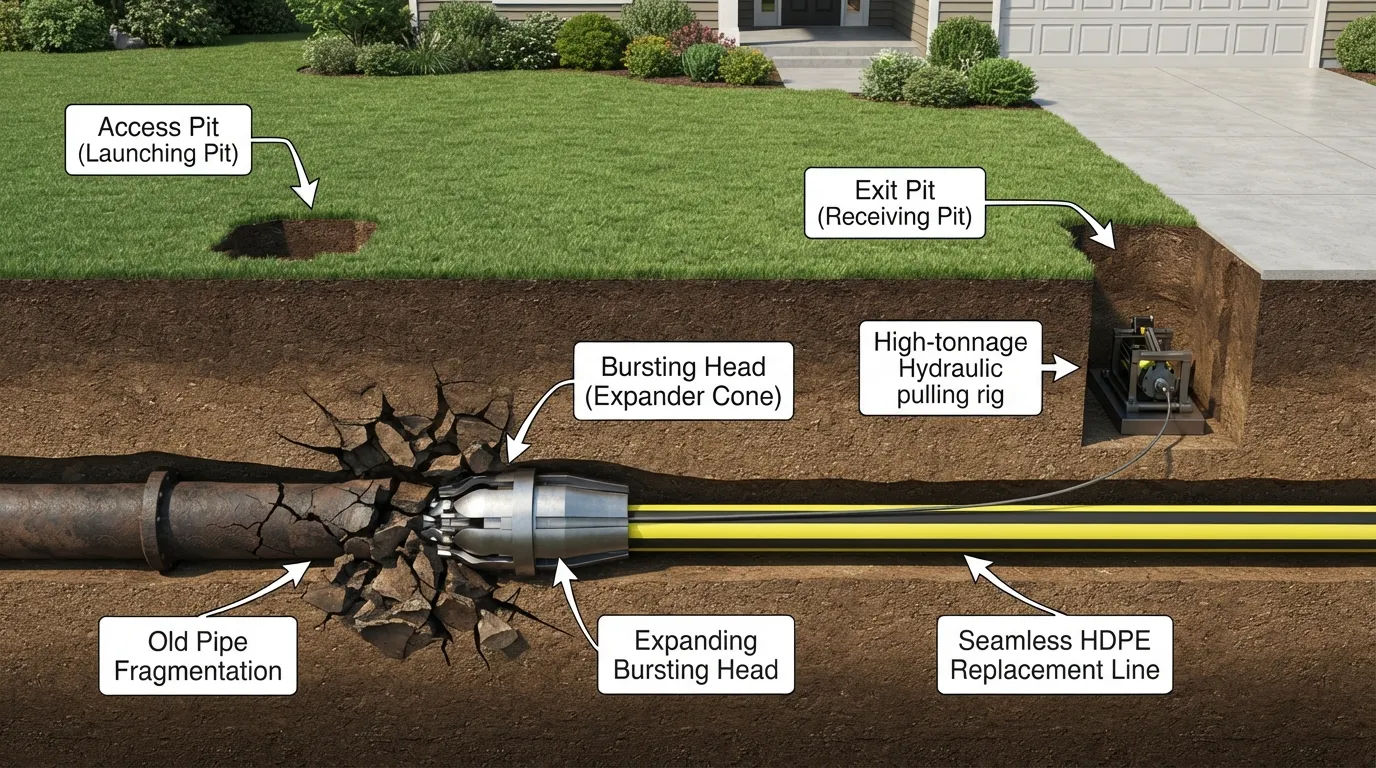
Pipe bursting is a trenchless pipe replacement method that breaks apart an existing, damaged underground pipe from the inside while simultaneously pulling a new, seamless high-density polyethylene (HDPE) pipe into its place. This trenchless technology replaces aging sewer, water, and gas lines with minimal excavation, eliminating the need to dig destructive open trenches across yards, driveways, or landscapes.
Property managers and homeowners typically encounter pipe bursting when facing severe plumbing issues—such as root intrusion, collapsed clay lines, or extensive pipe corrosion—where traditional utility repairs would prove too destructive or costly to surrounding infrastructure.
Key Characteristics of Pipe Bursting
Trenchless Approach: Requires only two small access points (an insertion pit and a receiving pit) rather than continuous open-trench digging.
Structural Upgrade: Replaces fragile materials like cast iron, terra cotta, or clay with continuous, durable HDPE pipe.
Capacity Enhancement: Expands the pipe cavity during fracturing, allowing contractors to install a replacement pipe of equal or larger diameter to boost flow capacity.
Pipe Bursting Trenchless Method vs. an Accidental Pipe Burst
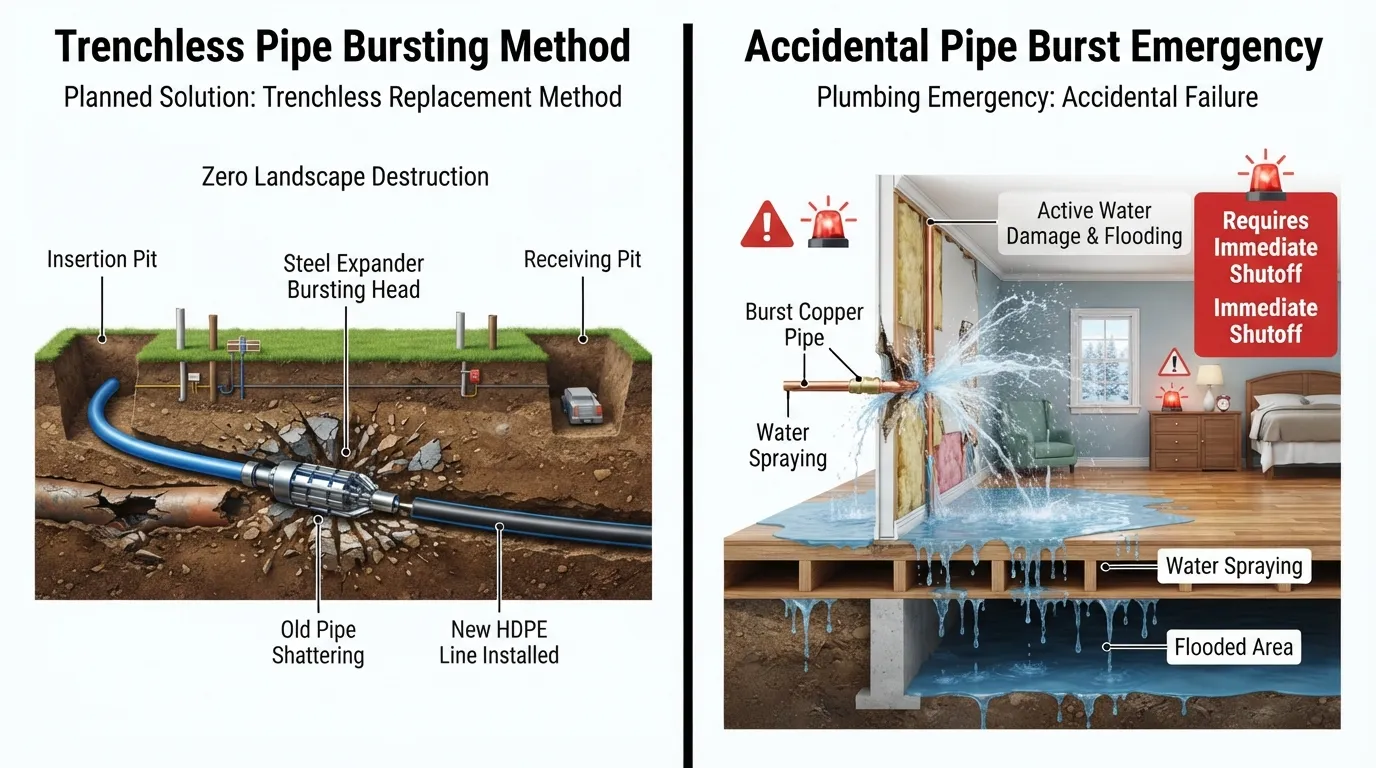
Pipe bursting is a planned trenchless repair technique used to replace underground utilities, whereas an accidental pipe burst is a sudden, catastrophic plumbing failure that causes immediate water damage. Confusing these two terms is common, but they represent entirely different scenarios—one is a long-term infrastructure solution, while the other is an urgent home disaster.
Pipe Bursting the Trenchless Repair Technique
The pipe bursting method is an engineered, non-invasive rehabilitation process performed by licensed utility contractors. Instead of excavating long trenches, technicians use specialized hydraulic machinery to fracture an old, deteriorated pipe while simultaneously pulling a new, high-density line into place.
Property owners intentionally hire experts for this trenchless repair process to address chronic underground issues, such as:
Severely Corroded Lines: Replacing failing cast iron or galvanized steel utility pipes.
Intrusive Tree Roots: Eliminating persistent root blockages in clay or terra cotta sewer lines.
Structural Pipe Collapse: Upgrading broken or offset pipes without destroying driveways, sidewalks, or landscaping.
When People Mean “A Pipe Just Burst” (Emergency Situations)
An accidental burst pipe is a sudden plumbing crisis where a pressurized water line fractures, causing rapid flooding and structural damage. This type of pipe leak typically occurs indoors or near the building foundation rather than deep underground in main utility runs.
Unexpected pipe failure usually stems from severe environmental or physical stress:
Freezing Temperatures: Water expands inside frozen pipes during cold spells, generating immense internal pressure until the wall ruptures.
Excessive Water Pressure: Spikes in municipal water pressure weaken internal joint fittings and thin pipe walls over time.
Severe Corrosion: Untreated chemical degradation creates thin spots that eventually give way under normal operating pressure.
If you are experiencing active water pooling or sudden pressure loss, seek an emergency plumber immediately to shut off the main water valve and contain the damage.
How Does Pipe Bursting Work? Step-by-Step Process
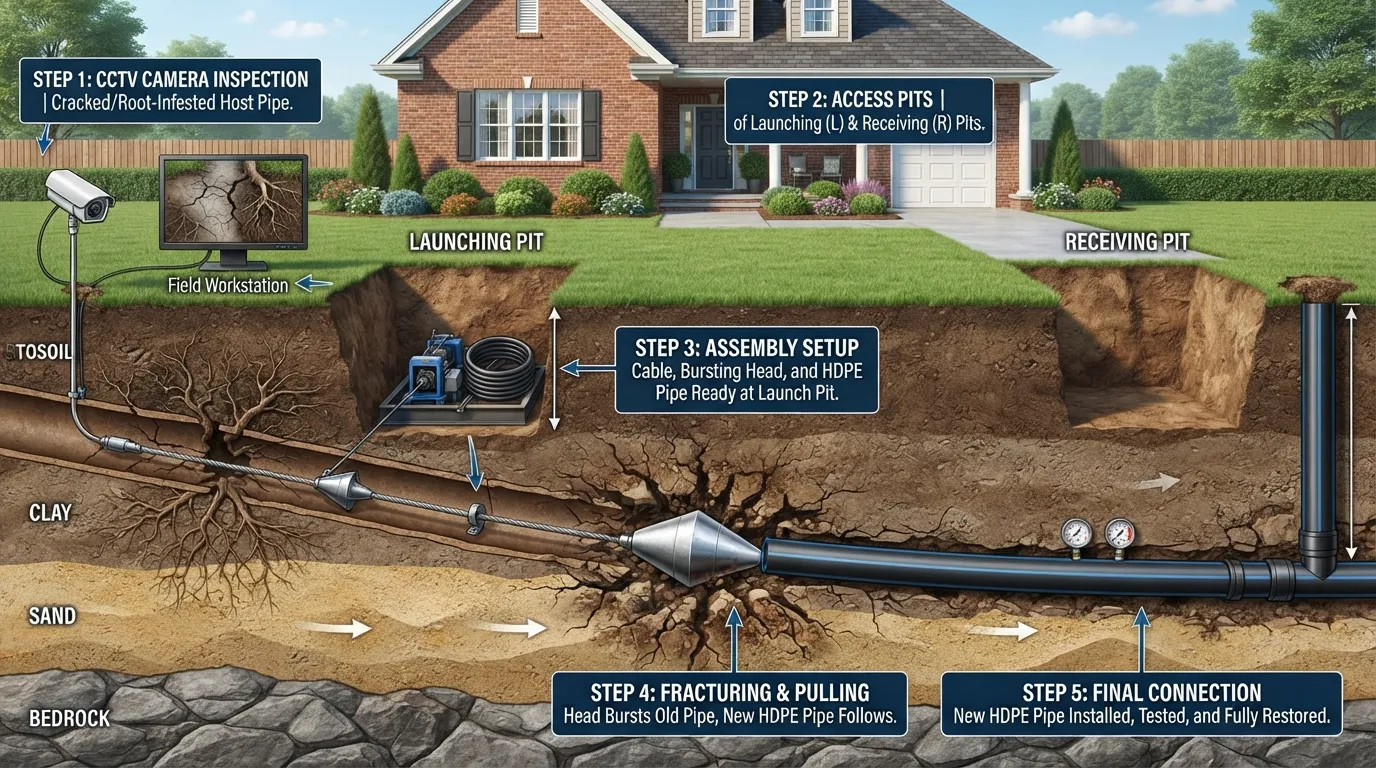
Pipe bursting replaces damaged underground utility lines in five controlled steps: evaluating the interior pipe condition, digging entry and exit pits, threading a pulling mechanism, fracturing the old line while pulling in new pipe, and completing final connections. This engineered sequence ensures seamless structural replacement without continuous surface excavation.
Technicians begin by inserting a high-definition CCTV camera into the host pipe to assess its internal condition, locate severe sags, and map all active service laterals.
Identify Blockages: Pinpoints root intrusions, severe structural collapses, or heavy mineral deposits.
Map Utilities: Confirms the exact position of connecting household drain lines before rehabilitation begins.
Verify Feasibility: Ensures the host pipe material is suitable for mechanical pipe fragmentation.
Contractors dig two targeted excavations: a launching pit where the new pipe enters and a receiving pit where the pulling equipment is anchored.
Launching Pit: Positioned at one end of the line to feed continuous high-density polyethylene (HDPE) pipe into the ground.
Receiving Pit: Houses the hydraulic machine or winch system that generates pulling force.
Targeted Footprint: Replaces hundreds of feet of continuous open trenching with just two small access points.
A heavy-duty pulling cable or solid pulling rod is threaded through the old line from the receiving pit to the launching pit.
Bursting Head Attachment: The steel pulling assembly connects to a cone-shaped bursting head at the launching pit.
Pipe Anchoring: The new HDPE pipe attaches directly behind the wider base of the expanding bursting head.
Power Rigging: The pulling cable connects to a powerful hydraulic machine or pneumatic machine stationed at the receiving pit.
The hydraulic unit pulls the bursting head through the host pipe, using outward radial force to break the old pipe apart while seamlessly laying the new line.
Pipe Fragmentation: The expanding head shatters host pipes made of clay, cast iron, PVC, or concrete, pressing fragments outward into surrounding soil.
Seamless Replacement: The trailing flexible HDPE pipe immediately occupies the newly expanded void created by the head.
Upgraded Capacity: When necessary, larger bursting heads allow for upsizing the pipe diameter to improve overall system flow.
Once the new line reaches the receiving pit, technicians perform quality checks and restore all utility connections to complete the sewer line replacement.
Service Lateral Reconnection: Specialized cutters or small targeted excavations reconnect branch lines to the main line.
Pressure & Flow Testing: Hydrostatic or air pressure testing verifies leak-free structural integrity.
Backfilling & Site Restoration: Workers compact dirt into the two access pits, leaving lawns and paved surfaces largely intact.
Types of Pipe Bursting Methods
Pipe bursting is categorized into three primary techniques based on the mechanical energy source used to fracture the host pipe: static, pneumatic, and hydraulic methods. Selecting the appropriate method depends on the existing pipe material, soil conditions, proximity to adjacent utilities, and required pipe diameter upsizing.
| Bursting Method | Power Mechanism | Best Use Cases | Key Limitation |
| Static | Continuous tension pull via hydraulic rods/cables | Cast iron, steel, ductile iron, densely packed urban areas | High tension pull requirements for heavy lines |
| Pneumatic | Compressed-air percussive hammering + winch | Clay, terra cotta, concrete, PVC, standard sewer runs | Shockwaves can damage nearby fragile utilities |
| Hydraulic | Expanding segmented head + pull-through winch | Brittle materials, tight access spaces, severe upsizing | Higher equipment complexity and setup time |
Static Pipe Bursting
Static pipe bursting relies entirely on a continuous, high-tonnage pulling force to fracture the old pipe without generating dynamic shockwaves or ground vibrations. A heavy-duty hydraulic rig at the receiving pit pulls solid steel rods or high-tensile wire cables attached to a static expander cone.
Bladed Head Design: Employs static cutting wheels or hardened steel blades to split tough materials like cast iron, ductile iron, and steel.
No Impact Vibrations: Prevents ground displacement or surface cracking, making it safe near gas lines, electrical conduits, and shallow foundations.
Pipe Diameter Upsizing: Provides the high tensile force needed to upsize pipelines by 20% to 30% or more through dense soils.
Pneumatic Pipe Bursting
Pneumatic pipe bursting combines forward tension with high-frequency percussive hammering driven by an air compressor. The cone-shaped bursting head delivers 180 to 580 impacts per minute to shatter brittle pipe walls, while a guide winch pulls the assembly forward along the original pipe route.
High-Speed Execution: Fractures brittle clay, terra cotta, concrete, and unreinforced PVC pipes quickly.
Constant Momentum: The dynamic hammering action drives through soil friction and localized collapsed sections where static pulling force alone might stall.
Subsurface Impact Restriction: Unsuitable for cast iron mains or installations immediately adjacent to fragile, aged utility networks due to micro-vibrations.
Hydraulic Pipe Bursting
Hydraulic pipe bursting utilizes an expanding bursting head that expands and contracts radially to break the host pipe from the inside. Rather than relying solely on forward pull, internal hydraulic pistons drive segmented steel expansion jaws outward against the inner pipe wall.
Radial Expansion: The head expands laterally to fracture the host pipe section by section, then contracts to be pulled forward into the next segment.
Reduced Pull Force: Lower friction resistance on pulling cables or rods allows for lighter rig setups at the access pit.
Controlled Ground Displacement: Ideal for tight spots or specialized utility corridors requiring precise control over soil displacement during expansion.
Pipe Bursting vs. Traditional Trench Digging Comparison
Choosing between pipe bursting and traditional open-cut excavation comes down to evaluating total property disruption, project completion timelines, and hidden restoration expenses. While open-cut trenching physically unearths the entire pipeline, pipe bursting accesses the line using small entry and exit points to preserve above-ground surfaces.
| Feature | Pipe Bursting (Trenchless) | Traditional Open-Cut Trenching |
| Excavation Requirement | 2 small access pits at line terminals | Continuous open trench along full pipe length |
| Average Project Timeline | 1 to 2 business days | 3 to 7+ business days |
| Surface & Hardscape Impact | Minimal (protects lawns, driveways, decks) | High (destroys surface paving, plants, structures) |
| Surface Restoration Costs | Low ($0 – $500 typical patch work) | High ($2,000 – $10,000+ for repaving & landscaping) |
| Pipe Upsizing Capability | Yes (can expand line by 1 to 2 sizes) | Yes (limited only by trench width) |
| Labor Overhead | Low (smaller crew, automated equipment) | High (extensive machine operation & manual digging) |
Excavation & Property Disruption
Traditional open-cut excavation requires heavy machinery to dig up every linear foot of dirt directly above the utility line. This process tears up established lawns, destroys concrete driveways, and cuts through gardens, asphalt, or retaining walls.
By contrast, the pipe bursting method isolates work exclusively to launching and receiving access pits. This targeted approach leaves surrounding landscaping, mature trees, and structural hardscapes completely undisturbed. For commercial properties, avoiding open trenches protects parking lots and walkway access, preventing costly business interruptions during commercial plumbing upgrades.
Time to Complete
Trenchless pipe bursting significantly accelerates project delivery:
Pipe Bursting Timeline: Most residential pipe bursting installations take 1 to 2 days to complete. The pull-through phase itself often takes only a few hours once access pits are prepped.
Traditional Trenching Timeline: Open excavation often spans 3 to 7 days or longer. Extra time goes into digging, installing shoring boxes for safety, backfilling thousands of pounds of soil, and compacting dirt layers.
Cost Difference
While the specialized hydraulic machinery for pipe bursting can yield a slightly higher upfront line item for labor and equipment setup, its total project cost is usually significantly lower than traditional trenching.
Direct Installation Expenses: Trenchless methods reduce total labor hours and cut backfill material needs. Pipe bursting can lower overall replacement costs by up to 30% to 40% compared to traditional digging.
Eliminated Restoration Costs: Traditional open-cut trenching leaves property owners with massive secondary bills to repave concrete driveways, rebuild stone hardscapes, and re-sod destroyed lawns. Pipe bursting eliminates these post-installation repair expenses.
How Much Does Pipe Bursting Cost? Is It Cheaper?
Pipe bursting typically costs between $100 and $250 per linear foot, with an average overall project range of $6,000 to $12,000 for standard residential main lines. While the initial quote for trenchless equipment and skilled labor can appear higher than basic trench digging, pipe bursting is almost always cheaper overall once landscape, hardscape, and driveway restoration expenses are factored in.
| Cost Category | Pipe Bursting (Trenchless) | Traditional Open-Cut Excavation |
| Base Price per Foot | $100 – $250 / ft | $50 – $150 / ft |
| Typical Total Line Cost (30-50 ft) | $6,000 – $12,000 | $4,000 – $13,000 (digging & line only) |
| Property Restoration Costs | $0 – $500 | $2,000 – $10,000+ (sod, paving, concrete) |
| Total Real Out-of-Pocket | $6,000 – $12,500 | $8,000 – $23,000+ |
Average Cost Range of Pipe Bursting
Most single-family residential sewer line replacements involve 30 to 50 linear feet of pipe. Pricing splits into three main cost Tiers based on job complexity:
Basic Residential Run (30–40 ft): $3,500 – $7,000 for shallow lines with easy access pits and no severe soil complications.
Standard Main Line Replacement (50–70 ft): $6,000 – $12,000 covering average depth, high-density polyethylene (HDPE) materials, and standard lateral connections.
Complex Commercial or Deep Line Run (80+ ft): $12,000 – $20,000+ for deep utility mainlines requiring heavy-duty hydraulic rigs, permits, and street cut access.
Factors That Affect the Price
Several core job variables determine where your quote falls within the price per foot spectrum:
Pipe Length and Diameter: Longer runs use more continuous HDPE pipe, while upsizing line capacity (e.g., expanding a 4-inch line to 6 inches) requires larger bursting heads and higher-tonnage pulling equipment.
Pipe Depth and Soil Density: Lines buried deeper than 6 to 8 feet require larger access pits, additional shoring boxes, and increased labor setup time.
Number of Lateral Connections: Reconnecting active household branch lines to the new HDPE main line adds $500 to $1,500 per junction depending on depth and location.
Permit and Inspection Fees: Local municipal permits, utility line locating services, and mandatory post-installation CCTV camera verification add $200 to $1,000 to total project overhead.
Pipe Bursting Cost vs. Full Pipe Excavation Cost
Looking purely at the contractor invoice for the pipe work creates a false impression that traditional digging is cheaper. Open-cut trenching carries massive hidden surface restoration costs that reverse the financial calculation.
Traditional Excavation Breakdown: Digging up a lawn, driveway, or sidewalk might carry a lower base pipe fee of $50 to $150 per foot. However, once you add $3,000 to repave a asphalt driveway, $4,000 to replace stone pavers or concrete, and $2,000 for re-sodding landscaping, traditional digging quickly balloons to $15,000 – $25,000 total.
Trenchless Savings Realization: Pipe bursting contains 95% of all physical disruption inside two small access pits. By eliminating heavy hardscape destruction, homeowners consistently save thousands of dollars on post-project property restoration.
Ready to get an accurate estimate for your underground line? You can schedule a professional inspection directly with our certified plumbing team to book an appointment online today.
How Long Does Pipe Bursting Take?
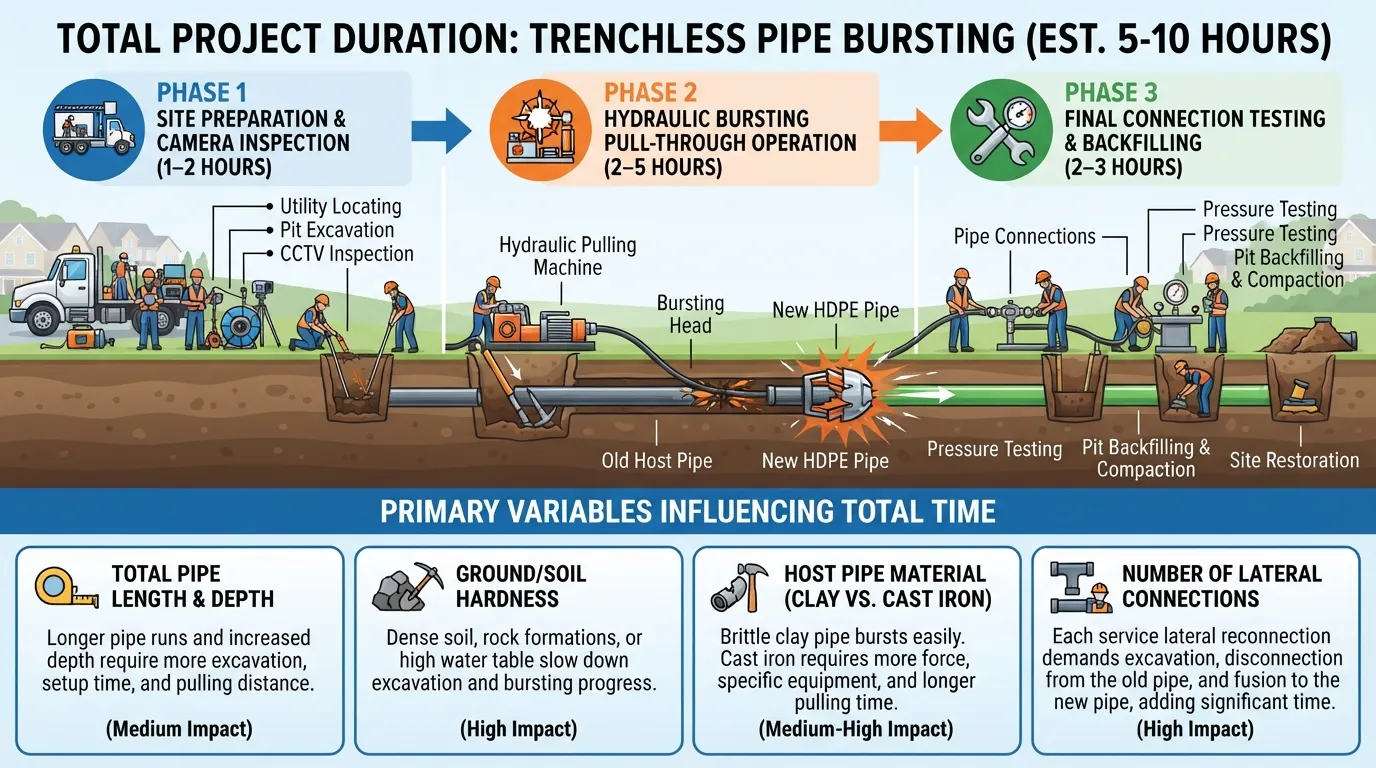
Trenchless pipe bursting generally takes 1 to 2 business days to complete for standard residential lines. The core physical replacement process—pulling the bursting head and laying the new high-density polyethylene (HDPE) pipe—typically requires only 2 to 5 hours of continuous operation once the entry and exit pits are prepped. Most residential projects achieve single-day completion, allowing utility service to be restored by the end of the day.
Factors Influencing Project Duration
Total Pipe Length and Depth: Longer utility runs require longer pull durations, while deeply buried lines require additional excavation and shoring time to establish safety-compliant access pits.
Subsurface Site Conditions: Densely packed clay, rocky soil formations, or groundwater infiltration can slow down hydraulic pulling equipment and extend setup times.
Host Pipe Material and Thickness: Brittle host lines like clay or terra cotta shatter quickly under radial pressure, whereas ductile iron, cast iron, or thick steel pipes demand higher tension and slower pulling speeds.
Number of Branch Laterals: Reconnecting active secondary drains or home service lines to the newly installed main line adds labor time for precision cutting and fitting.
Does Homeowners Insurance Cover Pipe Bursting or Sewer Line Replacement?
Standard homeowners insurance policies generally do not cover routine sewer line replacement or trenchless pipe bursting. Insurance coverage hinges almost entirely on whether the pipe failure was caused by a sudden, accidental event or by long-term, gradual degradation.
| Coverage Scenario | Standard Policy Response | Optional Rider Needed |
| Sudden Accidental Burst (e.g., Freeze/Explosion) | Covered (Structural & Water Damage) | None |
| Gradual Wear & Tear / Aging Line | Excluded | Service Line Endorsement |
| Tree Root Intrusion | Excluded | Buried Utility Rider |
| Interior Sewer Backup Damage | Excluded | Water/Sewer Backup Rider |
When Insurance Typically Covers Pipe Damage
Standard home insurance (HO-3 policies) protects against unexpected, sudden, and accidental perils. If your line fails due to a rapid, unforeseeable event, your policy’s dwelling or structural coverage may pay for the resulting damage and excavation costs:
Sudden Physical Impact: A third-party excavation accident, vehicle impact, or explosion directly damaging the underground line.
Severe Weather Events: Ground freezing or sudden lightning strikes that immediately fracture utility connections.
Interior Property Protection: Water damage to drywall, flooring, or personal belongings resulting from a sudden main failure is usually covered, even if the old pipe itself requires out-of-pocket repair.
When It Doesn’t (Wear and Tear Exclusions)
The majority of underground line failures stem from chronic issues rather than sudden emergencies. Standard policies explicitly list maintenance-related failures under their wear and tear exclusion clause:
Age and Corrosion: Deterioration of old cast iron, terra cotta, or orangeburg pipes over decades is classified as deferred maintenance.
Tree Root Penetration: Roots naturally growing into pipe joints to seek moisture are deemed preventable hazards.
Soil Movement and Settling: Gradual ground shifting or soil compaction that creates pipe sags (bellies) is typically excluded.
How to Get Coverage: Optional Riders
To cover planned trenchless replacements like pipe bursting, property owners must purchase a Service Line Endorsement (also called a Buried Utility Line Rider). This add-on costs around $20 to $50 annually and provides $10,000 to $20,000 in coverage for underground pipe repairs, excavation, and site restoration caused by wear, rust, or root damage.
What Type of Pipe Is Used for Pipe Bursting?
High-density polyethylene (HDPE) pipe is the universal industry standard material used for trenchless pipe bursting. Its exceptional tensile strength, flexibility, and impact resistance allow it to withstand heavy pulling forces as hydraulic expander heads break apart old line segments.
| Feature | HDPE Replacement Pipe | Legacy Pipe Materials (Cast Iron, Clay, Concrete) |
| Expected Lifespan | 50 to 100+ years | 30 to 50 years |
| Joint Type | Heat-fused monolithic connections (leak-free) | Mechanical, glued, or rubber-gasketed joints |
| Corrosion Resistance | Total resistance to chemical degradation & rust | High susceptibility to rust, pitting, and interior scaling |
| Flexibility | High (bends through ground shifts without cracking) | Rigid (cracks under soil settlement or thermal expansion) |
| Root Intrusion Risk | Zero risk (continuous, seamless wall) | High risk (roots enter through degraded joint gaps) |
HDPE (High-Density Polyethylene) Pipe
HDPE pipe is a heavy-duty thermoplastic material engineered for high-pressure underground utility applications. During the pipe bursting process, contractors join long sections of HDPE piping using specialized heat fusion welding.
Heat fusion melts the pipe ends together under precise temperature and pressure controls, bonding the segments into a continuous, seamless pipeline. Because the fused joints become as strong as—or stronger than—the pipe wall itself, the entire replacement line acts as a single, uninterrupted conduit pulled behind the expander head.
Why HDPE Is the Industry Standard Choice
Continuous Monolithic Structure: Eliminating weak pipe joints prevents root penetration, water filtration, and joint offset failures—the primary causes of sewer line backups.
Superior Chemical and Corrosion Resistance: HDPE does not rot, rust, pit, or corrode when exposed to harsh chemicals, sewer gases, acidic soils, or hard water mineral buildup.
Tensile Strength and Flexibility: The high ductility of HDPE allows it to absorb ground movement, seismic shocks, and soil settling without fracturing or shearing off.
Smooth Hydraulic Flow: The interior surface of HDPE features a low friction coefficient, boosting flow capacity and preventing interior waste accumulation compared to rough cast iron or terra cotta.
Long-Term Lifespan: Quality HDPE installations carry an estimated pipe lifespan of 50 to 100 years with minimal long-term maintenance requirements.
Benefits of Pipe Bursting
Minimal Surface Excavation: By utilizing only small insertion and receiving pits, pipe bursting avoids long, continuous open trenches across lawns, driveways, or sidewalks.
Preserves Surrounding Landscaping: Leaves trees, gardens, patios, and paved hardscapes untouched, preventing expensive post-project restoration costs.
Faster Project Completion: The pull-through and pipe replacement process typically takes only a single business day to execute, drastically reducing service downtime.
Durable HDPE Material: Installs continuous, seamless high-density polyethylene (HDPE) pipe that naturally resists root intrusion, soil movement, chemical corrosion, and rust.
Significant Total Cost Savings: Lower labor demands and the complete elimination of surface repaving and re-sodding expenses yield lower overall out-of-pocket costs compared to traditional digging.
Increased Hydraulic Capacity: Allows contractors to expand the subterranean void to pull in a replacement line of equal or larger diameter to improve system flow.
For a visual demonstration of how trenchless technology breaks down old underground pipes while pulling in durable new lines with minimal surface impact, check out The Advantages of Trenchless Pipe Bursting. This video clearly illustrates the real-world execution and key efficiency benefits of this method.
Downsides and Limitations of Pipe Bursting
While trenchless pipe bursting avoids widespread surface disruption, it is not a universal solution for every underground utility line. Mechanical constraints, non-fracturable pipe materials, soil displacement physics, and proximity to adjacent infrastructure impose specific technical limitations on where and how this method can be safely applied.
| Limitation Category | Pipe Bursting Constraint | Engineering Impact | Primary Alternative |
| Non-Brittle Pipe Materials | Ductile iron, thick steel, reinforced concrete | Resists fracturing; deforms or stalls expander heads | Pipe splitting, CIPP lining, or open-cut |
| Line Alignment | Sharp 45° or 90° pipe bends, severe sags | Rigid bursting assembly cannot navigate tight curves | Targeted access pits or CIPP lining |
| Soil Displacement | Compacted clay, dense rock, shallow depth | Outward pressure can heave ground or damage paving | Open-cut excavation |
| Utility Proximity | Nearby gas, power, or water lines (< 2–3 ft) | Dynamic shockwaves & soil shifts risk striking utilities | Hand-digging or static splitting |
Not Suitable for All Pipe Materials or Conditions
Pipe bursting relies on radial expansion force to shatter brittle host pipes like cast iron, clay, terra cotta, and PVC. Certain structural and material conditions render standard bursting ineffective or impossible:
Non-Fracturable Materials: Ductile iron, heavy steel, and reinforced concrete do not shatter cleanly under standard bursting heads. Ductile iron deforms and stretches under pressure rather than breaking, which can stall pulling machinery unless specialized cutting wheel splitters are used.
Severe Line Alignment and Bends: Bursting equipment requires a relatively straight path. High-tensile pulling rods and rigid steel expander heads cannot pass through sharp 45-degree or 90-degree elbows without binding or damaging surrounding soil.
Severe Pipe Sags (Bellies): If a buried line has settled into a deep sag, pulling an HDPE pipe through the original path preserves the low spot. Trenchless bursting cannot correct fundamental grade errors; open excavation is usually required to re-establish proper pitch.
Risk to Nearby Utility Lines
The outward soil displacement generated as the expander head fractures the old pipe pushes debris into the surrounding dirt. This outward pressure creates mechanical risks when other utilities run in close proximity:
Subsurface Ground Heave: In shallow installations (less than 3 to 4 feet deep) or highly compressed soils, outward soil expansion can push upward, causing asphalt cracking or concrete sidewalk heaving.
Cross-Bore and Collateral Damage: If an existing gas main, electrical conduit, or adjacent water line sits within 24 to 36 inches of the target pipe, the outward shockwave and soil expansion can crush or shear those nearby utilities.
Pneumatic Vibrations: Pneumatic bursting heads generate intense percussive shockwaves. These micro-vibrations can crack fragile, aging cast-iron gas mains running in the same trench corridor.
Access Requirements
Although pipe bursting eliminates long trenches, it is not completely “no-dig”. Technicians must still excavate entry and exit access pits to introduce the equipment and fuse the replacement HDPE pipe.
If the launching or receiving point sits directly beneath a home’s foundation, a finished basement floor, or an expensive concrete driveway, contractor crews must break through those surfaces to establish working pits. Additionally, every active household branch line (service lateral) connected to the main line requires a localized excavation or specialized robotic cutting tool to tie into the new HDPE pipe.
Which Pipe Materials and Situations Qualify for Pipe Bursting?
Determining whether your underground utility line qualifies for trenchless pipe bursting depends on the original host pipe material, the line’s structural path, and current soil conditions. Brittle materials that fracture under outward radial force are ideal candidates, whereas highly ductile or collapsed lines may require alternative trenchless solutions or open-cut repairs.
| Host Pipe Material | Pipe Bursting Feasibility | Primary Failure Mechanism / Considerations |
| Clay / Terra Cotta | Excellent | Shatters easily; ideal candidate for seamless HDPE replacement |
| Cast Iron | Excellent | Fractures cleanly under bladed or static expander heads |
| PVC / ABS Plastic | Good | Splits readily; requires adequate pulling tension to avoid binding |
| Concrete / Asbestos Cement | Good | Crumbles under radial expansion; requires heavy-duty expander |
| Ductile Iron / Steel | Conditional | Requires specialized static cutting wheels; deforms if pulled unassisted |
| Fully Collapsed Lines | Poor | Blocked pathway prevents pulling rod or cable insertion |
Pipe Materials That Work Well With Bursting
The pipe bursting method relies on outward radial pressure to break host pipes apart while clearing a path for the trailing line. Brittle materials shatter most efficiently:
Vitrified Clay and Terra Cotta: Older municipal and residential sewer lines made of fired clay are brittle, making them the easiest pipes to fracture completely without heavy machine strain.
Cast Iron Pipe: Common in mid-20th-century construction, cast iron develops severe internal rust scale and pitting over time. Hydraulic and static bursting heads shatter old cast iron walls easily.
PVC and ABS Plastic: Modern plastic lines that suffer from severe root intrusion, joint disconnection, or structural crush points split cleanly under continuous pulling tension.
Concrete and Transite (Asbestos Cement): Unreinforced concrete drains and transite pipes fragment smoothly under pneumatic or static expansion forces.
When a Professional Inspection Is Needed First
Before confirming that a pipeline qualifies for trenchless bursting, a licensed plumber must perform a high-definition video pipe inspection. Inserting a self-leveling fiber-optic camera into the line confirms structural integrity and identifies subsurface obstacles.
A comprehensive camera check identifies critical physical conditions that impact job feasibility:
Extent of Pipe Collapse: If a line is completely crushed flat or filled with packed dirt, technicians cannot pass the initial pulling cable or guide rod through. These blockages must be cleared or spot-repaired before bursting can proceed.
Identification of Active Leaks: Pinpointing hidden root entry points or major joint offsets allows contractors to plan precise entry and exit access points. If you suspect hidden subsurface leaks, schedule professional leak detection and repair services to locate structural failure points before work begins.
Pipeline Pitch and Slope: CCTV inspection verifies whether the original pipe maintains a proper downward slope. Because bursting follows the path of the original pipe, lines with severe bellies or back-pitches may require open-cut correction instead.
How Do I Know If My Main Sewer Line Is Clogged? Related Diagnostic Info
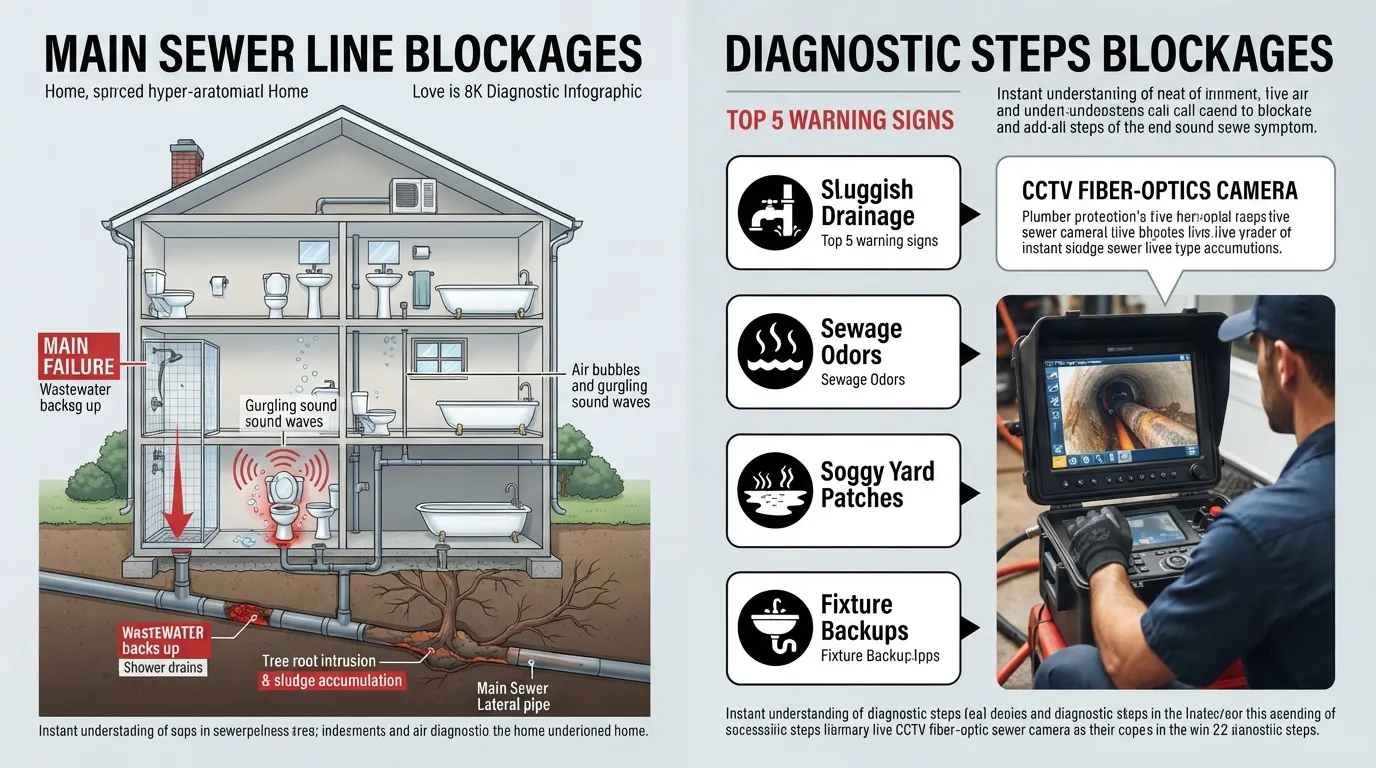
Identifying a main sewer line blockage early prevents raw sewage from backing up into your living spaces and damaging indoor flooring or fixtures. Unlike a isolated fixture clog, a main sewer line obstruction affects the entire plumbing system, causing widespread drainage issues across multiple rooms simultaneously.
Common Warning Signs of a Clogged or Damaged Sewer Line
Multiple Slow Drains: Sinks, showers, and bathtubs throughout the home drain at a sluggish pace despite clearing individual P-traps.
Sewer Backup in Lowest Fixtures: Flushing a toilet causes waste or graywater to push up into the lowest drains in the building, such as a floor drain or shower basin.
Gurgling Sounds From Plumbing: Air trapped behind an underground obstruction creates bubbling or gurgling noises in toilets or sink drains when water runs elsewhere in the house.
Foul Sewer Gas Odor: Cracks or blockages in the main line allow persistent sewage smells to escape through indoor drains or around outdoor access points.
Soggy or Overly Green Grass Patches: An underground crack or collapsed joint leaks nutrient-rich wastewater, creating unexpectedly lush, damp spots in your yard directly above the sewer pipe.
If you observe these system-wide red flags, schedule professional drain cleaning and diagnostic checks immediately to prevent complete utility failure. Technicians perform a high-definition sewer camera inspection to locate tree roots, debris, or structural collapses, determining whether a standard hydro-jetting cleanout or a full trenchless replacement is required.
Official Technical Reference
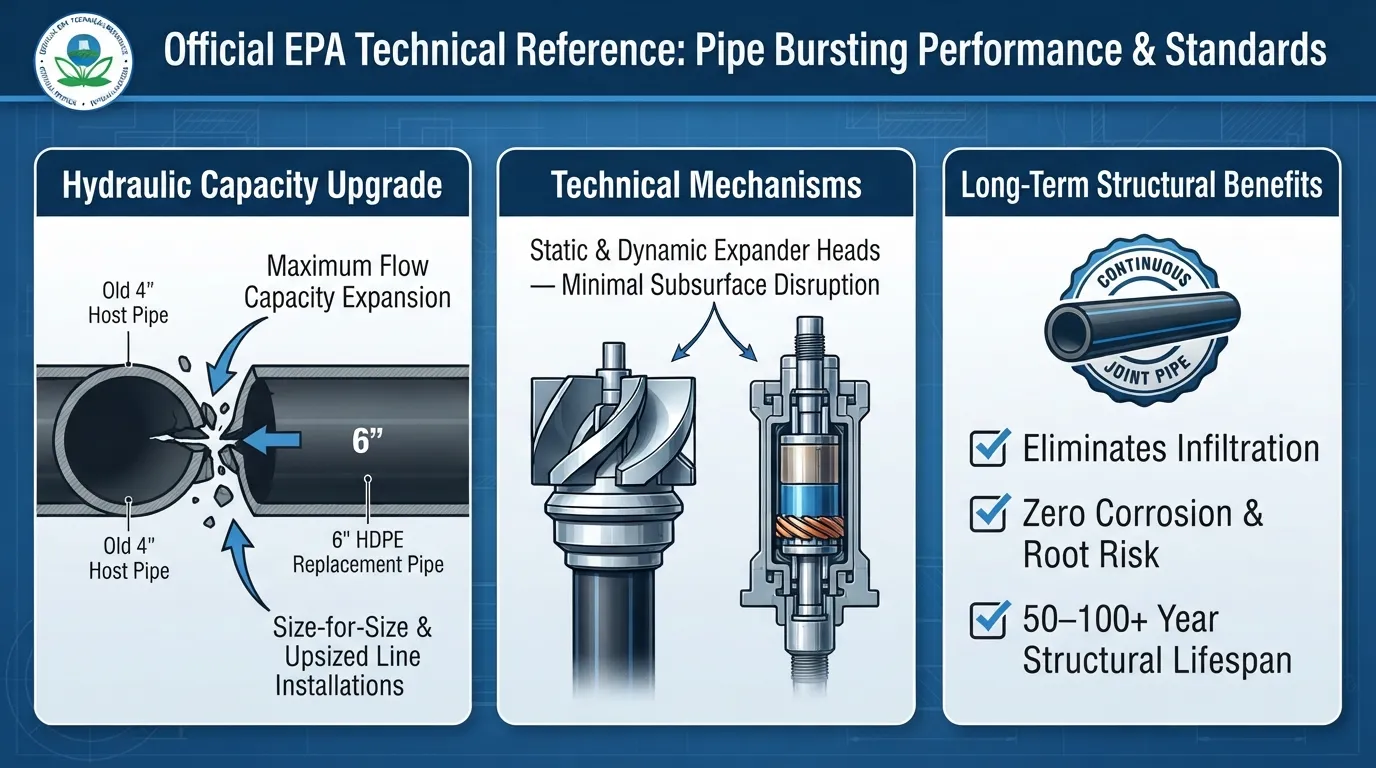
According to the EPA’s official Water Technology Fact Sheet on pipe bursting, trenchless rehabilitation provides the largest hydraulic capacity increase among no-dig sewer repair methods by enabling size-for-size replacement or upsized line installations. The U.S. Environmental Protection Agency outlines technical standards for static and dynamic expander heads, noting that continuous high-density polyethylene (HDPE) lines substantially reduce long-term infiltration and structural degradation in municipal and residential utility corridors.
FAQ Section PAA + Quora Capture
What to Do Immediately After a Pipe Bursts?
Shut off your home’s main water valve immediately to stop incoming water pressure and minimize active flooding. Once the main valve is closed, open low-lying faucets—such as basement sinks or outdoor hose bibbs—to drain remaining water from the system, turn off electricity to affected rooms if standing water threatens outlets, and contact an emergency plumber to inspect and repair the line.
How Do Bursting Pipes Occur?
Accidental pipe bursts occur when internal water pressure exceeds the structural strength of the pipe wall. The primary drivers include thermal expansion from freezing temperatures, severe internal corrosion, high municipal water pressure spikes, and mechanical damage from shifting soil or ground settling.
Why Do Water Pipes Keep Bursting?
Repeated pipe failures usually signal systemic issues rather than isolated incidents:
Unregulated Water Pressure: Household water pressure exceeding 80 PSI constantly stresses fittings and weakens metal walls.
Severe Pipe Age and Corrosion: Legacy galvanization or cast iron scaling creates thin spots that repeatedly breach under normal operation.
Corrosive Water Chemistry: Acidic water (low pH) or hard mineral deposits thin pipe walls from the inside out.
Improper Insulation: Unprotected pipes in crawl spaces or exterior walls freeze repeatedly during winter freeze-thaw cycles.
Why Don’t Pipes Burst When You Close a Tap?
Closing a faucet rapidly creates a temporary surge called hydraulic shock (or water hammer), but pipes don’t normally burst because modern plumbing systems use air chambers or water hammer arrestors to absorb the kinetic energy. However, if water pressure is dangerously high or pipes are already weakened by age and corrosion, repeated water hammer shocks can eventually trigger a sudden joint rupture.
What Is the 1-3-5 Rule in Plumbing?
The “1-3-5 rule” is an informal service-response benchmark used by some residential plumbing companies to communicate emergency turnaround times to customers:
1 Hour: Arrive at the property for an emergency service call.
3 Hours: Complete diagnostic camera checks and present an upfront repair proposal.
5 Hours: Complete standard line repairs or establish temporary water containment.
(Note: While some contractors use this 1-3-5 timeline as an internal operational target, it is an informal service guideline rather than a mandated plumbing code requirement.)
How Common Are Burst Pipes in Winter?
Burst pipes are among the most common winter property disasters, with industry data showing that frozen pipe claims spike dramatically whenever temperatures drop below 20°F (-6°C). Expanding ice creates pressure up to 2,000 PSI inside trapped water lines, making uninsulated pipes in attics, basements, and exterior walls vulnerable to catastrophic ruptures during severe cold snaps.
Final Verdict: Is Pipe Bursting Right for Your Property?
Trenchless pipe bursting offers a long-term, structural solution for replacing failing underground water and sewer lines without destroying your landscape, driveway, or hardscapes. By fracturing damaged clay, cast iron, or PVC host pipes while pulling seamless, corrosion-resistant HDPE pipe into place, this non-invasive technique delivers maximum durability with minimal surface disruption. Compared to traditional open-cut excavation, pipe bursting significantly reduces project timelines, eliminates expensive post-installation property restoration, and provides a leak-proof utility line built to last 50 to 100+ years.
If you are dealing with chronic line blockages, severe root intrusion, or structural pipe failure, consult a licensed sewer line replacement specialist to perform a comprehensive camera inspection and determine if your utility line qualifies for trenchless renewal.
Schedule Your Professional Pipe Inspection Today
Don’t let damaged underground lines disrupt your property or ruin your landscaping. Contact our certified plumbing experts to inspect your system, explore trenchless replacement options, and get a detailed quote.
Main Services
Related Posts
Need a Plumber in Miami?
Schedule service online or speak directly with the EZ Plumbing team.
Owner-Led Local Service
Know who is behind the business before you request service. The owners, contact line and Miami service pages are published clearly.
- Named business owners
- Direct phone and social channels
- Local Miami service information
Clear Help Before You Book
Review the relevant service page, contact the team directly and use the booking page when you are ready—without relying on vague claims.
- Service-specific information
- Direct questions before scheduling
- Clear online booking route