Sewer Line Replacement and Trenchless Sewer Line Repair: Costs, Methods & How to Choose
What Is Trenchless Sewer Repair vs. Traditional Replacement?
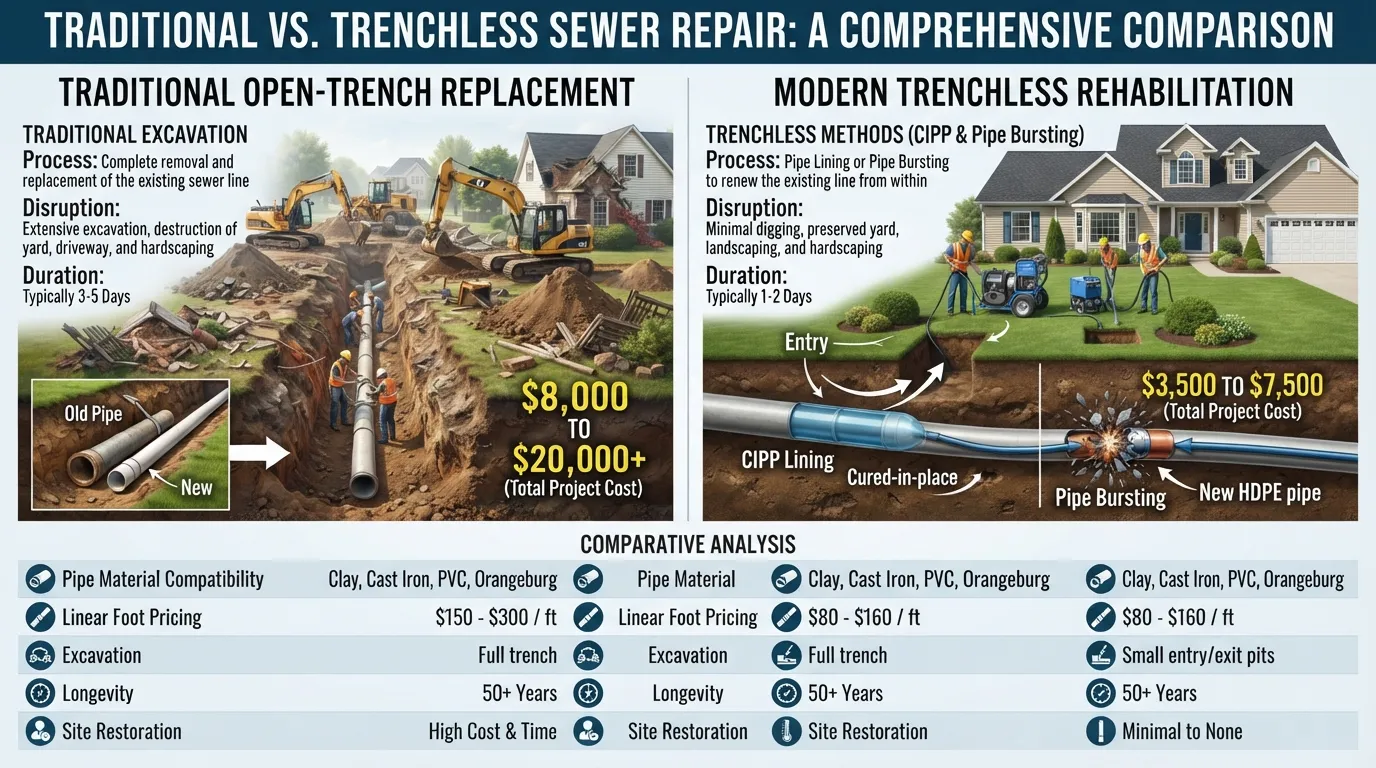
renchless sewer repair utilizes advanced no-dig technology like CIPP and pipe bursting to fix damaged pipes underground through small access points, typically costing between $3,500 and $7,500. Conversely, traditional sewer line replacement requires heavy excavation to physically dig up and replace the old line, often costing $4,000 to $12,000+ while completely disrupting landscaping, driveways, and hardscapes.
Trenchless Sewer Repair: A Quick Definition
Trenchless sewer repair is a modern plumbing technique designed to fix damaged underground sewer pipes without the need for destructive, full-scale trench excavation. Instead of digging up your entire yard, plumbers access the existing sewer pipe through small entry and exit pits, or sometimes just a single access point.
Cured-in-Place Pipe (CIPP): A flexible resin-saturated tube is pulled or blown into the damaged pipe and inflated, then cured in place using hot water, steam, or UV light to form a seamless new pipe within the old one.
Pipe Bursting: A conical steel bursting head is pulled through the old sewer pipe, simultaneously fracturing the damaged host pipe outward while dragging a seamless HDPE replacement pipe right behind it.
Property Preservation: Protects expensive landscaping, mature trees, custom patios, and concrete driveways from heavy machinery destruction.
Traditional Sewer Line Replacement: A Quick Definition
Traditional sewer line replacement is the conventional excavation method where heavy construction equipment digs a continuous trench along the exact path of the underground sewer line. This exposes the entire length of the broken pipe so technicians can manually uncouple, remove, and replace every section with brand-new PVC or cast-iron piping.
Full Visual Access: Allows plumbers to physically inspect the entire bed and surrounding soil conditions before laying down the replacement pipe.
Heavy Excavation Impact: Requires backhoes, trenchers, and manual digging crews, resulting in severe disruption to the property’s surface.
Restoration Costs: Homeowners must factor in secondary expenses to rebuild sod, re-pour concrete, or replace paved driveways after the backfill process is complete.
Key Difference at a Glance
Choosing between modern rehabilitation and conventional digging depends on the structural integrity of your plumbing and your property layout. For comprehensive professional assistance, you can explore specialized sewer line services to evaluate which approach fits your infrastructure.
| Feature / Factor | Trenchless Sewer Repair | Traditional Sewer Line Replacement |
| Excavation Level | Minimal (1 to 2 small access pits) | Extensive (Full trench excavation) |
| Average Cost Range | $3,500 – $7,500 | $4,000 – $12,000+ |
| Project Duration | Typically completed in 1 to 2 days | Usually takes 3 to 7 days |
| Property Damage | Negligible surface disruption | High disruption (lawns, driveways, patios) |
| Best Used For | Localized cracks, root infiltration, minor collapses | Entirely collapsed, severely offset, or bellied pipes |
Trenchless Sewer Repair Methods Explained
Trenchless sewer repair allows plumbing professionals to rehabilitate or replace underground lines without excavating your lawn or driveway. By utilizing specialized techniques like CIPP pipe lining and pipe bursting, technicians fix a cracked pipe, offset pipe, or completely collapsed pipe through minimal access points [01:01].
CIPP (Cured-in-Place Pipe) Lining — How It Works
Cured-in-Place Pipe (CIPP) lining creates a brand-new, jointless pipe directly inside your existing damaged infrastructure. Technicians thoroughly clean the host pipe with high-pressure hydro-scouring to remove scale and roots [01:44] before inserting the material.
Resin-Soaked Liner: A flexible felt or fiberglass tube is saturated with specialized liquid epoxy resin [02:10].
Inversion & Inflation: The resin-soaked liner is pulled or inverted into the compromised pipe and inflated with air or water pressure to press tightly against the interior walls.
UV or Steam Curing: Heat, steam, or ultraviolet light is applied to harden the epoxy resin within hours [02:10], forming a seamless structural pipe that seals all cracks and prevents root intrusion [02:10].
Pipe Bursting — How It Works
Pipe bursting is the preferred trenchless method when a sewer line is severely damaged, heavily deformed, or structurally collapsed beyond the capabilities of standard lining. This technique destroys the old pipe while simultaneously pulling a new one into its exact footprint.
Insertion Pits: Two small access holes are excavated at the entry and exit points of the damaged sewer run.
The Bursting Head: A steel conical bursting head, matched to the diameter of your utility line, is pulled through the underground pipe via a heavy-duty steel cable.
HDPE Replacement: As the bursting head shatters the old host pipe outward into the surrounding soil, it seamlessly drags a new, high-density HDPE pipe right behind it.
Which Method Fits Which Type of Damage
Selecting the right trenchless technology depends on the structural condition and configuration of your subterranean plumbing layout. Matching the appropriate method guarantees maximum pipe lifespan and structural integrity.
CIPP Lining Application: Ideal for structurally intact pipes suffering from minor root infiltration, isolated cracks, joint separations, or corrosion.
Pipe Bursting Application: Best suited for lines with severe structural damage, complete structural collapses, significant pipe offsetting, or when upgrading pipe diameter sizes.
Professional Assessment: A high-resolution CCTV video inspection is always performed beforehand to determine whether a resin-soaked liner or a full pipe-bursting replacement is required [01:15].
Visual Process Overview
Watch this video to see how trenchless technology works in action:
Cost Comparison: Trenchless Repair vs. Traditional Replacement
Trenchless sewer repairs typically cost between $4,000 and $15,000 total, or roughly $80 to $250 per linear foot, saving homeowners significant money by eliminating property destruction. Traditional excavation ranges from $8,000 to $20,000+ once expensive surface restoration like landscaping, concrete sidewalks, and driveways are factored into the final bill.
Cost Per Linear Foot: CIPP vs. Pipe Bursting vs. Excavation
Understanding linear pricing helps property owners estimate baseline material and labor expenses before scheduling an on-site camera inspection. Trenchless contractors price jobs by combining linear foot metrics with depth and job-site accessibility.
CIPP Lining: Ranges from $80 to $250 per linear foot, making it an efficient choice for structural rehabilitation.
Pipe Bursting: Ranges from $100 to $250 per linear foot due to the heavy pulling equipment and replacement HDPE materials required.
Traditional Excavation: While priced differently due to equipment mobilization and manual labor, overall project rates frequently align with or exceed trenchless methods once property repairs begin.
Total Project Cost Ranges (Residential Example)
| Method | Cost per Foot | Total Project Range | Best For |
|---|---|---|---|
| CIPP Lining | $80–$250 | $4,000–$15,000 | Cracked/rooted pipes, structurally aligned |
| Pipe Bursting | $100–$250 | $6,000–$20,000 | Collapsed, severely damaged, offset pipes |
| Traditional Excavation | N/A | $8,000–$20,000+ | Full access/inspection needed, shallow lines |
Why Trenchless Saves 30–50% on Total Project Cost
While material costs for trenchless resins or HDPE lines can look comparable to standard PVC pipes on paper, the total project investment is significantly lower because of hidden labor savings. Traditional digging requires heavy machinery and crews to spend days excavating trenches.
Surface Restoration Savings: Traditional digging ruins whatever sits directly above the sewer pipe, forcing homeowners to pay thousands extra to repour concrete driveways, rebuild patios, or replace sod.
Reduced Labor Hours: Trenchless projects are routinely completed in one to two days, slashing labor overhead compared to week-long excavation jobs.
Landscape Preservation: Protecting mature trees and permanent hardscaping prevents expensive secondary landscaping bills.
Factors That Increase or Decrease Your Final Quote
Every sewer line repair is unique, and several variables can push your estimate toward the lower or higher end of the national average.
Pipe Depth and Location: Deeper sewer lines or pipes running underneath structural foundations require specialized shoring or alternative access points.
Severe Obstructions: Heavy root intrusion, grease buildup, or scale require extensive hydro-scouring before a liner or bursting head can pass through.
Permits and Municipal Fees: Local plumbing permits, utility marking services, and municipal inspection fees are factored into the final quote.
Which Pipe Material Do You Have? Clay, Cast Iron, PVC, Orangeburg
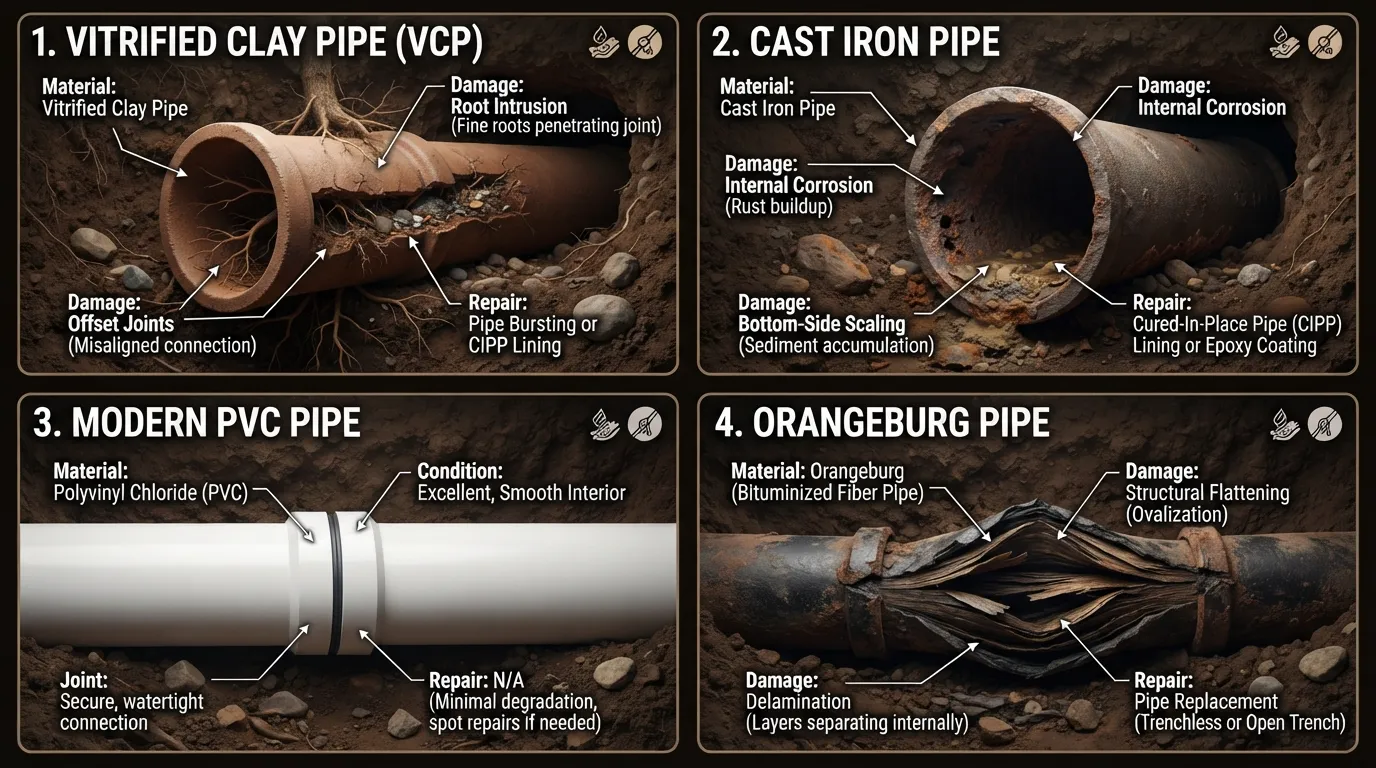
Identifying your underground sewer pipe material dictates whether CIPP lining, pipe bursting, or traditional excavation is required. Older properties frequently feature brittle clay or deteriorating Orangeburg, whereas modern installations rely on durable PVC, directly impacting your repair options and project longevity.
Clay Pipes — Common Issues & Best Repair Method
Vitrified clay pipes were standard in residential construction for decades, prized for their chemical resistance and durability. However, rigid clay sections are extremely vulnerable to shifting ground, freeze-thaw cycles, and invasive root intrusion through old mortar joints.
Typical Damage: Root infiltration, offset joints, radial cracking, and minor structural collapses.
Best Repair Method: CIPP lining works exceptionally well for structurally intact clay pipes with minor cracks or root damage, sealing joints permanently.
When Excavation Applies: Severely offset or completely crushed clay segments require pipe bursting or traditional excavation to restore proper drainage pitch.
Cast Iron Pipes — Common Issues & Best Repair Method
Cast iron sewer pipes were widely installed in homes built from the mid-20th century through the 1970s. Over decades of service, these heavy-duty metal lines corrode from the inside out due to acidic wastewater, household chemicals, and internal bottom-surface scouring.
Typical Damage: Internal scaling, heavy corrosion, structural pitting, bottom-side pipe rotting, and root penetration.
Best Repair Method: CIPP resin lining is the gold standard for failing cast iron, creating a seamless epoxy barrier that stops leaks and reinforces structural integrity without tearing up concrete slabs.
When Excavation Applies: If the cast iron pipe has experienced complete structural collapse or severe belly sagging where wastewater pools, localized replacement is necessary.
PVC Pipes — Common Issues & Best Repair Method
Polyvinyl chloride (PVC) represents the modern standard for residential sewer lines due to its smooth interior surface, chemical resistance, and flexible joint design. While PVC is remarkably durable, issues can still arise from improper initial installation or external forces.
Typical Damage: Improper grading leading to bellied pipes, loose joints caused by ground settling, or accidental puncture from landscaping equipment.
Best Repair Method: Spot repairs or localized trenchless lining can easily fix isolated joint leaks or minor cracks in an otherwise healthy PVC line.
When Excavation Applies: Severe structural sagging (bellies) where a section of pipe loses its slope requires excavating and re-bedding the affected pipe bed.
Orangeburg Pipes — Why These Often Require Full Replacement
Orangeburg pipe—made of compressed wood fibers bound with coal tar—was installed extensively during post-WWII housing shortages due to metal rationing. Designed to last around 30 years, virtually all Orangeburg pipes installed underground have reached or exceeded their structural lifespan.
Typical Damage: Flattening under soil weight, blistering, delamination, root crushing, and complete pipe collapse.
Why Lining Fails: Because Orangeburg essentially turns into wet cardboard over time, the walls lack the rigid structural backing required to support standard epoxy CIPP lining pressure.
Best Repair Method: Pipe bursting or traditional excavation is required to replace deteriorating Orangeburg pipe with modern, high-density HDPE or PVC piping.
How to Find Out What Material Your Sewer Line Is Made Of
Determining your existing pipe material prevents guesswork and ensures you choose the correct rehabilitation method before starting a project. Professional plumbing diagnostics provide definitive visual proof of your underground infrastructure.
Sewer Camera Inspection: A high-resolution CCTV camera pushed through your cleanout gives technicians a real-time, high-definition look at your pipe material and interior wall condition.
Home Age and Municipal Records: The construction year of your home and local municipal building codes often point directly to the original sewer material used during development.
Plumbing Cleanout Access: Visual inspection of the sewer stub-out or main cleanout in your basement or crawlspace can reveal exposed pipe composition.
Warning Signs You Need Sewer Line Repair or Replacement
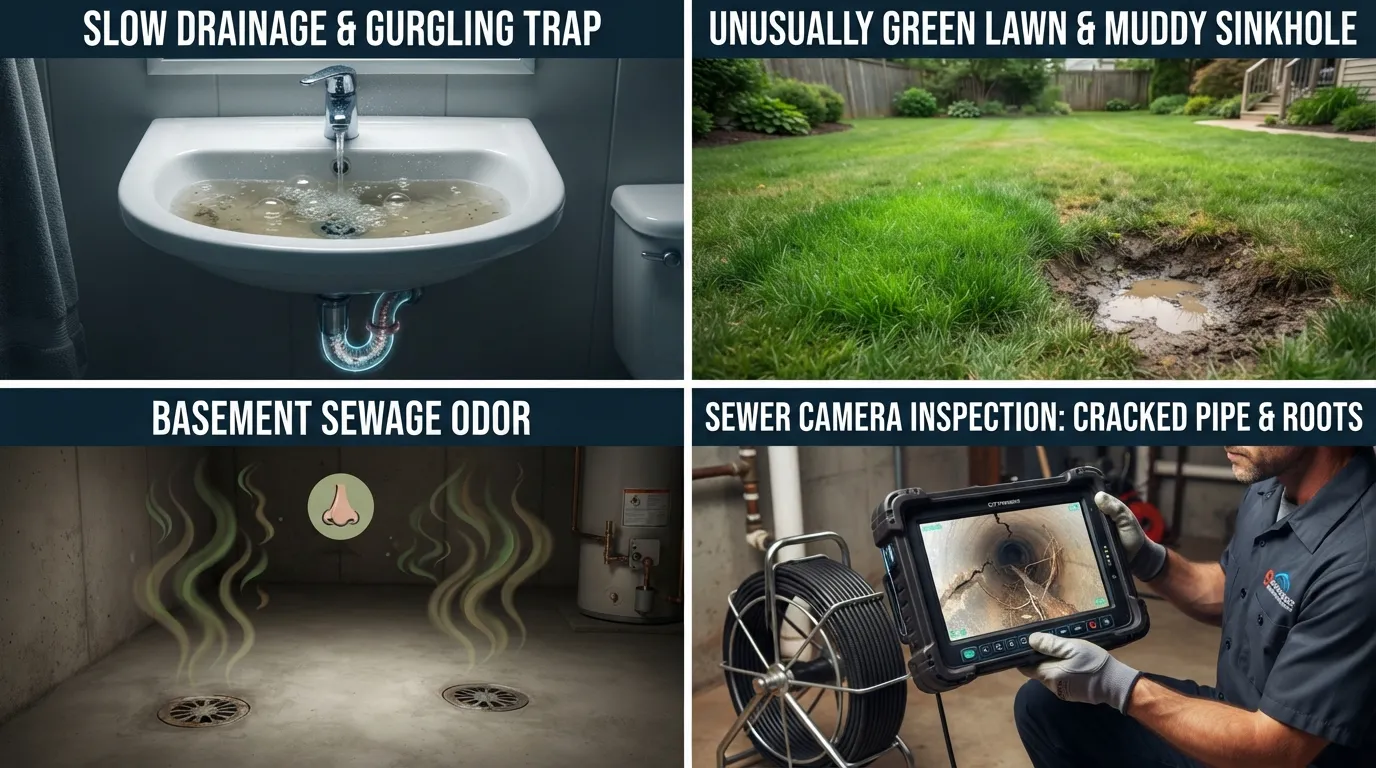
Recognizing the early symptoms of underground plumbing failure allows homeowners to fix minor issues before they escalate into catastrophic property damage. Spotting warning signs early ensures you can schedule professional diagnostics and evaluate trenchless options before structural cracks turn into full collapses.
Slow or Gurgling Drains
When multiple household fixtures—such as showers, toilets, and kitchen sinks—drain sluggishly at the same time, the root cause is rarely an isolated fixture clog. Instead, restricted airflow or narrowing pipe diameters in your main lateral indicate that professional slow or gurgling drains cleaning or structural rehabilitation is urgently required.
Simultaneous Sluggishness: If water backs up in a downstairs shower whenever the upstairs toilet flushes, your main sewer line is obstructed.
Gurgling Sounds: Bubbling or gurgling noises coming from drain traps mean air is being trapped and pushed back up through the plumbing vent system by a downstream blockage.
Recurring Backups
Persistent toilet overflows and wastewater backing up into lowest-level floor drains are undeniable red flags of severe sewer line distress. Snaking a main line provides only temporary relief if structural damage, heavy root intrusion, or pipe offset is causing chronic obstructions.
Basement or Ground-Level Flooding: Wastewater pushing out of cleanouts or lowest-level plumbing fixtures signals complete line failure.
Catch-All Blockages: If clearing a clog only works for a few days before the same symptoms return, a cracked or collapsed pipe is likely catching debris.
Wet Spots, Sinkholes, or Unusually Green Patches in the Yard
Subsurface leaks from a broken or separated sewer pipe will saturate the surrounding soil long before wastewater surfaces above ground. Identifying a wet spots or suspected leak in your yard early prevents dangerous lawn sinkholes and costly foundation erosion.
Unusually Lush Grass: Sewage acts as a potent fertilizer, causing patches of lawn directly over your sewer line to grow significantly greener and faster than the rest of the yard.
Unexplained Sinking: Sunken depressions or muddy sinkholes in your yard or driveway indicate that continuous water leakage is washing away supporting soil underground.
Sewage Odor Indoors or Outdoors
A healthy closed plumbing system should never emit foul sulfur or sewage odors inside your home or around your property exterior. Persistent smells usually point to cracked vent pipes, broken sewer lines, or dried-out traps leaking sewer gas.
Yard Odors: Lingering smells of raw sewage near your lawn or patio often trace back to a compromised underground lateral pipe.
Indoor Pungent Smells: Foul odors around basement drains or crawlspaces mean sewer gases are escaping through underground cracks.
When a Symptom Means “Call a Plumber Today”
Certain red flags demand immediate professional intervention to protect your home from extensive biohazard contamination and structural damage. If you experience an active wastewater overflow, raw sewage pooling indoors, or total drainage failure, you should call a plumber today for 24/7 emergency dispatch and high-definition video inspection.
The Sewer Camera Inspection — Your Required First Step
A professional sewer camera inspection is the mandatory first step before any plumbing contractor can accurately diagnose underground line failures or provide a fixed, itemized quote [02:53]. Utilizing high-definition video feed eliminates guesswork, ensuring your plumber selects the correct trenchless or replacement method for your exact pipe damage [01:21].
What Happens During a Sewer Camera Inspection
During a video inspection, a technician navigates a flexible, high-resolution waterproof camera through your home’s main cleanout access point [01:31]. The camera transmits live digital footage to a monitor, allowing both the technician and homeowner to observe the interior conditions of the subterranean pipe in real time.
Access Point Entry: The digital camera is fed into the lateral line via an existing outdoor or indoor cleanout without disturbing your landscaping [01:31].
Distance Tracking & Sonde Locating: Technicians use built-in radio transmitters on the camera head to pinpoint the exact depth and surface location of any structural problem from above ground.
Post-Cleaning Verification: A second camera pass is frequently performed after high-pressure hydro-scouring to ensure the host pipe interior is completely free of debris before CIPP lining [02:01].
Why an Exact Quote Isn’t Possible Without One
Reputable plumbing companies will never quote an exact flat-rate price for sewer repair over the phone without seeing visual evidence of the subterranean damage [02:53]. Because underground piping conditions vary drastically from property to property, an uninspected estimate is merely a blind guess.
Hidden Damage Variables: Surface symptoms like slow drains do not reveal whether you are dealing with a minor root clog, an offset joint, or a total pipe collapse.
Material & Length Constraints: Exact pricing depends heavily on the total linear footage affected, the composition of the pipe, and whether structural spot repairs or full system rehabilitation are required [02:43].
What the Inspection Reveals (Material, Blockage Location, Damage Severity)
A comprehensive video inspection provides undeniable data regarding your plumbing infrastructure, transforming a stressful plumbing emergency into a clear, manageable project [03:37].
Pipe Material Identification: Clearly distinguishes whether your lines are made of fragile clay, deteriorating Orangeburg, aging cast iron, or modern PVC [01:31].
Exact Blockage Location: Measures the exact distance from your cleanout to the obstruction, allowing precise pinpointing for localized repairs or minimal excavation [01:31].
Damage Severity Assessment: Confirms whether structural walls are sound enough to support CIPP resin lining or if extensive pipe bursting is required [02:43].
Visual Camera Inspection Demonstration
Watch this video to see how a professional sewer camera inspection identifies underground pipe damage:
Does Homeowners Insurance Cover Sewer Line Replacement?
Standard homeowners insurance policies typically do not cover sewer line replacement or repairs resulting from normal aging, ground settling, or root intrusion. Because insurers classify underground pipes as homeowner maintenance items, you will generally need to purchase a specific policy endorsement or check municipal responsibilities before starting a project. According to Nationwide‘s coverage guidelines, protecting external underground infrastructure requires dedicated service line add-ons.
What Standard Homeowners Policies Typically Exclude
Standard home insurance policies focus on sudden, external perils like windstorms, fires, or vandalism. They deliberately exclude subterranean infrastructure damage that develops slowly over time.
Wear and Tear Exclusions: Gradual pipe deterioration, material corrosion, and age-related decay are entirely the homeowner’s financial responsibility.
Root Intrusion & Soil Shifting: Damage caused by tree roots growing into pipe joints or shifting earth cracking clay and cast iron lines is classified as deferred maintenance.
General Maintenance Failures: Routine plumbing upkeep, clearing stubborn clogs, and repairing old orangeburg or cracked pipes must be paid for out of pocket.
When Coverage Does Apply (Sudden, Accidental Damage)
Insurance may step in only under rare circumstances where an acute, accidental event outside of normal wear and tear destroys your lateral line.
Covered Perils: If a heavy falling tree or vehicle impact crushes your exterior property and damages the shallow underground sewer pipe, standard dwelling or other structures clauses might apply.
Interior Backup Damage: While policies usually exclude the underground pipe itself, optional water backup riders can cover damage to indoor carpets, drywall, and furniture if a sewer line clogs and floods your basement.
Sewer Line Endorsements / Add-On Coverage Options
Most major insurance providers offer affordable optional riders—often called service line endorsements or utility line coverage—to protect against subterranean plumbing failures.
Service Line Coverage Riders: Usually costing between $30 and $100 annually, these add-ons provide $10,000 to $20,000 in coverage for underground water, gas, and sewer line repairs.
Excavation & Restoration Payoffs: Unlike basic plans, service line endorsements frequently cover the high cost of digging up lawns, cutting concrete, and replacing damaged landscaping.
Deductible Requirements: Filing a claim under a service line rider typically requires paying a standard deductible (often $500), which is far lower than paying out of pocket for a complete trenchless repair or pipe replacement.
Checking With Your Municipal Sewer Operator Before You Start
Property owners are almost always responsible for the entire sewer lateral running from the house foundation to the municipal main connection in the street. However, liability lines vary significantly depending on local municipal codes.
Property Line Boundaries: In some cities, the homeowner owns the pipe all the way to the city main connection in the middle of the road, while other municipalities take over responsibility once the pipe crosses the property line or sidewalk.
Utility Locates and Permits: Before hiring a contractor for trenchless repairs, contact your local municipal sewer operator or utility notification center (such as 811) to mark public utility lines and confirm local repair permits.
Pros and Cons of Trenchless Sewer Repair Honest Breakdown
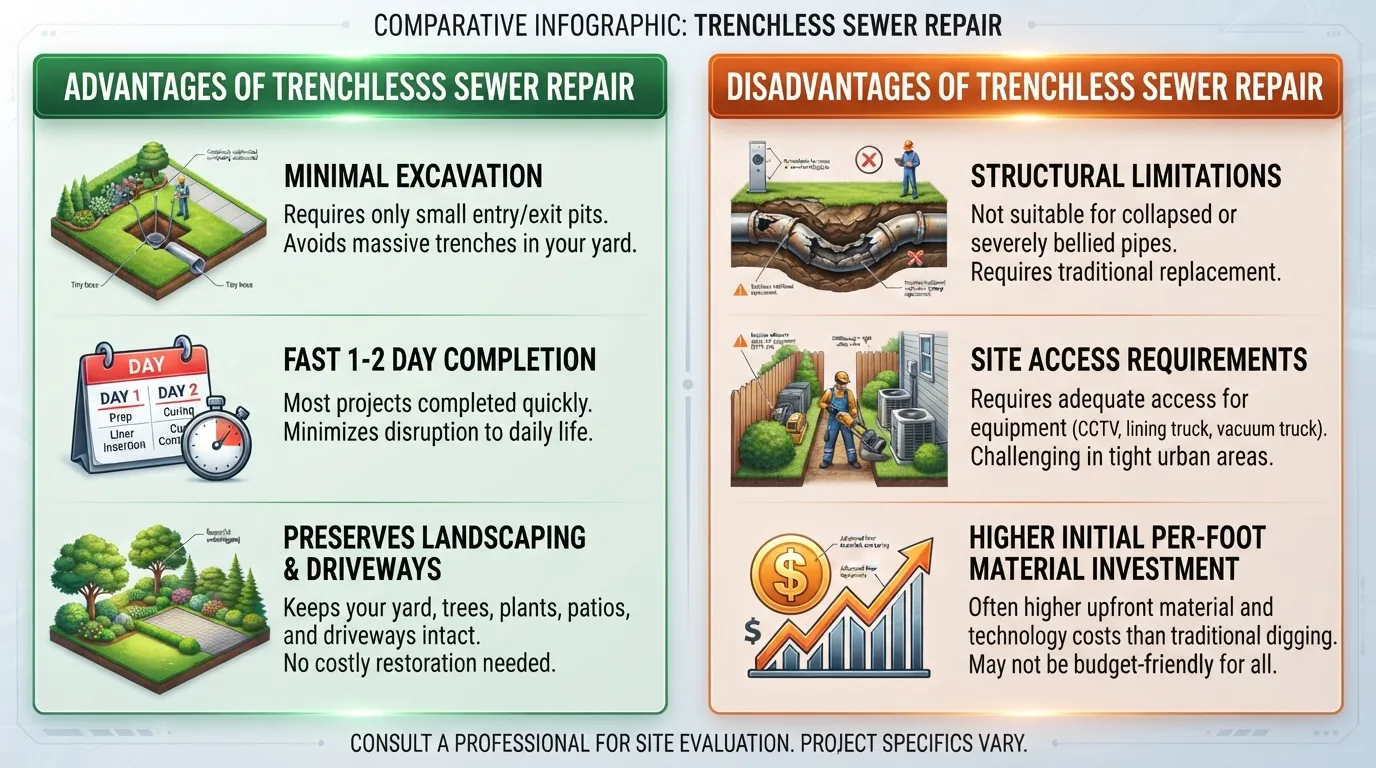
Trenchless sewer repair offers remarkable benefits like minimal surface disruption, faster completion times, and lawn preservation, but it also comes with notable drawbacks. While methods like CIPP lining and pipe bursting eliminate the need to tear up your yard, they require specific structural conditions and can involve higher upfront material costs per linear foot compared to traditional spot fixes.
Advantages: Less Excavation, Faster Timeline, Landscape Preservation
Modern trenchless technologies have revolutionized residential plumbing by bypassing the massive property destruction associated with conventional backhoes and trench diggers.
Minimal Excavation: Instead of digging a massive trench across your entire property, technicians only require one or two small access pits to rehabilitate the pipe.
Rapid Completion: Most residential trenchless lining or pipe bursting projects are fully completed within one to two days, minimizing disruption to your daily routine.
Landscape Preservation: Protects expensive sod, mature trees, custom interlocking patios, and concrete driveways from being bulldozed during repairs.
Disadvantages: Not Suitable for Every Damage Type, Upfront Cost Per Foot, Limited Access Situations
Evaluating the downsides of trenchless methods ensures you understand the technical and financial limitations before committing to a contractor’s proposal.
Structural Limitations: Trenchless liners cannot be installed in completely collapsed pipes, severe structural offset geometries, or lines with heavy bellies (sagging sections) that lack proper slope.
Higher Upfront Foot-Costs: Specialized epoxy resins, CIPP equipment, and high-density HDPE materials can drive up the initial cost per linear foot compared to standard PVC piping.
Site Access Restrictions: Technicians still require a viable entry point (such as an exterior cleanout or a manageable excavation pit) to feed lining materials or bursting heads into the system.
Is Trenchless Pipe Lining Worth It? (Direct Answer Box)
Trenchless pipe lining is almost always worth the investment for homeowners looking to protect expensive landscaping, driveways, and hardscapes. While the initial material cost per linear foot can be higher than traditional excavation, the massive savings on property restoration, combined with lifespans exceeding 50 years, make trenchless repair the preferred choice for structurally sound pipes.
Why Pipe Relining Can Seem Expensive Compared to Patch Repairs
Homeowners frequently experience sticker shock when comparing comprehensive trenchless relining quotes to cheap, localized spot patches or temporary snaking services.
Advanced Technology and Materials: Professional CIPP installation requires industrial-grade epoxy resins, calibration tubes, and specialized curing equipment like steam units or UV light trains.
Full-System Protection: Rather than fixing just a single isolated crack that will likely fail elsewhere next year, pipe relining seals the entire length of your compromised lateral against future root intrusion and joint leaks.
Elimination of Hidden Remediation Bills: While a patch repair might look cheaper upfront, it ignores overall pipe degradation and leaves you vulnerable to secondary landscaping and concrete replacement costs later.
How Long Do Trenchless Repairs Last? Lifespan & Durability
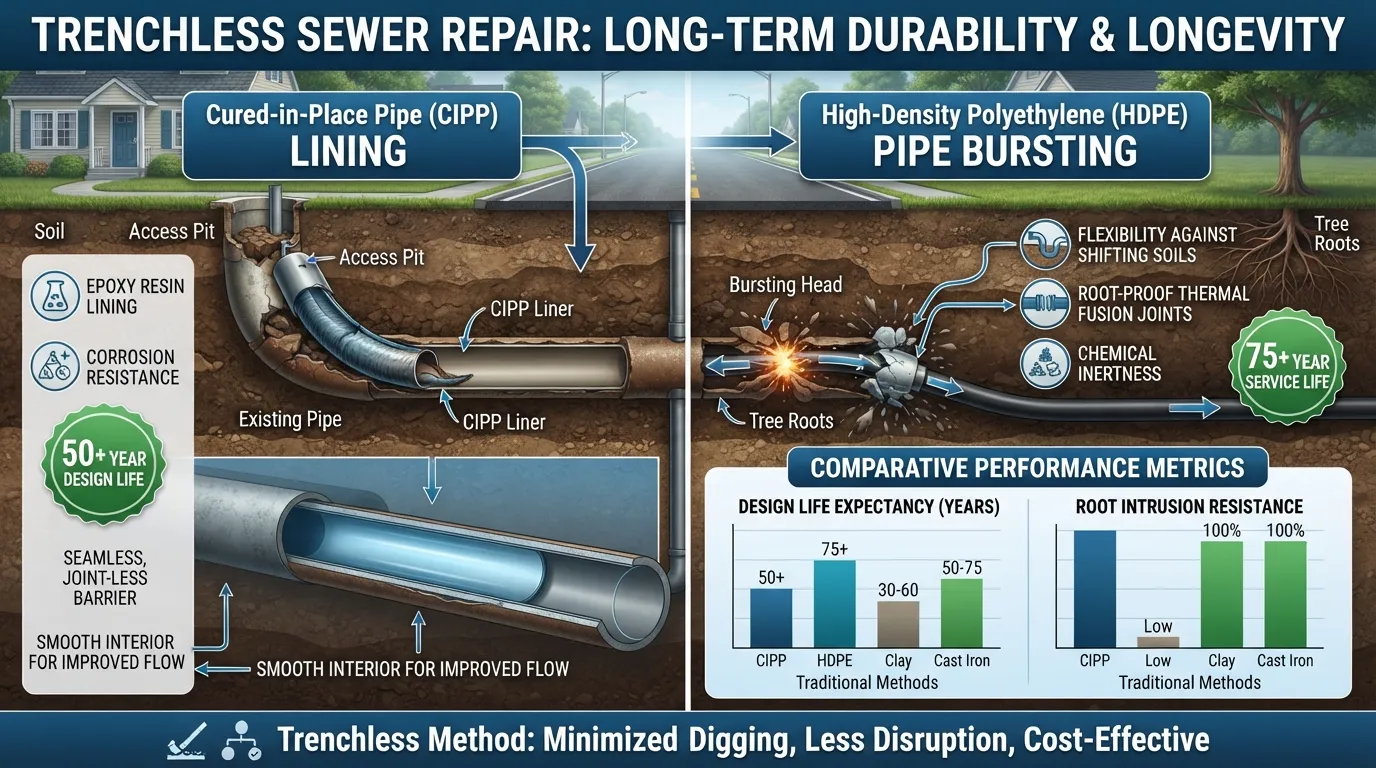
Trenchless sewer repairs are engineered for exceptional longevity, with both CIPP liners and HDPE pipe bursting systems boasting a projected design life of 50 years or more. Because these methods use corrosion-resistant epoxy resins and high-density plastics, they frequently outlast the original clay, cast iron, or orangeburg pipes they replace.
Expected Lifespan of CIPP Liners
Cured-in-Place Pipe (CIPP) lining creates a rigid, seamless structural pipe within your old host line, providing decades of reliable performance. Independent plumbing engineering studies and municipal testing confirm that properly installed epoxy liners easily achieve a 50-year service life.
Corrosion Resistance: The seamless epoxy and felt or fiberglass matrix is impervious to acidic wastewater, rust, and chemical degradation.
Root and Joint Protection: Without exposed joints or cracks, invasive tree roots are permanently locked out of the plumbing system.
Manufacturer Warranties: Reputable plumbing contractors routinely back their CIPP installations with robust warranties ranging from 10 to 50 years.
Expected Lifespan of HDPE Pipe Bursting
Pipe bursting replaces damaged infrastructure by pulling a brand-new, continuous high-density polyethylene (HDPE) pipe directly through the old line. HDPE is celebrated globally for its extreme physical toughness and chemical inertness.
50+ Year Durability: Municipalities utilize HDPE pipes for underground water and sewer mains because they are rated to last well over half a century under normal conditions.
Flexibility and Soil Resistance: HDPE naturally flexes with shifting ground and seismic movements without cracking or pulling apart at glued joints.
Root-Proof Fusion: Sections of HDPE are thermally fused together, creating a completely leak-free, solid plastic pipeline.
How Lifespan Compares to Traditional Pipe Replacement
Trenchless repairs match or exceed the durability of traditional open-cut excavations while eliminating the structural vulnerabilities of older plumbing materials.
Outlasting Legacy Materials: While traditional clay pipes can last decades if undisturbed, they remain vulnerable to shifting earth; traditional cast iron corrodes from the inside out within 40 to 60 years.
Equivalent to Modern PVC: Trenchless CIPP and HDPE match the 50 to 100-year lifespan of brand-new PVC pipe installations without the multi-thousand-dollar landscape destruction required to dig them in.
Can You Repair a Sewer Line Yourself? DIY vs. Professional
Attempting a DIY sewer line repair or replacement is virtually impossible for homeowners due to the heavy machinery, specialized epoxy resins, trenchless bursting equipment, and engineering expertise required. Underground utility repairs demand professional intervention to comply with local building codes and prevent catastrophic property or environmental damage.
Why DIY Sewer Line Work Is Rarely Recommended
Sewer lines are buried deep underground beneath lawns, driveways, and foundations, making physical access a major engineering hurdle. Even if a homeowner rents a backhoe, improper excavation or installation can lead to severe hazards.
Heavy Equipment Operation: Trenchless pipe bursting requires industrial hydraulic pullers capable of generating tens of tons of force [02:32], which can cause structural injury if mishandled.
Specialized Curing Tools: CIPP installation requires precise resin saturation and high-powered UV or steam curing units to ensure the structural liner bonds correctly without collapsing [00:44].
Risk of Total Line Destruction: Amateurs attempting to clear or replace lines often misjudge pipe grade, leading to negative slopes where wastewater completely stops draining.
Permitting and Code Requirements
Municipalities strictly regulate sewer lateral connections because improper repairs can contaminate public water mains and municipal sewer systems.
Mandatory Plumbing Permits: Legitimate sewer repairs require municipal permits, engineered plan submissions, and pre- and post-repair inspections by city code enforcement officers.
Utility Locating Laws: By law, anyone digging underground must contact utility notification services (like 811) to prevent striking high-voltage electrical lines, gas mains, or public water pipes.
What a Licensed Plumber’s Process Looks Like End-to-End
Hiring a professional ensures your infrastructure is diagnosed, repaired, and restored according to strict industry standards. When you partner with a licensed plumber’s full-service process, technicians execute a precise workflow from start to finish [00:14].
Initial Camera Diagnostics: Technicians deploy a high-definition CCTV camera to locate structural cracks, roots, and pipe material [00:14].
Hydro-Scouring Prep: High-pressure water jetting completely cleans scale and root intrusion from the host pipe interior [00:14].
Trenchless Execution: Plumbers install a seamless CIPP structural liner or execute a hydraulic pipe bursting pull [00:44], followed by a final quality assurance video inspection.
Visual Professional Process Walkthrough
Watch this video to see how a professional plumbing team executes an end-to-end trenchless sewer repair:
Residential vs. Commercial Sewer Line Considerations
Commercial sewer line repair involves much larger scale infrastructure, complex multi-story drainage networks, and strict municipal health codes compared to single-family residential properties. Because businesses cannot afford prolonged plumbing shutdowns, commercial plumbing projects require specialized trenchless methods designed to minimize operational disruption.
What’s Different About Commercial Sewer Line Repair
Commercial plumbing systems handle significantly higher volumes of daily wastewater, commercial grease, and heavy use from employees, customers, or tenants. These systems also feature larger pipe diameters, deeper subterranean layouts, and run beneath commercial parking lots or concrete foundations.
High-Volume Usage Demands: Commercial pipes experience accelerated wear from constant use, requiring heavy-duty industrial CIPP lining and robust structural reinforcement.
Complex Multi-Story Layouts: Unlike residential lines that connect directly to a single street lateral, commercial buildings often coordinate complex vertical stacks, grease traps, and multiple sub-surface branch lines.
Regulatory Compliance: Commercial properties must comply with strict local health ordinances, ADA plumbing standards, and commercial building codes during any repair or replacement.
Minimizing Business Downtime During Trenchless Work
For property managers and business owners, extended plumbing closures translate directly to lost revenue and frustrated customers. Utilizing professional commercial sewer line repair techniques allows businesses to remain open while subterranean infrastructure is rehabilitated.
After-Hours Scheduling: Licensed commercial plumbing teams routinely perform trenchless CIPP lining and pipe bursting overnight or during off-peak business hours.
Bypassing Excavation Chaos: Avoiding massive trenches in commercial parking lots or customer entryways prevents parking restrictions and maintains safe pedestrian access.
Rapid Return to Service: Because trenchless liners cure within hours, businesses can resume full wastewater operations the very next day without waiting for weeks of concrete pouring and soil compaction.
Frequently Asked Questions
How much does it cost to repair a trenchless sewer line?
Trenchless sewer line repairs typically range from $4,000 to $15,000 total, or roughly $80 to $250 per linear foot, depending on the chosen method, pipe depth, and overall job accessibility.
What are the disadvantages of trenchless sewer line replacement?
Disadvantages include structural limitations that prevent lining completely collapsed or severely sagging pipes, higher upfront material costs per linear foot, and the need for a viable access point.
Will homeowners insurance cover sewer line replacement?
Standard homeowners insurance policies exclude subterranean pipe wear and tear, root intrusion, and ground settling, though optional service line endorsements or utility riders can provide $10,000 to $20,000 in coverage.
Is trenchless pipe lining worth it?
Yes, trenchless pipe lining is well worth the investment because it protects expensive landscaping, driveways, and concrete patios while offering a 50-year structural lifespan.
What are the disadvantages of pipe relining?
Pipe relining cannot fix lines with heavy bellies (sagging sections) that lack proper slope, requires professional installation equipment, and involves a higher initial material investment than simple patching.
How much should pipe relining cost?
CIPP pipe relining generally costs between $80 and $250 per linear foot, resulting in total residential project costs averaging $4,000 to $15,000 based on the length of the run.
How long does sewer pipe relining last?
Properly installed CIPP resin liners and HDPE pipe bursting systems are engineered with a design life of 50 years or more, frequently outlasting the original host pipes.
How much does it typically cost to replace a sewer line?
Traditional open-excavation sewer line replacement typically costs between $8,000 and $20,000+, with final pricing heavily influenced by surface restoration requirements like concrete and lawn repair.
Why is pipe relining so expensive?
Pipe relining requires industrial-grade epoxy resins, specialized calibration tubes, high-powered steam or UV curing equipment, and certified technician labor to execute seamlessly.
Can you repair a sewer line without digging it up?
Yes, modern trenchless methods like CIPP (Cured-in-Place Pipe) lining and pipe bursting allow plumbers to repair or replace underground sewer lines through small access pits without digging trenches.
Get a Sewer Line Inspection or Quote Today
Protecting your home’s foundation and plumbing infrastructure from unexpected sewage failures begins with expert diagnosis and transparent project planning. Whether you need advanced trenchless rehabilitation or traditional excavation, partnering with experienced local sewer repair experts guarantees long-lasting results and total peace of mind.
Why Choose a Local Licensed Plumber for This Job
Navigating underground utilities requires specialized local knowledge, proper municipal licensing, and adherence to strict regional building codes. Working with certified professionals ensures your plumbing system is restored safely and efficiently without costly shortcuts.
Licensed and Insured Professionals: Protect your property with fully certified technicians trained in advanced CIPP and pipe bursting technologies.
Accurate Video Diagnostics: Eliminate guesswork with high-resolution CCTV camera inspections that pinpoint the exact root cause of your drainage issues.
Transparent Pricing: Receive honest, itemized quotes with clear explanations of your repair options before any work begins.
Book a Sewer Camera Inspection
Don’t wait until a slow drain turns into a catastrophic emergency sewer backup. Book your sewer inspection now to secure your appointment, get an accurate assessment of your underground pipes, and take back control of your home’s plumbing system.
Main Services
Related Posts
Need a Plumber in Miami?
Schedule service online or speak directly with the EZ Plumbing team.
Owner-Led Local Service
Know who is behind the business before you request service. The owners, contact line and Miami service pages are published clearly.
- Named business owners
- Direct phone and social channels
- Local Miami service information
Clear Help Before You Book
Review the relevant service page, contact the team directly and use the booking page when you are ready—without relying on vague claims.
- Service-specific information
- Direct questions before scheduling
- Clear online booking route