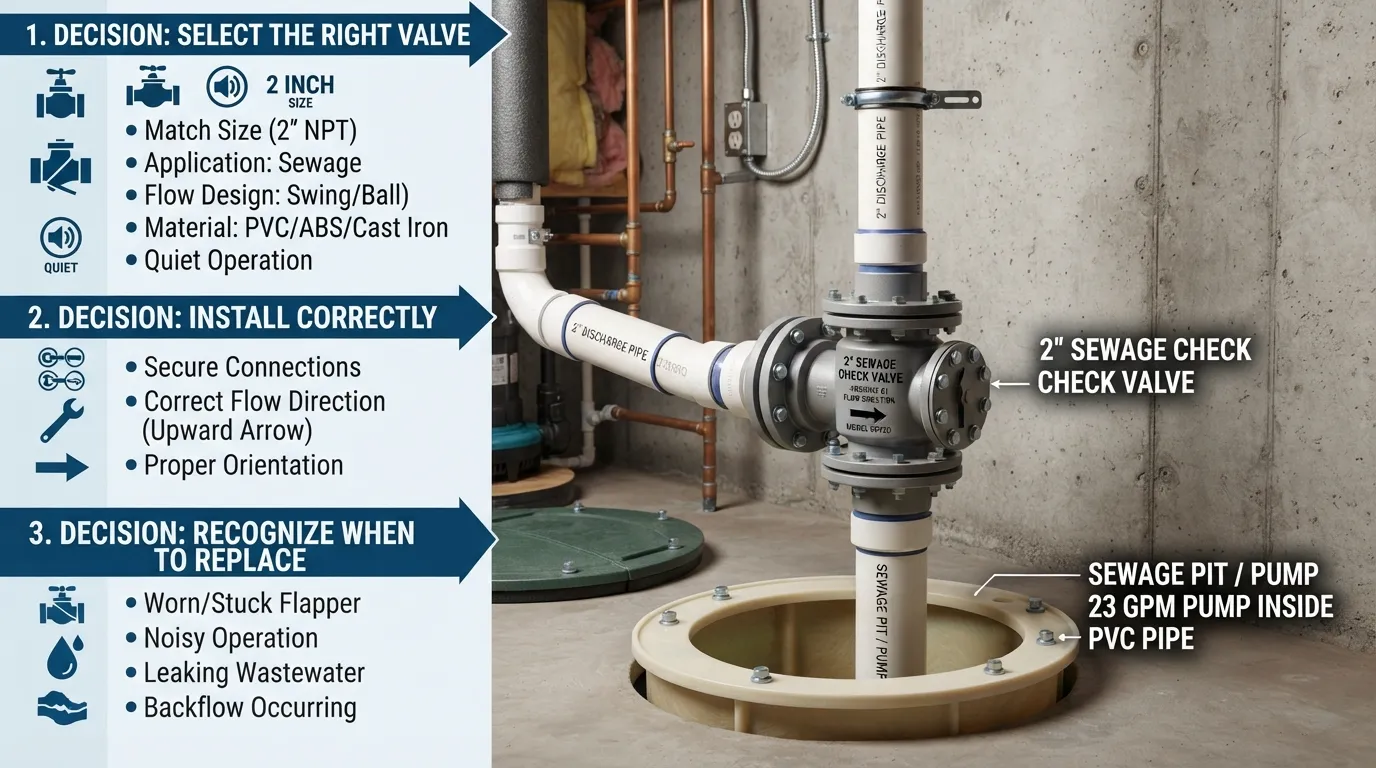
A 2 inch sewage check valve helps keep wastewater from flowing back toward the sewage basin after the pump shuts off. But choosing the right valve involves more than matching a 2-inch pipe. You also need to consider the pump, sewage application, flow, solids handling, connection type, installation orientation, noise, and future servicing.
What Does a 2 Inch Sewage Check Valve Do?
A 2 inch sewage check valve is a one-way valve installed in a sewage pump discharge line. It allows wastewater to move away from the pump when the pump runs, then closes when flow stops to help prevent the discharged wastewater from flowing back into the sewage basin. The correct valve should be rated for the application and matched to the pump and discharge piping.
If you are looking for a 2 inch check valve for a sewage pump, you are probably trying to solve one of two problems: you need a replacement, or you are installing a sewage pump and want to make sure the discharge system is configured correctly.
Either way, you do not want to choose a valve simply because the package says “2 inch.” Two valves can have the same nominal size but differ in connection method, flow characteristics, orientation requirements, construction, serviceability, and noise performance.
This guide walks you through what matters before you buy or install one, including quiet check valves, full-flow designs, sewage pump compatibility, installation, replacement symptoms, and the difference between a sewage check valve and a backwater valve.
Before You Buy: The 2-Inch Size Is Only the Starting Point
Before ordering a valve, verify these details against your pump and the valve manufacturer’s specifications:
- 2-inch nominal discharge size
- Sewage, effluent, or sump-pump application
- Connection type and pipe compatibility
- Required installation orientation
- Flow direction
- Solids-handling and full-flow characteristics
- Available space for installation and future servicing
- Noise or water-hammer concerns
- Pump manufacturer’s installation requirements
What Is a 2 Inch Sewage Check Valve?
A sewage check valve is designed to permit flow in one direction and restrict reverse flow. In a typical sewage pump installation, the pump pushes wastewater through the discharge pipe when it operates. When the pump stops, the water already in the discharge line can otherwise move back toward the basin.
The check valve closes against that reverse flow. This helps prevent the pump from having to repeatedly handle wastewater that has already been discharged and helps keep the discharge system operating in the intended direction.
The term 2 inch normally refers to the nominal connection or pipe size the valve is designed to work with. It does not mean that every internal opening, passage, or component is exactly 2 inches in diameter.
Does a Sewage Pump Need a Check Valve?
In many sewage pump systems, a check valve is used on the discharge line to prevent wastewater from flowing backward when the pump shuts off. Whether a particular installation requires one, where it should be placed, and which design is appropriate should be confirmed against the pump manufacturer’s instructions and applicable plumbing requirements.
Without effective backflow control, wastewater in the discharge line can return toward the basin. That can increase the amount of liquid the pump has to move again and can contribute to unwanted cycling or other operating problems depending on the system.
Simple Way to Think About It
Pump running: wastewater moves out of the basin → through the check valve → into the discharge system.
Pump stopped: the valve closes → reverse flow is restricted → wastewater is kept from simply running back toward the basin.
How a 2 Inch Sewage Check Valve Works
Most sewage check valves use a movable internal component such as a flapper. Pump pressure pushes the valve open in the intended flow direction. When that forward pressure disappears, the internal mechanism moves toward the closed position.
The exact mechanism varies by product. Some designs use a conventional flapper, while others incorporate features intended to reduce noise, improve closure, or make the valve easier to service.
1. Pump Starts
The pump creates flow through the discharge line.
2. Valve Opens
The valve permits wastewater to travel in the intended direction.
3. Pump Stops
Forward flow falls away and the valve moves toward closure.
4. Backflow Is Restricted
The closed valve helps stop wastewater from returning toward the basin.
How to Choose the Right 2 Inch Sewage Check Valve
The best valve is not necessarily the most expensive one. It is the valve that matches your pump, piping, application, installation conditions, and performance requirements.
1. Confirm the Pump Discharge Size
Start with the sewage pump manufacturer’s specifications. If the pump uses a 2-inch discharge connection, a valve designed for that connection size may be appropriate, but you still need to confirm the complete connection and piping arrangement.
Do not assume that a product described as a “2 inch check valve” automatically fits every 2-inch sewage installation.
2. Make Sure It Is Intended for Sewage
Sewage is not the same application as clean water. A sewage pump may need to move wastewater containing solids, so the valve’s internal design matters.
Look for a valve specifically identified by the manufacturer for sewage or the exact application recommended for your pump. Do not choose solely because the outside diameter or connection size looks correct.
3. Look at Full-Flow and Solids Handling
For sewage applications, unnecessary restriction inside the valve can be a concern. This is why many sewage check valves emphasize full-flow or full-port characteristics.
A useful question is not simply “Is it 2 inches?” but:
“Does this valve’s internal flow path and solids-handling capability match my sewage pump and the manufacturer’s requirements?”
Always use the manufacturer’s stated specifications rather than assuming that every full-flow valve has identical solids-handling performance.
4. Decide Whether You Need a Quiet Check Valve
If your existing check valve makes a noticeable clunk or banging sound every time the sewage pump shuts off, a quiet design may be worth considering.
A 2 inch quiet check valve may use a spring-assisted or specially engineered flapper mechanism intended to control closure and reduce hydraulic shock and operating noise. The exact performance depends on the design and installation.
Standard Design
- Simple one-way flow control
- May produce an audible closing sound
- Often suitable when noise is not a major concern
Quiet Design
- Designed to reduce closing noise or hydraulic shock
- Useful near finished living areas
- Confirm orientation and application requirements for the exact model
5. Check the Installation Orientation
This is one area where you should never rely on a universal rule.
Some sewage check valves have specific vertical or horizontal installation requirements, while other models are designed to work in more than one orientation. The correct position depends on the valve design and the manufacturer’s instructions.
Important Installation Warning
Do not install a 2-inch sewage check valve vertically or horizontally simply because another valve of the same size was installed that way. Check the installation instructions for the exact model you are using.
6. Choose the Right Connection Type
Common connection approaches include flexible couplings, compression connections, solvent-weld connections, and union-style configurations. Each has different implications for installation and future service.
Flexible Coupling
Can make replacement or servicing more convenient when the piping arrangement permits it.
Compression
Designed for a serviceable connection when compatible with the specific pipe and valve.
Solvent Weld
Provides a more permanent connection where the valve and piping system are designed for it.
Union Style
Can make future valve removal easier when the system layout and product design support it.
2 Inch Sewage Check Valve Buying Checklist
If you are standing in front of several products and they all say “2 inch,” use this checklist before choosing one:
- Application: Is it specifically suitable for your sewage or pump application?
- Size: Does the connection match the pump discharge and piping?
- Flow: Does the internal design provide the required flow characteristics?
- Solids: Does the manufacturer specify appropriate solids-handling capability?
- Orientation: Is your planned installation position permitted?
- Connection: Does it match your existing or planned piping method?
- Noise: Do you need a quiet or reduced-water-hammer design?
- Service: Can the valve be accessed if cleaning or replacement becomes necessary?
- Compatibility: Does the pump manufacturer approve or recommend the type?
- Instructions: Have you checked the exact model’s installation requirements?
2 Inch Sewage Check Valve Installation: What You Need to Know
Installing a check valve is not simply a matter of cutting a pipe and inserting the valve. The valve needs to be positioned correctly in the discharge system, installed in the correct flow direction, and connected according to the manufacturer’s instructions.
Typical System Arrangement
Sewage Basin → Sewage Pump → 2-Inch Check Valve → Discharge Piping → Building/Sewer Discharge System
The exact arrangement varies by pump, building, piping configuration, and applicable requirements. The check valve’s arrow or flow marking should point in the direction the wastewater is intended to travel.
Basic Installation Sequence
- Turn off and isolate the equipment according to the pump manufacturer’s safety instructions.
- Confirm the pump discharge size and the valve connection size.
- Identify the valve’s intended flow direction.
- Confirm whether the specific valve requires vertical, horizontal, or another approved orientation.
- Install the valve using the connection method specified for that model.
- Secure any flexible couplings and clamps according to the applicable manufacturer’s requirements.
- Make sure the discharge piping is properly supported and does not place excessive mechanical stress on the valve or pump.
- Restore the system and test operation while checking for leaks, abnormal noise, reverse flow, or other problems.
When Professional Installation Makes Sense
If the job involves modifying a sewage discharge system, opening a sewage basin, changing the building sewer connection, dealing with difficult access, or determining whether local plumbing requirements apply, professional help can be the safer choice. Sewage systems also involve sanitation concerns, so avoid unnecessary exposure when working on them.
Why Is My 2 Inch Sewage Check Valve Making a Loud Noise?
A loud clunk when a sewage pump shuts off can be associated with the check valve closing and the resulting hydraulic shock. The sound can be more noticeable when the valve closes abruptly or when the discharge system has conditions that amplify the pressure change.
A quiet or “klunkless” check valve may be designed to reduce this effect through its internal mechanism. However, changing the valve is not always the only possible explanation for unusual noise.
If the sound is new, unusually severe, or accompanied by poor pump performance, frequent cycling, leakage, or other symptoms, inspect the entire pump and discharge system rather than assuming the valve is the only problem.
Signs a 2 Inch Sewage Check Valve May Need Replacement
A check valve can eventually become damaged, worn, obstructed, or unable to seal properly. Possible warning signs include:
- Wastewater appears to flow back toward the sewage basin after pumping.
- The pump appears to cycle more frequently than expected.
- The valve produces a new or unusually loud closing noise.
- The valve body, connection, or coupling shows signs of leakage.
- The internal flapper does not close properly.
- Debris interferes with valve movement or sealing.
- The valve shows visible deterioration or damage.
- The pump or discharge system is no longer behaving as expected.
These symptoms are not proof that the check valve has failed. A sewage pump, float switch, discharge line, venting arrangement, or another component can produce similar symptoms. Proper diagnosis matters before replacing parts.
Check Valve vs. Backwater Valve: Are They the Same?
No. They can both relate to unwanted reverse flow, but they serve different purposes and should not automatically be treated as interchangeable.
Sewage Check Valve
Typically used in a pumped discharge line to allow flow away from the sewage pump while restricting reverse flow toward the basin.
Backwater Valve
Used in appropriate building drainage/sewer applications to help protect against unwanted reverse flow from a drainage or sewer system.
A backwater valve is therefore not simply a larger version of a sewage pump check valve. If your concern is a sewage pump discharge line, start with the pump and discharge system. If your concern is sewer backup into the building’s drainage system, the solution may involve a different type of valve and plumbing configuration.
Can You Put a Check Valve in a Sewer Line?
It depends on which part of the plumbing system you mean.
A sewage pump check valve is normally associated with the pump’s discharge piping. It should not automatically be substituted for a building sewer backwater valve or another backflow-control device simply because both are intended to restrict reverse flow.
If you are trying to protect a building from municipal sewer backup, the correct solution depends on the drainage layout, local requirements, and the specific source of the backflow. That is a different question from selecting a check valve for a sewage ejector pump.
Can a 2 Inch Sewage Check Valve Be Installed Horizontally?
Some can, but not every model has the same installation requirement.
This is one of the most important reasons to check the manufacturer’s instructions for the exact valve. Some products permit horizontal and vertical installation, while others specify a particular orientation or place conditions on horizontal installation.
If your existing piping is horizontal, do not choose a valve based only on its 2-inch size. Confirm that the model is approved for that orientation before purchasing it.
What Is the Best 2 Inch Check Valve for a Sewage Pump?
There is no single “best” 2-inch check valve for every sewage pump. The best choice is the one whose design and specifications match your particular installation.
Use Your Situation to Narrow the Choice
2 Inch Sewage Check Valve vs. Sump Pump Check Valve
You may see the terms sewage check valve and sump pump check valve used close together in product searches. That does not mean every valve is suitable for both applications.
The important question is what the valve was designed and specified to handle. A sewage pump can move wastewater containing solids, while a conventional sump pump generally deals with groundwater. Their discharge sizes and valve requirements can also differ.
If you are searching for a sump pump check valve quiet or a 2 inch check valve for a sewage pump, verify the actual pump model, discharge size, application rating, and valve manufacturer’s instructions before buying.
Can You Install a 2 Inch Sewage Check Valve Yourself?
A straightforward replacement in an accessible discharge line may be manageable for someone who understands the plumbing system and can safely follow the manufacturer’s installation instructions.
However, sewage plumbing deserves more caution than an ordinary clean-water repair.
DIY May Be Reasonable When
- You are replacing an accessible valve with a compatible model.
- The pipe arrangement does not require major modification.
- You understand the connection method and flow direction.
- You can safely isolate the pump and follow its instructions.
- You are confident the installation meets applicable requirements.
Professional Help Is Better When
- The sewage basin or discharge system requires substantial modification.
- The valve location is difficult or unsafe to access.
- You are unsure which valve type the pump requires.
- The work involves the building sewer or a possible sewer-backflow problem.
- Local plumbing requirements are unclear.
- The system has repeated failures that have not been diagnosed.
Common Mistakes When Choosing a 2 Inch Sewage Check Valve
Buying by Size Alone
A 2-inch label does not confirm application, orientation, connection, or internal design.
Ignoring Noise
A conventional valve may work while still producing an annoying closing sound in a finished basement.
Assuming Orientation
Different valve designs have different installation requirements.
Confusing Valve Types
A sewage pump check valve is not automatically a substitute for a building sewer backwater valve.
How to Troubleshoot a 2 Inch Sewage Check Valve
If something does not seem right, start with the symptom rather than immediately replacing the valve.
Problem: Wastewater seems to return to the basin.
Check whether the valve is closing correctly and whether debris or damage is preventing a proper seal.
Problem: The valve makes a loud clunk.
A closing event can create hydraulic shock. Consider whether the valve design, discharge configuration, or another system condition is contributing to the noise.
Problem: The pump seems to cycle repeatedly.
Backflow through a valve that is not sealing can be one possibility, but pump controls, float operation, discharge conditions, and other components should also be considered.
Problem: The valve or connection leaks.
Inspect the valve body, connection, coupling, clamps, and surrounding piping. Replace damaged components using compatible parts and installation methods.
How Much Does It Cost to Install a Sewer Backflow Valve?
There is no single reliable installation price that applies to every property. The cost depends on whether you are replacing an accessible sewage pump check valve or installing a larger backflow-control system on a building sewer.
Labor difficulty, access, pipe modifications, existing plumbing, valve type, local requirements, and whether additional work is required can all affect the final cost.
If you are comparing prices, make sure you are comparing the same scope of work. A simple accessible check-valve replacement is not the same project as installing a building sewer backwater valve.
Frequently Asked Questions
What is the best 2-inch check valve for a sewage pump?
The best valve is the one that matches the pump’s discharge size, sewage application, flow and solids requirements, connection method, installation orientation, and manufacturer specifications. If noise is important, a compatible quiet design may be preferable.
Does a sewage pump need a check valve?
Many sewage pump discharge systems use a check valve to restrict wastewater from flowing backward toward the basin when the pump stops. Confirm the exact requirement and installation arrangement in the pump manufacturer’s instructions.
Can you put a check valve in a sewer line?
A check valve can be appropriate in a pumped discharge line, but it should not automatically be substituted for a building sewer backwater valve. The correct device depends on where the unwanted reverse flow is occurring.
What is the difference between a check valve and a backwater valve?
A sewage pump check valve is generally used on a pumped discharge line to restrict flow back toward the pump basin. A backwater valve is used in appropriate drainage or sewer applications to help protect against reverse flow from the sewer or drainage system.
What is a sewer backflow preventer called?
Depending on the application, you may hear terms such as backwater valve, backflow preventer, or check valve. These terms should not be treated as interchangeable without considering the actual plumbing system and device type.
Can a 2-inch sewage check valve be installed horizontally?
Some models allow horizontal installation, while others have specific orientation requirements. Always follow the instructions for the exact valve rather than assuming that every 2-inch model can be installed the same way.
Why does my sewage check valve make a loud noise?
A loud closing sound can result from the valve closing against moving water and the resulting hydraulic shock. A quiet or spring-assisted design may reduce this effect, but the complete discharge system should be considered if the noise is severe or has suddenly changed.
Can I install a sewage check valve myself?
A simple accessible replacement may be possible for someone who understands the system and can safely follow the manufacturer’s instructions. More complicated sewage, sewer, or building-drainage work is better handled by a qualified plumbing professional.
When should I replace a 2-inch sewage check valve?
Replacement may be appropriate when the valve no longer seals, wastewater is returning toward the basin, the valve is damaged, or the internal mechanism cannot operate correctly. Diagnose the system before replacing the valve because similar symptoms can come from other components.
Key Takeaway: Don’t Choose by “2 Inch” Alone
A good 2 inch sewage check valve should match the complete system—not just the pipe size. Before buying, confirm the sewage application, pump discharge, flow characteristics, solids handling, connection type, orientation, and manufacturer’s requirements.
If noise is your concern, compare quiet designs. If reliability is your concern, prioritize compatibility and correct installation. If you are dealing with sewer backup rather than pump discharge backflow, make sure you are looking at the correct type of backflow-control device.
Need Help With a Sewage or Plumbing Problem?
If you are not sure whether your problem is a failed check valve, a discharge-line issue, a sewage pump problem, or a broader plumbing issue, getting the system properly evaluated can prevent you from replacing the wrong component.
For more information about plumbing solutions and related services, you can explore our home plumbing resources or browse our full range of plumbing services.
Need Professional Plumbing Help?
If your sewage pump, check valve, or discharge system is giving you trouble, speak with a plumbing professional about the problem and the right next step.
Related Manufacturer & Product Research
When comparing a 2-inch sewage check valve, it is useful to review the specifications and installation documentation for established valve and pump manufacturers. Product specifications can vary, so use these resources to verify the exact model rather than assuming that every 2-inch valve is interchangeable.
- Zoeller — 2-inch sewage and pump check-valve products
- Everbilt — 2-inch sewage check-valve products
- PumpSpy — quiet sewage and sump-pump check-valve products
- PumpBiz — 2-inch sewage check-valve products
- Menards — 2-inch sewage check-valve product listings
- U.S. Supply — sewage ejector check-valve products
- Tank Depot — 2-inch combination check-valve products
Important: Product designs, installation requirements, and specifications can vary by manufacturer and model. Always follow the current instructions supplied with the exact valve and sewage pump being installed, and follow applicable local plumbing requirements.