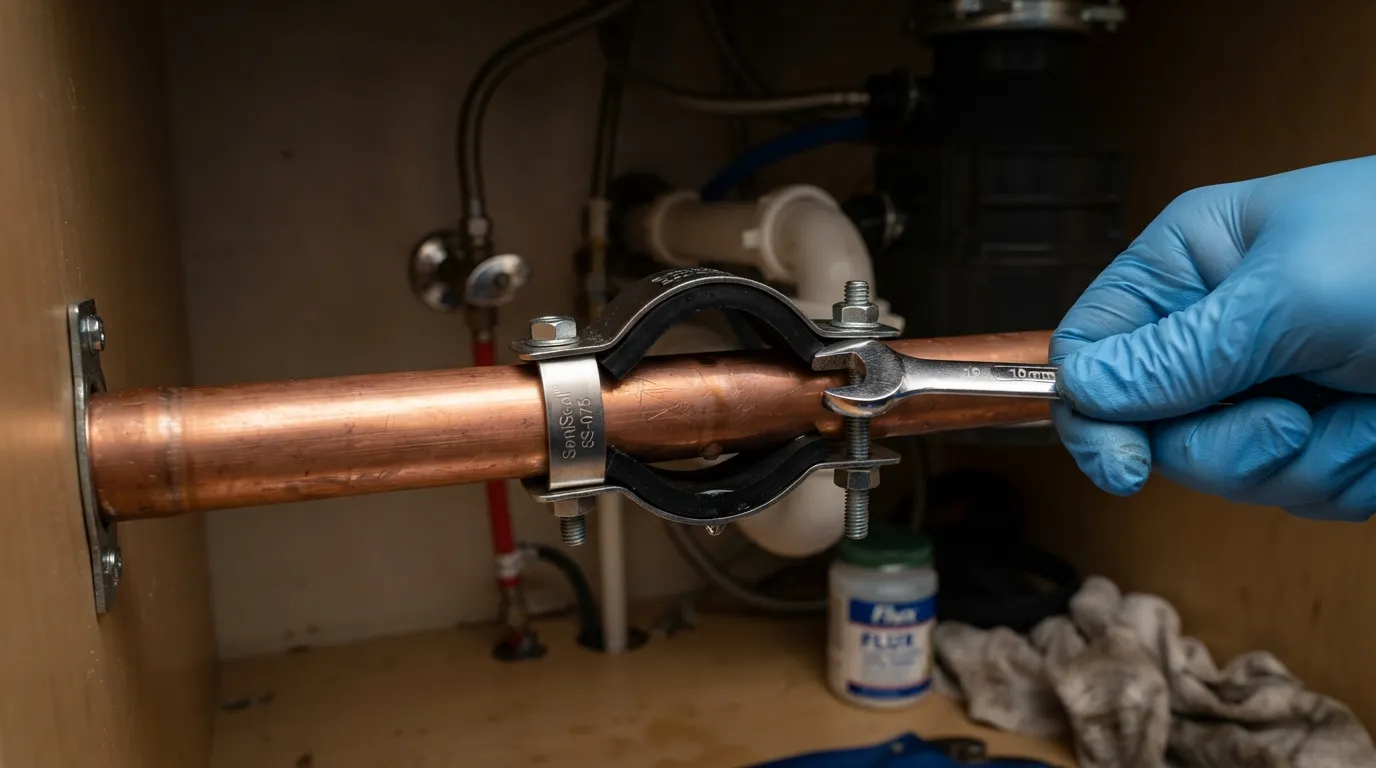
If you’ve just found water dripping from a small hole or crack in a copper pipe, you don’t need to panic — and in most cases, you don’t need to cut into your wall right away either. A copper pipe repair sleeve (also called a repair clamp) is one of the fastest ways to stop an active leak while you decide on a permanent fix. In this guide, I’ll walk you through exactly what a repair sleeve is, how to install one correctly, when it’s the wrong choice, and how to know if it’s time to call a licensed plumber instead.
A copper pipe repair sleeve is a metal band lined with a rubber gasket that clamps around a damaged section of pipe to seal a pinhole leak or crack. It’s a temporary, no-solder, no-shutoff-required fix — but it’s meant to buy you time, not replace a permanent repair.
What Is a Copper Pipe Repair Sleeve?
A repair sleeve (or repair clamp) is a stainless steel or metal band with a rubber gasket lining on the inside. When you wrap it around a leaking section of copper pipe and tighten the bolts, the rubber compresses against the pipe and seals off the leak. It’s designed for pressurized water supply lines — the pipes carrying water to your fixtures — not for drain or waste lines.
Repair Sleeve vs. Other Fixes: Which One Do You Actually Need?
Not every leak needs the same fix. Here’s how a repair sleeve compares to the other common options people ask about, including epoxy products like JB Weld and soldering a new coupling.
| Fix | Best For | Permanent? |
|---|---|---|
| Repair Sleeve / Clamp | Pinhole leaks, small cracks, emergency stop-gap | No — temporary |
| Epoxy Putty (e.g., JB Weld) | Very small dry-surface repairs, non-pressurized or low-pressure spots | Not recommended long-term on pressurized lines |
| Soldered Coupling / Patch | Replacing the damaged section entirely | Yes — permanent |
| Push-Fit / Compression Coupling | Quick permanent fix without a torch | Yes — permanent |
A quick note on epoxy: putty-style products can bond over a leak, but on a pipe that’s under constant water pressure, that bond is far less reliable than a mechanical clamp or a soldered joint. Most plumbers treat epoxy as a last-resort patch, not a real fix.
How to Choose the Right Size Sleeve
This is where a lot of DIY repairs go wrong before they even start. A repair sleeve has to match the outside diameter of your pipe, not just look “about right.”
- Common residential copper pipe sizes are ½ inch and ¾ inch (nominal), which measure larger on the outside — always measure the actual outer diameter, not the labeled size.
- Wrap a tape measure or use calipers around the pipe to get the exact outer diameter before buying a sleeve.
- Check the sleeve’s listed size range (for example, “33mm–36mm”) and make sure your pipe measurement falls comfortably inside that range, not right at the edge of it.
- If you’re between two sizes, size up rather than down — a slightly loose fit is safer than one that won’t close properly.
Step-by-Step: How to Install a Copper Pipe Repair Sleeve
- Shut off the water to that section if possible, even though many sleeves can be installed under light pressure — it makes the job easier and safer.
- Clean the pipe around the damaged area with an abrasive cloth or fine sandpaper. Dirt, corrosion, or paint under the gasket will stop it from sealing properly.
- Position the rubber gasket directly over the leak or crack, centering it as precisely as you can.
- Wrap the metal sleeve around the gasket and pipe, and start the bolts by hand to keep it aligned.
- Tighten the bolts evenly, alternating side to side rather than fully tightening one bolt at a time — this keeps even pressure around the pipe.
- Turn the water back on slowly and check closely around both edges of the sleeve for any dripping or seepage.
Common Mistake to Avoid
Don’t over-tighten the bolts. Copper is a soft metal, and cranking the clamp down too hard can dent or crush the pipe, which can turn a small pinhole leak into a much bigger crack. Tighten only until the dripping stops.
Can You Use a Repair Sleeve on a Sewer or Drain Pipe?
This is a common point of confusion, so it’s worth being direct about it: standard copper pipe repair sleeves are built for pressurized water supply lines, not sewer or drain pipes. Sewer lines are typically a different material (cast iron, PVC, or clay) and operate under different conditions — gravity flow rather than water pressure, and exposure to waste rather than clean water. If you’re dealing with a broken sewer or drain line, that’s a separate repair category and generally a job for a licensed plumber rather than a supply-line clamp.
Is a Repair Sleeve Permanent?
Even though some sleeves are marketed as long-lasting, most plumbers treat them strictly as a temporary, stop-the-bleeding solution rather than a final repair. The pipe underneath is still damaged — the clamp is just holding the leak back. The safest approach is to use the sleeve to stop water loss right away, then schedule a proper repair (soldered patch, coupling replacement, or full section replacement) as soon as you reasonably can.
DIY Repair Sleeve or Call a Plumber?
You can probably handle it yourself if:
- The leak is a small pinhole or hairline crack, not a split or burst section
- The pipe is easily accessible (not buried in a wall or slab)
- You’re comfortable measuring the pipe and installing a properly sized clamp
It’s time to call a plumber if:
- The pipe is inside a wall, ceiling, or slab and hard to reach
- There’s visible corrosion, multiple leak points, or a split pipe rather than a pinhole
- The sleeve stops the drip but the leak keeps coming back
- You’re dealing with a sewer, drain, or main water line rather than a small supply branch
Why Copper Pipes in Miami Develop These Leaks in the First Place
If you’re noticing pinhole leaks in copper pipe more than once, it’s not just bad luck. Miami’s combination of high humidity, hard water, and older cast-iron and copper plumbing in many homes creates conditions that speed up pipe corrosion from the inside and outside. Add in the seasonal pressure swings that come with hurricane season, and it’s common for a home with aging copper lines to develop several small leaks over just a few years rather than one isolated incident. A repair sleeve can handle each leak as it appears, but repeated pinhole leaks in different spots are usually a sign that the pipe itself is due for a broader inspection rather than one-off patches.
Watch: Installing a Pipe Repair Clamp
Key Takeaways
- A repair sleeve is a temporary clamp fix for pinhole leaks in copper supply lines — not a permanent repair, and not for sewer or drain pipes
- Always measure the pipe’s actual outer diameter before buying a sleeve, and avoid over-tightening the bolts
- Epoxy products can help in a pinch but are less reliable than a clamp or soldered fix on pressurized lines
- Repeated pinhole leaks, especially in Miami’s climate, often point to broader pipe corrosion worth having inspected
Frequently Asked Questions
What should you sleeve a copper pipe with?
A stainless steel or metal repair clamp with a rubber gasket lining, sized to match the pipe’s exact outer diameter.
Can you sleeve a copper water line?
Yes, repair sleeves are specifically designed for copper water supply lines with pinhole leaks or small cracks.
Can you sleeve a broken sewer pipe?
No, standard copper repair sleeves are made for pressurized supply lines, not sewer or drain pipes, which need a different repair approach.
How do you repair a leaking water pipe without replacing it?
A repair sleeve lets you seal a pinhole leak or crack without cutting into or replacing the pipe, though it’s meant as a temporary fix rather than a permanent one.
Should you sleeve a water line?
Sleeving is a reasonable choice for small, accessible leaks as an emergency measure, but a permanent repair should still follow.
How do you fix a leaking copper pipe without soldering?
A repair sleeve or a push-fit/compression coupling can both fix a leak without a torch, though a sleeve is temporary while a compression coupling is a permanent solution.
Will JB Weld work on a copper water line?
It can offer a short-term seal on very small spots, but epoxy is generally less reliable than a mechanical clamp on a pipe under constant water pressure.
What is a pipe sleeve in plumbing?
In this context, a pipe sleeve is a clamp-style band with a rubber gasket used to seal a leak from outside the pipe without cutting it.
How do you mend a broken water pipe?
For small leaks, a repair sleeve works as a fast fix. For a fully broken or split pipe, the damaged section usually needs to be cut out and replaced with a soldered or compression coupling — often a job better suited to a professional.
Not Comfortable Doing This Yourself?
A pinhole leak today can point to bigger corrosion issues underneath, especially in Miami’s climate. If the leak is hard to reach, keeps coming back, or you’d rather have it handled properly the first time, our licensed plumbers can take care of it for you.
Copper pipe leaks are one of the many issues we help homeowners across Miami with — from small pinhole repairs to full plumbing inspections. If you’re dealing with other plumbing concerns around the house, like an aging water heater, take a look at our water heater replacement guide, or browse our full plumbing services to see everything our team at Miami Florida Plumbing can help with.
Related Resources
If you’re ready to buy a repair sleeve, here are a few places that carry them: