If you’re looking for an outdoor on-demand propane water heater, you’re probably trying to solve one of two problems: you need reliable hot water without a large storage tank, or you want a propane-powered system that can be installed outdoors and provide hot water only when you need it.
The important part is choosing the right type and size. A small portable propane heater designed for an outdoor shower is very different from a permanent residential tankless water heater designed to serve several fixtures in a home.
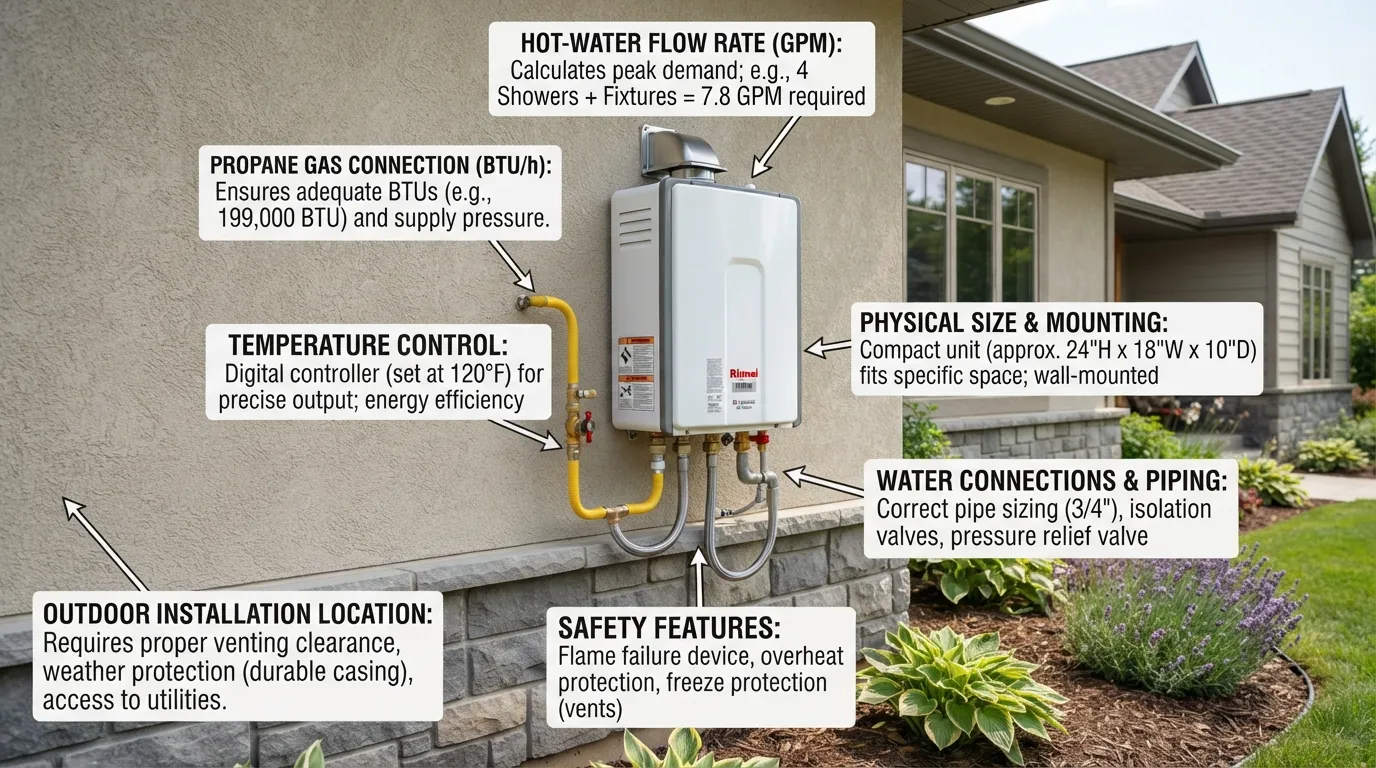
An outdoor on-demand propane water heater heats water as you use it instead of storing a large tank of hot water. For a permanent home installation, you should choose an outdoor-rated residential model based on your peak hot-water demand, required temperature rise, gas supply, installation location, and the manufacturer’s specifications—not simply the highest GPM number you can find.
In this guide, I’ll show you how to tell the difference between portable and whole-home units, understand GPM and BTU ratings, evaluate installation requirements, estimate the factors that affect cost, and decide whether an outdoor propane tankless system actually makes sense for your property.
What Is an Outdoor On-Demand Propane Water Heater?
An outdoor on-demand propane water heater is a tankless water-heating system that uses propane as its fuel and heats water as it flows through the unit. Unlike a conventional storage water heater, it does not continuously keep a large volume of water hot in a tank.
When a hot-water fixture calls for water, the heater detects flow and activates its heating system. Water passes through the heat exchanger, absorbs heat, and travels to the fixture.
That basic concept sounds simple, but the actual performance of a tankless system depends on several variables, including water flow, incoming water temperature, desired outlet temperature, heating capacity, water pressure, and the specifications of the particular model.
The key idea
“On-demand” does not mean the heater can produce unlimited hot water under every condition. It means the system heats incoming water continuously while the unit has enough heating capacity to satisfy the required flow and temperature rise.
Portable vs. Residential Outdoor Propane Tankless Water Heaters
This is one of the most important distinctions to make before you buy anything.
Search results for outdoor propane water heaters often mix portable camping-style products with permanently installed residential systems. They may look similar in product photos, but they can serve completely different purposes.
If you need hot water for one outdoor shower at a cabin, a portable unit may be perfectly reasonable. If you want to replace a home’s existing water heater, you should generally be looking at a properly sized residential system rather than choosing a camping-style heater because it has the same fuel type.
How Do You Choose the Right Size?
The biggest mistake I see people make when comparing tankless water heaters is looking at GPM alone.
GPM means gallons per minute. It tells you how much water flow a unit can handle under specified conditions. But it does not, by itself, tell you whether that heater will deliver the hot-water performance you expect in your home.
GPM: How Much Water Are You Using?
Start by considering which fixtures might operate at the same time.
- One shower
- Two showers
- A shower and bathroom faucet
- A shower and kitchen faucet
- Multiple showers plus other hot-water fixtures
Your peak demand is based on the combined flow you may need at the same time. The heater then needs enough heating capacity to raise the incoming water to your desired hot-water temperature at that flow.
BTU: How Much Heating Power Is Available?
BTU input is another important specification. In simple terms, it describes the fuel input available to the heater for producing heat.
That means you should not assume that a heater with a higher advertised GPM will automatically perform better for every application. Compare the manufacturer’s GPM performance with its BTU input, temperature-rise information, and installation requirements.
Temperature Rise Matters Too
Temperature rise is the difference between the temperature of the incoming water and the temperature you want the heater to deliver.
A simple way to think about sizing
Your required performance depends on water flow + incoming water temperature + desired outlet temperature + heater capacity.
This is why choosing a heater solely because its box says “high GPM” can lead to disappointment. Manufacturer sizing information should be checked for the actual conditions in your installation.
How Much GPM Do You Need?
There isn’t one GPM number that is automatically correct for every household.
If you’re supplying one fixture, your demand may be relatively modest. If multiple people can use showers and faucets simultaneously, the required flow can be substantially higher.
A useful way to approach the decision is to ask yourself:
- How many people live in the home?
- How many showers could operate at the same time?
- Could a shower run while someone uses another hot-water fixture?
- What is the flow rate of the fixtures?
- What does the heater’s manufacturer specify for the required temperature rise?
For example, current residential outdoor propane models vary considerably. Rheem lists an outdoor propane model with a maximum listed flow of 8.4 GPM, while Rinnai lists outdoor propane residential models at different maximum flow rates, including 5.3, 6.5 and 7.5 GPM depending on model. These figures are model specifications, not universal recommendations for every home. :contentReference[oaicite:0]{index=0}
Can an Outdoor Propane Tankless Water Heater Be Installed Outside?
Yes, but the heater must be specifically designed and listed for outdoor installation. “Outdoor” does not mean that any propane tankless water heater can simply be mounted on an exterior wall.
For example, manufacturers publish specific outdoor installation requirements covering the installation location, combustion/exhaust clearances and proximity to openings. Rinnai’s outdoor installation documentation provides clearance requirements around openings, grade, air inlets and other features. :contentReference[oaicite:1]{index=1}
Your exact requirements depend on the model, installation instructions, applicable fuel-gas and plumbing requirements, and local enforcement requirements.
Important: don’t guess the clearance
Do not copy a clearance number from another heater and assume it applies to yours. Check the installation manual for the exact model and confirm the applicable local requirements before choosing the mounting location.
Where Should an Outdoor Propane Water Heater Be Installed?
The mounting location deserves more attention than many buyers realize.
Before purchasing the heater, consider:
- Distance from windows and doors
- Nearby air intakes
- Required exhaust or terminal clearances
- Distance from combustible materials
- Accessibility for maintenance and service
- Protection from unsuitable environmental exposure
- Availability of water connections
- Availability and suitability of the propane supply
- Electrical requirements for the specific model
- Local code and installation requirements
Manufacturer installation guidance can also address water quality, corrosion exposure, electrical supply and the location of combustion air and exhaust termination. :contentReference[oaicite:2]{index=2}
In other words, don’t buy the heater first and figure out where it will go afterward. The installation location can influence which model is practical.
Does an Outdoor Propane Tankless Water Heater Need Venting?
This is a question that often causes confusion.
Some outdoor tankless gas water heaters are designed so that they do not require the same type of venting arrangement used by an indoor gas appliance. However, that does not mean the installation has no combustion-air, exhaust, clearance, or code requirements.
For example, outdoor manufacturer manuals specify where the exhaust terminal and air supply may be located relative to openings and other building features. :contentReference[oaicite:3]{index=3}
The correct approach is to select an outdoor-rated model and follow its exact installation instructions rather than assuming that all propane tankless heaters have identical requirements.
What Propane Connections Does the Heater Need?
A permanent propane tankless installation requires more than simply connecting a propane cylinder to the heater.
The fuel system must be suitable for the appliance and installed according to the manufacturer’s requirements and applicable code. Gas piping, sizing, regulators, shutoff components and available fuel capacity can all matter.
For example, Rheem identifies propane as the fuel for its outdoor propane model and notes that gas-line compatibility remains subject to local code. :contentReference[oaicite:4]{index=4}
That is why an existing propane setup should be evaluated before you purchase a high-output tankless water heater. The heater’s required fuel input needs to be compatible with the property’s gas system.
Is an Outdoor Propane Tankless Water Heater Safe?
A properly selected and installed outdoor propane tankless water heater can be a practical residential water-heating solution. But safety depends heavily on correct installation, fuel connections, clearances, combustion/exhaust requirements, maintenance and following the manufacturer’s instructions.
Important safety considerations
- Use a model approved for the intended outdoor application.
- Follow the manufacturer’s installation and clearance requirements.
- Have propane connections installed and checked appropriately.
- Keep required clearances around exhaust and air-intake areas.
- Do not block or modify required openings.
- Provide the electrical supply specified for the unit.
- Keep the heater accessible for inspection and service.
- Follow the manufacturer’s maintenance instructions.
Rinnai’s installation documentation, for example, calls for the installation to comply with local codes or applicable national fuel-gas standards and includes a location checklist addressing clearances, combustion/exhaust locations and water conditions. :contentReference[oaicite:5]{index=5}
Outdoor Propane Water Heater Installation in Miami, FL
If you’re installing one in Miami, don’t treat a generic internet installation diagram as the final authority.
Florida has a statewide building code, while local authorities handle code enforcement and permitting requirements. As of August 2026, the Florida Building Commission’s current code framework is still based on the 8th Edition (2023) Florida Building Code, while the 9th Edition (2026) update has an effective date of December 31, 2026. :contentReference[oaicite:6]{index=6}
Because requirements can change and local permitting can depend on the specific property and scope of work, verify the requirements that apply to your installation before work begins.
For a permanent system, the evaluation should consider the heater itself, existing water lines, propane supply, electrical requirements, mounting location, clearances, drainage where applicable, and access for future service.
If you need broader help with the plumbing side of the project, you can also explore our professional plumbing services.
How Much Does an Outdoor Propane Tankless Water Heater Cost?
The price can vary widely because there are really two different purchases: the equipment and the installation.
For an accurate project budget, consider these components:
- Water heater equipment
- Propane connection work
- Water-line modifications
- Electrical requirements
- Mounting and installation materials
- Removal of an existing water heater, if applicable
- Permits or inspections where required
- Additional work needed to bring an existing installation up to applicable requirements
Don’t compare the wrong prices
A portable outdoor shower heater and a permanently installed whole-home propane tankless system are not equivalent purchases. Comparing their online prices as if they were interchangeable can give you a very misleading idea of the actual project cost.
For a replacement project, the existing plumbing and fuel setup can also affect the final installation requirements. If you’re replacing an existing water heater, you can review our water heater replacement services to understand the next step.
Propane vs. Natural Gas vs. Electric Tankless Water Heaters
Propane isn’t automatically the best fuel for every property. Your existing utility setup and the type of installation you want can influence the decision.
The right choice depends on the property rather than on one fuel being universally better.
Advantages of an Outdoor On-Demand Propane Water Heater
- No large storage tank: Tankless systems heat water as needed rather than storing a large volume of hot water.
- Outdoor installation: An appropriately designed outdoor model can keep the appliance outside the living space.
- Continuous heating capability: The system can continue heating while there is demand, provided the unit can meet the required flow and temperature rise.
- Space flexibility: A wall-mounted tankless system can occupy less physical space than a traditional storage tank.
- Propane fuel option: Propane can make sense for properties where it is an appropriate and available fuel source.
Potential Drawbacks to Consider
- The initial installation can be more involved than simply replacing a storage tank with another storage tank.
- The propane supply and gas piping must be suitable for the appliance.
- Sizing is more important because the system must heat water at the required flow rate.
- Installation location and clearances matter.
- Tankless systems can require periodic maintenance depending on the model and water conditions.
- A high advertised GPM does not guarantee the performance you need at your actual temperature rise.
Maintenance: What Happens After Installation?
Buying the heater is only part of the ownership equation.
Follow the maintenance schedule provided by the manufacturer. Depending on the model and installation, maintenance can include checking the system, cleaning filters, addressing mineral buildup, inspecting connections, and performing manufacturer-recommended flushing or descaling procedures.
Water conditions can also affect maintenance requirements. Some manufacturers specifically include water quality and hardness considerations in their installation guidance because unsuitable water conditions can affect the heat exchanger. :contentReference[oaicite:7]{index=7}
If you notice unusual temperature changes, error codes, reduced performance, leaks, unusual noises, or other problems, don’t ignore them. Use the manufacturer’s troubleshooting guidance and seek qualified service when necessary.
Who Should Buy an Outdoor Propane Tankless Water Heater?
It may make sense if…
- You have an appropriate propane supply.
- You want a permanent outdoor installation.
- You need hot water without a large storage tank.
- Your household can benefit from properly sized tankless capacity.
- You are willing to have the system professionally evaluated and installed.
Think twice if…
- You are choosing only by the highest GPM number.
- You haven’t checked your propane capacity.
- You don’t know where the heater can legally and safely be mounted.
- You actually need a small portable heater rather than a whole-home system.
- You haven’t considered installation and modification costs.
A Simple Buyer Decision Guide
Start here
1. Is this for occasional outdoor use?
If yes, investigate portable propane water heaters designed for that application.
2. Is it replacing the home’s primary water heater?
If yes, focus on residential outdoor tankless models and proper sizing.
3. How many fixtures can run simultaneously?
Use peak demand to establish the required flow.
4. What temperature rise does the application require?
Compare the heater’s performance at the relevant conditions rather than relying only on the maximum GPM.
5. Is the propane system suitable?
Confirm the fuel supply and gas piping requirements.
6. Can the proposed location satisfy the manufacturer’s requirements?
Check clearances, openings, air/exhaust requirements, accessibility and local requirements.
Questions to Ask Before You Buy
- Is this heater designed for permanent outdoor residential installation?
- What is its maximum and usable GPM under the temperature-rise conditions I need?
- What is the BTU input?
- What propane pressure and gas-line requirements does the manufacturer specify?
- What electrical supply does the model require?
- What clearances are required around windows, doors, air intakes and other building features?
- What maintenance does the manufacturer recommend?
- Is the unit appropriate for my expected simultaneous hot-water demand?
- Will my existing plumbing and propane setup need modifications?
- What permits or inspections apply to my installation?
Frequently Asked Questions
What is the difference between an outdoor propane water heater and an outdoor propane tankless water heater?
An outdoor propane water heater can refer broadly to different types of propane-powered water-heating equipment. An outdoor propane tankless water heater specifically heats water on demand rather than storing a large volume in a tank.
Are outdoor propane tankless water heaters good for a whole house?
Some residential outdoor propane tankless models are designed for whole-home applications, but suitability depends on the unit’s capacity and your home’s peak hot-water demand. A portable outdoor heater should not automatically be treated as a whole-house replacement.
Can I use a portable propane water heater for my house?
Don’t assume that a portable camping or outdoor-shower heater is an appropriate substitute for a permanently installed residential water heater. Check the product’s intended use, listings, installation requirements and capacity before considering it for a home.
Is a higher GPM always better?
No. Higher maximum GPM does not automatically mean a heater is the right choice. You also need to consider temperature rise, BTU input, incoming water temperature, simultaneous demand and the manufacturer’s performance specifications.
Does an outdoor propane tankless water heater need electricity?
Many modern tankless gas water heaters use electrical components and therefore have specific electrical requirements. Check the exact model’s installation documentation rather than assuming that a propane appliance operates entirely without electricity.
Can I install an outdoor propane water heater anywhere outside?
No. The unit must be approved for outdoor installation, and the installation location must satisfy the manufacturer’s requirements and applicable codes. Clearances around openings, air inlets, exhaust terminals and other features can matter. :contentReference[oaicite:8]{index=8}
Is propane better than natural gas for a tankless water heater?
Neither fuel is universally better. The better option depends on your existing fuel availability, installation requirements, appliance options and the property’s needs.
How much does an outdoor propane tankless water heater cost?
The equipment price is only one part of the total project. The final cost can also include plumbing modifications, propane work, electrical requirements, installation materials, removal of an existing heater and permits or inspections where applicable. The equipment and installation should therefore be evaluated together.
Should I choose my heater before having the installation evaluated?
It is usually better to evaluate the application first. Your peak hot-water demand, propane setup, plumbing, electrical requirements and proposed mounting location can all influence which model is appropriate.
Watch: Outdoor Propane Tankless Water Heater Installation & Setup
Video can be useful for understanding how outdoor propane tankless systems are configured, but a video should not replace the installation manual or the requirements that apply to your property.
Final Takeaway: Choose the System, Not Just the Heater
An outdoor on-demand propane water heater can be an excellent option when the fuel source, installation location, household demand and equipment specifications all line up.
The smartest way to buy one is not to start with the question, “Which heater has the highest GPM?”
Start with:
- What will I use it for?
- Do I need portable or permanent residential equipment?
- What is my peak hot-water demand?
- What temperature rise do I need?
- Is my propane supply suitable?
- Where can the unit be installed safely?
- What does the manufacturer require?
- What installation and permitting requirements apply locally?
Once those questions are answered, comparing models becomes much easier—and you are far less likely to buy a heater that looks good on a product page but doesn’t fit your actual application.
Not Sure Which Propane Tankless Water Heater Fits Your Home?
Before you purchase a unit, it’s worth having the hot-water demand, existing plumbing, propane setup and proposed installation location evaluated. That can help you choose the right system instead of paying for the wrong size or discovering installation problems after the purchase.
Related Resources
If you’re comparing equipment before buying, manufacturer documentation is especially useful because installation requirements, clearances, performance ratings and maintenance instructions vary by model.
- Rheem outdoor propane tankless water heater specifications
- Rinnai outdoor propane tankless water heater specifications
- Rinnai outdoor tankless installation manual and clearance information
- Florida Building Commission code update information
Product specifications, installation requirements and local code requirements can change. Always verify the current manufacturer’s documentation and applicable local requirements for the specific water heater and property before installation.