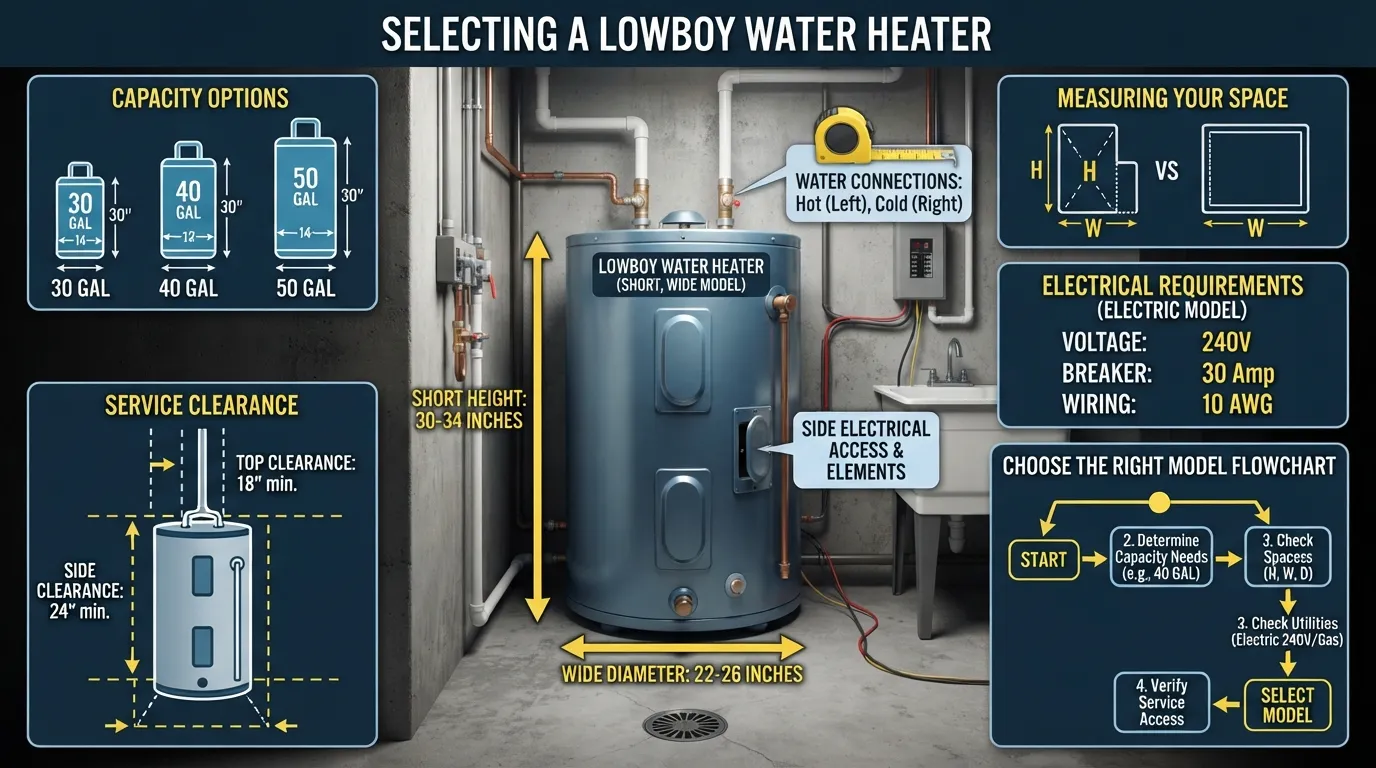
If you need hot water but do not have enough vertical space for a standard tall tank, a lowboy water heater may be the solution you are looking for. Its shorter, wider design is made for situations where height is limited, such as some utility closets, crawl spaces, mobile homes, condos, and other low-clearance areas.
But choosing one is not simply a matter of finding the shortest tank that will fit. You also need to consider the tank’s width, capacity, water-connection locations, electrical requirements, available service space, and the hot-water demand in your home.
A lowboy water heater is a short, wider storage-tank water heater designed for spaces where vertical clearance is restricted. Many residential lowboy models are electric and are available in different capacities, but the exact dimensions, connection layout, electrical requirements, and performance vary by model. If you are replacing an existing heater, measure the available space and check the new model’s specifications before buying.
In this guide, I will show you what a lowboy water heater is, how it compares with a standard tall heater, how to choose the right capacity, how to measure your space, what side connections mean, and what you should verify before a replacement or installation.
What Is a Lowboy Water Heater?
A lowboy water heater is a short and relatively wide storage-tank water heater. Instead of using more vertical space like a conventional tall tank, the lowboy design uses a wider footprint to keep the overall height lower.
That makes the design useful when the available height is the main limitation. Depending on the model and application, a lowboy may be considered for a low-ceiling utility area, crawl-space installation, closet, mobile home, condo, or another location where a taller tank would be difficult to install.
The important point is that “lowboy” describes the physical configuration. It does not by itself tell you the tank’s capacity, energy efficiency, electrical requirements, connection arrangement, or whether a particular model will fit your installation.
Why Choose a Lowboy Water Heater?
The biggest reason to choose a lowboy is usually simple: you do not have enough vertical clearance for a standard tank.
- Low ceilings can make a tall water heater impractical.
- A utility closet may have limited height.
- A crawl-space or other restricted installation area may favor a shorter tank.
- Some replacement projects may benefit from side water connections.
- A wider tank can provide the required storage capacity without requiring as much height.
Important: Do not choose a water heater based on height alone. A tank that fits vertically may still be too wide, have incompatible connection locations, lack the required service clearance, or have electrical requirements that do not match your installation.
Lowboy vs. Standard Tall Water Heater
The main difference is the shape and resulting space requirements. A standard tall water heater generally uses more vertical space and less floor width, while a lowboy uses less height and more horizontal space.
There is no universal “better” design. If you have plenty of vertical clearance but very little floor space, a tall heater may make more sense. If height is your limiting factor, a lowboy may be the better configuration.
How Much Space Does a Lowboy Water Heater Need?
This is where many buyers make a mistake. They measure only the height of the old tank and assume any lowboy will fit.
Lowboy dimensions vary by capacity and model, so you should always use the manufacturer’s specification sheet for the exact unit you are considering.
Measure These Five Things Before You Buy
- Available height: Measure from the floor or mounting surface to the lowest obstruction above the proposed tank.
- Available width: A lowboy is wider than a comparable tall configuration, so measure the full side-to-side space.
- Connection locations: Check where the hot and cold water connections are located on your existing system and where they are located on the replacement model.
- Electrical requirements: For an electric model, verify voltage, wattage, breaker requirements, wiring, and other model-specific requirements.
- Service and installation clearance: The tank must not merely fit physically. The installer also needs appropriate access to make connections, service components, and perform future maintenance.
The Lowboy Fit Test
Before ordering a model, ask:
- Does the height fit?
- Does the diameter or width fit?
- Can the water connections be made without awkward modifications?
- Does the electrical configuration match the installation?
- Is there enough access around the heater for installation and service?
- Does the selected model meet applicable local installation requirements?
What Size Lowboy Water Heater Do You Need?
Lowboy water heaters are available in different storage capacities, and the right capacity depends on more than the number of people living in your home.
Your decision should consider household size, peak hot-water demand, fixture usage, recovery performance, and available installation space.
30-, 40-, or 50-Gallon Lowboy?
Do not assume that a 50-gallon model is automatically better. If your space cannot accommodate its dimensions or your installation cannot support its requirements, a smaller model may be more appropriate. On the other hand, choosing a tank that is too small can leave you short of hot water during periods of high demand.
What Is a Lowboy Electric Hot Water Heater?
A lowboy electric hot water heater combines the short, wide lowboy configuration with electric tank heating. Many of the lowboy products appearing in the current search results are electric models.
The important thing to remember is that lowboy refers to the tank’s configuration, not a universal electrical specification. Different models can have different voltage, wattage, heating-element, wiring, and breaker requirements.
Before replacing an electric water heater, compare the existing installation with the exact specifications for the replacement model. If you are unsure whether your electrical service can support a particular heater, have the installation evaluated by a qualified professional.
What Are Side Water Connections?
Some lowboy water heaters use side water connections, which place the water connections on the side of the tank rather than relying on a connection arrangement that may require more vertical room.
This can be especially useful when height is restricted. Rheem, for example, markets lowboy models with side water connections specifically around installation flexibility in height-restricted applications.
Do not assume every lowboy has the same connection layout. Always check the exact product specification sheet. Connection position, size, electrical configuration, and other installation details can vary from one model to another.
Lowboy Water Heater Specifications You Should Understand
Product specification sheets can look complicated, especially if you are replacing a heater for the first time. Here are the specifications that matter most when comparing models.
Tank Capacity
This tells you how much water the storage tank can hold nominally. Compare capacity with your household’s hot-water demand rather than choosing the largest tank that will fit.
First-Hour Rating
The first-hour rating helps describe how much hot water a tank can deliver during a period of heavy demand, taking both stored hot water and the heater’s recovery capability into account. It can be more useful for comparing practical hot-water performance than looking at tank capacity alone.
Recovery Rate
Recovery tells you how quickly the heater can replace hot water after demand. A tank with a particular storage capacity can perform differently from another model with the same nominal capacity because heating performance and recovery characteristics may differ.
UEF
Uniform Energy Factor, or UEF, is an efficiency rating used for water heaters. When comparing models, look at the UEF together with capacity, performance, purchase cost, and the intended application rather than treating the highest number as the only deciding factor.
Height and Diameter
These are critical for a lowboy installation. A tank can have the right capacity and still be unsuitable because its diameter is too large for the available floor space.
Voltage and Wattage
For electric models, check the exact voltage and wattage requirements. Never assume that two tanks with the same capacity use the same electrical configuration.
How to Choose a Lowboy Water Heater: A Simple Decision Process
- Start with the space. Measure height, width, depth, and available access.
- Determine your hot-water demand. Consider household size, showers, baths, laundry, dishwasher use, and periods when several fixtures may operate close together.
- Choose a suitable capacity range. Compare 30-, 40-, and 50-gallon options based on actual demand and available space.
- Check the exact dimensions. Do not rely on the word “lowboy” alone.
- Check connection locations. Make sure the hot and cold water connections can be installed appropriately.
- Check electrical requirements. Confirm voltage, wattage, wiring, and other model-specific requirements for an electric unit.
- Compare performance. Review first-hour rating, recovery information, UEF, and other specifications relevant to your needs.
- Confirm installation requirements. Local code, access, safety requirements, and site conditions should be considered before installation.
The Best Lowboy Is the One That Fits More Than Your Space
A good choice needs to satisfy four things at the same time:
- Physical fit — the tank fits the available space.
- Hot-water fit — the capacity and recovery meet your demand.
- Connection fit — water and electrical connections work with the installation.
- Installation fit — the unit can be safely installed and serviced under applicable requirements.
Lowboy Water Heater Replacement: What Should You Check?
If you are replacing an existing water heater, you may be tempted to buy another tank with the same gallon capacity and assume it will be a direct replacement.
That is not always enough.
Before selecting the replacement, compare the old and new units for:
- Tank height
- Tank diameter
- Storage capacity
- Hot and cold water connection locations
- Connection sizes
- Electrical voltage and wattage
- Required access and service clearance
- Drain and relief-valve arrangement
- Applicable installation and safety requirements
If the new heater has different dimensions or connection locations, the project may require additional plumbing or electrical work. That is one reason a professional assessment can be valuable before purchasing the replacement unit.
If you are replacing an existing water heater in South Florida, you can also review our water heater replacement service for help with the replacement process.
How Much Does a Lowboy Water Heater Cost?
There is no single price that applies to every lowboy water heater. The total cost can vary significantly depending on the model, capacity, efficiency, electrical requirements, brand, availability, and installation conditions.
If you are comparing prices, do not compare the tank price alone. A lower-priced unit may not be the right choice if its dimensions, connections, capacity, or electrical requirements do not match your installation.
What Can Affect the Final Cost?
- Tank capacity
- Manufacturer and model
- Energy-efficiency specifications
- Electrical requirements
- Whether the existing connections line up
- Additional plumbing modifications
- Electrical modifications when required
- Installation access and site conditions
- Permitting or code-related requirements where applicable
Are A.O. Smith, Bradford White, and Rheem Lowboy Heaters Available?
Yes, major water-heater manufacturers have lowboy or short-tank products and related specifications, but the exact product lineup depends on the market, capacity, fuel type, and model.
The current search landscape includes products and information associated with A.O. Smith, Bradford White, Rheem, State Water Heaters, and other manufacturers. The important thing is not simply choosing the most recognizable brand. You should compare the specifications of the exact model that fits your application.
For example, manufacturer documentation can provide model-specific information about dimensions, capacity, connections, electrical configuration, and performance. That information is more useful for an installation decision than a generic statement that one brand is “best.”
Common Mistakes to Avoid When Buying a Lowboy Water Heater
- Measuring only height. Remember that lowboy tanks need more floor width.
- Choosing capacity based only on household size. Actual hot-water demand and recovery performance matter too.
- Assuming all 40- or 50-gallon tanks have the same dimensions. Always check the exact model.
- Ignoring connection placement. A physically compatible tank may still create installation problems if the connections do not line up.
- Ignoring electrical requirements. Electric models can have different voltage and wattage requirements.
- Buying based only on price. Compare the complete installation and performance requirements.
- Skipping professional evaluation when the installation is complicated. Especially when plumbing, electrical work, clearance, or code requirements are involved.
Is a Lowboy Water Heater Right for You?
A lowboy may be worth considering if:
- Your installation has limited vertical clearance.
- You have enough floor width for a wider tank.
- Your required storage capacity is available in a suitable lowboy configuration.
- The model’s water connections work for your installation.
- The electrical requirements are compatible with the existing system when choosing an electric model.
- The unit can be installed with appropriate access and clearance.
A lowboy may not be the right choice if your installation has very limited floor width, if the required capacity is not available in a suitable configuration, or if the selected model cannot be installed properly in the available space.
Frequently Asked Questions About Lowboy Water Heaters
What is a lowboy water heater?
A lowboy water heater is a shorter, wider storage-tank water heater designed for installations where vertical clearance is limited. Exact dimensions and specifications vary by model.
What is a lowboy hot water heater used for?
It is commonly considered for locations where a standard tall tank would not fit because of limited height. Examples can include some utility closets, crawl spaces, mobile homes, condos, and other restricted spaces, provided the specific model is suitable for the installation.
What sizes do lowboy water heaters come in?
The supplied search data includes 30-, 40-, and 50-gallon lowboy searches and products. Availability varies by manufacturer and model, so check the current product specifications for the capacity you need.
Are lowboy water heaters electric?
Many lowboy products appearing in residential search results are electric. However, “lowboy” describes the physical configuration rather than a universal fuel type. Always verify the exact model’s specifications.
How tall is a lowboy water heater?
Lowboy models are designed to be substantially shorter than many standard tall tanks, but there is no single height that applies to every lowboy. The exact height depends on the manufacturer, capacity, and model, so use the manufacturer’s specification sheet when measuring for installation.
Is a lowboy water heater better than a tall water heater?
Not automatically. A lowboy is better suited when vertical space is limited, while a tall model may be preferable when floor width is restricted and there is enough height. The right choice depends on your space, hot-water demand, connections, and installation requirements.
What does side connection mean on a lowboy water heater?
It means the water connections are positioned on the side of the tank. This can provide installation flexibility in height-restricted areas, but the exact connection arrangement must be checked on the specific model.
How do I know what size lowboy water heater I need?
Start with your household’s hot-water demand and then confirm which capacity fits your available space. Compare storage capacity with first-hour rating, recovery performance, dimensions, and the way your household actually uses hot water.
What should I measure before buying a lowboy water heater?
Measure available height, width, and depth, then check connection locations, electrical requirements, and service access. The manufacturer’s exact dimensions should be used for the final fit check.
Can a lowboy water heater replace a standard water heater?
A lowboy can potentially be used as a replacement when the selected model meets the home’s hot-water needs and the installation can accommodate its dimensions, connections, electrical requirements, and applicable installation requirements. A replacement is not automatically a direct swap simply because the gallon capacity is the same.
Final Takeaway
A lowboy water heater can be an excellent solution when you need storage-tank hot water but do not have enough vertical space for a standard tall heater.
The smartest way to choose one is not to start with the brand or the price. Start with the space and the demand: measure the installation area, determine how much hot water your household needs, compare the exact dimensions and connection layout, verify electrical requirements for electric models, and then compare performance and cost.
If you are unsure which configuration will work in your home, getting the installation evaluated before ordering the tank can help you avoid buying a model that technically fits the height but creates problems with width, connections, access, or installation.
Need Help With a Water Heater Project?
If you are replacing a water heater or need help determining which configuration makes sense for your installation, you can explore our plumbing services or learn more about water heater replacement.
For assistance with your water-heater project, schedule a professional plumbing consultation.
Related Manufacturer & Product Resources
Because lowboy dimensions, electrical requirements, connection layouts, capacity, and performance vary by model, it is worth checking the manufacturer’s documentation before making a final purchase decision.
- Bradford White Lowboy Electric Water Heaters
- Rheem Electric Short Lowboy With Side Water Connections
- Rheem Lowboy With Side Water Connections: Installation Flexibility
- A.O. Smith Electric Water Heater Product Information
- American Standard Low Boy Side-Connect Water Heater
- Home Depot Lowboy Water Heater Products
Helpful Resources
Visual demonstrations can be useful when you are trying to understand lowboy water-heater configurations and installation considerations. Always use the exact manufacturer’s documentation for the final specifications of the model you intend to install.