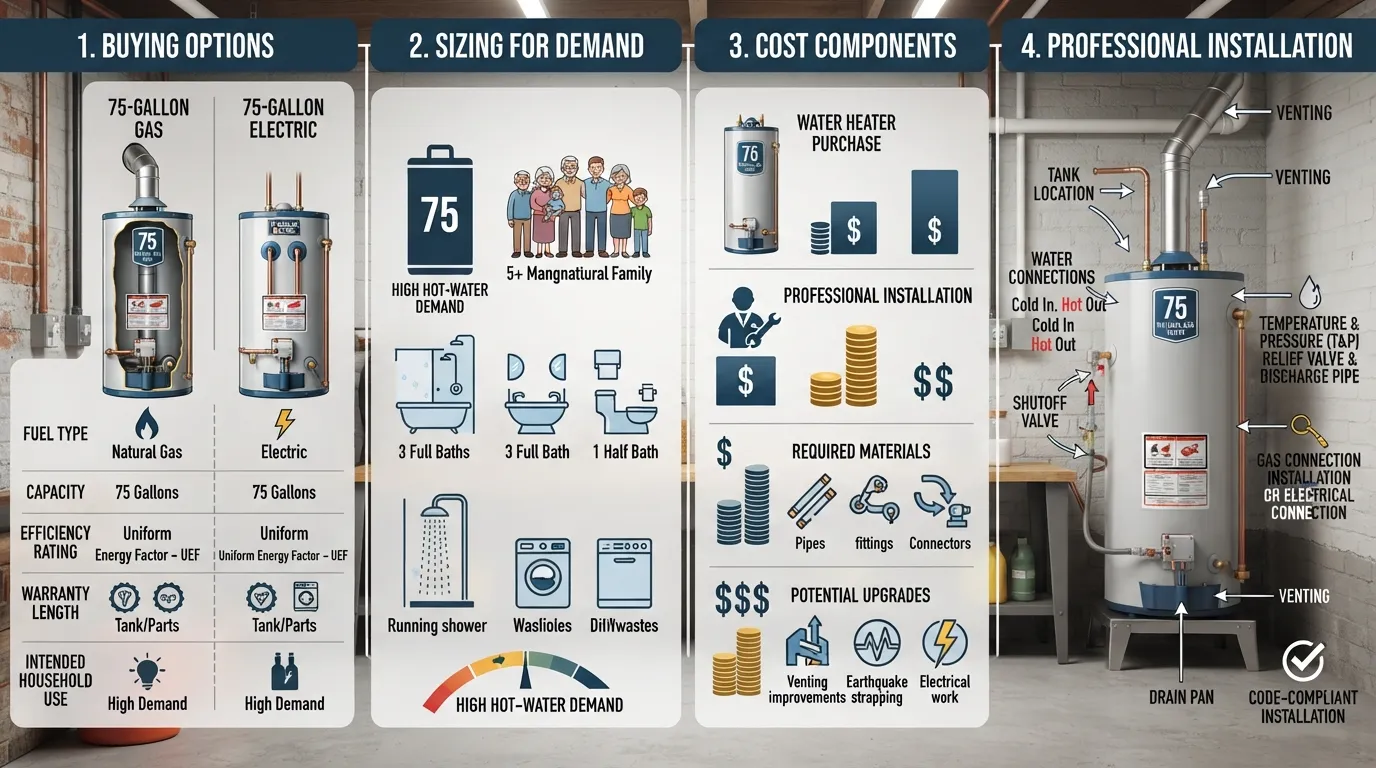
If you are shopping for a 75 gallon water heater, you probably have one main question: Do I really need a tank this large, and which type is right for my home?
A 75-gallon water heater can be a good choice for a home with high hot-water demand, multiple bathrooms, or several people using hot water during the same part of the day. But tank size alone does not tell you how much hot water a unit can actually deliver. Fuel type, burner input, first-hour rating, recovery rate, installation requirements, and your household’s peak demand all matter.
A 75-gallon water heater is designed for homes with higher hot-water demand, but you should not choose one based on tank capacity alone. Compare your peak-hour demand with the heater’s First Hour Rating (FHR) and consider recovery rate, fuel type, available space, venting, installation requirements, and operating costs before buying.
In this guide, I’ll walk you through how a 75-gallon water heater works, who typically needs one, how to compare gas and electric options, what specifications actually matter, what affects the total cost, and what to check before replacing or installing one.
What Is a 75 Gallon Water Heater?
A 75-gallon water heater is a large-capacity storage tank designed to hold and heat a substantial volume of water for household use. The tank stores hot water so it is available when you open a shower, faucet, bathtub, dishwasher, or washing machine.
You may also see the same size described as a 75-gallon hot water heater, 75-gal water heater, or 75 gal water heater. The terminology can vary between manufacturers and retailers.
One important detail is that the advertised tank size should not be confused with the amount of hot water the heater can deliver during a busy period. A gas unit can heat incoming water while hot water is being used, which is why its First Hour Rating can be considerably higher than the tank’s nominal capacity.
Do You Really Need a 75 Gallon Water Heater?
The best way to answer this is to look at your household’s peak hot-water demand, not simply the number of people living in the house.
A 75-Gallon Tank May Make Sense If You Have:
- Several people using hot water during the same time period.
- Multiple bathrooms with frequent simultaneous use.
- Long or back-to-back showers.
- A large bathtub or soaking tub that requires substantial hot water.
- Frequent dishwasher and washing-machine use during peak periods.
- An existing water heater that regularly runs out of hot water.
- A household with consistently high hot-water demand.
But bigger is not automatically better. If your household does not need the additional capacity, a 75-gallon tank may take up more space and cost more than necessary. Depending on your home, a properly sized 50-gallon tank, a high-recovery unit, or a tankless system could be worth considering.
75 Gallons Does Not Mean 75 Gallons of Hot Water Per Hour
This is one of the most important things to understand before buying a large water heater.
A storage tank’s capacity tells you approximately how much water it can hold. It does not tell you how much usable hot water the system can provide during your busiest hour.
What Is First Hour Rating?
First Hour Rating (FHR) estimates how much hot water a storage water heater can supply during its busiest hour, beginning with a fully heated tank and accounting for the heater’s ability to recover as hot water is used.
That is why a 75-gallon gas water heater can have a First Hour Rating well above 75 gallons. For example, published specifications for certain A. O. Smith 75-gallon gas models list a First Hour Rating of 125 gallons. Specifications vary by model, so always check the manufacturer’s data for the exact unit you are considering.
What Is Recovery Rate?
The recovery rate describes how quickly a water heater can heat incoming water after hot water has been used. Gas models with high BTU input can have strong recovery performance, while electric models work differently and must be evaluated according to their heating elements, electrical capacity, and other specifications.
Buying Tip
Don’t compare 75-gallon water heaters by tank capacity alone. Look at FHR, recovery rate, BTU input, efficiency, fuel type, and your actual peak demand.
75 Gallon Gas Water Heater Options
When people search for a 75 gallon gas water heater or 75 gallon natural gas water heater, they are usually looking for a high-capacity tank with enough recovery performance for heavy household use.
Gas storage water heaters can use natural gas or liquid propane (LP), depending on the model and the home’s fuel supply. Some models use atmospheric venting, while others use power-vent configurations.
Why Gas Can Be Attractive for High Demand
- High-capacity gas models can have substantial burner input.
- Higher BTU input can contribute to strong recovery performance.
- Gas may be a practical choice for homes that already have suitable gas service and venting.
- Some large gas models offer high First Hour Ratings.
However, gas installation can require proper venting, gas connections, combustion-air considerations, and compliance with applicable local requirements. A replacement is not always a simple matter of disconnecting one tank and connecting another.
75 Gallon Natural Gas vs. Propane Water Heaters
If your home uses gas, determine whether you have natural gas or LP/propane service before selecting a model. Natural-gas and propane water heaters are not automatically interchangeable.
The fuel type affects the appliance configuration, gas supply requirements, burner setup, and installation. Always select a model specifically approved for the fuel available at your property.
75 Gallon Gas vs. Electric Water Heater
A 75-gallon electric water heater is another option, and it should not be dismissed simply because many large-capacity search results are gas models.
The right choice depends on your home’s existing utilities, energy costs, available space, installation requirements, and hot-water demand. There is no single fuel type that is automatically best for every household.
75 Gallon vs. 50 Gallon Water Heater
If you are replacing a 50-gallon unit, don’t assume that upgrading to 75 gallons is necessary. Compare your current system’s performance with your actual demand first.
The key is not to choose the largest tank available. Choose the system that can reliably meet your household’s peak demand without creating unnecessary installation and operating costs.
75 Gallon Water Heater Specifications You Should Compare
When comparing models, product names and tank capacity are only the starting point. These specifications can tell you much more about how a particular unit will perform.
1. First Hour Rating
FHR is one of the most useful specifications for sizing a storage water heater because it considers both stored hot water and recovery during the first hour of heavy use.
2. BTU Input
For gas models, BTU input indicates the burner input rate. Higher input can contribute to faster recovery, but it should always be considered together with the complete appliance specifications and installation requirements.
3. Recovery Rate
Recovery tells you how quickly the heater can restore hot-water availability after demand begins to deplete the tank.
4. UEF and Efficiency
The Uniform Energy Factor (UEF) is an efficiency metric used for comparing qualifying water-heating products. A higher UEF generally indicates greater efficiency within the applicable product category, but you should also consider fuel prices, usage, and the specific operating conditions of your home.
5. Warranty
Check both tank and parts warranty terms. Warranty length can vary significantly by model, and warranty conditions may depend on installation and maintenance requirements.
6. Dimensions and Weight
A large water heater needs more than enough room for the tank itself. You also need to think about service clearance, connections, venting, access, and the route used to bring the tank into the building.
Example: What Can a 75-Gallon Gas Model Actually Deliver?
Published manufacturer specifications show why looking beyond tank capacity matters. One A. O. Smith 75-gallon gas model lists a nominal capacity of 74 gallons, rated storage of 71 gallons, 75,100 BTU input, and a 125-gallon First Hour Rating.
Another A. O. Smith ProLine 75-gallon gas model lists a 125-gallon First Hour Rating and an 81-gallon-per-hour recovery rate, along with model-specific efficiency and warranty specifications.
Why This Matters
Two water heaters can both be marketed as “75 gallon” units while having different BTU inputs, FHRs, recovery rates, efficiency ratings, dimensions, venting requirements, and warranties. Always compare the specifications of the exact model—not just the tank size.
How Much Does a 75 Gallon Water Heater Cost?
The cost of a 75-gallon water heater depends heavily on the model, fuel type, venting configuration, efficiency, warranty, and installation conditions. There is no single price that applies to every home.
When budgeting, separate the total project into two major categories:
- Equipment cost: the water heater itself.
- Installation cost: labor, removal, connections, venting changes, permits where required, code-related work, and other site-specific requirements.
What Can Increase Installation Cost?
- Changing from one fuel type to another.
- Modifying gas lines or electrical service.
- Changing or repairing venting.
- Relocating the water heater.
- Limited access to the installation area.
- Additional plumbing modifications.
- Permit or code requirements.
- Removal and disposal of the old tank.
- Required safety or code upgrades.
Because installation conditions vary, a professional assessment is the safest way to get an accurate replacement estimate for your particular home.
Will a 75 Gallon Water Heater Fit in Your Home?
Before ordering a large tank, measure more than the existing water heater’s footprint.
Check These Five Things
- Tank dimensions: confirm height and diameter for the exact model.
- Service clearance: make sure technicians can access the unit for inspection and repair.
- Doorways and access: verify the tank can physically reach the installation location.
- Connections: check the location of water, gas, electrical, drain, and vent connections.
- Installation requirements: verify applicable manufacturer and local requirements before installation.
Large tanks can also be very heavy. The installation team needs to consider both the empty unit and the weight of the filled tank, along with the condition of the floor and installation area.
75 Gallon Water Heater Installation Requirements
Installation requirements vary by heater type and location, but a professional installation commonly involves checking the water connections, shutoff, temperature-and-pressure relief protection, drainage, fuel or electrical connections, venting where applicable, and required clearances.
For gas equipment, the venting and combustion system must be appropriate for the specific appliance. You should never assume that an existing vent automatically meets the requirements of a replacement model.
Local building and plumbing requirements can also affect the installation. If you are replacing an older heater with a different model, have the installation evaluated rather than relying only on the dimensions of the old unit.
75 Gallon Tank vs. Tankless Water Heater
A tankless water heater is another option for homeowners with high hot-water demand. Instead of storing a large volume of heated water, a tankless system heats water as it flows through the heat exchanger.
A tankless system is not automatically a better replacement for every 75-gallon tank. The correct choice depends on your home’s demand, available utilities, installation conditions, budget, and long-term goals.
How Long Does a 75 Gallon Water Heater Last?
There is no single lifespan that applies to every 75-gallon water heater. Service life depends on the model, water conditions, installation, usage, maintenance, and the condition of components such as the tank and anode rod.
Instead of waiting for a major failure, watch for warning signs such as:
- Water leaking around the tank.
- Rust or corrosion.
- Repeated loss of hot water.
- Unusual noises from the tank.
- Discolored hot water.
- Inconsistent water temperature.
- Visible deterioration around connections or valves.
- A noticeable increase in operating problems.
75 Gallon Water Heater Maintenance
Maintenance requirements vary by model and manufacturer. Follow the maintenance instructions supplied with your specific heater rather than applying a one-size-fits-all schedule.
Depending on the system, maintenance may involve checking the tank and connections, inspecting the anode rod, addressing sediment, checking safety components, and inspecting gas burners or venting on applicable gas models.
Safety First
Gas connections, combustion equipment, venting, electrical work, and pressure-relief components should be handled according to the manufacturer’s instructions and applicable local requirements. If you are unsure about a water-heater installation or safety component, have it inspected by a qualified professional.
How to Choose the Right 75 Gallon Water Heater
If you have decided that a 75-gallon system may be appropriate, use this process before buying.
- Estimate your peak-hour demand. Look at the busiest period of the day, not your average daily use.
- Compare First Hour Ratings. Choose a unit whose FHR is appropriate for your demand.
- Choose the fuel type. Consider natural gas, LP, or electricity based on your existing utilities and installation conditions.
- Compare recovery performance. Don’t rely on tank capacity alone.
- Check dimensions. Confirm the unit can fit through the access route and in the installation location.
- Review venting and connection requirements. This is particularly important when replacing a gas heater.
- Compare warranty and efficiency. Look at the exact manufacturer’s specifications.
- Calculate the complete project cost. Include equipment, removal, installation, permits where applicable, and any required modifications.
- Confirm local requirements. Make sure the selected model and installation comply with applicable codes and manufacturer instructions.
75 Gallon Water Heater Buying Checklist
- ☐ Confirm that 75 gallons is appropriate for your household demand.
- ☐ Compare First Hour Rating.
- ☐ Check recovery rate.
- ☐ Check BTU input for gas models.
- ☐ Confirm natural gas vs. LP compatibility.
- ☐ Compare gas and electric options where appropriate.
- ☐ Check UEF and other efficiency specifications.
- ☐ Check warranty terms.
- ☐ Measure the available space.
- ☐ Confirm access for delivery and installation.
- ☐ Check venting requirements for gas models.
- ☐ Ask about code and permit requirements.
- ☐ Get a complete installation estimate rather than comparing tank prices alone.
75 Gallon Water Heater FAQs
How many people can a 75 gallon water heater serve?
There is no universal household-size limit. The correct size depends on how much hot water your household uses during its busiest period, the heater’s First Hour Rating, recovery performance, and the type of fixtures being used simultaneously.
Is a 75 gallon water heater enough for a large family?
It may be, but household size alone is not enough to determine the answer. Compare peak-hour demand with the heater’s First Hour Rating and consider simultaneous showers, tubs, laundry, and dishwasher use.
What is the best 75 gallon water heater?
There is no single best model for every home. The right choice depends on fuel type, FHR, recovery rate, efficiency, dimensions, warranty, installation requirements, and your home’s demand.
How much does a 75 gallon gas water heater cost?
The price varies by model and installation conditions. Equipment cost and installation cost should be considered separately because venting, gas connections, permits, accessibility, removal, and other site-specific work can change the final project price.
What is the difference between a 75 gallon water heater and a 75 gallon gas water heater?
“75 gallon water heater” describes the capacity category, while “75 gallon gas water heater” specifies a gas-powered model. A 75-gallon unit can also be electric, depending on the available products and configuration.
Is a 75 gallon water heater better than a 50 gallon model?
Not automatically. A 75-gallon model can provide more storage capacity, but the correct choice depends on peak demand, FHR, recovery performance, space, installation requirements, and cost.
What should I look at besides gallons?
Start with First Hour Rating and recovery rate. Then compare BTU input for gas units, efficiency, fuel type, dimensions, venting, warranty, and installation requirements.
Can I replace my existing 50 gallon heater with a 75 gallon heater?
Possibly, but the larger tank must fit the available space and meet the home’s plumbing, fuel, venting, electrical, drainage, and applicable code requirements. A professional assessment is recommended before ordering the replacement.
Should I choose a 75 gallon tank or a tankless water heater?
That depends on your demand, utilities, installation conditions, budget, and preferences. A tankless system can provide continuous-flow heating within its capacity, while a 75-gallon tank stores a large volume of hot water and uses recovery to replenish it.
When a 75 Gallon Water Heater Replacement Makes Sense
If your current water heater is repeatedly running out of hot water, leaking, showing corrosion, or becoming unreliable, replacement may be more practical than continued repairs. However, the replacement should be sized around your actual demand rather than simply matching the old tank.
If you are in Miami and want help determining whether a 75-gallon system is appropriate, you can learn more about water heater replacement options and have the existing installation evaluated before choosing a replacement.
Why Professional Sizing Matters
A water heater is part of your home’s plumbing system, not just a product sitting on the floor. The right replacement needs to work with your available utilities, installation space, connections, venting where applicable, and household demand.
A professional can also help you determine whether you actually need 75 gallons or whether another configuration would meet your demand more efficiently.
Need Help Choosing the Right Water Heater?
Before you buy a 75-gallon unit, let a plumbing professional evaluate your existing system, hot-water demand, available space, and installation requirements.
Related Plumbing Resources
If your water-heater project is part of a larger plumbing issue, you can also explore our plumbing services for related residential plumbing needs.
Helpful Manufacturer & Product Resources
If you are comparing specific 75-gallon water heaters, manufacturer and retailer product pages can be useful for checking current model specifications, availability, warranty information, and published product details. Always verify the exact model before making a purchase because specifications and availability can change.
- A. O. Smith 75-Gallon Gas Water Heater Product Information
- A. O. Smith ProLine High-Capacity Water Heater Specifications
- Home Depot 75-Gallon Water Heater Listings
- Bradford White 75-Gallon High-Input Water Heater Information
Final Takeaway: Choose Performance, Not Just Tank Size
A 75 gallon water heater can be an excellent solution when your home has substantial hot-water demand, but the number “75” should not be the only factor driving your decision.
Start with your busiest hour of hot-water use. Compare that demand with the heater’s First Hour Rating. Then evaluate recovery rate, gas versus electric operation, BTU input, efficiency, dimensions, warranty, venting, installation requirements, and total project cost.
If you are replacing an existing system, don’t automatically assume that another tank of the same size—or a larger one—is the right answer. The best water heater is the one that reliably meets your home’s real demand while fitting the space, utilities, installation requirements, and budget.
Don’t buy a 75-gallon water heater simply because you think “bigger is better.” Choose based on peak demand + First Hour Rating + recovery + fuel type + installation requirements. That approach gives you a much better chance of getting the hot-water performance your home actually needs.