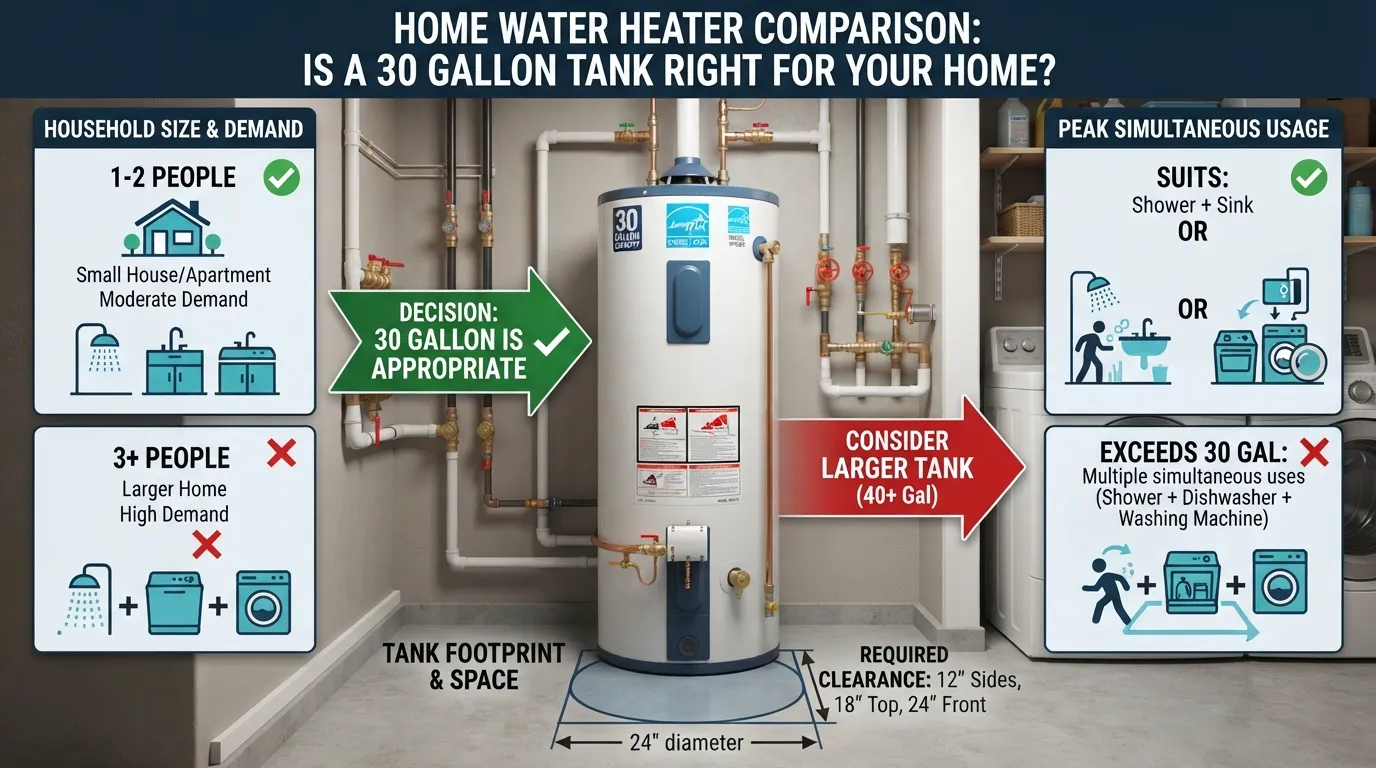
If you are looking for a 30 gallon water heater, the most important question is not simply which model has the lowest price. The better question is whether 30 gallons is actually the right capacity for your household, fuel type, available space, and hot-water demand.
A 30-gallon tank water heater can be a practical choice for a smaller household, but the tank’s labeled capacity is only part of the story. Configuration, first-hour rating, recovery performance, dimensions, energy source, and installation requirements can all affect whether a particular unit works well for you.
A 30 gallon water heater can make sense for a small household or a home with relatively moderate hot-water demand. But you should not choose one based on capacity alone. Before buying or replacing one, check the household’s peak demand, the heater’s first-hour rating, fuel type, physical dimensions, electrical or gas requirements, warranty, and installation conditions.
If your existing heater needs replacement, it is also important to remember that a new 30-gallon model does not necessarily have the same dimensions or performance as your old one. Two heaters with the same nominal capacity can have different heights, diameters, connection locations, energy ratings, and first-hour ratings.
What Is a 30 Gallon Water Heater?
A 30 gallon water heater is a storage-tank water heater designed around a nominal 30-gallon capacity. It stores heated water so hot water is available when you open a faucet, start a shower, or use another hot-water fixture.
You may also see the same product category described as a 30 gal water heater, 30 gallon hot water heater, 30 gallon hot water tank, or 30 gallon tank water heater.
Those phrases generally refer to the same basic capacity category, but they do not tell you everything about the actual product. A 30-gallon unit can be electric, gas-fired, or available in certain dual-fuel configurations, and it can be built in different physical configurations such as short or tall models.
Is a 30 Gallon Water Heater Enough for You?
This is the question I would answer before comparing brands or prices.
Household size is useful, but it should not be the only sizing factor. Your actual hot-water demand depends on how many people use hot water, when they use it, how long showers last, how many fixtures operate at the same time, and how quickly the heater can recover after hot water is used.
Use This Rule as a Starting Point
A 30-gallon heater may be a reasonable starting point for a smaller household with moderate hot-water use. If several people take long showers close together or multiple hot-water appliances run at the same time, a larger capacity or a different water-heating solution may be worth considering.
Who May Be a Good Fit for 30 Gallons?
- A smaller household with moderate hot-water demand.
- A home where hot-water use is spread throughout the day.
- An installation where a compact tank configuration is useful.
- A replacement situation where the existing system and household demand are already well matched to this capacity.
Who May Need More Than 30 Gallons?
- A larger household with high simultaneous hot-water demand.
- Homes where several people regularly take back-to-back long showers.
- Homes with frequent simultaneous use of showers, tubs, dishwashers, or washing machines.
- Situations where the existing 30-gallon heater regularly runs out of hot water.
If your current 30-gallon heater is constantly running out of hot water, simply buying another 30-gallon unit may not solve the underlying problem. The better approach is to evaluate demand and the heater’s performance specifications before choosing the replacement.
30 Gallons Does Not Automatically Mean 30 Gallons of Usable Hot Water
One of the most important details people miss when shopping for a water heater is the difference between nominal tank capacity and first-hour rating.
The nominal capacity describes the storage category of the tank. The first-hour rating describes how much hot water the heater can deliver during the first hour under the manufacturer’s test conditions, taking both stored hot water and the heater’s ability to recover into account.
That means two 30-gallon electric water heaters can have different hot-water delivery performance even though both are labeled “30 gallon.”
What Should You Compare?
- Nominal capacity: the tank’s labeled gallon size.
- First-hour rating: a useful indicator of how much hot water the unit can deliver during a high-demand period.
- Recovery performance: how effectively the heater replaces hot water after demand occurs.
- Energy efficiency: look at the manufacturer’s current energy rating and specifications.
For example, current A. O. Smith 30-gallon electric models demonstrate why capacity alone is not enough. One short model lists a 30-gallon nominal capacity and a 47-gallon first-hour rating, while a tall model lists a 48-gallon first-hour rating. The exact specifications vary by model, so always check the manufacturer’s current documentation for the unit you are considering.
30 Gallon Electric Water Heater vs. Gas vs. Dual-Fuel
A 30-gallon water heater is not limited to one fuel type. The right option depends on what your home already supports, the installation requirements, operating considerations, and the performance you need.
Do not assume that an electric, gas, and dual-fuel 30-gallon heater are interchangeable just because they share the same nominal capacity. Installation requirements can be very different.
30 Gallon Short Electric Water Heater vs. Tall vs. Lowboy
If space is one of your biggest concerns, look beyond the gallon rating.
Manufacturers can offer the same nominal tank capacity in different height and footprint configurations. A 30 gallon short electric water heater may fit an installation where a taller tank does not, while a tall model may use the available vertical space differently.
30 Gallon Short Water Heater
A short configuration can be useful where vertical clearance is limited. However, do not choose a short model simply because it says “30 gallon.” Confirm its actual height, diameter, connection locations, and other installation dimensions.
30 Gallon Tall Water Heater
A tall model uses more vertical space and may have a different footprint and connection arrangement. It can be the right choice when the installation area provides adequate height and the model’s specifications match your existing setup.
30 Gallon Lowboy Water Heater
“Lowboy” is generally used for a shorter, broader tank configuration designed for installations where height is restricted. Exact dimensions vary by manufacturer and model, so treat “lowboy” as a configuration description rather than a universal size specification.
Important Before Replacement
Never assume that a new 30-gallon tank will physically fit just because your old tank was also 30 gallons. Measure the available space and compare the current manufacturer’s dimensions, connection locations, access requirements, and installation specifications.
What Specifications Matter on a 30 Gallon Electric Water Heater?
When you compare a 30 gallon electric hot water heater, the product specification sheet is often more useful than the marketing headline.
1. First-Hour Rating
This is one of the most useful numbers for comparing hot-water delivery. A higher first-hour rating can indicate greater delivery capability under the manufacturer’s test conditions, but you should still compare the rating with your actual household demand.
2. Heating Element Wattage
Electric models may use one or more heating elements. Current A. O. Smith 30-gallon examples use dual 4,500-watt elements, but the exact design varies by model. Do not assume every 30-gallon electric water heater has the same electrical requirements.
3. Voltage and Electrical Requirements
Check the model’s required voltage, maximum wattage, breaker and wiring requirements, and the condition of the home’s existing electrical service. Installation should follow the manufacturer’s instructions and applicable local requirements.
4. Energy Rating
Look at the manufacturer’s current energy-efficiency specification rather than choosing based on the words “energy efficient” alone. The energy rating allows you to make a more meaningful comparison between compatible models.
5. Tank Protection
Tank construction and corrosion-protection features can include glass or enamel linings, anode rods, insulation, heat traps, and sediment-control features. The exact features depend on the manufacturer and model.
6. Warranty
Compare the actual warranty terms rather than using warranty length as the only buying criterion. Check whether the warranty covers the tank, parts, labor, and which conditions or exclusions apply.
7. Dimensions and Connection Locations
Height, diameter, depth, water-connection location, drain arrangement, T&P relief-valve location, and access space can all matter during installation or replacement.
30 Gallon Water Heater Cost: What Should You Actually Compare?
If you are searching for 30 gallon electric water heater price, 30 gallon water heater cost, or the cheapest 30 gallon electric water heater, it is tempting to compare only the purchase price.
That can be misleading.
Your total cost can include:
- The water heater itself.
- Installation labor.
- Required electrical or gas work.
- Changes needed to connections or venting, where applicable.
- Required safety components or installation materials.
- Removal and disposal of the old unit.
- Future maintenance or repairs.
- Energy costs over the life of the heater.
Cheapest Is Not Always Best Value
A lower purchase price does not automatically mean a lower overall cost. Compare the heater’s specifications, installation requirements, warranty, expected operating needs, and suitability for your household before deciding.
Prices also vary significantly by market, model, availability, installation conditions, and time. Because of that, I would not rely on a generic “30 gallon water heater price” without identifying the exact model and installation situation first.
How to Choose a 30 Gallon Water Heater: A Practical Decision Process
If I were helping you narrow down a 30-gallon water heater, I would work through these questions in order.
- How much hot water does your household actually use? Consider peak demand, not just the number of people living in the home.
- Is 30 gallons enough? Compare your demand with the heater’s first-hour rating and current performance.
- Which fuel type fits the home? Electric, gas, or another compatible configuration should be determined by the installation and household requirements.
- What physical space is available? Measure height, width/diameter, depth, access, and connection locations.
- What electrical or gas requirements apply? Verify the manufacturer’s requirements before purchasing.
- Which specifications matter for your situation? Compare first-hour rating, energy rating, wattage or BTU input where applicable, warranty, and tank-protection features.
- Are you replacing an existing heater? Check whether the new model is actually compatible with the existing installation.
- What is the complete installed cost? Compare the full project rather than the tank price alone.
What to Check Before Replacing a 30 Gallon Water Heater
A replacement is a little different from buying a water heater for a new installation.
Before ordering the new unit, verify:
- The current tank’s nominal capacity.
- The existing fuel type.
- Available installation space.
- Existing electrical service or gas connection.
- Water-connection locations and sizes.
- Vent configuration for applicable gas systems.
- Drain and discharge arrangements.
- Access for removal and installation.
- The new manufacturer’s installation requirements.
- Whether a different capacity would better match the household’s current demand.
If your old 30-gallon heater is failing frequently, running out of hot water, leaking, or no longer meeting your household’s needs, replacement is also a good time to ask whether the original sizing was appropriate.
30 Gallon Water Heater Safety: What You Should Know
Water heaters combine hot water, pressure, and—depending on the system—electricity or combustible fuel. Installation and replacement should therefore be approached as a safety-sensitive plumbing project.
Important components and considerations can include:
- A properly installed temperature and pressure relief valve.
- Correct electrical connections for electric models.
- Proper gas and venting arrangements for applicable gas models.
- Correct water connections and shutoff arrangements.
- Manufacturer-specified installation clearances and requirements.
- Proper drainage and discharge arrangements where required.
- Compliance with applicable local codes and manufacturer instructions.
When Professional Help Makes Sense
If replacement involves gas connections, electrical changes, venting, unfamiliar plumbing connections, or uncertainty about sizing, have the installation evaluated by a qualified professional rather than treating the new tank as a simple like-for-like swap.
30 Gallon Water Heater Features Worth Understanding
Different manufacturers use different feature names, but several technical concepts repeatedly appear in this category.
Anode Rod
An anode rod is designed to help protect the tank from corrosion. Different models use different anode materials and designs, so check the manufacturer’s documentation for the specific heater.
Tank Lining
Many storage water heaters use a protective glass or enamel lining inside the tank. The purpose is to help protect the steel tank from corrosion.
Insulation and Heat Traps
Tank insulation helps reduce standby heat loss, while heat-trap components can help reduce unwanted heat movement through the plumbing connections. Exact designs vary between models.
Temperature and Pressure Relief Valve
The T&P relief valve is an important safety component on storage water heaters. It should be installed and maintained according to the manufacturer’s requirements and applicable code.
30 Gallon Water Heater vs. a Larger Tank: When Should You Upgrade?
If you are replacing a 30-gallon heater, do not automatically assume the replacement should also be 30 gallons.
Consider a larger capacity or another water-heating solution if:
- The existing tank frequently runs out of hot water.
- Multiple occupants need hot water at the same time.
- Hot-water demand has increased since the original installation.
- You regularly use multiple high-demand fixtures simultaneously.
- The existing heater was undersized for the home from the beginning.
On the other hand, increasing capacity is not automatically better. A larger tank can require more installation space and may not be necessary for a household with moderate demand. The goal is to match the system to the actual application.
30 Gallon Electric Hot Water Heater: What Does a Real Specification Sheet Tell You?
Consider how much more useful a specification sheet becomes when you understand what the numbers mean.
As one current manufacturer example, A. O. Smith’s 30-gallon ProLine models list different first-hour ratings and physical configurations depending on the exact model. That is why the model number and current specification sheet matter more than the phrase “30 gallon” by itself.
Common Mistakes When Buying a 30 Gallon Water Heater
Choosing Only by Price
The least expensive tank may not be the best match for your installation or household demand.
Assuming Every 30-Gallon Tank Is the Same Size
Short, tall, lowboy, and other configurations can have different dimensions and connection layouts.
Ignoring First-Hour Rating
Nominal capacity alone does not tell the complete hot-water delivery story.
Buying Before Checking the Existing Installation
A new heater can require different electrical, gas, venting, connection, or clearance arrangements.
Using a Generic Price as a Buying Decision
Installed cost depends on the model and the work required at the property.
Assuming Bigger Is Always Better
A larger tank may be unnecessary if household demand is modest and the existing sizing already works.
30 Gallon Water Heater FAQ
Is a 30 gallon water heater good for a small household?
It can be. A 30-gallon unit may suit a smaller household with moderate hot-water demand, but the final decision should consider peak usage, first-hour rating, recovery performance, and the specific installation.
How many people can use a 30 gallon water heater?
There is no universal occupant number that guarantees a 30-gallon tank will be sufficient. Household size is only one factor. Shower length, fixture flow, simultaneous use, appliance demand, and the heater’s delivery and recovery characteristics also matter.
What is the difference between a 30 gallon water heater and a 30 gallon hot water tank?
In everyday use, these phrases usually refer to the same storage-tank category. The more important distinction is the specific heater’s fuel type, configuration, specifications, and performance.
Is a 30 gallon electric water heater enough for two people?
It can be suitable for two people with moderate hot-water use, but heavy or simultaneous demand can change the answer. Compare your usage pattern with the model’s first-hour rating rather than relying on household size alone.
What is a 30 gallon short electric water heater?
It is a 30-gallon nominal electric storage water heater built in a shorter physical configuration. Short models can be useful where vertical clearance is limited, but exact dimensions and specifications vary by manufacturer and model.
What is a 30 gallon lowboy water heater?
A lowboy is generally a shorter, broader tank configuration intended for installations where vertical space is restricted. Always verify the exact model dimensions before purchasing.
How much does a 30 gallon water heater cost?
The total cost depends on the exact model, fuel type, availability, installation requirements, and local labor. Instead of relying on one generic price, compare the complete installed cost and the specifications of the actual model.
Should I replace my old 30 gallon water heater with another 30 gallon unit?
Not necessarily. If your existing heater regularly runs out of hot water or your household demand has changed, replacement is an opportunity to reassess the sizing and performance requirements before selecting another 30-gallon tank.
Are all 30 gallon electric water heaters the same?
No. Models can differ in dimensions, heating elements, wattage, first-hour rating, energy rating, tank protection, connection locations, warranty, and other features.
What should I check before buying a 30 gallon electric hot water heater?
Check household demand, first-hour rating, dimensions, voltage, wattage, electrical requirements, connection locations, warranty, energy rating, and installation requirements. For a replacement, compare the new model with the existing installation before purchasing.
My 30 Gallon Water Heater Buying Checklist
Before You Buy
- Confirm that 30 gallons matches your actual hot-water demand.
- Compare first-hour ratings.
- Choose the appropriate fuel type.
- Measure the installation area.
- Check electrical or gas requirements.
- Verify connection locations.
- Compare energy-efficiency specifications.
- Review tank and parts warranty terms.
- Consider total installed cost rather than tank price alone.
- For replacement, confirm compatibility before ordering.
Need Help Choosing or Replacing a 30 Gallon Water Heater?
If you are not sure whether a 30-gallon unit is the right size, or you are replacing an existing water heater, the best next step is to evaluate the home’s hot-water demand and the installation itself.
You can also explore our water heater replacement service if your current unit needs to be replaced.
For broader plumbing needs, you can see our plumbing services and find the service that matches your project.
Not Sure Which Water Heater Fits?
Get professional help evaluating the size, configuration, and replacement requirements for your home.
For more information about our company and the plumbing help available to homeowners, visit our Miami plumbing home page.
Related Resources
If you are comparing 30-gallon water heaters before buying, manufacturer product literature can be useful for checking the exact dimensions, first-hour rating, energy specifications, warranty, and installation requirements of a particular model.
- A. O. Smith 30-gallon electric water heater product specifications and literature.
- Manufacturer installation instructions and warranty documentation for the exact model you are considering.
- Professional water heater replacement guidance for homeowners who need to verify compatibility before installation.
the best 30 gallon water heater is not necessarily the cheapest model or the one with the most features. It is the model whose capacity, first-hour delivery, fuel type, dimensions, specifications, and installation requirements actually fit your home and your hot-water demand.