If you are searching for a 100 gallon gas hot water heater, you are probably trying to answer more than one question. You may want to know how much a 100-gallon water heater costs, whether 100 gallons is actually the right size, which brands are worth considering, how much hot water it can deliver, and what is involved in replacing one.
The important thing is that 100 gallons is only the storage capacity. A good buying decision also requires you to look at BTU input, first-hour delivery, recovery performance, efficiency, fuel type, venting, dimensions, weight, warranty, and the conditions at your property.
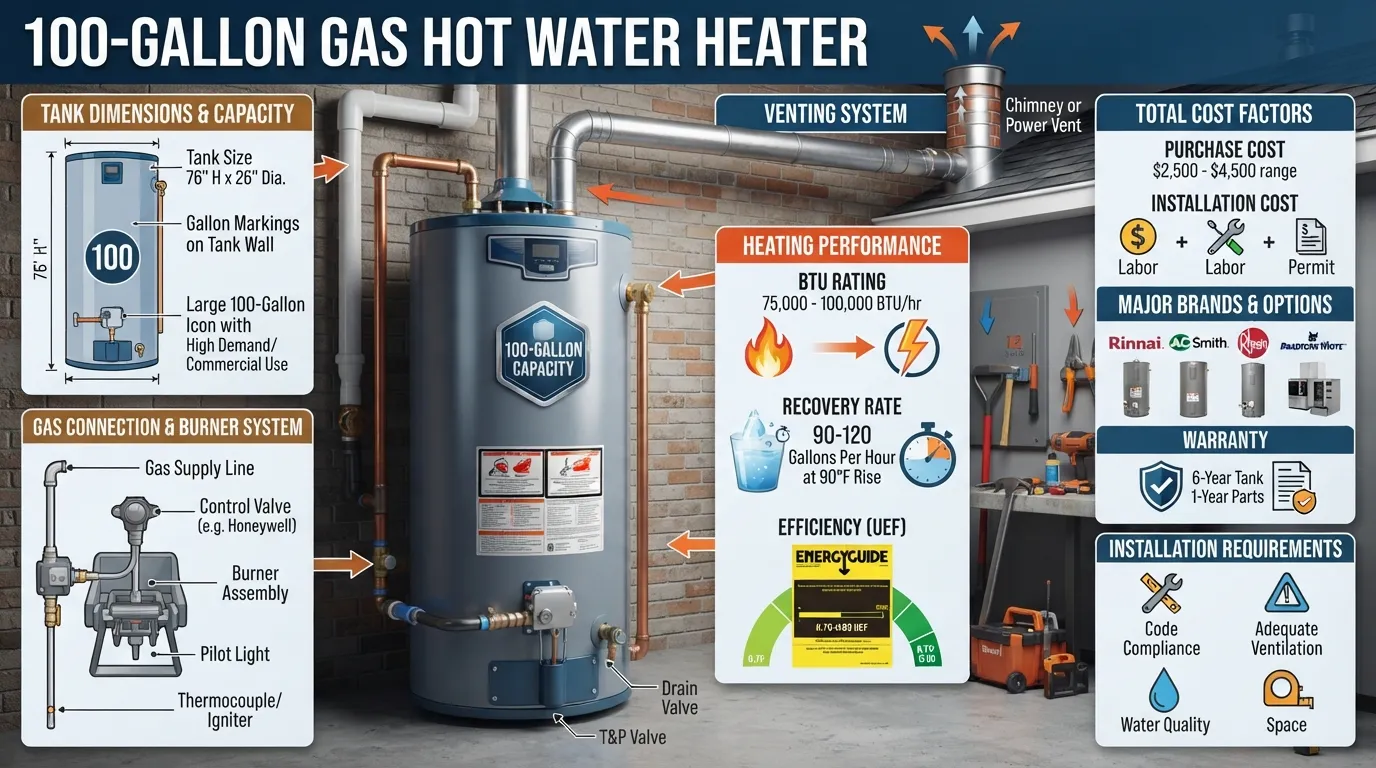
A 100-gallon gas water heater is a high-capacity tank system designed for properties with substantial hot-water demand. It can be appropriate for larger homes, multi-unit properties and commercial applications, but you should not choose one based on tank size alone.
The key numbers to compare are: storage capacity, BTU input, first-hour delivery, recovery performance, efficiency, fuel type and installation requirements.
In this guide, I will help you work through those decisions, including 100 gallon water heater price, sizing, popular brands, installation considerations, replacement signs, and the questions you should ask before buying.
What Is a 100 Gallon Gas Water Heater?
A 100-gallon gas water heater is a tank-style water-heating system designed to store a large volume of hot water while a gas burner heats incoming water and restores the tank’s hot-water capacity after use.
These systems are commonly found in higher-demand applications. Depending on the model and application, that can include larger residences, multi-unit buildings, restaurants, commercial kitchens, offices and other properties that require more hot-water output than a typical residential tank can provide.
However, there is an important distinction between storage capacity and hot-water delivery.
A 100-gallon tank does not automatically mean that every 100-gallon heater delivers the same amount of usable hot water. Different models can have very different burner inputs, recovery rates, efficiencies, first-hour ratings, venting requirements and physical dimensions.
Do You Really Need a 100 Gallon Water Heater?
This is the first question I would answer before choosing a brand or model.
If your existing heater is 100 gallons, you should not automatically assume that your next heater also needs to be 100 gallons. The correct replacement depends on the property’s actual hot-water demand and the performance of the proposed replacement.
A 100-gallon system may be appropriate when you have:
- High simultaneous hot-water demand
- A large home with unusually high hot-water usage
- Multiple residential units sharing a water-heating system
- A restaurant or commercial kitchen
- An office or other commercial property with substantial hot-water demand
- A need for significant stored hot-water capacity
- An existing high-capacity system that was properly sized for the application
But a 100-gallon tank may be unnecessary when demand is lower. Depending on the property, an 80-gallon high-recovery system, multiple smaller tanks, a tankless system, or another commercial configuration may make more sense.
Don’t size the heater by gallons alone
Your plumber should consider peak hot-water demand, first-hour delivery, recovery performance, BTU input, fuel supply, venting, available space and applicable installation requirements before selecting the replacement.
100 Gallon Water Heater Price: How Much Does It Cost?
There is no single price for a 100-gallon gas water heater. Equipment prices vary considerably depending on the manufacturer, BTU input, efficiency, venting configuration, fuel type, commercial rating and model.
Current published equipment listings illustrate that difference. For example, one commercial water-heater supplier currently lists 100-gallon gas models from several thousand dollars for lower-input units to well above $10,000 for higher-input or specialized models. These are equipment prices, not guaranteed installed prices. :contentReference[oaicite:0]{index=0}
That distinction matters because your final replacement cost can include much more than the tank itself.
What Can Affect the Total Installed Price?
- The new water heater
- Professional installation labor
- Removal and disposal of the old tank
- Gas piping modifications
- Water connection modifications
- Venting changes
- Required safety components
- Drain and discharge work
- Expansion-control components where applicable
- Permits and inspections where required
- Delivery and handling of a large, heavy appliance
- Changes required by the existing installation or applicable code
For that reason, I would never use an online product price as your final replacement budget without checking what is required at the property.
100 Gallon Gas Water Heater Cost: Equipment Price vs. Replacement Price
When you compare products, make sure you are comparing similar systems.
A conventional atmospheric commercial heater and a high-efficiency condensing model can both have approximately 100 gallons of storage while having very different equipment costs and installation requirements.
For example, current manufacturer specifications show 100-gallon commercial gas heaters available with different BTU inputs and efficiency levels. Lochinvar’s CGL250100 model lists 100 gallons nominal capacity, 98 gallons rated storage, up to 250,000 BTU, 80% thermal efficiency, a 3-year limited tank warranty and a 1-year limited parts warranty. :contentReference[oaicite:1]{index=1}
A.O. Smith also lists a 100-gallon-class high-recovery atmospheric model with 75,100 BTU input, 80% thermal efficiency and an 81-gallon-per-hour recovery rate under its published test conditions. :contentReference[oaicite:2]{index=2}
Those examples show why two heaters described as “100-gallon gas water heaters” can have very different performance characteristics.
How Big Is a 100 Gallon Water Heater?
A 100-gallon commercial gas water heater is a substantial appliance, but exact dimensions vary by manufacturer and model.
For example, Lochinvar lists one 100-gallon commercial gas model at 72 inches high, 30.25 inches in diameter and 720 pounds shipping weight. Its specifications also list 98 gallons of rated storage. :contentReference[oaicite:3]{index=3}
Another important point is that the 720-pound figure is a model-specific shipping weight. You should never assume that every 100-gallon heater weighs the same.
Why Dimensions and Weight Matter
Before ordering a large replacement, consider the entire route from delivery to the mechanical room.
- Will the tank fit through the entrance?
- Are doorways and access routes wide enough?
- Can the old heater be removed safely?
- Is there adequate working clearance around the new unit?
- Can the installation area support the equipment?
- Does the new model have different connection locations?
- Will the existing venting work with the replacement?
A water heater that fits on paper can still require additional work if access, connections or venting are different.
100 Gallons vs. BTU: Why Burner Input Matters
One of the easiest mistakes to make is assuming that a larger tank automatically means better performance.
It doesn’t.
Tank capacity tells you how much water the tank is designed to store. BTU input tells you the heating input of the burner. Recovery and first-hour performance help you understand how well the system can keep up with continued demand.
The four numbers I would compare first
1. Storage capacity: The nominal size of the tank.
2. BTU input: The heating input supplied by the burner.
3. Recovery: How quickly the system can restore hot-water capacity under its rated conditions.
4. First-hour delivery: A useful way to compare how much hot water a system can deliver during a concentrated demand period.
This is why choosing a water heater solely because it says “100 gallon” can lead to a poor match for your building.
How Much Hot Water Can a 100 Gallon Gas Water Heater Actually Deliver?
The answer depends on the specific model and operating conditions.
Suppose two systems both have approximately 100 gallons of storage. If one has a significantly different burner input or recovery capability, their ability to keep up with repeated hot-water use can be different.
When comparing models, look at:
- Nominal storage capacity
- Rated storage volume
- BTU input
- First-hour delivery or rating
- Recovery rate
- Thermal efficiency
For example, A.O. Smith’s published specifications for its FCG-100 atmospheric model identify a 98-gallon nominal tank, 75,100 BTU burner and an 81-gallon-per-hour recovery rate. :contentReference[oaicite:4]{index=4}
The important lesson is that 100 gallons of storage does not equal 100 gallons of hot-water delivery every hour. The burner and recovery characteristics are part of the equation.
What Is a First-Hour Rating?
First-hour performance helps describe how much hot water a storage water heater can deliver during a period of high demand, taking both stored water and the heater’s recovery capability into account.
This is especially important for properties where several hot-water uses can occur close together.
If you are comparing a 100-gallon heater with an alternative configuration, first-hour performance can give you a much more useful comparison than tank capacity alone.
For example, a smaller high-recovery system may be able to serve a particular demand profile more effectively than a larger tank with lower recovery capability. The actual choice should be based on the building’s demand and the manufacturer’s rated performance.
Natural Gas vs. Propane for a 100 Gallon Water Heater
Before choosing a model, confirm whether your property uses natural gas or propane.
Do not assume that a natural-gas water heater and propane water heater are interchangeable. The appliance must be approved for the intended fuel, and the gas supply, connections, controls, venting and installation requirements must match the selected model.
Manufacturers offer 100-gallon-class commercial systems for different fuel configurations. Lochinvar’s published CGL250100 specifications, for example, identify gas power and selectable natural-gas/propane configurations on the product page. :contentReference[oaicite:5]{index=5}
The safest approach is to identify the fuel first and then select a model designed and approved for that application.
Atmospheric vs. High-Efficiency Condensing Water Heaters
The type of gas water heater can be just as important as the tank capacity.
Atmospheric Gas Water Heaters
Atmospheric commercial water heaters use a conventional combustion and venting arrangement. They can be a practical choice when the building already has a suitable configuration and the selected model meets the property’s requirements.
The exact venting and combustion-air requirements remain model-specific.
High-Efficiency Condensing Models
Condensing gas water heaters can achieve substantially higher thermal efficiency than conventional atmospheric designs, but they can also require different venting, condensate handling, electrical connections and installation planning.
Bradford White currently lists commercial eF Series gas water heaters with models reaching up to 97% thermal efficiency, including 100-gallon models with different BTU inputs. :contentReference[oaicite:6]{index=6}
So, if you see a high-efficiency model with a higher purchase price, compare the complete system rather than judging it by equipment price or efficiency alone.
Higher efficiency is not automatically the cheapest installation
A high-efficiency system may reduce energy use under appropriate operating conditions, but equipment cost and installation requirements can be different. Compare equipment cost, installation cost, operating requirements and expected use together.
Best 100 Gallon Gas Water Heater Brands
If you search for a 100-gallon commercial gas water heater, you will encounter several established manufacturers. Among the entities appearing in this market are Rheem, A. O. Smith, Bradford White, Lochinvar and State Water Heaters.
There is no honest universal answer to the question, “Which is the No. 1 water heater brand?” The better question is which specific model is the right fit for your property.
What Should You Compare Between Brands?
- Storage capacity
- BTU input
- First-hour delivery
- Recovery performance
- Thermal efficiency
- Natural gas or propane compatibility
- Venting configuration
- Physical dimensions
- Weight
- Warranty
- Parts and service availability
- Installation requirements
- Total installed cost
Bradford White, for example, currently lists 100-gallon eF Series commercial gas models with inputs including 150,000, 199,000, 250,000 and 300,000 BTU/Hr., demonstrating how much performance can vary within the same nominal tank size. :contentReference[oaicite:7]{index=7}
100 Gallon Water Heater Brands: What Makes a Model a Good Choice?
Instead of asking which brand is “best,” I recommend matching the model to the application.
A practical model-selection checklist
- High demand: Pay close attention to BTU input, recovery and first-hour performance.
- Limited space: Compare exact dimensions, clearances and access requirements.
- Efficiency priority: Compare thermal efficiency and the complete installed system.
- Replacement priority: Check whether the existing gas, water and vent connections can accommodate the new model.
- Long-term service: Consider warranty, parts availability and qualified service support.
100 Gallon Water Heater vs. 80 Gallon: Which Is Better?
A 100-gallon tank is not automatically better than an 80-gallon tank.
If your property has moderate demand, an appropriately sized 80-gallon high-recovery system may be sufficient. If demand is very high, reducing storage without checking first-hour performance and recovery could leave you with inadequate hot water.
Before moving from 100 gallons to 80 gallons, compare:
- Peak simultaneous demand
- First-hour hot-water requirements
- First-hour rating of the proposed replacement
- BTU input
- Recovery rate
- Available space
- Fuel supply
- Venting requirements
The goal is not to buy the largest tank. The goal is to buy the system that can reliably meet your actual demand.
One 100 Gallon Tank vs. Two Smaller Water Heaters
For some high-demand properties, installing multiple smaller units can be worth considering instead of one very large tank.
A multiple-unit configuration can potentially provide useful redundancy because one unit may remain available if another needs service, depending on how the system is designed and the property’s actual demand.
However, multiple units also require additional equipment, connections, controls, space and installation work.
That means the decision should be based on the property’s demand profile, available space, budget, reliability goals and professional system design.
How Long Does a 100 Gallon Water Heater Last?
There is no single lifespan that applies to every 100-gallon gas water heater.
Service life can be influenced by:
- Water quality
- Usage intensity
- Operating temperature
- Maintenance
- Sediment and mineral accumulation
- Corrosion
- Installation quality
- Tank design
- Commercial or residential duty
- Model-specific components and construction
It is also important to distinguish warranty coverage from actual service life. A three-year or six-year limited warranty does not mean that the water heater is designed to fail when the warranty expires.
When Should You Replace a 100 Gallon Gas Water Heater?
If you already have a 100-gallon heater, replacement becomes a serious consideration when the tank or system is no longer reliably meeting your needs.
Common warning signs include:
- A leaking tank
- Visible corrosion
- Repeated component failures
- Unreliable hot-water supply
- Insufficient recovery during peak use
- Unusual operating behavior
- Increasing repair frequency
- A system that no longer matches the property’s demand
- A major change in how the building uses hot water
If the tank itself is leaking, replacement is generally a different decision from repairing an external component. A professional inspection can help determine whether the problem is repairable or whether replacing the entire unit makes more sense.
100 Gallon Gas Water Heater Replacement in Miami
If you are replacing a large gas water heater in Miami, there is another layer to the decision: the existing installation and applicable local requirements.
Miami-Dade County’s published permitting information identifies regulated plumbing and gas work that can require permits, while its permit-exemption information includes only limited water-heater replacement circumstances. A 100-gallon gas-water-heater replacement should therefore not be assumed to fall under the same exemption as a small electric replacement. :contentReference[oaicite:8]{index=8}
Local requirements can also depend on the property’s jurisdiction and the exact scope of the work. That is why the installation should be evaluated before you order the replacement equipment.
What Should Be Checked During a Replacement?
- Gas type and available gas supply
- Existing gas piping
- Water connections
- Venting configuration
- Combustion-air requirements
- Required clearances
- Temperature and pressure relief provisions
- Drain and discharge arrangements
- Electrical requirements for the selected model
- Physical access and delivery route
- Applicable permits and inspections
- Manufacturer installation requirements
For a local plumbing company, the replacement is also an opportunity to check whether the old 100-gallon configuration is still the best fit for the building rather than simply performing a like-for-like swap.
If you are evaluating your options, you can learn more about our water heater replacement service.
What Should You Ask a Plumber Before Buying?
If I were comparing 100-gallon water-heater replacement options, I would ask these questions before choosing a model:
- Do I actually need 100 gallons?
- What is my property’s peak hot-water demand?
- What first-hour delivery should I target?
- What BTU input is appropriate?
- Is my property set up for natural gas or propane?
- Can the existing gas supply support the proposed model?
- Can the existing venting be reused?
- Will the new unit fit through the existing access route?
- Would one 100-gallon tank or multiple smaller units be better?
- What is included in the complete installed price?
- Are permits or inspections required for this replacement?
100 Gallon Gas Water Heater Buying Checklist
Before you buy, confirm these items
- 100-gallon capacity is actually necessary
- Natural gas or propane
- Peak hot-water demand
- BTU input
- First-hour delivery/rating
- Recovery performance
- Thermal efficiency
- Venting configuration
- Exact dimensions
- Equipment weight
- Delivery access
- Water and gas connection requirements
- Warranty
- Parts and service availability
- Permit and inspection requirements
- Total installed cost
- Whether another system configuration could serve the property better
100 Gallon Gas Water Heater: Quick Decision Guide
Which direction makes sense?
If your main concern is high demand:
Compare BTU input, first-hour delivery and recovery rather than looking at gallons alone.
If your main concern is efficiency:
Compare efficiency, equipment price, installation requirements and expected operating conditions together.
If your main concern is upfront cost:
Compare the complete installed project price, not just the online tank price.
If your main concern is reliability:
Compare recovery, first-hour performance and whether a multiple-unit configuration could provide useful redundancy.
If your current heater is failing:
Have it evaluated before automatically ordering another 100-gallon tank.
Frequently Asked Questions About 100 Gallon Gas Water Heaters
How much does a 100-gallon hot water heater cost?
The equipment price varies by brand, BTU input, efficiency, fuel type, venting and model. Current published commercial listings show a wide spread in equipment-only pricing, from several thousand dollars to well over $10,000 for some higher-input models. Installation, removal, venting, gas work, permits and other site-specific requirements can add substantially to the project cost. :contentReference[oaicite:9]{index=9}
How long should a 100 gallon water heater last?
There is no universal lifespan. Water quality, usage, maintenance, corrosion, installation quality, operating conditions and the particular model all influence service life. Warranty length should not be treated as a guaranteed lifespan.
Which is the No. 1 water heater brand?
There is no single brand that is best for every application. Rheem, A. O. Smith, Bradford White, Lochinvar and State are among the manufacturers you may encounter. The best choice depends on the specific model and your property’s requirements.
How big is a 100 gallon water heater?
Exact dimensions vary by model. One current Lochinvar 100-gallon commercial gas model is listed at 72 inches high and 30.25 inches in diameter, with a 720-pound shipping weight. Other models can be different, so always verify the manufacturer’s specification sheet before planning delivery or installation. :contentReference[oaicite:10]{index=10}
Is a 100-gallon gas water heater good for a large house?
It can be appropriate for a high-demand home, but house size alone should not determine the tank size. Peak hot-water demand and the proposed heater’s first-hour and recovery performance are more useful when deciding whether 100 gallons is necessary.
Is a 100-gallon water heater better than an 80-gallon model?
Not necessarily. An 80-gallon high-recovery system may be sufficient for one property, while another property may need the larger storage capacity. Compare storage, BTU input, recovery and first-hour performance before deciding.
Can I replace a 100-gallon water heater with a smaller tank?
Possibly. Your existing tank size does not automatically determine the correct replacement size. The new system should be evaluated against the property’s actual demand and the manufacturer’s performance specifications.
Can I replace a natural-gas water heater with a propane model?
Do not assume that the two are interchangeable. The selected water heater must be approved for the intended fuel, and the gas supply, connections, controls and venting must be appropriate for the installation.
What is more important: gallons or BTU?
Neither should be considered by itself. Gallons describe storage capacity, while BTU input and recovery characteristics help determine how quickly the system can restore hot-water capacity. First-hour delivery is also important when evaluating high-demand applications.
Should I buy the highest-BTU 100-gallon water heater?
Not automatically. Higher input can provide greater recovery capability, but the correct BTU input depends on the building’s demand, gas supply, venting, installation requirements and the model’s overall design.
Final Takeaway: Choose the Right System, Not Just the Biggest Tank
If you are searching for a 100 gallon gas hot water heater, the most important takeaway is simple: 100 gallons is only one specification.
The right system should match your property’s actual hot-water demand, not just the size of your old tank.
Before buying, compare BTU input, first-hour delivery, recovery performance, efficiency, fuel type, venting, dimensions, weight, warranty and total installed cost. If you are replacing an existing unit, also determine whether the current 100-gallon configuration is still appropriate.
For Miami homeowners and property owners, professional evaluation is particularly useful because a large gas-water-heater replacement can involve the existing gas and venting system, physical access and applicable permitting requirements.
You can also explore our full range of plumbing services if your water-heater project is part of a larger plumbing issue.
Need Help Choosing a 100-Gallon Water Heater?
Before you purchase a replacement, have the existing system evaluated so you know whether 100 gallons is still the right capacity and what installation work the new model will require.
For more information about the company behind this service, you can also visit Miami Florida Plumbing.
Related Resources & Manufacturer References
If you are comparing products before purchasing, use the manufacturer’s documentation for the exact model you are considering. Manufacturer specifications are especially useful for verifying capacity, BTU input, recovery, efficiency, dimensions, fuel type, venting and warranty.
- Rheem commercial water-heating products
- A. O. Smith commercial gas water heaters
- Lochinvar commercial gas water heaters
- Bradford White commercial gas water heaters
- State Water Heaters commercial products
Source note: Product specifications and local requirements can change. Verify the current manufacturer’s documentation and applicable local requirements for the exact water heater being installed.
Current manufacturer information used for technical comparisons in this guide includes published specifications from Lochinvar, A. O. Smith and Bradford White. :contentReference[oaicite:11]{index=11} Miami-Dade permitting information should also be checked for the property’s specific jurisdiction and scope of work. :contentReference[oaicite:12]{index=12}