The Ultimate 2026 Guide to Water Heater Installation: Costs, Risks, and Pro Secrets
The True Value of Professional Water Heater Installation

- A water heater is often the most overlooked appliance in a home—until the hot water stops flowing. In 2026, water heater replacement has evolved from a simple “tank swap” into a high-stakes infrastructure project.
- Because hot water systems now account for approximately 18% of the average home’s energy consumption, the way your unit is installed directly impacts your household’s monthly overhead and long-term financial planning.
The 2026 Landscape: Beyond “Plug and Play”
- The days of “plug and play” installations have largely vanished due to aggressive federal efficiency mandates.
- As of October 6, 2026, new Department of Energy (DOE) standards require many commercial and residential-duty gas units to utilize advanced condensing technology, which mandates specialized drainage for acidic condensate and unique venting materials like PVC instead of traditional metal.
- Furthermore, high-tech systems like Hybrid Heat Pump units and Tankless models have become the new standard for energy-conscious homeowners.
- These units are not simple replacements; they are sophisticated machines that require:
Hybrid Units:
- ambient air volume (typically 1,000 cubic feet) and dedicated condensate management.
Tankless Units:
- Precise gas-to-air ratios and often upgraded electrical panels to handle 240V/30-50 Amp loads.
Relevance: Why Installation is a Performance Factor
- While the water heater itself is a significant one-time purchase, the installation quality is the primary variable that determines the total cost of ownership.
- A unit’s efficiency rating (UEF) is only achievable if the system is calibrated correctly within your home’s unique plumbing ecosystem.
Lifespan:
- A professionally installed unit can last its full expected lifespan (8–12 years for tanks; 20+ years for tankless).
- In contrast, DIY errors like failing to install a thermal expansion tank or neglecting dielectric unions can lead to premature tank failure in as little as 3–5 years.
Safety:
- Beyond preventing leaks, pro-level installation ensures compliance with modern safety codes, such as seismic strapping in earthquake-prone zones and proper T&P (Temperature and Pressure) relief valve routing to prevent catastrophic tank explosions.
Energy Savings:
- Proper insulation of the first six feet of piping and precise thermostat calibration (typically to 120°F) can reduce standby heat loss, potentially saving homeowners up to $550 annually when upgrading to high-efficiency models.
Cost Breakdown by Unit Type 2026 Estimates

- Navigating water heater costs in 2026 requires looking past the price tag on the box. Total “installed costs” are a combination of the unit price, specialized labor, and the ever-evolving cost of materials like copper and high-heat venting.
- Below is a detailed breakdown of what homeowners are currently paying for professional installation across the three primary system types.
Standard Tank Water Heaters: The Reliable Baseline
Technical Cost Analysis • Video Credit: Quick Water Heater
Traditional storage tanks remain the most common choice due to their lower upfront cost, but there is a distinct pricing gap between electric and gas models.
Electric Storage Tanks ($600 – $1,800 Total):
- These are generally the most affordable to install. Because they do not require complex venting or gas lines, labor is often straightforward, ranging from $200 to $600.
Gas Storage Tanks ($900 – $3,100 Total):
- Natural gas and propane units carry a higher price point due to the specialized “gas fitter” expertise required. Labor for these units averages $400 to $1,000, accounting for the time spent ensuring proper exhaust venting and leak-testing fuel connections.
High-Efficiency Systems: Performance at a Premium
For those looking to maximize energy savings or “endless” hot water, the initial investment is significantly higher.
Tankless Systems ($1,400 – $5,600 Total):
- While the units themselves are compact, the labor to install them is intensive.
The “Retrofit Tax”:
- If you are switching from a tank to a tankless unit, expect to pay $1,500 to $2,500 just in infrastructure upgrades.
- This includes widening gas lines (upgrading from 1/2-inch to 3/4-inch to meet high-BTU demand) or installing dedicated 240V/50-Amp electrical circuits.
Hybrid Heat Pump Heaters ($2,000 – $4,600 Total):
- These units are the “gold standard” for 2026 efficiency.
2026 Incentives:
- While upfront costs are high, the Inflation Reduction Act continues to provide primary savings.
- Most homeowners can claim a federal tax credit of 30% (up to $2,000) via IRS Form 5695, effectively bringing the “real” cost down closer to a traditional gas unit.
Capacity Pricing: Sizing Your Investment
The physical size of the tank (or the GPM of a tankless unit) scales the cost of both the appliance and the labor required to move and fit it.
| Tank Size | Average Installed Cost (2026) | Best For |
| 40-Gallon | $800 – $2,300 | 1–4 People |
| 50-Gallon | $1,000 – $2,500 | 3–5 People (The National Standard) |
| 75+ Gallon | $1,100 – $7,500 | 5+ People / Homes with large soaking tubs |
Pro Insight: When comparing 40 vs. 50-gallon units, the price difference is often less than $150. Given the “recovery rate” advantages, 50-gallon units have become the default choice for 2026 residential replacements to avoid “cold-shower” complaints during peak morning hours.
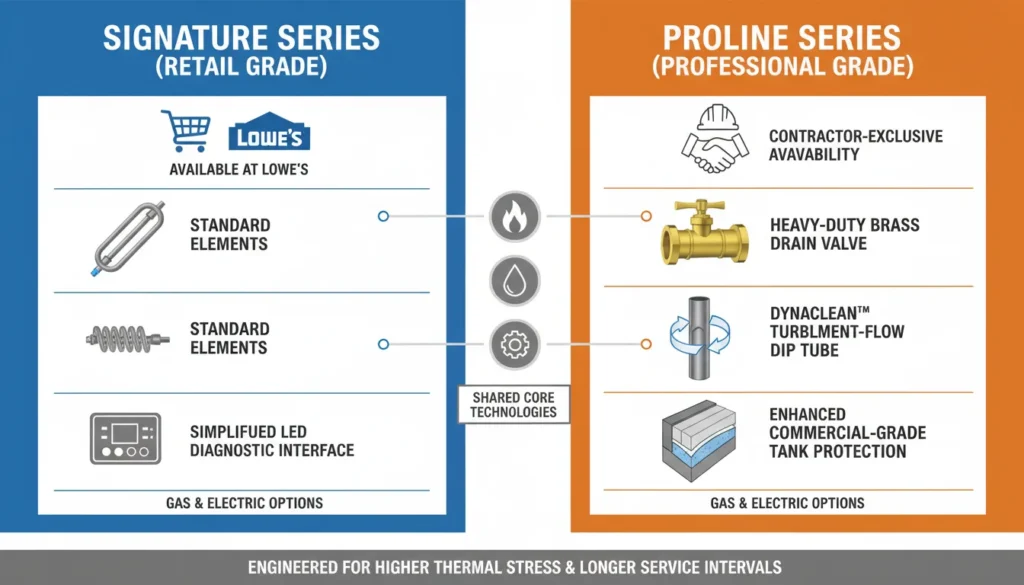
Retailer vs. Private Plumber Home Depot & Lowe’s

- When the hot water goes out, most homeowners immediately look toward “Big Box” retailers like Home Depot or Lowe’s for a quick fix.
- However, in 2026, the choice between a retail giant and a local private plumber involves more than just the sticker price. Understanding the logistics behind these installations is key to avoiding “hidden” costs that can inflate your final bill.
The Big Box Reality: Pricing and Logistics
Retailers use a high-volume model, often acting as a middleman between you and an independent local contractor.
National Average Pricing:
- In 2026, Home Depot lists its average total cost for a standard tank installation at approximately $1,950, while tankless installations average $4,300. Lowe’s basic installation fees typically start around $320 for labor, but after adding the unit, piping, and required safety parts, most homeowners find their total is between $1,100 and $2,400.
The “Free Installation” Myth:
- You will often see “free delivery” or “free consultation” advertised. It is important to clarify that professional labor is never free.
- While they may waive a $75 delivery fee, the installation itself starts at a flat base rate (typically $300–$600) and increases based on the parts needed to meet current 2026 building codes.
Service Comparison: Choosing Your Partnership
The right choice depends on whether you value financing convenience or long-term technical accountability.
| Feature | Retailer (Home Depot/Lowe’s) | Private Licensed Plumber |
| Pros | Easy financing (0% APR offers), consistent pricing, background-checked contractors. | Direct communication, specialized gas/electric expertise, higher accountability. |
| Cons | “Contractor Lottery” (you don’t pick the pro), fixed scheduling, potential communication gaps. | Can have higher upfront labor quotes, availability may vary by season. |
| Warranty | Manufacturer’s warranty on the unit; limited labor warranty from the retailer. | Often provides a labor guarantee and manages the unit warranty directly for you. |
Disposal, Permits, and “Hidden” Fees
One area where Big Box quotes and private plumber bids often diverge is in the “add-on” services.
Haul Away & Disposal:
- Don’t assume your old tank will be taken for free. Retailers and plumbers typically charge $100 to $475 to disconnect, remove, and legally dispose of your old water heater, depending on the unit’s size and accessibility.
Permit Filing:
- In 2026, almost every municipality requires a permit for water heater replacement. Retailers usually charge a flat administrative fee plus the cost of the permit (totaling $50 to $300).
- A private plumber may include this in their labor quote or bill it as a separate line item.
Access Fees:
- If your water heater is in a difficult location—such as an attic, tight crawlspace, or behind a furnace—expect an “accessibility surcharge” of $125 to $300 from any provider.
Why a Licensed Plumber is Non-Negotiable

- When it comes to water heater installation in 2026, the phrase “licensed professional” is a safety standard, not a suggestion.
- While many home improvement tasks can be tackled by a capable DIYer, water heater replacement—particularly for gas-fired units—involves critical life-safety systems that require specialized training to manage.
The Gas Line Mandate: NFPA 54 Compliance
Working with gas-fired units carries inherent risks that extend beyond simple plumbing. Licensed plumbers are trained to comply with NFPA 54: The National Fuel Gas Code, which provides the blueprint for safe fuel gas piping.
Leak Prevention:
- Professionals use specialized manometers to perform “drop tests,” ensuring the entire fuel system is airtight before a single flame is lit.
Ignition Safety:
- Plumbers ensure that gas units in garages are elevated at least 18 inches off the floor to prevent the ignition of flammable vapors that may settle near the ground.
Exhaust Management:
- A pro ensures that venting is sloped correctly and sealed with high-heat compounds to prevent carbon monoxide (CO) from backing up into your living space—a leading cause of silent residential fatalities.
Managing the “Closed-Loop” System
- Professional installation isn’t just about connecting pipes; it’s about balancing a complex, high-pressure system.
- A licensed plumber manages three critical components that are frequently installed incorrectly by amateurs:
Thermal Expansion Tanks:
- In modern “closed-loop” plumbing systems (common in 2026), water has nowhere to go when it expands during heating.
- Without an expansion tank, this pressure can turn your water heater into a literal rocket. A pro sizes and pre-charges these tanks to match your home’s specific PSI.
Pressure-Regulating Valves (PRV):
- If your municipal water pressure exceeds 80 PSI, it will destroy your appliances and fixtures. Plumbers test your incoming pressure and install PRVs to safeguard your home’s entire plumbing network.
T&P Relief Valves:
- These safety valves are designed to blow off if temperature or pressure reaches dangerous levels.
- A plumber ensures the discharge pipe is routed correctly—downward and to a safe drain—to prevent scalding or water damage during a system failure.
The “Pro Edge” in Corrosion Protection
- The most significant “hidden” difference between a professional and a DIY installation is how the units are protected from Galvanic Corrosion.
- Most retail guides fail to mention that when you join dissimilar metals (like a copper pipe to a steel water heater tank), an electrochemical reaction occurs that “eats” the metal, leading to leaks within 3–5 years.
Technical Insight: Dielectric Unions & Anodeless Risers
Master plumbers utilize two specific tools to break this electrical circuit and double the life of your unit:
Dielectric Unions: These are specialized fittings that use a non-conductive plastic sleeve and gasket to physically separate the copper from the steel. This breaks the electrical path, stopping the corrosion before it starts.
Anodeless Risers for Gas Lines: When gas lines are buried, they are susceptible to “stray current” electrolysis. A pro uses an Anodeless Riser at the transition point. This device uses a polyethylene (PE) carrier inside a steel sleeve, ensuring the underground portion of your gas service remains corrosion-free and leak-proof for decades.
Key Installation Steps & Technical Requirements

- Properly installing a water heater in 2026 involves more than just tight connections; it requires a disciplined sequence of site preparation and a technical understanding of fluid dynamics to prevent immediate equipment failure.
- Following these industry-standard steps ensures your unit remains compliant with modern safety codes.
Site Prep: Draining and the 18-Inch Safety Rule
Before the new unit can be positioned, the old system must be decommissioned safely. This starts with a complete tank drain.
The Draining Process:
- A professional attaches a high-temperature hose to the drain valve and opens a hot water faucet elsewhere in the house to break the vacuum.
- This prevents “sediment locking,” where old mineral buildup clogs the valve during the exit flow.
The 18-Inch Elevation Rule:
- One of the most vital safety codes for garage installations (National Fuel Gas Code/Uniform Plumbing Code) requires the ignition source (pilot light or heating element) to be elevated at least 18 inches above the floor.
The Science:
- Flammable vapors—such as gasoline from a car or lawnmower—are heavier than air and settle near the ground. Elevating the unit significantly reduces the risk of these vapors being ignited by the water heater’s burner or spark.
The Hookup: Safety Valves and Connector Choices
Modern plumbing relies on specific components to handle the high pressures generated during the heating cycle.
T&P Relief Valves:
- The Temperature and Pressure (T&P) relief valve is your home’s “last line of defense.” It is designed to open if the tank reaches 210°F or 150 PSI.
- A pro ensures the discharge pipe is made of code-approved materials (like CPVC or copper) and terminates between 6 and 24 inches above the floor, pointing downward to prevent scalding.
Flexible vs. Rigid Connections: * Flexible Connectors:
- Preferred in seismic zones (like California) because they allow the unit to move slightly during a tremor without snapping the pipes. They also simplify installation in tight closets.
Rigid Copper:
- Offers the most “permanent” feel and maximum flow rate, but requires precise soldering and is more prone to stress-cracking if the house settles or vibrates.
The Startup: Preventing the “Dry Fire” Disaster
The most common mistake made during DIY installations occurs at the very end of the project: turning the power on too soon.
The “Air Bleed” Process:
- After connecting the water lines, you must open the hot water faucets in the home before turning on the electricity or gas.
- You should let the water run until the “sputtering” stops and a steady, solid stream of water flows. This confirms that all air pockets have been purged from the tank.
Avoiding “Dry Firing”:
- If an electric water heater is energized while an air pocket remains at the top, the upper heating element will be exposed to air instead of water.
- Without water to dissipate the heat, the element will reach catastrophic temperatures and burn out in less than 30 seconds.
- This is known as “dry firing,” and it typically requires a full element replacement before the unit can ever produce hot water.
Hidden Cost Factors & Regional Variations

- Budgeting for a water heater in 2026 requires looking beyond the manufacturer’s suggested retail price (MSRP). “Hidden” costs—ranging from site-specific labor surcharges to mandatory infrastructure upgrades—can easily double the initial estimate.
- Furthermore, where you live plays a decisive role in the final invoice due to drastic differences in labor rates and local code requirements.
Location Accessibility: The “Obstacle” Surcharge
Plumbers typically provide quotes based on a “standard” installation—one where the unit is easily accessible in a basement or garage. If your home’s layout is more complex, expect additional labor fees:
Attic and Crawlspace Installs:
- Maneuvering a 150-lb steel tank through a pull-down attic ladder or into a cramped crawlspace is a multi-person job. Licensed pros often add a surcharge of $125 to $300 per hour or a flat fee of $250 to $500 for these high-difficulty areas.
Vertical Logistics:
- In urban areas like New York or Chicago, carrying a 50-gallon tank up three flights of stairs in a walk-up apartment can add $150 to $300 to the labor total.
Tight Closets:
- If the unit is tucked behind a furnace or inside a finished laundry room closet that requires door removal or minor carpentry, labor hours can increase by 20% to 30%.
Infrastructure Upgrades: Preparing Your Home for 2026 Tech
Upgrading to a modern, high-efficiency unit often reveals that your home’s existing utilities are outdated.
New Gas Lines ($260 – $820):
- If you are switching from a standard tank to a high-output tankless system, your existing 1/2-inch gas line may be insufficient.
- Installing a larger 3/4-inch line to support the unit’s BTU demand typically costs between $260 and $820, depending on the length of the run.
Dedicated Electrical Circuits ($570 – $1,100):
- Hybrid heat pump heaters and electric tankless models require a dedicated 240V circuit.
- Hiring an electrician to run this new line from your breaker panel generally costs around $700 on average, with prices reaching $1,500+ if your electrical panel is full and requires a sub-panel upgrade.
Venting Modifications ($500 – $1,000):
- 2026 efficiency standards often require “power venting” through a side wall via PVC pipe rather than using an old masonry chimney.
- This transition involves specialized masonry or siding work, typically adding $500+ to the project.
Regional Trends: The Geography of Plumbing Costs
Labor rates fluctuate wildly across the United States. While the national average for water heater labor is approximately $45 to $200 per hour, your local economy dictates the ceiling.