The Complete Guide to Clay Sewer Pipe Repair & Replacement in Miami Expert Solutions
If your home was built between 1900 and 1980, there is a 90% chance your underground system consists of Vitrified Clay Pipes (VCP). After 1980, the industry standard shifted rapidly to PVC because clay pipes could not withstand modern soil pressure and aggressive root systems.
Why Plumbers Used Clay
In the past, contractors chose clay pipes for three main reasons:
Inert Material: Clay does not rot and is highly resistant to chemicals or acidic waste.
Zero Corrosion: Unlike metal pipes (such as cast iron), clay never rusts.
Cost-Effective: During its peak usage, clay was the most affordable and widely available manufacturing material.
Are Clay Pipes Used Today?
No. Modern residential plumbing has phased out clay pipes.
The Main Problem (Brittleness): Clay pipe is as fragile as glass. Even slight ground movement or heavy loads (like driveway pressure) can cause it to crack instantly.
Modern Choice Today’s standard is Schedule 40 PVC or HDPE. Unlike rigid clay, these modern materials are flexible, easier to install, and feature “water-tight” joints that prevent root intrusion.
How Long Do Clay Sewer Pipes Last?
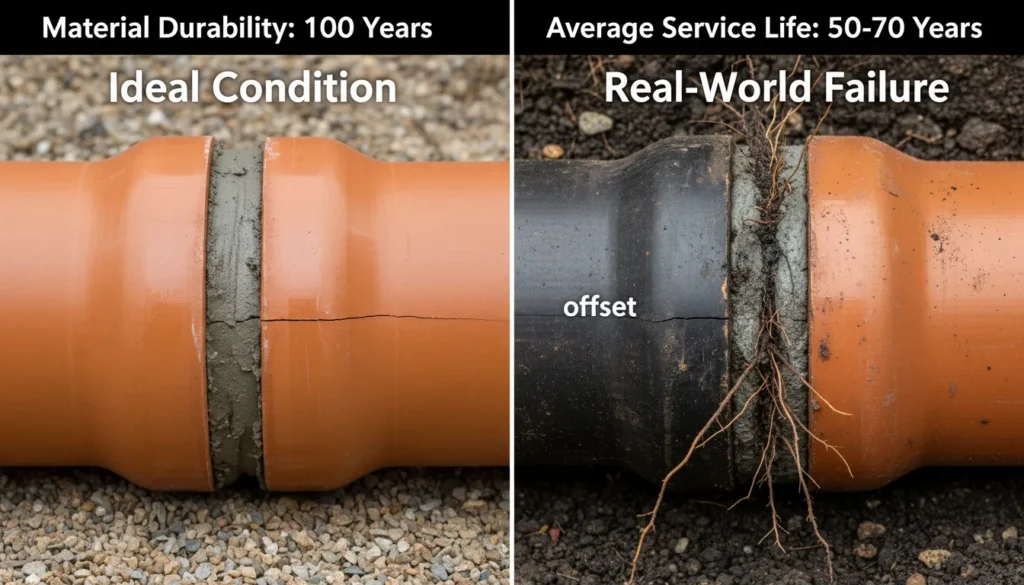
Expected Lifespan: 50 to 100 Years
Under ideal conditions, vitrified clay is one of the most durable materials ever used in plumbing. Because it is a ceramic material, it does not biologically degrade. However, a pipe’s “material life” is different from its “service life.” While the clay itself may last a century, the system often fails much sooner.
Why Clay Pipes Fail Early: Structural vs. Environmental Factors
In the real world, most clay pipes do not reach the 100-year mark. Here is why they fail prematurely:
Structural Factors:
Poor Installation: If the bedding (the soil/gravel under the pipe) was not packed correctly, the heavy clay pipe will sag and eventually snap.
Heavy Loads: Clay cannot handle the weight of modern SUVs or heavy construction equipment driving over the soil above it.
Environmental Factors:
Soil Shifting: Natural ground movement or “expansive soil” (soil that swells with rain) puts immense pressure on the rigid pipe.
Tree Root Strategy: Roots act like a slow-motion hydraulic jack. Once they find a tiny gap in a joint, they expand, eventually shattering the pipe from the inside out.
The “Brittle” Factor: Why Clay Doesn’t Bend
The biggest difference between old clay and modern PVC is flexibility.
Modern Pipes (PVC/HDPE): These are “flexible” conduits. If the ground moves slightly, the pipe can flex without breaking.
Clay Pipes: These are “rigid” conduits. They have zero “give.” Think of it like a glass rod versus a plastic straw. If you try to bend a glass rod even a fraction of an inch, it shatters. This brittleness is the primary reason for failure in older neighborhoods.
Top 5 Clay Sewer Pipe Problems
1. Tree Root Intrusion (The “Moisture Magnet” Effect)
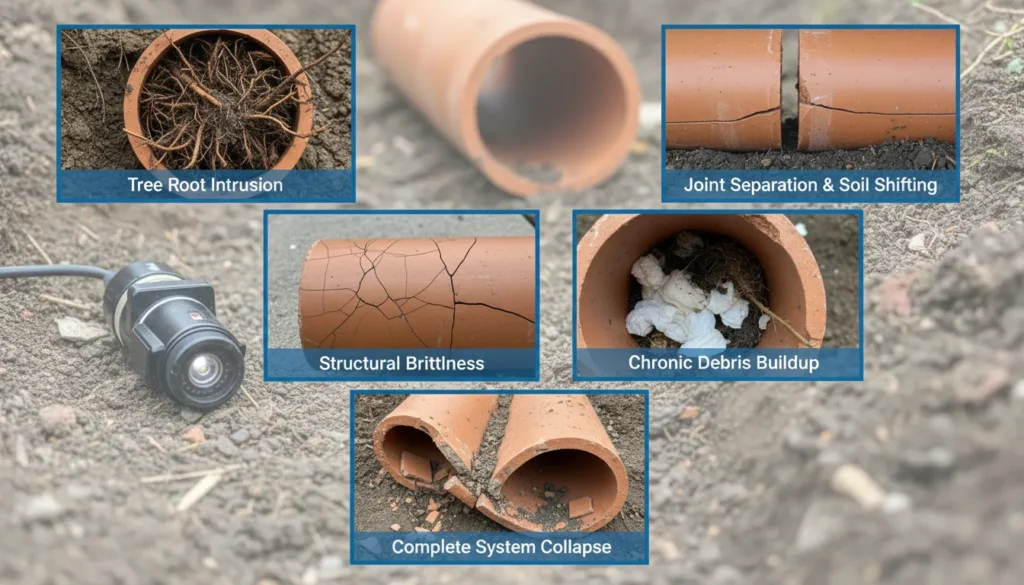
Tree roots are the #1 enemy of clay pipes. Because clay joints were historically sealed with porous materials, they allow moisture to leak out. Roots sense this moisture and grow toward the joints, eventually squeezing through the tiny gaps. Once inside, the roots expand like a slow-motion hydraulic jack, eventually shattering the pipe and causing massive blockages.
2. Joint Separation & Offsets
Clay pipes were installed in short 2-foot to 3-foot sections. Over decades, the soil beneath these sections shifts. This causes the joints to become “offset” or misaligned. An offset joint creates a “lip” inside the pipe that catches debris (like toilet paper and grease), leading to chronic clogs and allowing raw sewage to leak into the surrounding soil.
3. Brittleness & Cracking
Unlike modern plastic pipes that can flex, clay is a rigid ceramic. It is essentially as fragile as a dinner plate. Heavy loads—such as a large SUV parked on a driveway or a shifting foundation—apply “point pressure” to the pipe. Since clay cannot bend, it simply cracks or collapses under the weight.
4. Aging Infrastructure: When “Old” Becomes “Broken”
Most clay pipes in the U.S. have been underground for 50 to 80 years. Over time, the structural integrity of the vitrified clay weakens. What was once a solid drainage system becomes a crumbling line of “broken pottery” that can no longer support the weight of the earth above it.
5. Blockages & Backups (The Domino Effect)
A failing clay pipe doesn’t just leak; it creates a domino effect. A small crack allows a few roots in; those roots catch debris; that debris causes a slow drain; and eventually, the entire system suffers a “Main Line Backup.” This results in raw sewage backing up into your lowest drains, such as basement showers or floor drains.
5 Warning Signs Your Clay Sewer Line is Failing
1. The Smell Test: Foul Odors
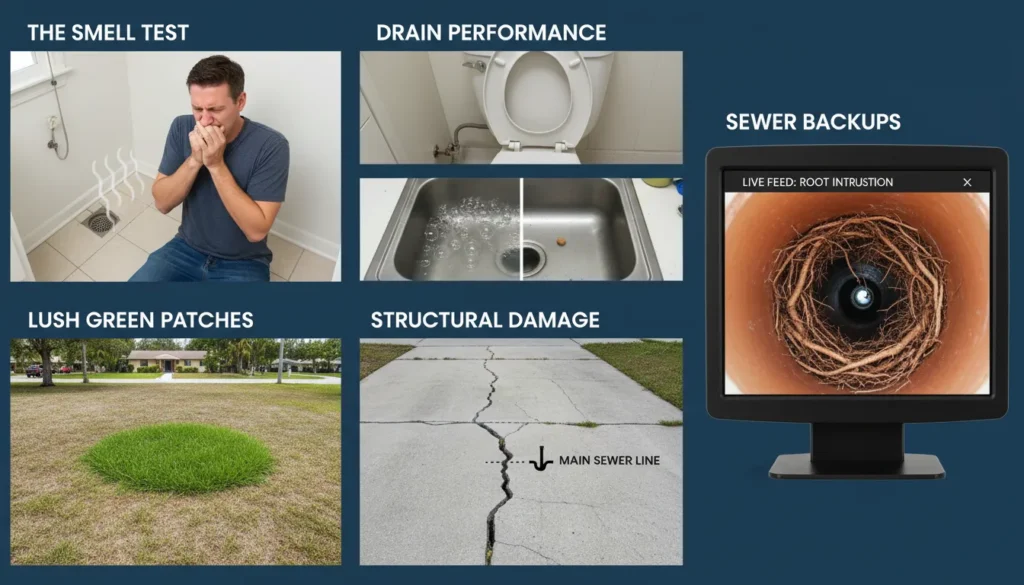
If you smell “rotten eggs” or raw sewage in your yard or basement, it’s a red flag. In a healthy PVC system, the pipe is airtight. In an old clay system, cracks or separated joints allow sewer gases to escape into the soil and eventually into your home. If the smell is stronger after a rainstorm, your clay pipe is likely leaking.
2. Visual Clues: “Lush Green Patches”
Is one specific area of your lawn greener and growing faster than the rest? While it looks like healthy grass, it’s actually Nature’s Fertilizer. Raw sewage is rich in nutrients that act as a powerful fertilizer for your grass. If you see a “mysterious” green strip over your sewer line, the clay pipe beneath it is definitely leaking.
3. Drain Performance: Slow Drains & Gurgling Toilets
If your sinks are draining slowly or your toilet “gurgles” when you run the shower, you have a venting or blockage issue. In clay pipes, this is usually the first sign of Root Intrusion. The roots have created a “net” inside the pipe that catches toilet paper, slowing down the flow of water.
4. The Water Bill: Unexplained Spikes
A sudden, unexplained increase in your water bill can sometimes indicate a massive leak in the main line. While most sewer leaks don’t affect the “metered” water coming into the house, a collapsed clay line can cause backup issues that force you to run more water to clear drains, indirectly raising your costs.
5. Persistent Sewer Backups
The most obvious sign of failure is a backup in your lowest drains (like a basement floor drain or shower). If you have a plumber “snake” the line and the clog returns within a few weeks, the clay pipe has likely collapsed or is completely filled with roots. At this point, “cleaning” is no longer a solution; you are looking at a structural failure.
Clay Sewer Pipe vs. PVC: The Modern Comparison
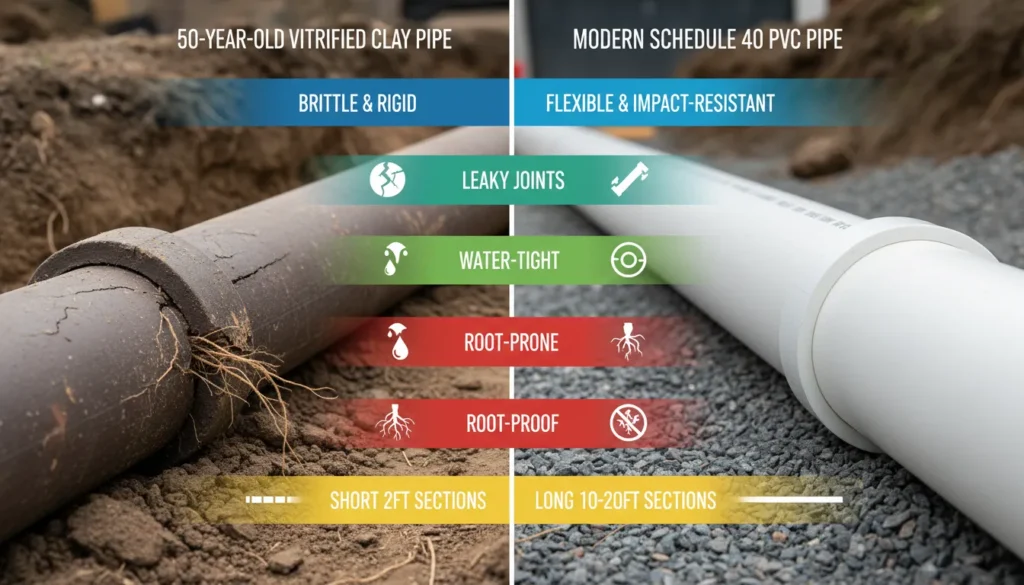
When it comes to modern plumbing in Miami, the debate between old clay and modern plastic is over. While clay was the king of the 20th century, PVC (Polyvinyl Chloride) is the undisputed gold standard today.
Side-by-Side Comparison
| Feature | Vitrified Clay Pipe (Old) | Schedule 40 PVC (Modern) |
| Durability | High chemical resistance, but very brittle. | High impact resistance; won’t shatter. |
| Flexibility | Rigid; cracks with slight ground movement. | Flexible; moves with shifting soil. |
| Joints | Many joints (every 2-3ft); prone to leaks. | Fewer joints (10-20ft); solvent-welded (leak-proof). |
| Root Resistance | Poor; roots easily enter through joints. | Excellent; roots cannot penetrate welded joints. |
| Installation | Heavy and difficult to handle. | Lightweight and fast to install. |
| Lifespan | 50-100 years (but fails due to joints). | 100+ years (with zero joint failure). |
The Winner: Why Plumbers Switched to PVC/HDPE
The transition from clay to PVC wasn’t just about cost; it was about reliability. In a city like Miami, where the water table is high and the ground is constantly shifting, a rigid pipe like clay is a liability. Plumbers and engineers switched to PVC and HDPE (High-Density Polyethylene) because these materials create a “Monolithic System.” When PVC joints are chemically welded, they become a single, continuous tube. This means there are no gaps for tree roots to “smell” moisture and no weak points for the pipe to separate. PVC is the clear winner for long-term peace of mind.
Can Clay Sewer Pipes be Repaired?
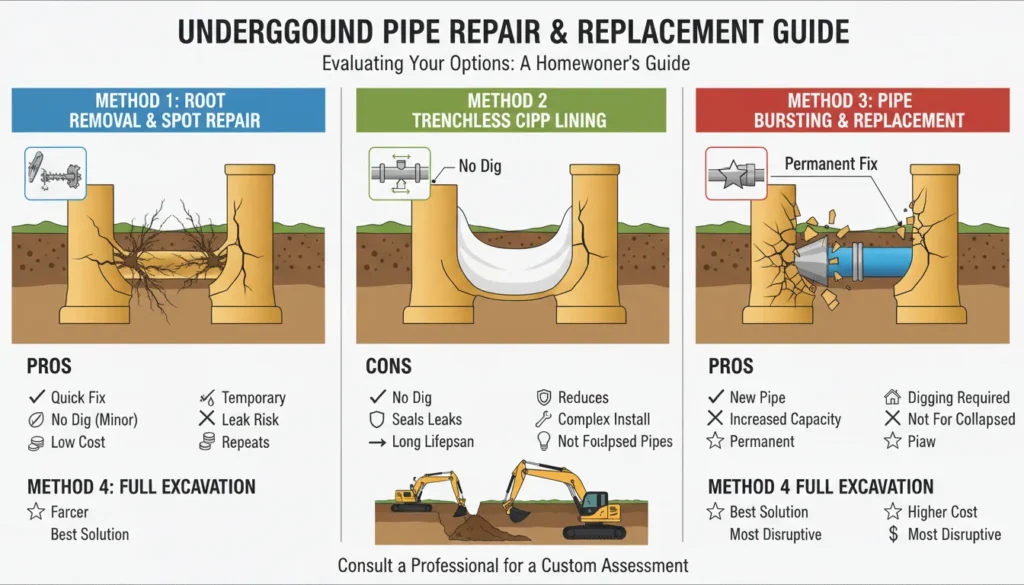
If your clay pipe is failing, you have four main options. The right choice depends on the severity of the damage and your budget.
Temporary Fix: Root Removal & Chemical Treatments (The “Band-Aid”)
The Process: A plumber uses a heavy-duty “snake” or hydro-jetter to cut the roots out of the pipe. Afterward, a chemical foaming agent is used to kill any remaining root ends.
The Reality: This is not a permanent fix. Roots grow back within 6–12 months because the crack in the joint is still there.
Cost: Low ($300 – $800), but you will pay this every year.
Trenchless Pipe Lining (CIPP) – Repairing from the Inside
The Process: Known as “Cured-In-Place Pipe” (CIPP), a flexible liner saturated with epoxy resin is pulled through the old clay pipe. Once it hardens, it creates a “pipe within a pipe.”
The Advantage: No digging required. It seals all cracks and joints, making the line 100% root-proof.
Cost: Mid-to-High ($125 – $250 per foot).
Trenchless Pipe Bursting: One-Step Replacement
The Process: A heavy bursting head is pulled through the old, brittle clay pipe, shattering it outward. Simultaneously, a new HDPE (High-Density Polyethylene) pipe is pulled into the space.
The Advantage: You get a brand-new, full-diameter pipe without digging a trench through your driveway or lawn.
Cost: High ($150 – $300 per foot).
Full Excavation: The Traditional Method
The Process: Plumbers dig a trench to remove the old clay pipes and install new PVC.
The Reality: This is only necessary if the clay pipe has completely collapsed and a liner cannot pass through it. In Miami, this often involves the extra cost of repairing landscaping, patios, or driveways.
Cost: Varies ($3,000 – $20,000+ depending on depth and length).
The Cost Factor: Repair vs. Replacement
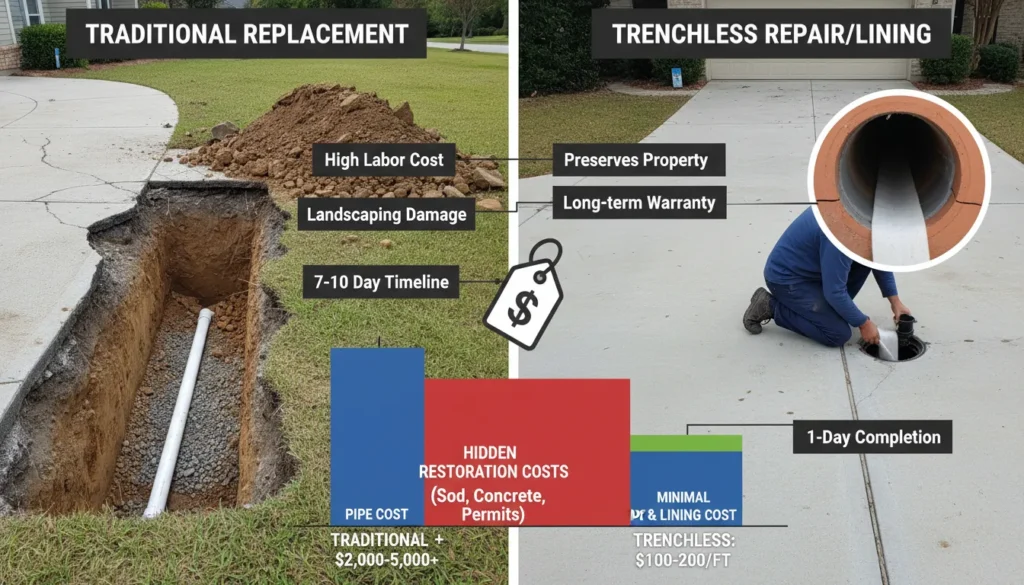
When dealing with failing clay pipes, the cheapest “upfront” price is often the most expensive in the long run. Here is the breakdown of what you can expect to pay in today’s market.
Clay Sewer Pipe Replacement Cost (Per Foot)
The cost of replacing a clay line depends heavily on the method used:
Traditional Excavation: $50 – $250 per linear foot. While the pipe material (PVC) is cheap, the labor to dig a 6-foot deep trench is expensive.
Trenchless Pipe Lining (CIPP): $125 – $250 per linear foot. You pay for the high-tech epoxy resin and specialized equipment, but you save your driveway.
Pipe Bursting: $150 – $300 per linear foot. This is the premium “one-and-done” permanent replacement.
The “Hidden Costs” of Sewer Work
A quote for “pipe replacement” rarely covers everything. In Miami, you must account for:
Permits and Inspections: Miami-Dade or Broward counties require plumbing permits and a final inspection by a city official. (Estimated: $200 – $600)
Camera Inspections: Before any work starts, a high-definition sewer camera must be used to map the line. (Estimated: $250 – $500)
Landscaping & Restoration: If you choose traditional digging, you will have to pay to replace your sod, pavers, or concrete driveway once the plumber is finished. (Estimated: $1,000 – $5,000+)
Insurance: Does Homeowners Insurance Cover Clay Pipe Failure?
This is the most common question we get.
The Bad News: Standard homeowners insurance typically does not cover “wear and tear” or “gradual deterioration” (which includes 50-year-old clay pipes failing or root intrusion).
The Exception: Insurance may cover the damage if the pipe suddenly “bursts” and floods your home, but they rarely pay for the pipe itself.
Pro Tip: Check if you have a “Service Line Coverage” rider on your policy. This is an optional add-on that specifically covers the cost of repairing underground utility lines.
Expert Maintenance: How to Prevent Clay Pipe Damage
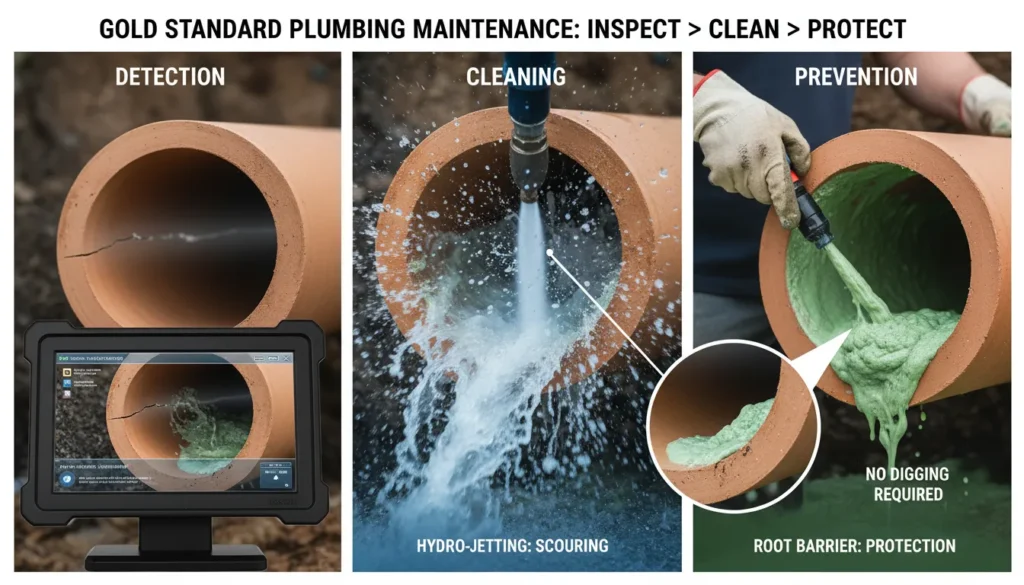
If you have an older home in Miami, you don’t have to wait for a backup to take action. Proactive maintenance can extend the life of your clay sewer line by years and prevent expensive emergency repairs.
Annual Camera Inspections: The “Check-Up”
The only way to truly know the condition of a clay pipe is to see it from the inside. A high-definition sewer camera is pushed through the line to identify tiny cracks or the very beginning of root growth.
Pro Tip: In Miami, do this every 12 to 24 months if you have large trees on your property. Catching a small root today prevents a collapsed pipe next year.
Hydro Jetting: High-Pressure Cleaning
Hydro jetting uses specialized nozzles to blast water at up to 4,000 PSI through your sewer line.
The Pros: It scours the pipe walls clean, removing grease, scale, and even thick tree roots that a standard snake might miss.
The Cons: If your clay pipe is already very old and “crumbly,” the high pressure could potentially cause further damage. Always perform a camera inspection before hydro jetting an old clay line.
Root Killers: Chemical Barriers
Since we know tree roots are the #1 cause of clay pipe failure, using a chemical root inhibitor is a smart move.
How it works: Products containing Copper Sulfate or Dichlobenil (foaming root killers) are flushed down the toilet. The foam fills the entire pipe and kills any roots it touches without killing the tree itself.
Frequency: Most experts recommend a treatment once or twice a year to keep the “Bell and Spigot” joints clear.
The Future of Your Home’s Drainage
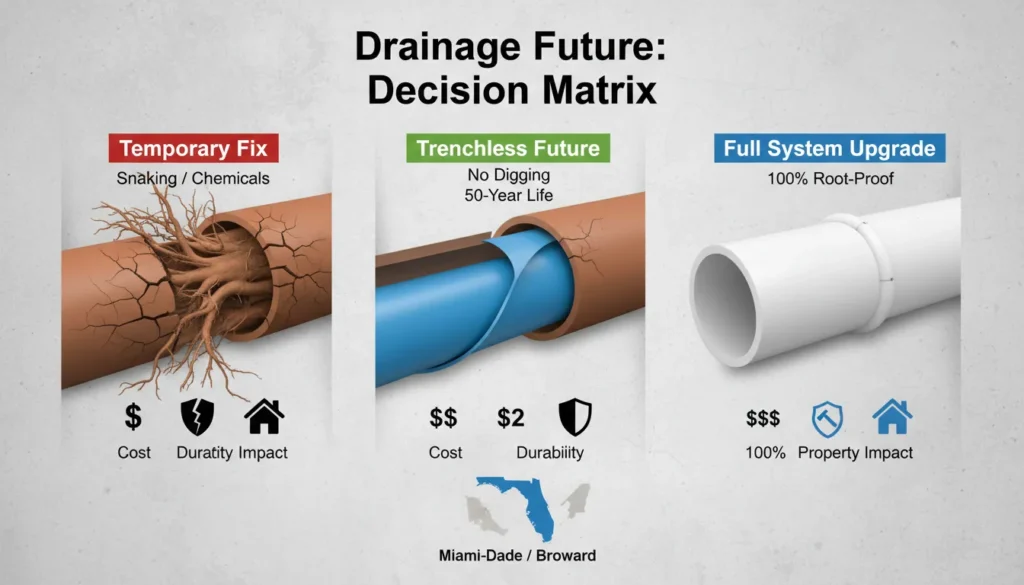
Navigating the world of clay sewer pipes can be overwhelming, but for Miami homeowners, the choice usually comes down to one thing: Long-term reliability. While these vintage pipes have served South Florida for decades, their “Bell and Spigot” design and brittle nature make them a ticking time bomb in modern conditions.
Should You Repair or Replace?
To help you decide, follow this expert rule of thumb:
Choose REPAIR (Cleaning/Root Treatment) if: Your pipes are structurally sound, you have very minor root growth, and you are on a tight budget. Just remember, this is a maintenance task, not a permanent fix.
Choose REPAIR (Trenchless Lining) if: Your clay pipe has cracks or root intrusion but has not collapsed. This is the best way to save your landscaping and driveway while getting a 50-year warranty.
Choose REPLACEMENT (Excavation or Bursting) if: The clay pipe has “bellied” (sagged), collapsed completely, or the joints are so offset that a camera cannot pass through.
The Final Verdict
If you live in an older Miami neighborhood, don’t wait for a sewage backup to flood your home. The cost of a preventative camera inspection is nothing compared to the cost of an emergency cleanup. Whether you choose to line your pipes or replace them entirely, moving away from aging clay is the best investment you can make for your home’s infrastructure.
Frequently Asked Questions
They are brittle and have many joints. This makes them prone to cracking under ground pressure and highly susceptible to tree root intrusion.
If they are cracked, collapsed, or causing frequent backups, yes. Modern PVC is a much more reliable, root-proof alternative.
It refers to the maximum distance (in feet) between a trap and its vent based on the pipe’s diameter. (Note: Specifics vary by local Miami-Dade/Florida building codes).
Typically 50 to 100 years. However, the joints usually fail much sooner (around 30–50 years).
For a full interior and exterior replumb, costs typically range from $8,000 to $15,000, depending on the materials used (like PEX or PVC).
Standard policies usually do not cover age-related wear and tear or roots. They only cover “sudden and accidental” damage unless you have a specific “Service Line” rider.
Yes, but it may lower the home’s value or make it harder for the buyer to get insurance, as these pipes are known for rusting and low pressure.
In most residential areas, they are buried 3 to 6 feet deep, though they can be deeper depending on the slope to the city main.
If it is “channeling” (the bottom is rusted out) or heavily corroded, replacement is necessary to prevent structural soil failure under your home.