7 Brutal Top Load Washer Secrets: Why Most 2026 Models Fail Early
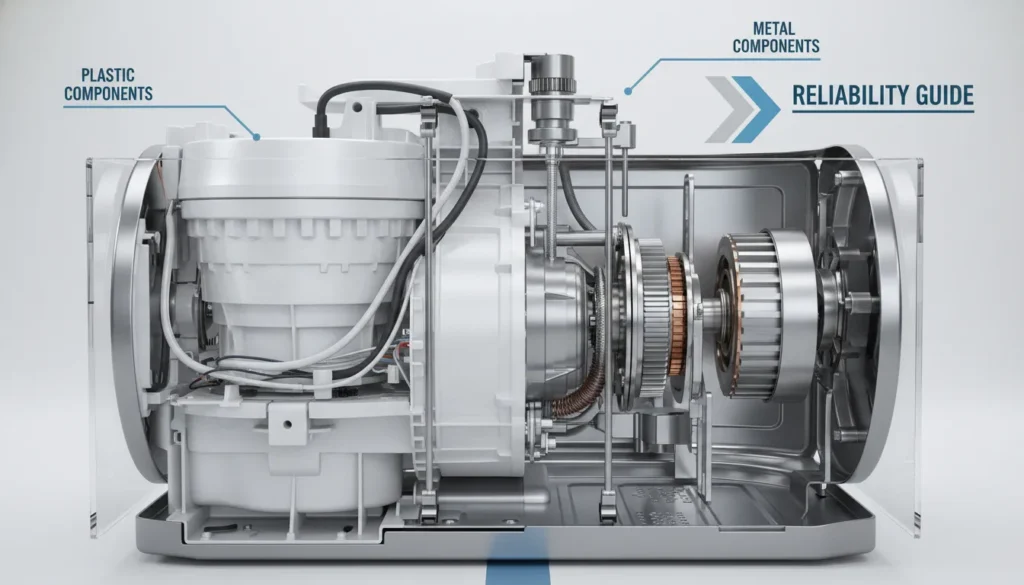
Most modern top load washers last only 6 to 9 years because of cheap plastic components and complex electronics. To get 15+ years of service, you must choose a machine with a direct-drive motor and avoid over-relying on “Smart” features that are prone to board failure.
The Reality of Modern Laundry
Buying a new washer in 2026 feels like a gamble. You see shiny touchscreens and “AI” sensors, but underneath the cabinet, many brands have replaced heavy-duty steel with plastic gear sets and thin suspension rods.
As someone who has seen thousands of these machines torn apart on the repair bench, I can tell you: complexity is the enemy of longevity.
Why Your Salesman is Wrong
The “Efficiency” Trap: High-efficiency (HE) models save water but often lead to bearing failure if you use too much detergent.
The “Smart” Myth: A Wi-Fi-connected control board costs $350+ to replace—often more than the machine is worth after five years.
The Agitator vs. Impeller Debate: It isn’t just about clothes’ wear; it’s about mechanical stress on the motor.
In this guide, I’m stripping away the marketing fluff to give you the Top Load Washer Secrets that manufacturers don’t want you to know. Whether you are dealing with a banging noise, a suds error, or just looking to buy the last washer you’ll ever need, you’re in the right place.
The “Quick Answer” Hub: How Long Do Top Load Washers Really Last?
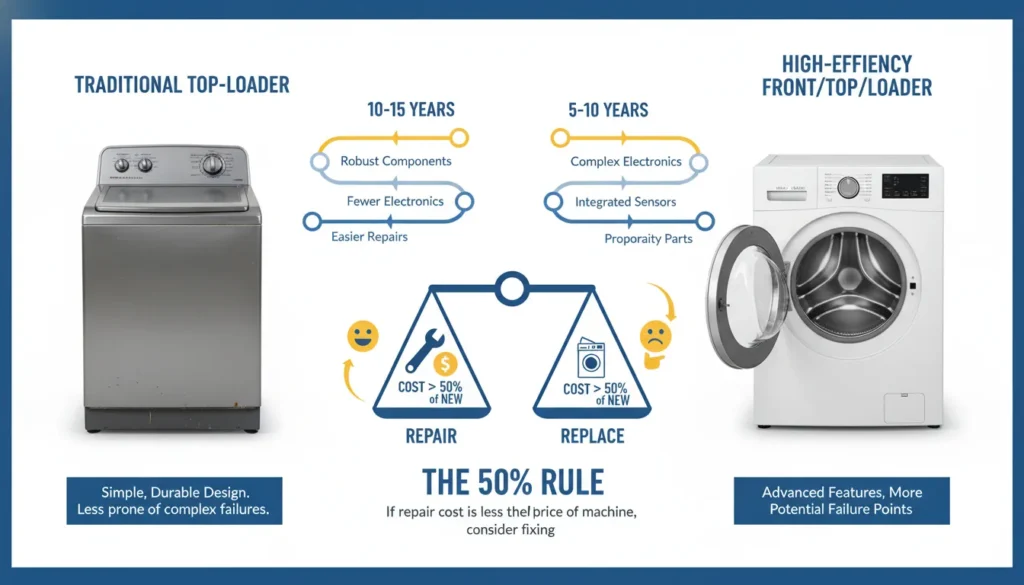
On average, a top load washer lasts 10 to 14 years in 2026, though high-efficiency (HE) models often trend closer to 8–11 years due to more complex electronics. If your machine is over 8 years old and the repair bill exceeds 50% of the cost of a new unit, it is financially smarter to replace it rather than fix it.
The 2026 Reliability Snapshot
| Washer Type | Expected Lifespan | Primary Failure Point |
| Traditional Agitator | 12–15 Years | Transmission / Belt |
| High-Efficiency (HE) | 8–12 Years | Control Board / Bearings |
| Commercial-Grade | 20+ Years | Minimal (Built to be fixed) |
The “50% Rule” for Repairs
Before you call a technician, use this expert math to see if you’re throwing money away:
The Math: Take the cost of the repair. If it’s more than half the price of a brand-new machine, stop.
The Age Factor: If your washer is 8+ years old, it has likely already completed 3,000+ cycles. At this stage, after one major repair, the pump or motor is usually next to fail.
The “Hidden” Cost: Don’t forget that a 2026 model uses roughly 30% less water and energy than a 10-year-old unit, saving you about $50–$200 per year in utilities.
Hidden Top Load Washer Secrets Your Salesman Won’t Tell You
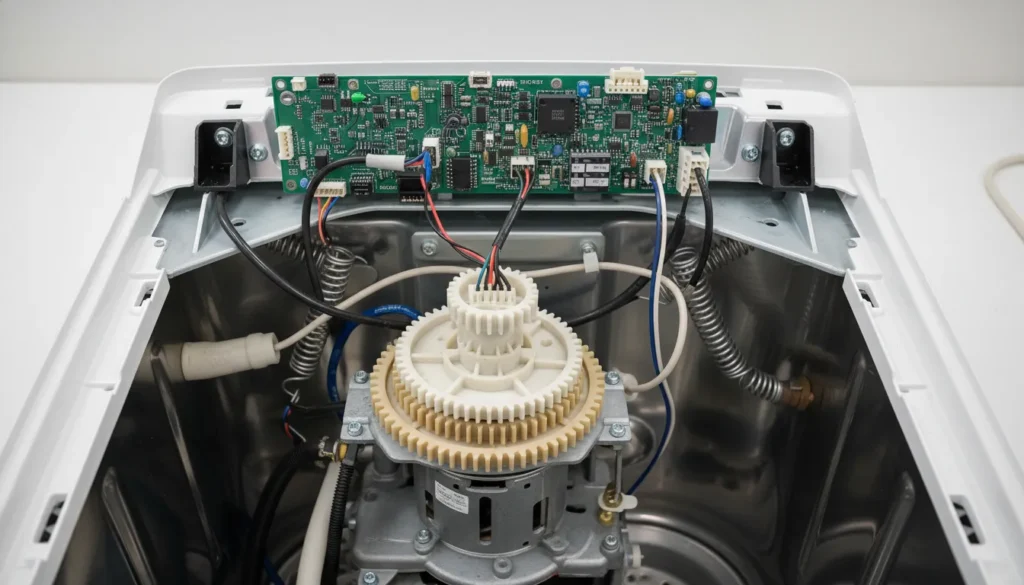
⚠️ Look Closely: Modern manufacturers often use plastic gear assemblies to save costs. If your machine sounds like it’s grinding metal, these are the ‘secrets’ starting to fail!
Modern marketing focuses on “Smart” features, but the truth about top load washer reliability lies in what you can’t see. Behind the shiny exterior, manufacturers have made specific engineering shifts that trade long-term durability for lower production costs.
The Death of the Transmission: Plastic vs. Metal
In older models, the transmission (gearbox) was a heavy, cast-iron unit filled with metal gears and oil. In 2026, many “budget-friendly” models use plastic orbital gears.
The Problem: Plastic gears are quieter but cannot handle the heat or torque of heavy loads (like jeans or towels) over time.
The Secret: If you hear a high-pitched whining or grinding noise during the spin cycle, your plastic gears are likely stripping. Once they go, the repair usually costs more than the machine.
Planned Obsolescence vs. Build Quality
Manufacturers know most consumers buy based on price and “Smart” labels. This has led to “Clip-Fit” production:
Bushings instead of Bearings: High-end units use ball bearings for smooth spinning. Cheaper models use plastic bushings that wear out, causing the dreaded tub wobble.
Pressed Motors: Unlike older rebuildable motors, modern motors are often riveted shut. If a tiny internal component fails, you have to replace the entire motor assembly ($250+).
The “Smart” Control Board Trap
The most expensive part of a modern top load washer is the electronic control board—the “brain” of the machine.
Humidity is the Enemy: In many machines, the control board is poorly shielded from the steam rising out of the tub. This leads to corrosion and random error codes.
Voltage Spikes: Modern boards are sensitive to power fluctuations. Without a dedicated surge protector, a single thunderstorm can “fry” your $400 control board instantly.
Pro Tip: Always look for a washer with mechanical knobs or “Tactile Buttons” rather than a full touchscreen. They are significantly cheaper to repair and last twice as long in humid laundry rooms.
Agitator vs. Impeller: The Engineering Truth for 2026
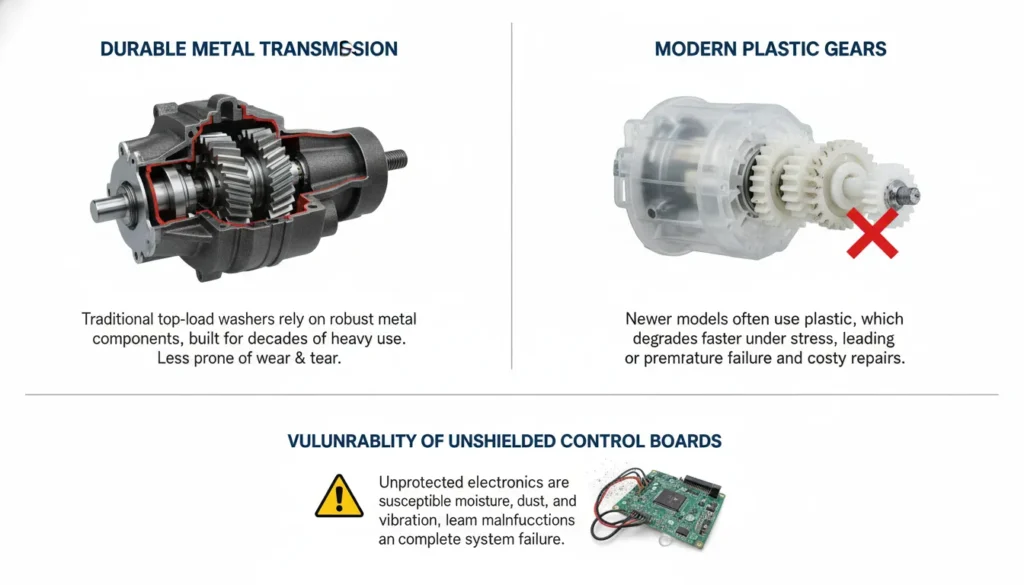
🔍 Visual Recap: What’s Under the Hood?
| The Gears: | Old = Cast Iron | New = Plastic Orbital |
| The Brain: | “Smart” Boards are sensitive to Humidity & Spikes |
| The Motor: | Many are Riveted Shut (Not Repairable) |
*Note: The image above highlights these exact failure points mentioned in our guide.*
When you open the lid of a top load washer, you’ll see one of two things: a tall central post (Agitator) or a low-profile disc at the bottom (Impeller). While salesmen focus on “gentleness,” the real difference is in the mechanical friction used to lift stains.
Why the “Dual-Action Agitator” is Making a Comeback
In 2026, we are seeing a massive return to the dual-action agitator. Unlike a single-piece post, the top half moves independently to spiral clothes downward, while the bottom fins scrub them clean.
The Benefit: It solves the “floating load” problem where clothes just sit on top of the water.
Expert Insight: If you wash heavily soiled work clothes, mud, or pet bedding, an agitator is non-negotiable. It provides the physical “scrubbing” that water jets alone cannot mimic.
The “Deep Fill” Myth: More Water ≠ Cleaner Clothes
One of the biggest top load washer secrets is that modern HE (High-Efficiency) machines are designed to clean with concentrated detergent.
The Reality: When you hit the “Deep Fill” button, you dilute the detergent enzymes.
When to use it: Only use Deep Fill for bulky items like comforters where you need to flush out heavy debris (like sand or pet hair). For normal loads, the extra water actually reduces the friction needed to get clothes clean.
Agitator vs Impeller – The Real Cleaning Test
Impeller Washers: The “High-Capacity” Specialist
If you have a large family and wash five loads of “office casual” clothes a day, an impeller washer is your best friend.
More Volume: Without the center post, you gain about 0.5 to 0.8 cu. ft. of space—enough for one extra pair of jeans per load.
Gentle Care: Because it relies on clothes rubbing against each other rather than a plastic post, your T-shirts won’t stretch or “pill” as quickly.
Plumber-Approved Maintenance
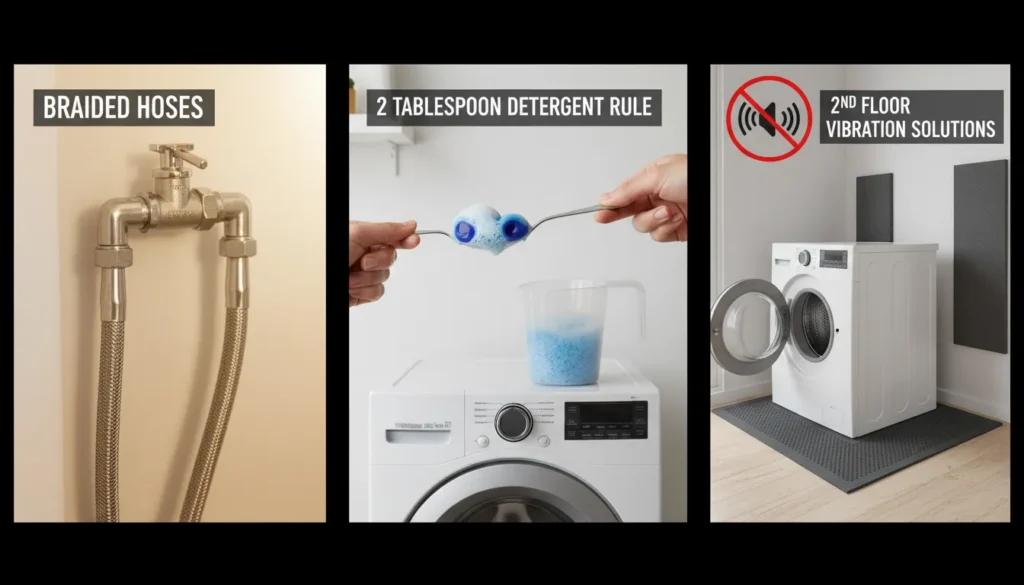
🔧
The Plumber’s “No-Flood” Checklist
Swap rubber for Braided Stainless Steel.
Strictly 2 tablespoons to save pump seals.
Use 3/4″ Plywood for 2nd-floor installs.
Ensure drain pipe isn’t airtight (Siphon check).
*Refer to the infographic above for visual placement of these components.*
A top load washer is a powerful machine that handles hundreds of pounds of moving weight. Without proper maintenance, that power will eventually shake the machine apart. As a plumber, I see the same three mistakes destroy machines every single week. Here is how to avoid them.
The “Suds Error” Trap: How HE Detergent Kills Your Pump
Most users see the “Suds” or “SD” error code and think they just used too much soap. The truth is scarier: excess suds act like a sandpaper paste on your pump’s seals.
The Secret: Modern HE washers only need 2 tablespoons of detergent. If you see bubbles during the rinse cycle, you’ve used too much.
The Fix: Run a monthly “Tub Clean” cycle with a dedicated descaler or two cups of white vinegar to dissolve the hidden “scrubbing” residue.
Braided Stainless Steel Hoses: Your $30 Insurance Policy
Rubber hoses are the #1 cause of catastrophic home floods. Over time, the constant water pressure causes rubber to “bubble” and eventually burst.
The Upgrade: Always replace factory rubber hoses with braided stainless steel. They are burst-resistant and have a much higher pressure rating.
Expert Tip: If your laundry room is on a second floor, look for “Auto-Shutoff” hoses. They have a built-in valve that snaps shut if they detect a sudden change in pressure.
2nd Floor Installation Secrets: Solving the Vibration Issue
If your top load washer is on a wooden floor (common in 2026 apartments), the floor acts like a drum, amplifying every vibration.
The 3/4″ Plywood Hack: If leveling the feet doesn’t stop the shaking, place a sheet of 3/4″ marine-grade plywood under the machine. Screw it directly into the floor joists to create a rigid platform.
Avoid “Tall Feet”: Keep the leveling legs as short as possible. The higher you unscrew them, the more “flex” you introduce, which leads to suspension rod failure.
The Drain Pipe Reality Check
Plumbers often find “drainage issues” aren’t caused by the machine, but by the house.
The 2-Inch Rule: Modern high-speed pumps move water so fast that old 1.5-inch drain pipes can’t keep up, leading to backups.
The Gap: Ensure there is a small gap where your washer’s drain hose enters the wall pipe. If it’s airtight, it can create a siphon effect that pulls water out of the machine while it’s still trying to wash.
The 2026 Reliability Leaderboard (Brand Analysis)
Choosing a brand in 2026 isn’t about who has the best TV commercials; it’s about service call rates. Based on recent industry data and technician reports, here is how the major players stack up in terms of real-world durability.
2026 Washer Reliability & Repairability Comparison
Service Rate: 3.7%
Repairability: High
Service Rate: 5.2%
Repairability: Medium
Service Rate: 5.5%
Repairability: Low
Service Rate: 6.1%
Repairability: Medium
Service Rate: 8.4%
Repairability: Low
The “Gold Standard”: Speed Queen (TC5 & TR7)
If you want a top load washer that lasts 20 years, Speed Queen is the only serious answer.
The Secret: They use a heavy-duty transmission and a solid steel tub. While others use plastic, they stick to metal.
The Trade-off: You pay more upfront (usually $1,200+), and they have smaller capacities. But in the long run, your cost-per-wash is the lowest in the industry.
The Modern Workhorse: Whirlpool & Maytag
These brands are the “safe bet” for most families. Because they share many internal parts, they are the easiest to repair for local plumbers and technicians.
Whirlpool: Known for its “Load & Go” systems and removable agitators. It’s the most versatile choice for 2026.
Maytag: Focuses on the “Pet Pro” niche. If your house is covered in dog hair, their specialized filtration system is a game-changer for protecting your drain pump.
The Tech Giant: LG
LG has dominated the “Impeller” (No agitator) market recently.
Reliability: Their Inverter Direct Drive motors are incredibly quiet and have very few mechanical failures.
The Warning: If the main control board fails, it’s expensive. Always use a surge protector with an LG to protect its sensitive electronics.
Common Mistakes: 5 Ways You’re Accidentally Killing Your Washer
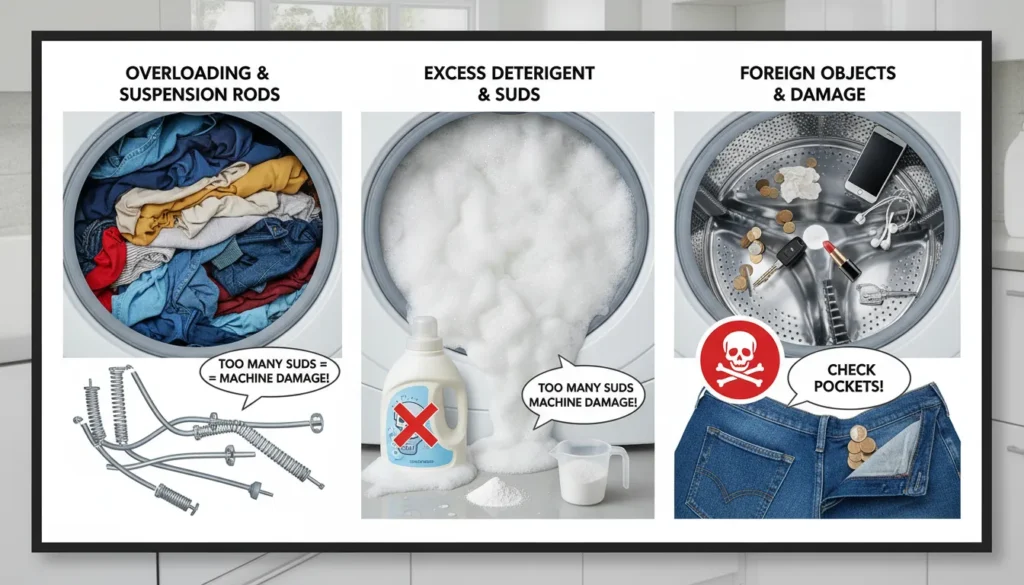
🚫
Are You Accidentally Killing Your Machine?
- [!] Overloading: Snap-testing your suspension rods.
- [!] Soap Overdose: Creating a mold-friendly biofilm.
- [!] Pocket Hazards: Coins that act like shrapnel for pumps.
- [!] Closing the Lid: Trapping humidity and frying circuits.
- [!] Balance Errors: Forcing a spin on a tilted tub.
*Check the infographic above to see the internal damage these mistakes cause!*
Most top load washer failures aren’t caused by bad luck—they are caused by small habits that strain the machine’s mechanical limits. If you want to avoid a $400 repair bill, stop doing these five things immediately.
1. Overloading the Suspension Rods
Modern washers use four thin steel rods to “float” the tub. When you cram too many heavy towels into a single load, you bottom out these rods.
The Symptom: If your machine starts making a loud “Banging Noise” or moves across the floor during the spin cycle, your suspension is shot.
The Rule: Never fill the tub more than 3/4 full (loose). Clothes need room to move, and your rods need room to breathe.
2. Using Too Much Detergent (The “Scrub” Effect)
As we discussed in the top load washer secrets section, more soap does not equal cleaner clothes.
The Damage: Excess detergent creates a “film” on the outer tub that leads to mold and odors. Even worse, it causes the pump to work twice as hard to push out the suds, leading to premature motor burnout.
3. Leaving Coins and Keys in Pockets
This seems minor, but it’s a leading cause of “dead” machines.
The Disaster: A small coin can slip between the inner and outer tub, eventually making its way into the drain pump impeller. One 10-cent coin can snap a plastic pump blade in seconds, causing a full-house flood.
4. Closing the Lid Immediately After Use
Top loaders are less prone to mold than front loaders, but they aren’t immune.
The Biofilm Risk: If you close the lid while the tub is still damp, you create a greenhouse for bacteria.
The Expert Fix: Leave the lid open for at least 2 hours after your last load. This allows the internal moisture to evaporate, protecting the electronics from humidity-driven corrosion.
5. Ignoring the “Out of Balance” Error
If your machine stops and displays an “uB” or “UE” error, don’t just hit “Start” again.
The Danger: Forcing a machine to spin an unbalanced load puts massive torque on the drive shaft.
The Fix: Open the lid, manually redistribute the heavy items, and then restart. Your transmission will thank you.
Top Load Washer FAQs (People Also Asked)
Is it worth fixing a 7-year-old washing machine?
It depends on the repair cost and the brand. Using the 50% Rule, if the repair costs more than half of a new top load washer, you should replace it. Since most modern units have a lifespan of 10–12 years, a 7-year-old machine is entering its “senior years,” and a major repair (like a transmission or motor) is often not a wise investment.
Which brand of top load washer lasts the longest?
Speed Queen is widely considered the longest-lasting brand, with a design life of 25 years (approx. 10,400 cycles). Among mainstream brands, Whirlpool and LG consistently rank high for reliability and the availability of replacement parts, making them easier to maintain over a decade or more.
Why is my new top load washer making clicking and humming sounds?
Modern HE washers use electronic actuators and sensors to calibrate the load. The “clicking” you hear is the lid locking and the shifter moving between sensing and agitation modes. Unlike older machines that filled with water immediately, 2026 models “dry-sense” the load size first to determine the exact amount of water needed.
How do I stop my washer from vibrating on a wooden floor?
The best solution is to ensure the leveling legs are as low as possible and locked with their jam nuts. If vibration continues, place a 3/4-inch plywood board under the machine to bridge the floor joists. You can also use anti-vibration rubber pads, but avoid “cheap foam” ones as they can actually make the wobbling worse by increasing the machine’s center of gravity.
Does a top loader use more water than a front loader?
Yes, typically. A traditional agitator top load washer can use up to 40 gallons per load, whereas a front loader uses about 13–15 gallons. However, modern HE top loaders have closed this gap significantly, using sensors to limit water usage to roughly 19–22 gallons per cycle.