- HOME
- Water Softener Filtration Systems
- Whole House Water Filtration Systems
Professional Water Filtration Systems in Miami: Whole-Home & Point-of-Use Solutions
At EZ Plumbing, we don’t just install filters; we engineer total water integrity. Whether you need to eliminate Miami’s hard water minerals, remove 99% of toxins for drinking safety, or protect your entire home’s plumbing from corrosion, this guide covers everything you need to know about 2026’s top-rated purification technology.
Why EZ Plumbing is Miami’s Choice for Pure Water
✅ Eliminate 99% of Contaminants
Our multi-stage systems are specifically calibrated for Miami’s municipal water, removing lead, chlorine, and PFAS that standard filters miss.
✅Double Your Appliance Lifespan
By removing corrosive minerals and sediment, we protect your water heater, dishwasher, and luxury fixtures from internal scale damage.
✅ Health-First Engineering
Experience softer skin, shinier hair, and pure drinking water that supports kidney health and superior hydration for your entire family.
- ⭐ Verified Expertise: IICRC Certified & State Licensed Plumbing Contractors.
- 💰 Instant Value: $50 Flat-Rate Discount applied to all new system installations.
- 🧪 Zero-Risk Start: Complimentary on-site Water Hardness & Purity Analysis included.
What is the Best Water Filtration Method for Your Home?
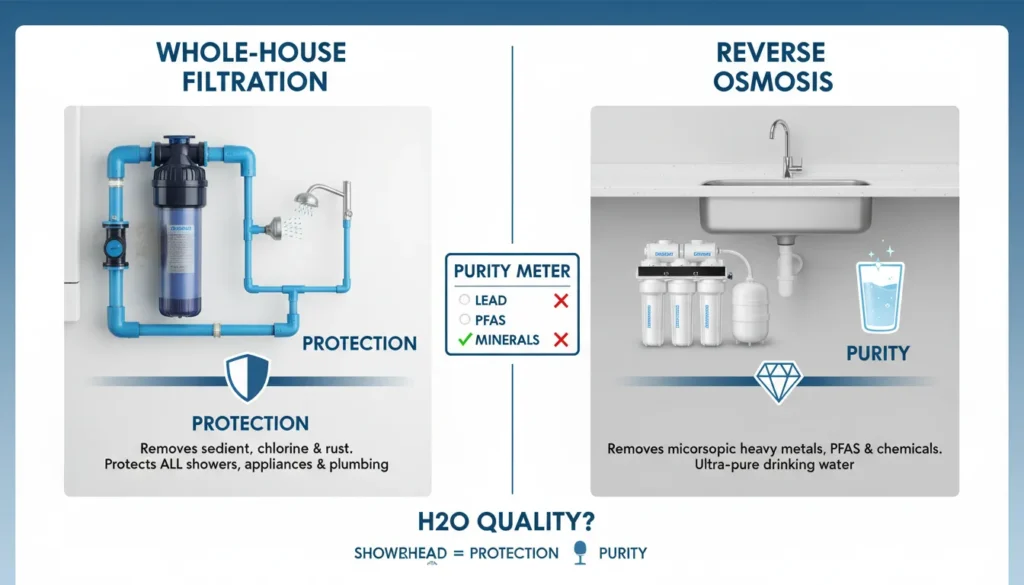
The best water filtration method depends on whether your priority is the purity of your drinking water or the protection of your home’s entire plumbing infrastructure. For comprehensive results, a combination of technologies is often required to address different types of contaminants.
The Direct Comparison: Whole-House vs. Reverse Osmosis
Whole-House Filtration Point-of-Entry
This method is considered the best for appliance protection and skin health. It is installed at the main water line and removes sediment, chlorine, and minerals from every tap. It prevents limescale buildup in water heaters and dishwashers while ensuring chlorine-free water for showers.
Reverse Osmosis Point-of-Use
This is the superior method for high-purity drinking and cooking water. It uses a semi-permeable membrane to remove up to 99% of dissolved solids, including lead, arsenic, and PFAS. It is typically installed under the kitchen sink to provide bottled-quality water on demand.
Activated Carbon Filtration
Ideal for improving taste and odor. It utilizes adsorption to trap organic chemicals and VOCs. This is often used as a primary stage in both Whole-House and RO systems.
Understanding the Water Filtration Process
The most effective water filtration process follows a multi-stage approach to ensure no contaminants are missed:
Pre-Filtration: A sediment filter removes large particles like sand, rust, and silt.
Chemical Removal: Activated carbon filters adsorb chlorine and unpleasant odors.
Membrane Purification: Reverse Osmosis (RO) strips away microscopic dissolved solids and heavy metals.
UV Sterilization: An ultraviolet light stage neutralizes 99.9% of bacteria and viruses (crucial for well water).
Post-Filtration/Remineralization: A final stage polishes the water for taste and adds back essential minerals like calcium and magnesium for pH balance.
Understanding the 5 Stages of Professional Water Filtration
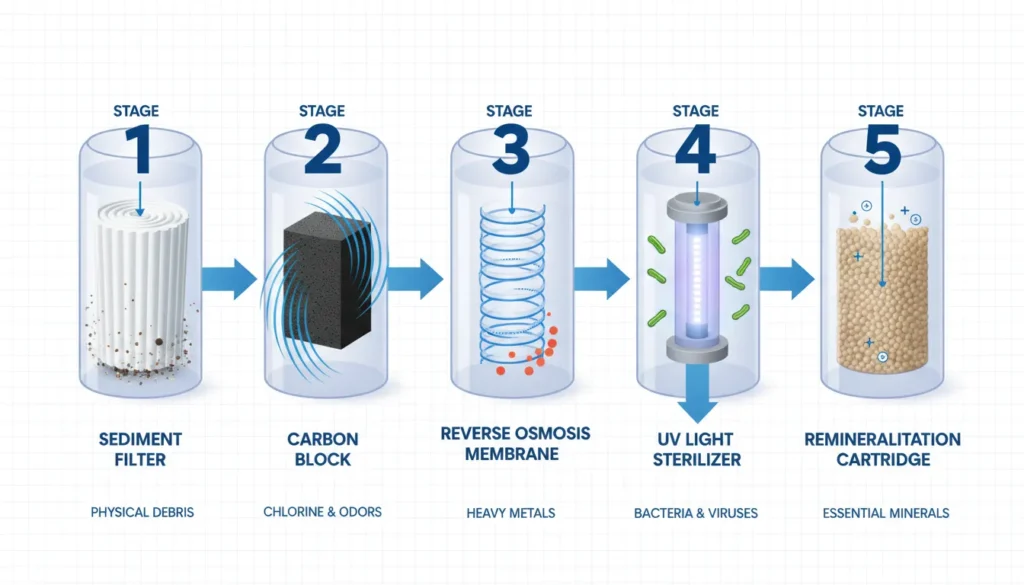
To achieve true water purity, a single filter is never enough. High-performance systems utilize a multi-stage “barrier” approach, where each level is designed to target specific molecular and physical contaminants. Below is the technical breakdown of the 5-stage process that defines industry-leading water treatment.
Stage 1: High-Capacity Sediment Filtration The Physical Barrier
The first line of defense involves a mechanical filter designed to trap suspended solids. This stage removes sand, silt, rust, and debris that can clog your plumbing and damage your appliances.
Target: Large particles (typically 5 to 20 microns).
Benefit: Extends the lifespan of the more delicate downstream filters.
Stage 2: Catalytic Activated Carbon Adsorption The Chemical Neutralizer
In this stage, water passes through highly porous carbon. Through a process called Adsorption, chemical contaminants stick to the surface area of the carbon.
NSF/ANSI Standard 42: This stage is certified to reduce aesthetic impurities like chlorine, improving taste and odor.
Target: VOCs (Volatile Organic Compounds), pesticides, and herbicides.
Stage 3: High-Rejection Reverse Osmosis The Molecular Sieve
Often considered the most critical stage, Reverse Osmosis (RO) forces water through a semi-permeable membrane at high pressure.
NSF/ANSI Standard 58: This is the gold standard for reducing total dissolved solids (TDS).
Target: Up to 99% of lead, arsenic, fluoride, nitrates, and microscopic heavy metals.
Stage 4: Ultraviolet UV Sterilization The Biological Guard
For homes on well water or areas with biological concerns, UV light is used to scramble the DNA of living organisms. Unlike chemicals, UV does not change the taste of water.
Target: 99.9% of bacteria, viruses, and cysts (such as E. coli and Giardia).
Expert Insight: This is a crucial addition for any “7-stage water filtration” configuration.
Stage 5: Alkaline Remineralization The pH Balancer
Since high-level purification can make water slightly acidic, the final stage passes water through natural mineral stones (calcium and magnesium).
NSF/ANSI Standard 53: Ensures the reduction of specific health-related contaminants while balancing pH.
Benefit: Restores a crisp, refreshing taste and ensures the water is not “aggressive” to your body or copper piping.
Top-Rated Systems: Pentair, Aquasure, and APEC Compared
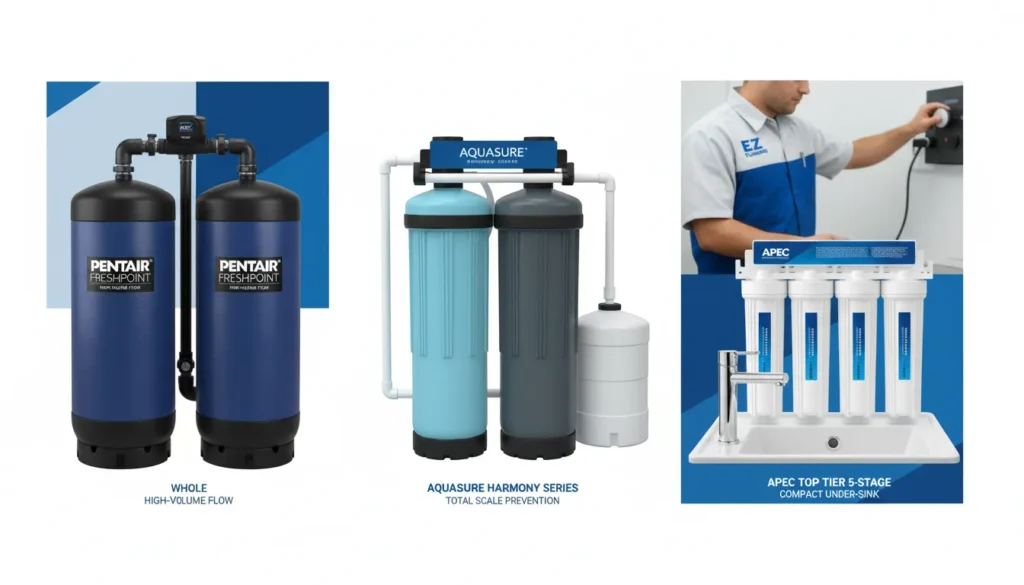
Selecting a water treatment solution requires understanding the balance between filtration capacity, maintenance requirements, and space availability. Based on performance data and laboratory certifications, we have analyzed the leading systems currently dominating the market to help you identify the ideal fit for your property.
Aquasure Harmony Series Best for Total Home Protection
The Aquasure Harmony Bundle is the definitive choice for homeowners dealing with both “Hard Water” and chemical contaminants.
Key Feature: Combines a high-efficiency water softener with a multi-stage filtration system.
Why it Wins: It is specifically engineered for scale prevention, protecting your plumbing infrastructure while providing high-flow purified water to every bathroom and kitchen tap.
Maintenance: Features a digital control head for automated regeneration, reducing salt waste.
APEC Top Tier 5-Stage Best for Drinking Water Purity
For those focused strictly on high-purity consumption, the APEC Top Tier 5-Stage remains the gold standard in Point-of-Use (POU) filtration.
Key Feature: High-rejection Reverse Osmosis (RO) membrane certified to NSF/ANSI Standard 58.
Why it Wins: It excels at contaminant removal, stripping away up to 99% of heavy metals, including lead, arsenic, and fluoride.
Build Quality: Uses food-grade, leak-free fittings and high-capacity filters that last twice as long as standard retail alternatives.
Waterdrop G3P600 Best for Space-Saving Efficiency
Modern kitchen designs often leave little room for bulky tanks. The Waterdrop G3P600 solves this with an advanced tankless design.
Key Feature: A 600 GPD (Gallons Per Day) high-flow, tankless RO system.
Why it Wins: It is the top choice for space-saving efficiency and produces much less wastewater than traditional models (2:1 pure-to-drain ratio).
Smart Tech: Includes a real-time TDS (Total Dissolved Solids) monitor and filter life indicator directly on the faucet.
Comparing Market Alternatives: Pentair vs. Kinetico vs. Whirlpoo
| System Model | Best For | Removal Rate | Maintenance Logic |
|---|---|---|---|
| Aquasure Harmony Bundle | Scale Prevention (Whole-Home) | 95% + Water Softening | Automated Digital Control |
| APEC Top Tier 5-Stage | Contaminant Removal (Drinking) | 99% Lead & Arsenic | Standard 12-Month Change |
| Waterdrop G3P600 | Space-Saving Efficiency | 99% Pure Tankless RO | 3-Second Filter Twist |
| Pentair FreshPoint | Industrial Durability | Heavy Duty / High Flow | Pro-Grade Maintenance |
Expert Buying Insight: How to Choose
When browsing for a Whirlpool water filtration unit or a professional Pentair water filtration system, always check the “Service Flow Rate.” A system that filters 99% of toxins is useless if it drops your shower’s water pressure to a trickle. For large homes (4+ bathrooms), we recommend high-capacity “entry-point” systems like the Aquasure Harmony to ensure volume and purity work in tandem.
2026 Cost Guide: Installation and Maintenance Estimates
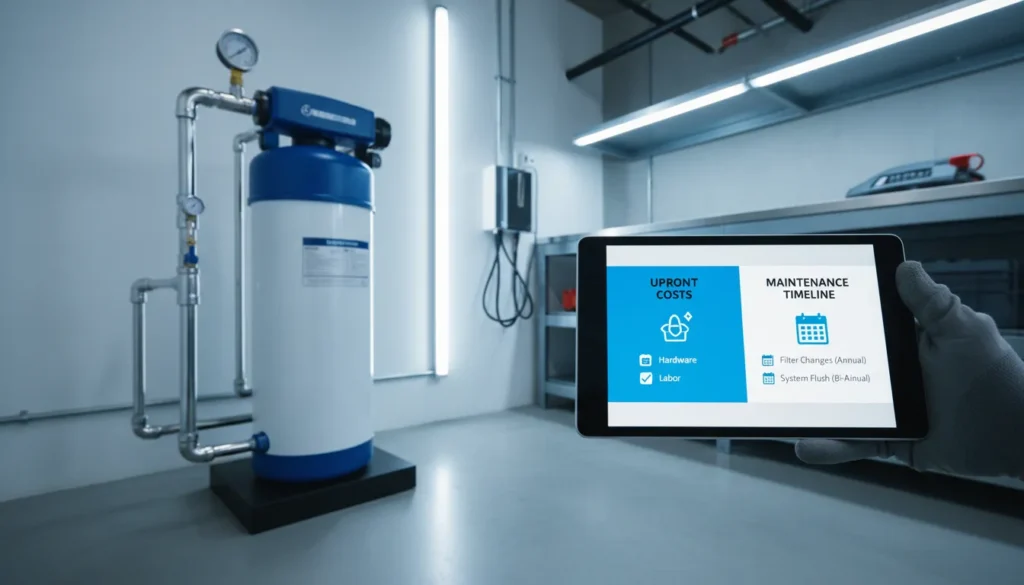
Understanding the whole home water filtration systems cost is the most critical step in your decision-making process. In 2026, the total investment is no longer just about the initial purchase; it’s about the “Total Cost of Ownership,” which includes professional installation, filter longevity, and annual maintenance.
Whether you are looking for a water filtration system for home near me or a specialized industrial-grade unit, the following data represents the current market averages for Miami and surrounding areas.
2026 Price & Maintenance Comparison Table
| System Type | Upfront Cost (Avg.) | Filter Life | Maintenance Needs |
|---|---|---|---|
| Whole-House (Standard) | $1,800 – $3,500 | 6 - 12 Months | Sediment flushing & Pre-filter change |
| Whole-House (Softener Bundle) | $3,500 – $6,500 | 3 - 5 Years (Membrane) | Salt refills & Resin cleaning |
| Under-Sink Reverse Osmosis | $450 – $1,200 | 6 - 24 Months | Stage 1-3 replacement & Sanitization |
| UV Purification Add-on | $600 – $1,100 | 9,000 Hours (Bulb) | Annual Lamp & Sleeve replacement |
Factors Influencing Your Total Investment
While the table above provides the technical averages, several variables can adjust your final quote:
Water Hardness Levels: Homes in Miami with high calcium carbonate (above 7 GPG) often require a water softener bundle to prevent the filtration membranes from clogging prematurely.
Plumbing Complexity: The cost to install a whole home water filtration system may increase if your main water line is difficult to access or requires significant re-piping to accommodate the new unit.
Filtration Stages: A 7-stage system provides higher purity than a 3-stage system but carries a higher annual filter replacement cost.
Pro-Tip: Saving on Maintenance
To ensure your system maintains its NSF/ANSI Standard performance, we recommend scheduling an annual “System Health Check.” Ignoring filter changes not only lowers water quality but can cause pressure drops that stress your home’s entire plumbing network.
Frequently Asked Questions About Water Purity
Navigating the world of water treatment can be complex. Below, we address the most common technical and health-related questions based on the latest 2026 water quality standards and consumer concerns.
In 2026, Reverse Osmosis (RO) with a Remineralization stage is the top choice. It removes 99% of contaminants while restoring healthy minerals for taste and pH balance. Brands like AquaTru and APEC consistently lead the market in purity tests.
A Multi-Stage Reverse Osmosis system is considered the “Gold Standard.” It combines mechanical sediment removal, carbon adsorption for chemicals, and a semi-permeable membrane to block microscopic toxins like lead and PFAS.
On average, homeowners spend between $1,130 and $3,500. Under-sink RO units start around $150–$600, while comprehensive whole-house systems range from $1,500 to over $6,000 depending on complexity.
Yes, you can install a faucet-mounted filter or an under-sink RO unit in the bathroom. This is highly recommended in older buildings where lead pipes may affect water quality between the main line and your bathroom tap.
In the professional industry, filtration is categorized by how it treats the water:
Mechanical Filtration: Physically blocking particles (sediment, sand, rust).
Chemical/Adsorption Filtration: Using activated carbon to “stick” to and remove chlorine and VOCs.
Membrane/Molecular Filtration: Using Reverse Osmosis or Ultrafiltration to strip away dissolved solids at a microscopic level.
In technical and laboratory settings, water is graded by its purity level:
Type 3 (Primary Grade): Produced via RO; suitable for general home use and basic lab rinsing.
Type 2 (Analytical Grade): Further deionized; used for high-precision laboratory testing.
Type 1 (Ultrapure Water): The highest level of purity; used in semiconductor manufacturing and molecular biology. Most residential “Whole-Home” systems aim for high-quality Type 3 water.
While the benefits are overwhelming, users should consider two main drawbacks of water filters:
Maintenance Commitment: Filters must be changed on schedule (every 6–12 months) to prevent bacteria buildup and pressure drops.
Wastewater (RO only): Traditional Reverse Osmosis systems discharge “brine” water during the cleaning process, though modern 2026 tankless models have significantly improved this efficiency.
Secure Your Miami Home’s Water Integrity Today
The quality of your water dictates the health of your family and the longevity of your home’s infrastructure. In Miami, the presence of heavy minerals and municipal additives makes professional filtration a necessity rather than a luxury. By choosing a certified installation, you are not just filtering water—you are protecting your pipes from internal corrosion and ensuring every drop in your home meets 2026 safety standards.
At EZ Plumbing, we provide the technical expertise required to navigate Miami’s unique water challenges. Whether you are dealing with the scale buildup from hard water or the taste of chlorine, our team is ready to deploy a custom solution tailored to your property’s specific needs.
Why Miami Homeowners Trust Us
- Miami-Dade Coverage: We provide rapid, local service across the entire Miami metro area, ensuring your system is installed by technicians who understand local water pressure and chemistry
- Certified Technicians: Every installation is performed by IICRC-certified and state-licensed plumbing contractors, ensuring your manufacturer warranty remains 100% valid.
- 24/7 Support: Water issues don't follow a 9-to-5 schedule. We offer around-the-clock support for maintenance, filter replacements, and emergency system repairs.
