How Much Does It Cost to Replace a Water Heater in 2026? Full Breakdown
The Household Essential: The Silent Engine of Home Comfort
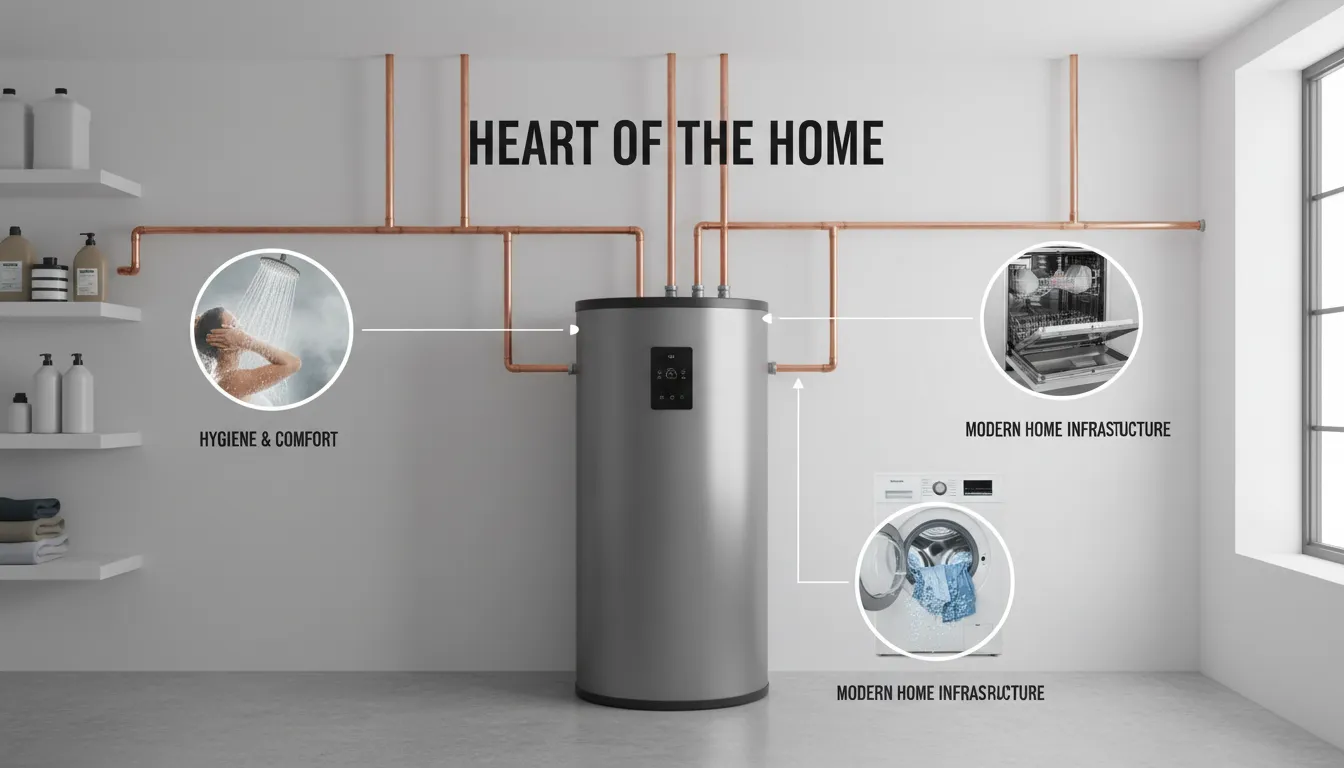
The water heater is arguably the most overlooked appliance in the modern home—until the shower runs cold.
Beyond just providing a comfortable morning rinse, your water heater is a critical hub for home hygiene, powering dishwashers and laundry cycles that keep your environment sanitary.
In 2026, these units have evolved into highly sophisticated systems, integrating smart technology and energy-efficient heat pumps that do more than just heat water; they manage one of your home’s largest energy loads.
The Replacement Trigger: Proactive vs. Reactive Spending
- Statistically, most homeowners wait for a catastrophic failure—usually a flooded basement or a total loss of hot water—before seeking a replacement.
- However, this “reactive” approach is the most expensive way to manage the appliance. By the time a unit fails, you are often forced into a “same-day” emergency installation, which can carry a 20–30% premium in labor costs and limits your ability to shop around for energy-efficient models or tax-eligible units.
Why Proactive Replacement Saves Money:
Avoid Emergency Fees: “Rush” plumbing services can add hundreds to your bill.
Prevent Property Damage: A leaking 50-gallon tank can cause thousands of dollars in water damage to flooring and drywall.
Strategic Upgrades: Planning ahead allows you to take advantage of seasonal sales and federal rebates that aren’t available during a 2:00 AM emergency.
Objective: The 2026 Data-Driven Outlook
This guide provides a transparent, evidence-based look at the water heater landscape as of February 2026. Whether you are currently staring at a puddle in your utility room or simply planning for the future, we will break down:
Current Costs: Why the average replacement now ranges between $1,600 and $2,500.
Lifespan Expectations: The difference between the 10-year traditional tank and the 20-year tankless investment.
The DIY vs. Pro Debate: Analyzing the safety risks, warranty implications, and local code requirements that define a modern installation.
The Bottom Line – Average Replacement Costs
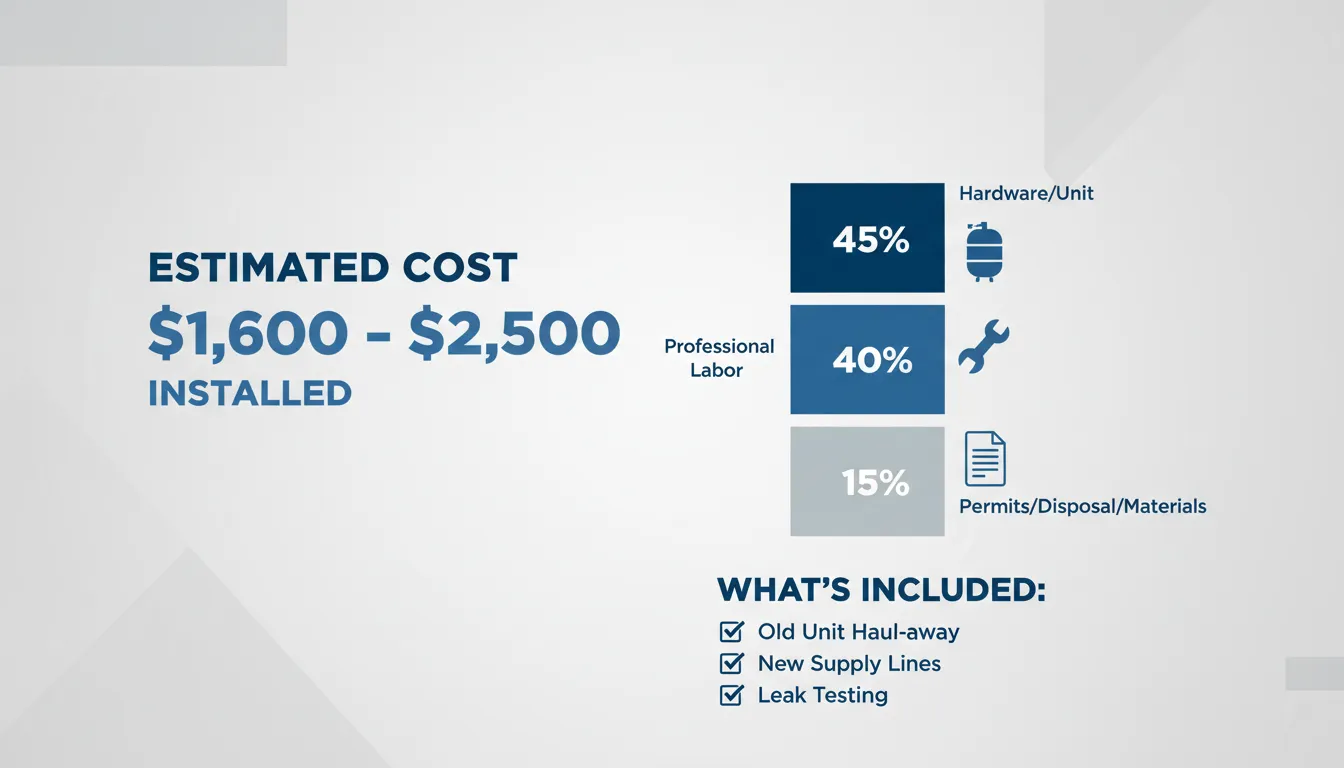
- Navigating the financial side of a water heater replacement requires an understanding of three distinct pillars: the hardware (unit), the expertise (labor), and the regulatory requirements (permits and disposal).
- In 2026, the national average for a standard tank replacement sits firmly between $1,600 and $2,500, but “basic” doesn’t always mean “simple.”
The Price Range: A Reality Check
While high-end hybrid or solar systems can soar above $5,000, most American households will fall into the $1,600–$2,500 bracket for a direct tank-for-tank swap. This range typically covers:
The Unit: $600 – $1,300 (standard 40–50 gallon tank).
Professional Labor: $600 – $1,000.
Disposal & Materials: $100 – $200 (includes hauling away the old unit and new supply lines).
Labor vs. Parts: Understanding the Plumber’s Invoice
The cost of labor is no longer a minor footnote; it often accounts for 40% to 60% of your total bill. Professional plumbers in 2026 generally follow two pricing models:
Flat-Fee Installation: Most high-volume plumbing companies offer a flat rate for a “standard swap,” which provides price certainty but may exclude “unforeseen” code upgrades.
Hourly Rates: Independent licensed plumbers typically charge between $100 and $200 per hour. A standard installation takes 2–4 hours, but complexity quickly adds up.
Why Labor Costs Vary:
Geographic Region: Homeowners in major metros like San Francisco or New York pay roughly 30–45% more than the national average due to higher overhead and strict licensing.
Installation Complexity: If your unit is in a tight crawlspace, an attic, or requires new venting to meet 2026 safety codes, expect a “difficulty surcharge” of $200–$500.
Retailer Installation Services: Home Depot vs. Lowe’s
Many homeowners turn to big-box retailers for convenience. Both Home Depot and Lowe’s act as “middlemen,” subcontracting the work to local licensed pros.
| Feature | The Home Depot (Typical 2026) | Lowe’s (Typical 2026) |
| Average Total Cost | $1,950 – $2,400 (Tank) | $1,800 – $2,300 (Tank) |
| Basic Labor Fee | Starts around $600 – $800 | Starts around $550 – $750 |
| Permit Handling | Included in quote (Approx. $100-$300) | Included in quote (Approx. $100-$300) |
| Pros | Often provides 1-year labor warranty. | Frequent “rebate” promos on installation. |
Important Note on Retailers: The price you see on the sticker in the aisle is only for the tank. Both retailers will charge extra for the mandatory permit (required by law in most states) and “basic hookup kits” (valves and connectors) which can add $150 to the final quote.
Visual Breakdown: Watch how professional labor and material costs are calculated in 2026.
Choosing Your Unit – Capacity and Fuel Types
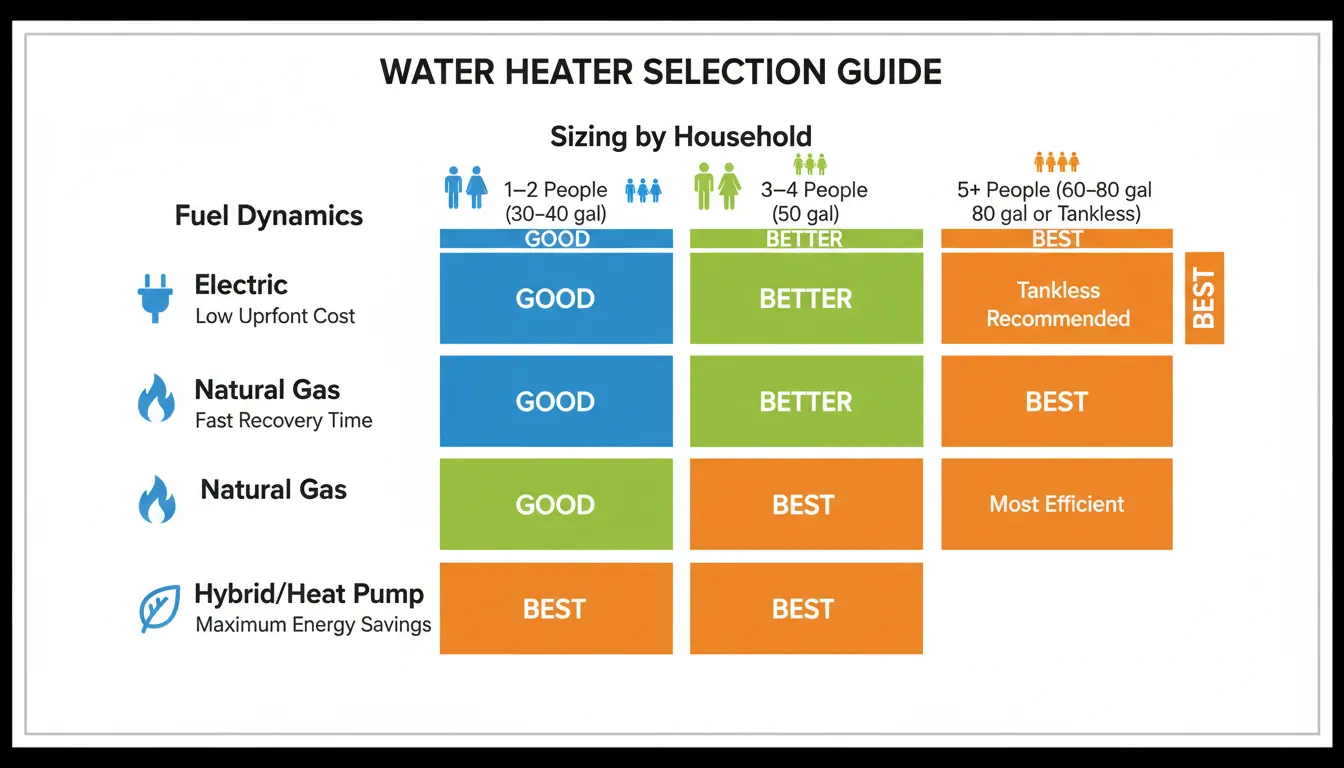
Selecting the right water heater is a balancing act between your family’s daily needs and your long-term utility budget. In 2026, sizing isn’t just about the physical footprint; it’s about “First Hour Rating” (FHR) and choosing a fuel source that aligns with modern energy incentives.
Sizing Your Home: 40-Gallon vs. 50-Gallon Tanks
- The choice between a 40-gallon and 50-gallon tank is the most common decision homeowners face.
- While a 10-gallon difference may seem minor, it represents a 25% increase in capacity, which can be the difference between a warm shower and a cold surprise.
The 40-Gallon Standard:
- Ideal for households of 1 to 2 people. It is compact, heats up quickly, and has lower “standby” heat loss. If you live in a smaller home or apartment with one bathroom, this is typically the most cost-effective choice.
The 50-Gallon Powerhouse:
- Recommended for families of 3 to 5. In 2026, 50-gallon units are often equipped with higher BTU burners (for gas) or dual elements (for electric), allowing them to handle “peak hour demand”—such as back-to-back showers and a running dishwasher—without a drop in temperature.
Expert Tip: Check the First Hour Rating (FHR) on the unit’s yellow EnergyGuide label. A 50-gallon tank with a high FHR can actually outperform a poorly insulated 60-gallon tank.
Fuel Source Dynamics: Gas vs. Electric
The infrastructure of your home usually dictates your fuel type, but if you have the option to switch, here is the 2026 cost-benefit breakdown:
Electric Water Heaters: * Upfront Cost: Cheapest to purchase and install. No venting or gas lines required.
Performance: Slower “recovery time” (the time it takes to reheat the tank after a long shower).
- Long-Term Spend: Electricity is generally more expensive per BTU than gas, leading to higher monthly bills.
Natural Gas Water Heaters:
Upfront Cost: Higher unit price and requires professional venting.
Performance: Faster recovery. A 50-gallon gas unit can often reheat in 30–45 minutes, compared to 60–90 minutes for electric.
Long-Term Spend: Lower monthly operating costs, though gas prices vary by region.
The Modern Shift: Heat Pump Hybrid Water Heaters
The most significant trend in 2026 is the rapid adoption of Heat Pump (Hybrid) water heaters. These units don’t “create” heat; they move it from the surrounding air into the tank, much like a refrigerator in reverse.
Why they are trending:
Hyper-Efficiency: They are 2 to 3 times more efficient than standard electric tanks.
Massive Savings: A typical family of four can save over $300–$500 per year on electricity.
Tax Incentives: In 2026, federal tax credits (like those under the Inflation Reduction Act) can cover up to 30% of the project cost (up to $2,000), making the “premium” price of a hybrid unit much more accessible.
Tank vs. Tankless – The 20-Year Investment
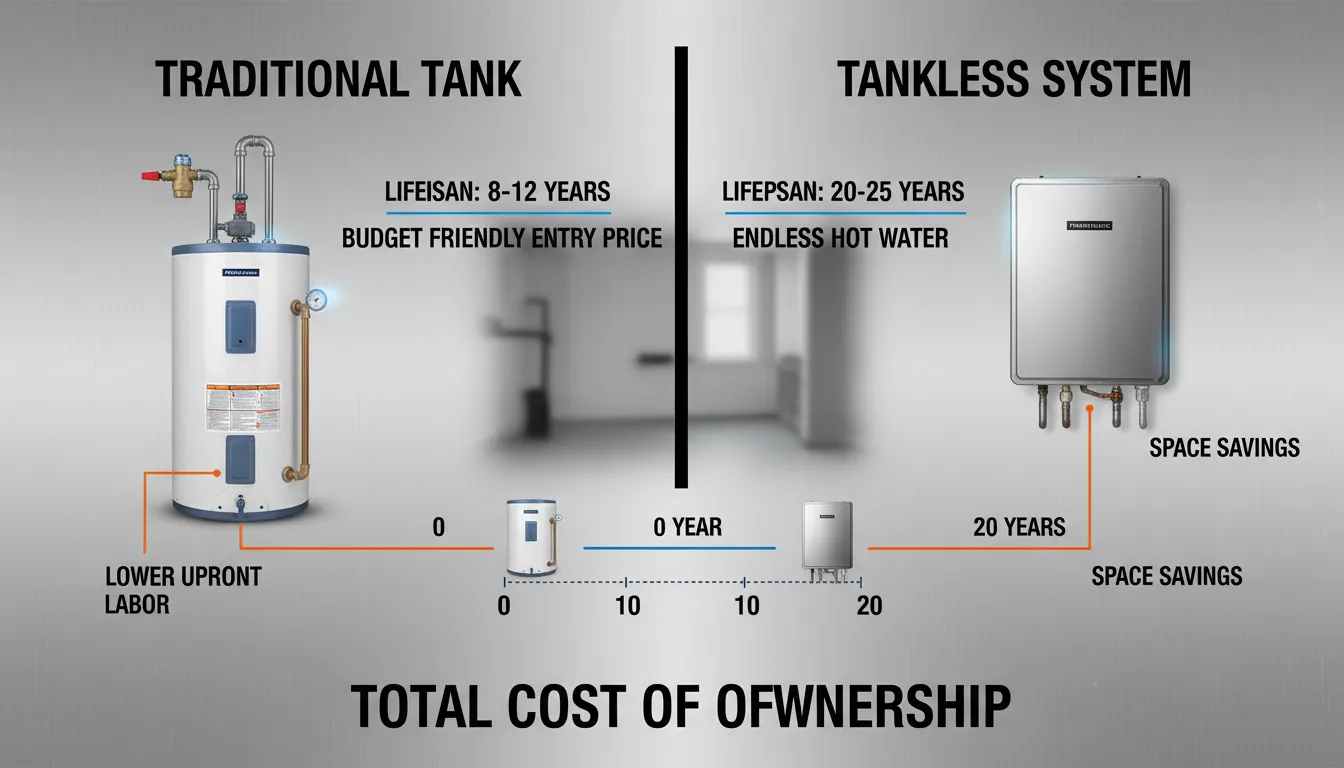
- When it comes to replacing a water heater in 2026, the debate usually boils down to the “budget-friendly classic” versus the “high-efficiency innovator.”
- While the upfront price difference is stark, the long-term value of a tankless system often bridges the gap for homeowners planning to stay in their properties for a decade or more.
Conventional Tanks: The Reliable 10-Year Choice
Traditional storage tank water heaters remain the most popular choice due to their lower entry price and simple mechanics. These units maintain a reservoir of hot water (usually 40 or 50 gallons) 24/7, regardless of whether you are home or asleep.
Lifespan: Typically 8 to 12 years. In hard water areas, this can drop significantly without regular maintenance.
Upfront Cost: Expect to pay $1,600 – $2,400 for a full professional installation.
The Downside: “Standby heat loss” occurs as the tank constantly reheats water to maintain its temperature, leading to higher monthly utility bills. Once the tank is empty, there is a “recovery period” of 30 to 60 minutes before hot water is available again.
Tankless On-Demand: The 20-Year Powerhouse
Tankless units, often called “on-demand” heaters, only heat water when a faucet is turned on. This eliminates the need for a bulky storage tank and provides a virtually endless supply of hot water.
Lifespan: Engineered for longevity, these units last 20 to 25 years—nearly double that of a tank.
Space Savings: These units are roughly the size of a carry-on suitcase and are mounted on the wall, reclaiming 9 to 12 square feet of floor space.
Upfront Cost: A complete installation for a whole-home gas tankless system in 2026 typically ranges from $3,900 to $5,500.
The “Hidden” Conversion Costs: Why Switching Costs More
The most common mistake homeowners make is assuming a tankless unit costs the same to install as a tank. If you are converting from a tank to a tankless system for the first time, your quote will include several “one-time” infrastructure upgrades:
| Upgrade Type | Estimated Cost (2026) | Why It Is Necessary |
| Gas Line Upsizing | $400 – $800 | Tankless units require a massive “burst” of gas to heat water instantly. Older 1/2-inch lines often must be upgraded to 3/4-inch. |
| Venting Modifications | $400 – $800 | High-efficiency gas tankless units produce acidic condensate and require specialized stainless steel or PVC venting that differs from old tank vents. |
| Electrical Circuit | $200 – $500 | Most gas tankless units require a dedicated 120V outlet for their digital control board and electronic ignition. |
The Bottom Line on ROI: While you may spend an extra $2,000 on the initial conversion, the extended lifespan means you are paying for installation labor once every 20 years instead of twice. When combined with energy savings of $100–$150 per year, the system often pays for itself by year 12.
Is It Time? Signs Your Water Heater is Failing
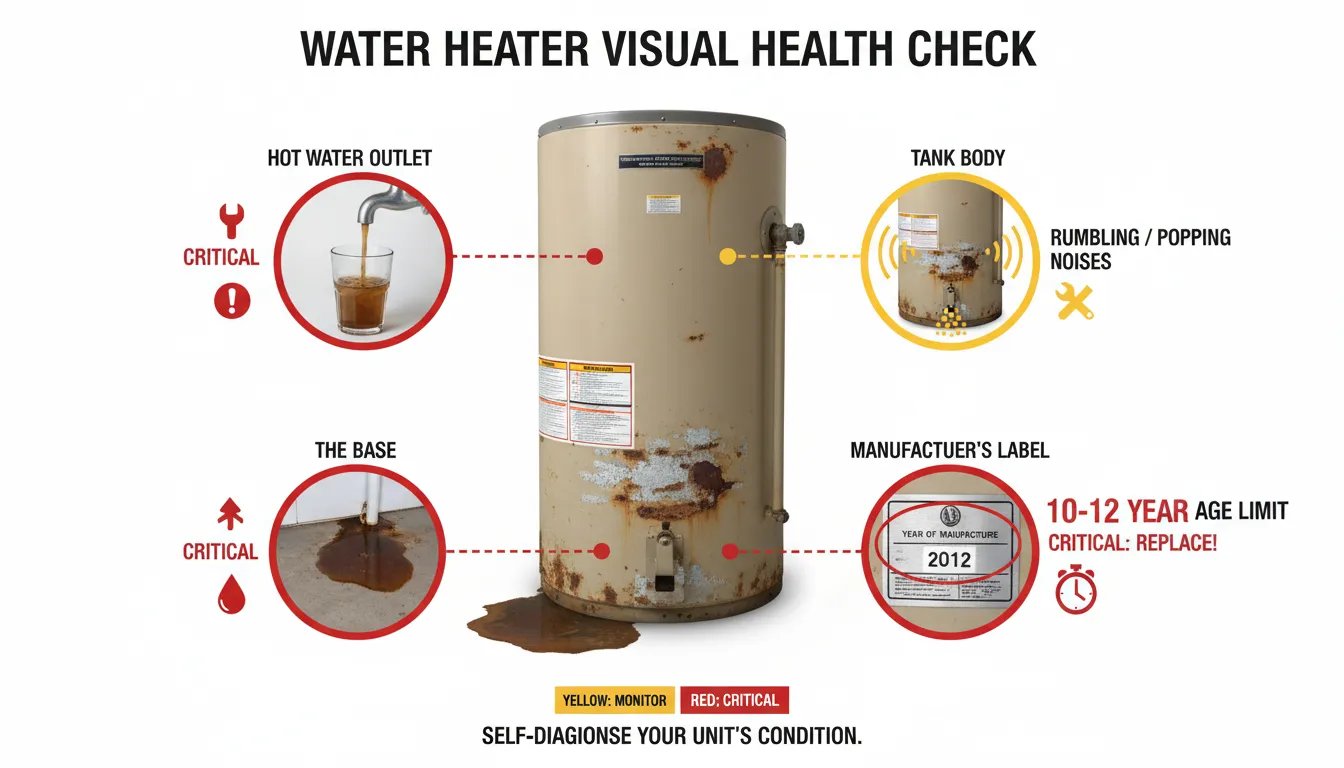
- Identifying a failing water heater before it becomes an emergency can save you thousands in restoration costs.
- In 2026, with the average home containing more high-value electronics and finished basements than ever, a “wait and see” approach is a high-risk gamble.
The Age Factor: The 10-Year “Ticking Time Bomb”
- While some units defy the odds, the structural integrity of a standard steel-tank water heater is fundamentally tied to its age.
The 10-12 Year Benchmark:
- Most conventional tanks are engineered with a 6-to-10-year warranty. Once a unit passes the 12-year mark, the internal protective glass lining has likely developed microscopic fractures, and the “sacrificial” anode rod (which prevents rust) is usually depleted.
Why it’s a Ticking Time Bomb:
- Internal corrosion is invisible. A tank that looks pristine on the outside could be paper-thin on the inside, leading to a sudden, catastrophic seam failure.
Visual and Audible Cues: What to Look, Listen, and Smell For
Your water heater will often attempt to “communicate” its distress through these three primary warning signs:
Rusty or Discolored Water:
- If your cold water runs clear but your hot water has a reddish, brown, or orange tint, it’s a definitive sign of internal tank corrosion. This means the steel is oxidizing directly into your water supply.
Popping and Rumbling Noises:
- Often described as “popcorn cooking” or “thundering,” these sounds occur due to sediment buildup (calcium and magnesium). This layer of “scale” traps water underneath it; as the burner heats that trapped water, it turns to steam and “pops” through the sediment crust.
- Expert Insight: This doesn’t just make noise; it creates “hot spots” that weaken the tank’s metal and force your heater to run longer, skyrocketing your energy bills.
The Fatal Sign: Moisture at the Base:
- If you find pooling water or dampness around the bottom of the unit, it is a critical red flag.
- Is it just a valve? Sometimes moisture comes from a loose connection or a faulty Temperature & Pressure (T&P) relief valve.
- The Death Knell: If the moisture is seeping from the bottom seams of the tank jacket itself, the internal vessel has breached. This cannot be repaired.
To Repair or Replace? The “50% Rule”
Deciding whether to sink money into an old unit or invest in a new one is a simple mathematical exercise used by top-tier plumbers in 2026.
The 50% Rule: If the cost of the repair (labor + parts) exceeds 50% of the price of a brand-new installation, you should replace the unit.
Why the 50% Rule works:
Warranty Reset: A $500 repair on a 9-year-old tank only warranties that specific part for a few months. A new unit provides a fresh 6-to-12-year warranty on the entire system.
Efficiency Gains: Replacing a decade-old unit with a modern 2026 model typically reduces energy consumption by 15–25%, meaning the “extra” cost of replacement starts paying for itself on day one.
Risk Mitigation: Fixing a heating element on a 12-year-old tank doesn’t stop the tank from leaking next month.
Beyond the Unit – Common Codes and Upgrades
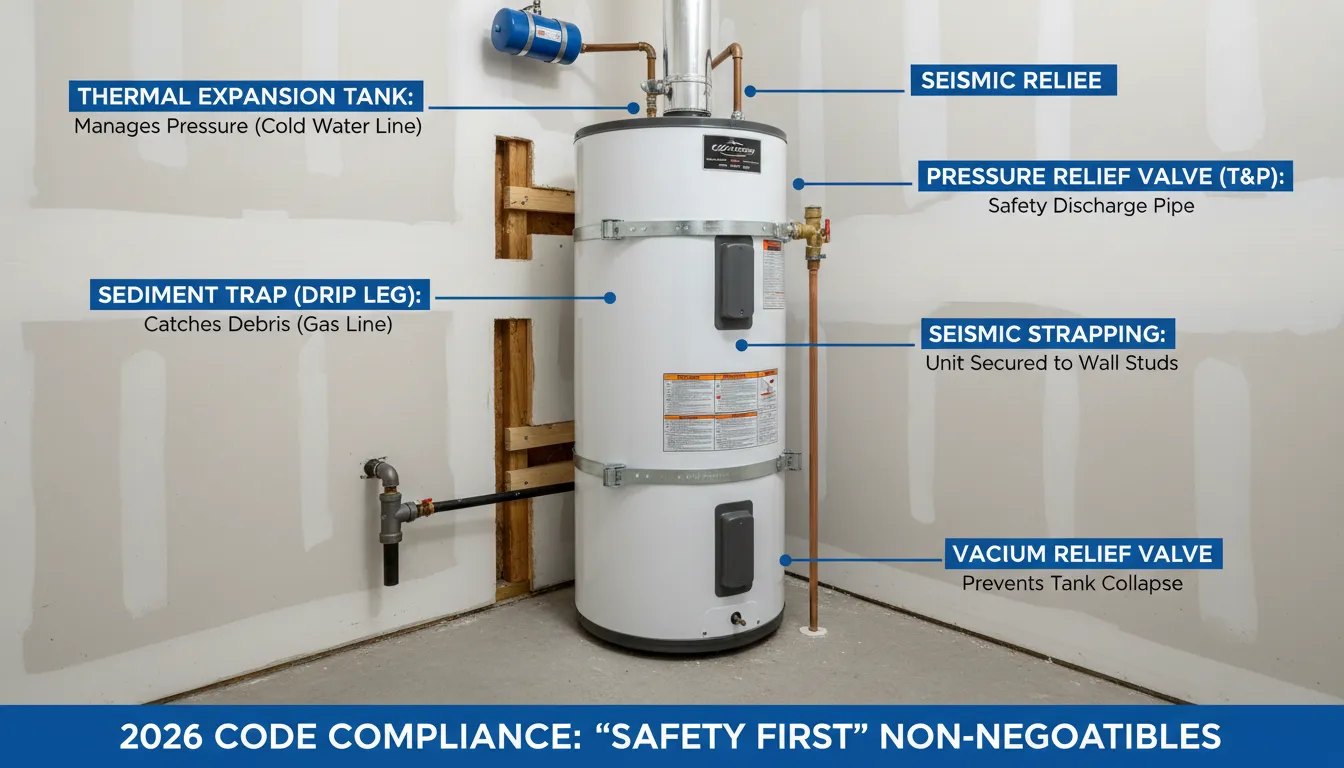
- When budgeting for a water heater replacement in 2026, many homeowners are surprised to find that the “sticker price” of the unit is only part of the story.
- Modern building codes have introduced mandatory safety and efficiency upgrades that, while adding to the initial cost, are designed to protect your home from flooding, fires, and structural damage.
Thermal Expansion Tanks: Protecting Your Plumbing “Heart”
- A thermal expansion tank is a small, basketball-sized vessel installed on the cold water line above your heater. In 2026, these are a code requirement in nearly all jurisdictions that operate on a “closed” plumbing system (systems with a backflow preventer or pressure-reducing valve).
The Problem:
Water expands when heated. In a closed system, this extra volume has nowhere to go, creating intense pressure spikes that stress your pipes, faucets, and the water heater’s internal tank.
The Solution:
The expansion tank contains a rubber bladder that absorbs this excess pressure, preventing your Temperature & Pressure (T&P) relief valve from constantly dripping and significantly extending the life of your heater.
Cost Insight:
Adding an expansion tank typically adds $150 to $300 to your installation but can prevent a premature tank rupture.
Safety Features: Earthquake Straps and Pressure Relief
Depending on your geography and local 2026 safety standards, your plumber will likely include these non-negotiable safety items:
Earthquake Seismic Straps:
- Mandatory in high-risk zones (like California, Washington, and parts of the Midwest). These heavy-gauge metal straps anchor the unit to the wall studs.
- Why it matters: In a tremor, an unanchored 50-gallon tank (weighing roughly 450 lbs) can tip, shearing gas and water lines and leading to fire or flood.
T&P Discharge Pipe:
- Code requires a dedicated discharge pipe connected to the pressure relief valve. This pipe must run via gravity to an approved termination point (like a floor drain or the home’s exterior) to ensure that if the tank overheats, the scalding water is safely diverted away from people.
Code Compliance: The Venting “Hidden Cost”
- Venting regulations are the most frequent cause of “quote shock.” As energy standards (like NAECA) tighten, newer water heaters are designed to be more efficient, which often changes how they exhaust gases.
Atmospheric vs. Power Venting:
- If you are upgrading to a high-efficiency model, you may no longer be able to use your old masonry chimney or metal flue.
The Upgrade Cost:
- Switching to a Power Vent unit (which uses a fan to push exhaust through PVC pipes) can add $300 to $600 for the unit itself, plus an additional $300 to $500 for the electrical work and new vent routing through a side wall.
Permit Fees:
- In 2026, most cities require a plumbing permit ranging from $50 to $300. This ensures a city inspector verifies that your venting is airtight and your gas lines are leak-free—a critical step for your home insurance validity.
Savings, Tax Credits, and Rebates
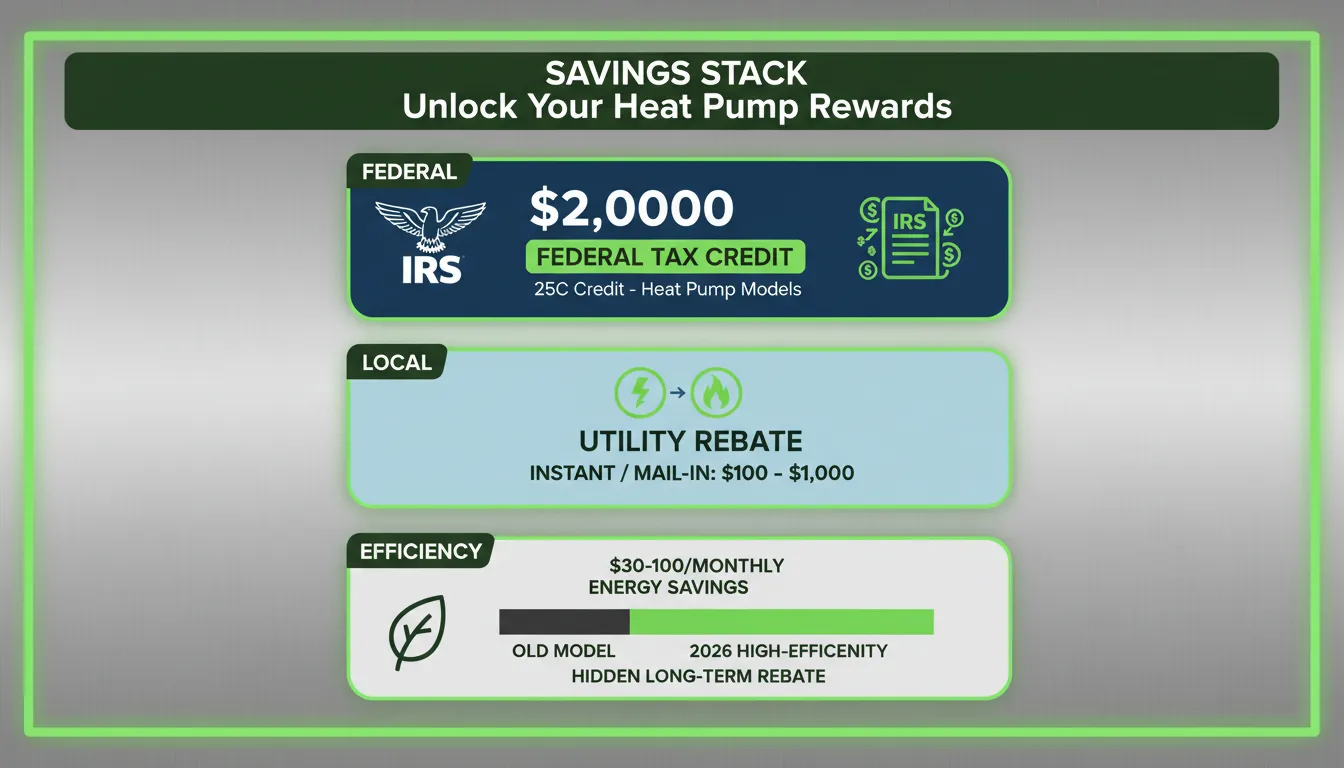
- In 2026, the financial landscape for water heater replacement has shifted.
- While some federal programs have evolved, the combination of tax incentives and state-level rebates remains a powerful way to offset the cost of high-efficiency models, sometimes reducing the “net cost” of a premium unit to that of a standard one.
Federal Incentives: The 25C and Clean Energy Credits
- Federal tax credits are a dollar-for-dollar reduction in the taxes you owe, making them more valuable than a simple deduction.
The Energy Efficient Home Improvement Credit 25C:
- For tax year 2026, homeowners can claim 30% of the project cost, capped at $2,000 annually for heat pump water heaters.
- If you install a high-efficiency gas tankless or gas storage unit that meets the highest CEE (Consortium for Energy Efficiency) tiers, you may still be eligible for a credit of up to $600.
Residential Clean Energy Credit:
- your replacement includes solar water heating, you can claim a 30% credit with no annual dollar limit.
Pro Tip:
- To claim these, you must use IRS Form 5695. Ensure you receive a “Manufacturer’s Certification Statement” from your plumber to prove the unit qualifies for the 2026 standards.
Local Utility Rebates: Instant Savings
- Many utility companies offer “point-of-sale” or mail-in rebates because it is cheaper for them to help you use less energy than it is for them to build new power plants.
How to Find Them:
- Use the Energy Star Rebate Finder or visit your local utility’s “Energy Efficiency” portal.
Typical Rebate Values:
- In 2026, many electric cooperatives provide $500 to $1,000 in instant rebates for heat pump water heaters, while gas providers often offer $100 to $200 for high-UEF (Uniform Energy Factor) tankless models.
State Programs HEAR/HEEHRA:
- Under the Inflation Reduction Act, many states (like North Carolina, Colorado, and California) have launched “High-Efficiency Electric Home Rebate” programs.
- Depending on your household income, these can cover 50% to 100% of the installation cost for electric heat pump units, potentially reaching up to $1,750 in direct rebates.
Maintenance for Longevity: The ROI of an Annual Flush
- The most effective way to “save” money is to avoid a replacement entirely. For a unit that is already 10 to 15 years old, an annual sediment flush is mandatory for survival.
The Sediment Barrier:
- Over time, minerals like calcium and magnesium settle at the bottom of the tank. In gas units, this sediment acts as an insulator, forcing the burner to stay on longer and “cook” the bottom of the tank, which leads to metal fatigue. In electric units, sediment can bury and burn out the lower heating element.
The 15-Year Goal:
- Regular flushing can extend a unit’s life by 3 to 5 years. By removing the insulating layer of grit, you also maintain the unit’s original efficiency, preventing a 10–15% creep in your monthly energy bills.
Cost vs. Benefit:
- A professional flush typically costs $100 to $200. Compared to a $2,000 replacement, this is one of the highest-return maintenance tasks in your home.
FAQs People Also Ask
As you approach a water heater replacement, certain logistical and brand-specific questions often arise. In 2026, the market is more divided than ever between “retail-grade” convenience and “professional-grade” longevity. Below are the most frequent queries homeowners ask during the quoting process.
How long does a professional replacement take?
For a standard tank-to-tank swap, you can typically expect the process to take 2 to 4 hours.
Hour 1: Draining the old tank (the longest step if sediment is heavy) and disconnecting gas/electric and water lines.
Hour 2-3: Removing the old unit, positioning the new one, and reconnecting supply lines.
Hour 4: Testing for leaks, verifying proper venting, and allowing the tank to fill and heat.
Note: If you are converting from a tank to a tankless system, the timeline extends to 6 to 8 hours due to required upgrades to gas lines and venting.
Why do plumbers recommend brands like Bradford White?
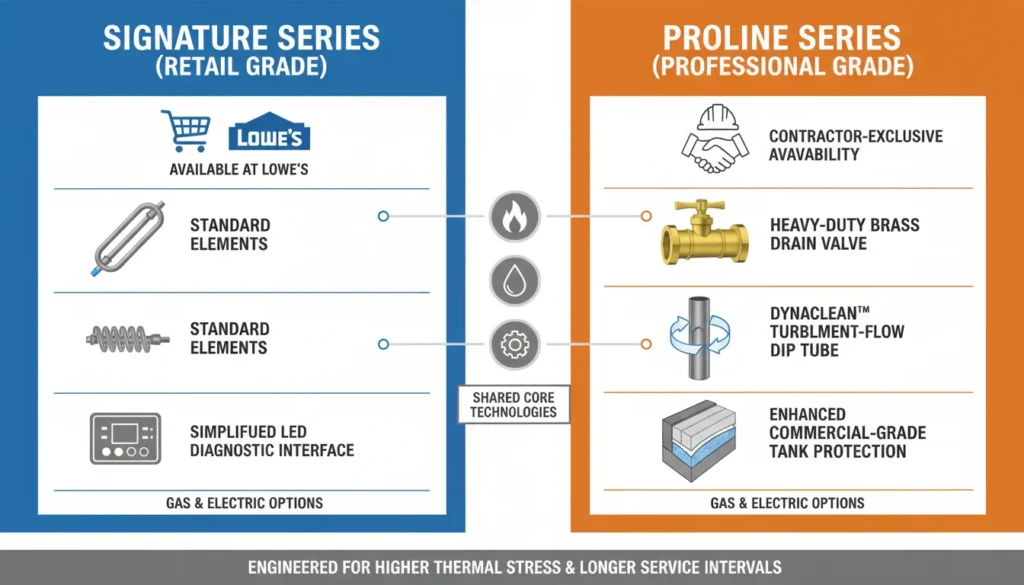
You will notice that most licensed plumbers steer homeowners toward brands like Bradford White or A.O. Smith (Professional Series) rather than the models found on retail shelves.
Wholesale Quality vs. Retail Grade:
- While big-box brands like Rheem or Whirlpool are accessible, professional-grade units often feature higher-quality components, such as brass drain valves (instead of plastic) and thicker internal tank linings (Vitraglas® technology).
Warranty Support:
- Professional brands are sold through supply houses. If a part fails, a plumber can usually swap it under warranty instantly at a local wholesaler.
- Retail models often require you to call the manufacturer and wait for a shipped part, leaving you without hot water for days.
Can I install a water heater myself?
While “DIY” is popular for many home tasks, water heater installation carries significant risks that often outweigh the $600–$1,000 in labor savings.
The Safety Risks: * Gas Lines:
- Improperly sealed connections can lead to slow gas leaks or explosions.
Venting:
- Incorrectly installed flues can cause carbon monoxide to backdraft into your living space—a silent and deadly hazard.
The Warranty Trap:
- Many manufacturers, including Bradford White, will void the warranty if the unit is not installed by a licensed professional.
The “Home Sale” Factor:
- During a home inspection, an unpermitted, DIY installation can be flagged as a code violation, potentially stalling a sale or leading to insurance claim denials in the event of a leak.
Does Home Depot or Lowe’s offer free installation?
No. While these retailers frequently advertise “Free Delivery” or “Free Consultation,” installation is always a paid service.
The “Basic Installation” Fee:
- In 2026, both Home Depot and Lowe’s typically charge a base labor fee starting between $550 and $850.
Additional Costs:
- This base fee rarely includes the cost of mandatory local permits ($50–$300), new supply lines, or required code upgrades like expansion tanks or seismic straps.
The Process:
- You pay the retailer, and they subcontract the job to a local plumbing firm. You are essentially paying for the convenience of one-stop shopping and the retailer’s secondary labor warranty.
People Also Search For
Beyond the basics of price and capacity, modern homeowners in 2026 are increasingly searching for specialized services and comparing long-term reliability. Understanding these adjacent topics can help you avoid common pitfalls during an urgent replacement.
Emergency “Same Day” Water Heater Replacement
When a tank bursts, “Same Day” service isn’t just a luxury—it’s a necessity to prevent mold and structural damage.
Availability:
- Major retailers like The Home Depot and many local plumbing conglomerates offer same-day installation if you call before noon.
The Cost of Urgency:
- Expect to pay an “emergency premium.” While a standard installation is $600–$1,000, a same-day or after-hours emergency swap can push labor costs to $1,200 or higher.
The Trade-off:
- In a rush, you may be limited to whatever units are currently in stock on the truck, which might prevent you from choosing a specific high-efficiency model or a preferred brand.
The Most Reliable Water Heater Brands of 2026
Reliability is the top-searched metric for homeowners who never want to deal with a leak again. Based on 2026 plumber feedback and consumer data, the market is led by:
Bradford White:
- Still the “Gold Standard” for professionals. Known for their Hydrojet® Total Performance System, which aggressively reduces sediment buildup—the #1 killer of water heaters.
A.O. Smith ProLine XE:
- Highly rated for its “tank-within-a-tank” glass lining and superior corrosion resistance.
Rheem Maximus Series:
- A leader in “Smart” water heaters. Their 2026 models feature LeakSense™, which can detect a leak as small as a pinhole and automatically shut off the water supply to your home.
Rinnai:
- The undisputed leader in the tankless category, favored for their easily replaceable internal components that can extend the unit’s life to 25 years.
Tankless vs. Tank: Why Some Plumbers Still Prefer Tanks
Despite the marketing push for tankless “endless” hot water, many experienced plumbers still recommend traditional tanks for specific households.
The “Flow Rate” Struggle:
- A single tankless unit can struggle to provide hot water to a shower, a dishwasher, and a washing machine simultaneously.
- In 2026, many plumbers still prefer 50-gallon tanks for large families because the “reservoir” of hot water provides consistent pressure and temperature across multiple fixtures.
Maintenance Reality:
- Tankless units are high-maintenance. They require annual descaling (flushing with a vinegar solution) to prevent the heat exchanger from clogging.
- If you live in a hard-water area and aren’t diligent about maintenance, a tankless unit can fail faster than a cheap tank.
Power Outages:
- In 2026, most gas tankless heaters require electricity to operate their digital igniters and fans.
- If your area is prone to power outages, you will have no hot water, whereas a traditional gas tank heater with a standing pilot light will keep working.
The 2026 Cost-to-Value Summary
In 2026, a water heater is no longer just a “dumb tank” in the basement; it is a strategic home investment. While the average replacement cost of $1,600 to $2,500 for a standard tank may seem like a steep immediate expense, the shift toward high-efficiency technology has drastically improved the long-term ROI.
Choosing a Heat Pump (Hybrid) or Tankless model can reduce your annual energy spend by up to $500, effectively paying back the “green premium” in just a few years. When you factor in the 2026 federal tax credits—which offer up to $2,000 for qualifying heat pumps—modernizing your hot water system has never been more financially viable.
Actionable Advice: Don’t Sign the First Quote
To ensure you get the best value and a safe installation, follow these three steps before committing to a contractor:
Get Three Itemized Quotes: Prices vary wildly between big-box retailers and local plumbing firms. Ensure every quote includes the unit price, labor, and a “haul-away” fee for your old tank.
Verify Permit & Code Inclusion: Never skip the permit. Ask specifically if the quote includes the local plumbing permit fees ($50–$300) and mandatory 2026 code upgrades like thermal expansion tanks or seismic strapping.
Check the Warranty Fine Print: Confirm that the installer is “factory-authorized.” A DIY or uncertified installation can void your 6-to-12-year manufacturer warranty, leaving you unprotected if the tank fails prematurely.
Secure Your Home’s Hot Water Today
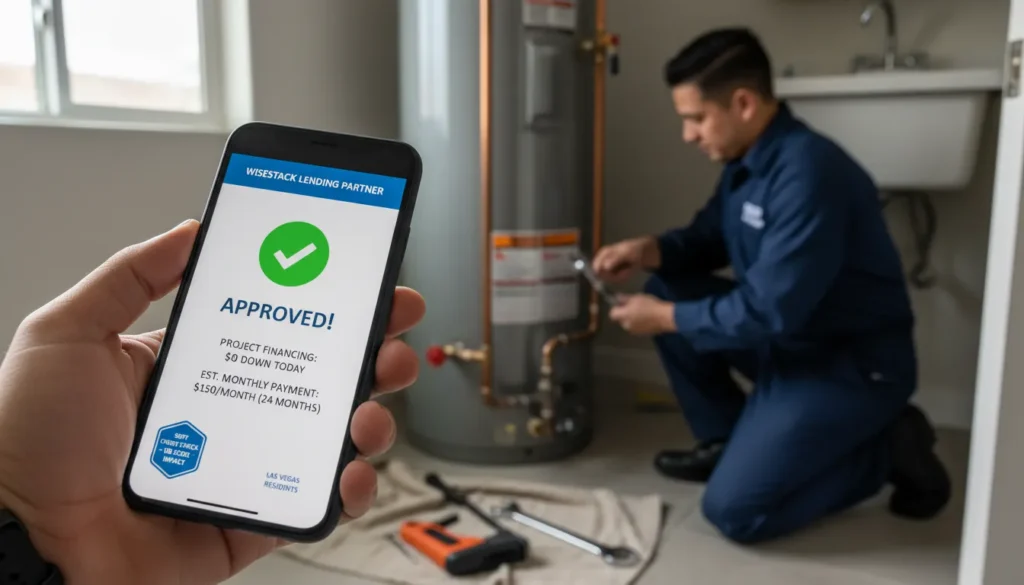
Don’t wait for a flood to force your hand. Whether you need an emergency swap or are looking to upgrade to a high-efficiency smart heater, the safety of your home depends on professional expertise.
Contact a Licensed Local Plumber to schedule an inspection, verify your home’s code compliance, and claim your 2026 energy rebates before they expire.