- Home
- Water Damage Restoration
- Water Removal
Emergency Water Removal Miami: 24/7 Rapid Flood Extraction & Cleanup
When water compromises your property, you don’t just need a plumber; you need an emergency extraction force. At EZ Plumbing, we provide the fastest water removal near me with a guaranteed 60-minute on-site arrival anywhere in Miami-Dade. Whether it is a midnight burst pipe, a storm-surge flood, or a hazardous sewage backup, our specialized recovery units are standing by 24/7 to stop the damage before it becomes permanent.
Our water clean up service is not just about surface drying. We utilize 2026 industrial protocols to extract standing water from deep within flooring and wall cavities, ensuring your home or business is structurally sound and mold-free.
Why Miami Chooses EZ Plumbing for Rapid Extraction
✅Residential & Commercial Coverage
From high-rise condos in Brickell to sprawling warehouses in Doral, we scale our extraction equipment to fit the flood.
✅Emergency Sewage Spills
Handling “Category 3” water requires biohazard expertise. We provide professional sewage cleanup to safely eliminate pathogens and odors.
✅$0 Upfront for Insurance Claims
We work directly with your insurance provider (State Farm, Progressive, etc.), handling the documentation and billing so you can focus on your family.
- ⏰ 60-Minute Arrival: Our GPS-tracked units ensure the fastest water clean up service in Miami-Dade.
- 🛡️ IICRC Certified: Every technician is a master of the S500 Restoration Standards.
- 💰 $0 Upfront with Insurance: We provide a full water damage restoration checklist and bill your insurance company directly.
- 📍 Local Expertise: From Coral Gables to Miami Beach, we know Miami’s unique flood challenges.
Professional Water Extraction: Industrial Equipment & 5-Stage Process
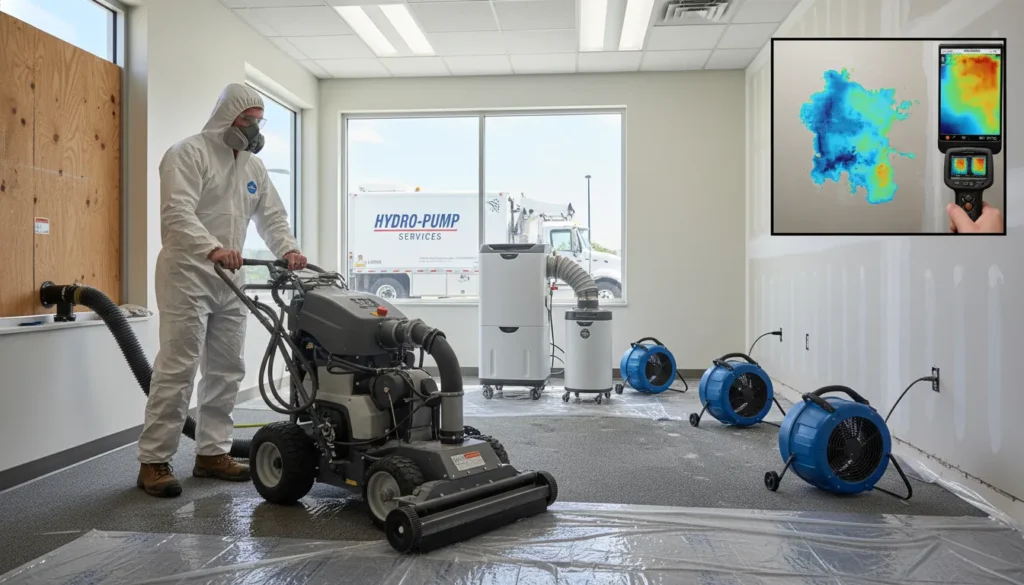
When a flood occurs, the water you see on the floor is only the beginning. The real threat is the “hydrostatic pressure” that forces water into porous subfloors and drywall. To combat this, a standard retail water removal machine or a household “Shop-Vac” is fundamentally inadequate. Professional water extraction is a thermal and mechanical science that requires industrial-grade water removal equipment to ensure a 0% moisture baseline.
The 5-Stage Professional Recovery Sequence
To guarantee a “Bone-Dry” result, our 2026 protocol follows a strict scientific sequence:
Thermal Moisture Mapping: Before extraction, we use Infrared FLIR™ Cameras to locate water “Migration Paths” hidden behind baseboards and under cabinetry.
High-Volume Bulk Extraction: We deploy 300-GPM (Gallons Per Minute) truck-mounted water extraction pumps. This is 50x more powerful than a retail vacuum, removing the weight of the water before it warps the building’s structure.
Weighted Subsurface Compression: For carpets and hardwoods, we use a specialized water extraction tool (the “Ride-on Extractor”) that uses body weight to squeeze moisture out of the deep padding that manual tools cannot reach.
Low-Grain Refrigerant (LGR) Dehumidification: Standard fans only move wet air. LGR Dehumidifiers remove moisture at the molecular level, pulling water vapor out of the air to prevent “Secondary Water Damage” (mold and wood rot).
HEPA Air Scrubbing: As the area dries, we neutralize airborne spores and odors using Triple-HEPA Filtration, ensuring the air quality is medical-grade.
| Feature / Capability | DIY Method (Mop/Shop-Vac) | Industrial Extraction Protocol |
|---|---|---|
| Extraction Depth | Surface Only (Top 5%) | Structural (100% Subfloor) |
| Water Removal Speed | 5 - 10 GPM (Slow) | 300+ GPM (Truck-Mounted) |
| Hidden Moisture Detection | None (Visual Only) | Infrared Thermal Mapping |
| Drying Timeframe | 7–10 Days (High Mold Risk) | 24–72 Hours (Controlled) |
| Biological Sanitization | Household Soap (Ineffective) | EPA-Registered Antimicrobial |
| Equipment Used | Retail Water Removal Pump | Industrial LGR Dehumidifiers |
The Failure of the "Shop-Vac" Strategy
A retail water removal pump is designed for small spills, not floods. When water stays in a home for more than 24 hours, it undergoes a chemical change, transitioning from “Category 1” (Clean) to “Category 2” (Grey) water. Only industrial-grade water removal equipment has the suction lift and airflow velocity required to break the surface tension of water trapped in building materials.
Sewage Cleanup Services: Handling Blackwater & Biological Risks
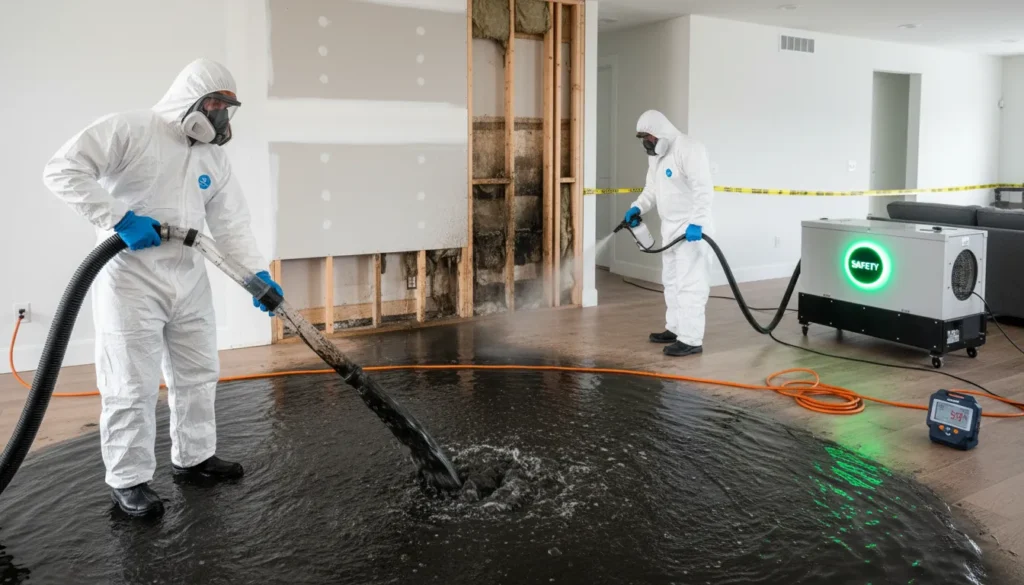
Miami’s unique coastal environment and aging infrastructure mean that a heavy tropical storm can quickly lead to a sewage backup. This is not just a “water” problem; it is a Category 3 Biohazard event. Known in the industry as Blackwater, this fluid contains raw sewage, heavy metals, and over 120 types of hazardous pathogens.
If you are searching for sewage cleanup services near me in the Miami-Dade area, you are dealing with a situation that requires more than a simple water cleaning service. It requires a surgical decontamination process to protect your family from life-threatening bacteria that thrive in Florida’s humidity.
The Biological Threat in Miami’s Flood Water
When sewage enters a Miami home, it brings a cocktail of contaminants that can become airborne (aerosolized) within hours. Our professional sewage cleanup protocol is designed to neutralize:
Waterborne Pathogens: E. coli, Salmonella, and Hepatitis A.
Fungal Spores: Miami’s heat allows sewage-based mold to colonize within 24 hours.
Aerosolized Endotoxins: Toxins that can trigger severe asthma and respiratory issues if not extracted correctly.
The Professional Decontamination Protocol
To ensure your property is safe for habitation, our specialized team follows a high-tech 3-step recovery sequence:
Contained Bio-Extraction
We use sealed-vacuum water extraction pumps to remove raw sewage without allowing bacteria to spray into the air. This is critical for Miami’s high-rise condos and open-plan homes where air circulates quickly.
Strategic Material Removal
Items like carpet, padding, and low-level drywall that have absorbed Category 3 water are safely removed according to Florida’s bio-waste regulations.
Antimicrobial Shielding
We apply an EPA-registered, hospital-grade disinfectant to all affected studs and subfloors. This botanical shield penetrates deep into the material to kill 99.9% of bacteria and neutralize the “ghost odors” common in Miami’s humid climate.
⚠️ Miami Emergency Alert: Do Not Enter Blackwater Without PPE
Sewage contains parasites and viruses that can enter the body through the skin or inhalation. If you have a backup in Miami, call for professional extraction immediately.
Specialized Solutions: Water Removal for Electronics & Land Runoff
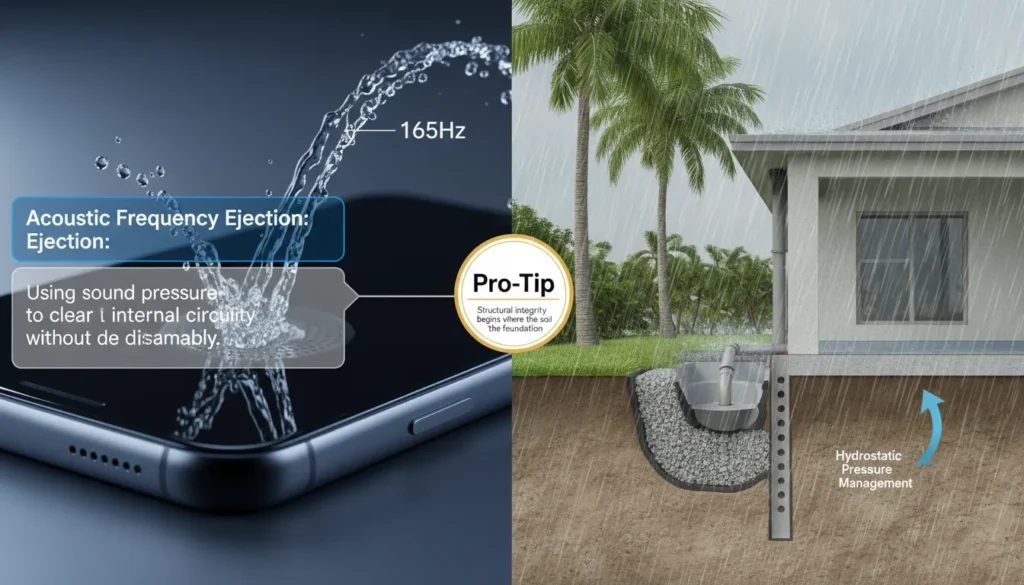
Water removal is not limited to the structural integrity of your home; it extends to the delicate circuitry of your devices and the soil stability of your property. In 2026, water extraction technology has evolved to include acoustic pulse methods for electronics and hydrostatic dewatering for saturated landscapes.
The Acoustic Science: Water Removal from Phone Speakers
If you have dropped your device in a pool or sink, the most critical area to address is the speaker mesh. Traditional methods like “rice” are now considered obsolete and dangerous for modern smartphones. To remove water from speaker sound chambers, we utilize a process called Acoustic Ejection.
165Hz Sonic Pulses: By playing a specific water removal sound for phone speakers (typically a high-frequency 165Hz sine wave), the speaker diaphragm vibrates at a velocity that physically “kicks” the water droplets out of the grill.
The Pressure-Wave Method: This water removal phone technique uses air pressure generated by the sound waves to break the surface tension of the water, preventing the corrosion of internal logic boards.
Environmental Engineering: Water Removal from Land
In Miami, heavy tropical downpours often lead to “puddling” or soil saturation that threatens your foundation. Water removal from land (technically known as dewatering) is essential to manage Hydrostatic Pressure—the force exerted by standing water that can crack concrete slabs and flood basements.
Professional Land Dewatering Methods
Sump Pump Integration: For low-lying Miami properties, we install automatic submersible pumps that activate the moment water levels rise in the soil.
Hydrostatic Relief Vents: These allow water to flow through a structure rather than pushing against it, preventing catastrophic wall failure.
French Drain Extraction: A subsurface system that redirects water runoff away from the foundation and toward the city’s storm drains.
Water Extraction Cost: 2026 Pricing & Insurance Claim Assistance
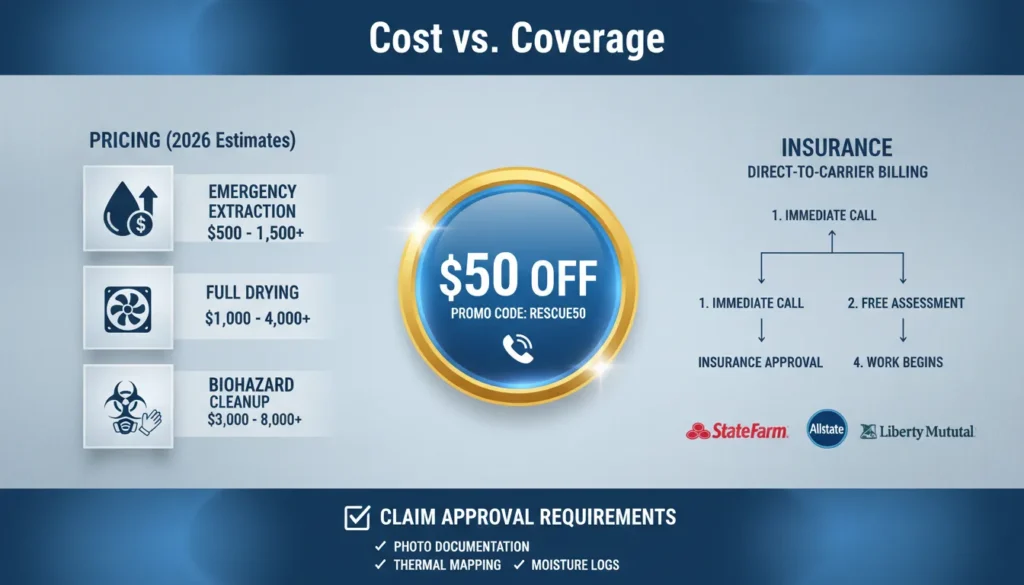
The most common question during a flood is: “How much is this going to cost?” In Miami, water extraction cost is determined by the “Category” of water and the “Class” of the flood (how much of the area is wet). At the 2026 market rate, professional extraction typically ranges from $3.50 to $7.00 per square foot, but the total investment depends on how deep the moisture has migrated into your structure.
2026 Transparency: Standard Pricing Tiers
| Service Level | Estimated Cost Range | What's Included? |
|---|---|---|
| Emergency Extraction | $500 - $1,500 | ✓ Bulk water removal + Anti-microbial spray. |
| Full Structural Drying | $2,000 - $5,000 | ✓ Extraction + LGR Dehumidification + 3 Days Monitoring. |
| Sewage (Cat 3) Cleanup | $3,500 - $8,000+ | ✓ Biohazard removal + HEPA scrubbing + Material disposal. |
Does Insurance Cover Water Remediation?
Yes. In most cases, if the water damage is “Sudden and Accidental” (like a burst pipe or water heater failure), your homeowners’ insurance will cover the full water remediation cost.
We specialize in Direct Insurance Billing. We work directly with major carriers like State Farm, Liberty Mutual, Allstate, and Progressive. Our goal is to ensure you have $0 out-of-pocket costs beyond your deductible.
The Professional Water Damage Restoration Checklist
To ensure your insurance claim is approved 100%, our technicians follow a digital water damage restoration checklist that adjusters require:
Photo Documentation: High-resolution “Before” photos of standing water.
Moisture Maps: Infrared readings proving the water migrated into the walls.
Psychrometric Logs: Daily reports showing the dehumidifiers are successfully removing moisture.
Inventory of Loss: A detailed list of non-salvageable items for your “Contents Claim.”
How to Bypass Out-of-Pocket Costs
When you call for emergency extraction, we don’t demand a massive down payment. We document the loss and open a claim with your insurance immediately. This “Insurance-First” approach allows you to get the water out of your home now, while the insurance company handles the bill later.
Water Removal FAQ: Expert Answers to Your 2026 Concerns
The best way depends on the volume. For minor puddles, a wet/dry vacuum is sufficient. However, for floods over 2 inches deep or covering more than 100 sq. ft., the best way is industrial truck-mounted extraction. This removes thousands of gallons per hour and prevents water from migrating into your wall cavities.
In the restoration industry, the physical removal of liquid is called Water Extraction. If you are removing water from soil or a construction site, it is called Dewatering. The overall process of cleaning, drying, and sanitizing is known as Water Mitigation or Remediation.
Standard policies cover water removal if the damage is “sudden and accidental” (e.g., a burst pipe or washing machine overflow). However, Flood Insurance (for rising outdoor water) is a separate policy. In Miami, we recommend having both for full protection.
Do not use rice. The most effective way is using Acoustic Ejection:
Play a 165Hz high-frequency sound (search “Water Eject Sound” on YouTube or use the “Water Eject” iOS Shortcut).
The sound vibrations physically push water out of the speaker grills.
Keep the phone upright and air-dry for 24 hours.
Insurance typically denies claims for:
Gradual Damage: Slow leaks that occurred over weeks or months.
Maintenance Neglect: Damage from a roof you knew was failing.
Ground Seepage: Water rising through a foundation crack.
Secure Your Property with Miami’s Water Integrity Experts
When the extraction is complete, the journey to a safe home is just beginning. Unlike generic water damage restoration companies that only focus on surface-level drying, we provide a holistic “Total Property Integrity” approach. In the subtropical climate of Miami-Dade, residual moisture is the enemy; if even 1% of the moisture remains, toxic mold colonization is a certainty.
Whether you searched for basement water removal near me or are in need of emergency flood cleaning services after a tropical storm, our mission is to return your property to its pre-loss condition—or better. We bridge the gap between emergency pumping and long-term structural health.
The EZ Restoration Guarantee: From Extraction to Mold Prevention
Our final phase ensures that your home isn’t just dry—it’s chemically and biologically stable:
Deep-Tissue Dehumidification: Pulling moisture from the “Inner-Air” of your wall cavities.
Antimicrobial Barrier: Applying a long-lasting shield that prevents mold spores from activating.
Structural Certification: A final moisture-meter reading to prove your home meets IICRC S500 standards.
Why Miami Chooses Our Expertise
- Miami-Dade Local: Fast 60-minute arrival from Downtown to Kendall.
- Certified Mastery: IICRC-trained techs using 2026 restoration science
- 24/7 Dispatch: Round-the-clock response because floods never sleep.
- Instant $50 Off: Use Code EZ-DRY50 for immediate service savings.
Zero-Stress Insurance Recovery
Stop worrying about the paperwork. We offer direct insurance billing with all major carriers, ensuring your restoration starts immediately with $0 upfront costs in most cases. We document every drop of moisture to ensure your claim is processed accurately and fast.
