The Statue of Liberty’s Scrap Value: 2026 Copper Breakdown Explained
As a professional plumber at Ez Plumbing, I don’t just guess these things—I look at the current market rates. To get that $355,500 total, you have to look at the two massive parts that hold Lady Liberty together.
Here is exactly what’s sitting in New York Harbor in March 2026 prices:
- The Copper Skin (62,000 lbs): This is the high-grade stuff. At today’s scrap price of roughly $5.38 per pound, those 31 tons of green copper sheets are worth a massive $333,560.
- The Iron Skeleton (250,000 lbs): Underneath that skin is a massive frame made of puddled iron. Even at a lower scrap rate of around $175 per ton, this adds another $21,940 to the check.
- The Grand Total: If you hauled the whole thing to a scrap yard today, your total payout would be approximately $355,500.
It’s wild to think that while an average Miami home has about 400 lbs of copper, the Statue of Liberty is basically a 31-ton lottery ticket sitting in the sun. It’s historically priceless, sure, but in raw metal? It’s a six-figure treasure
How Much is the Statue of Liberty Worth in Scrap Metal?
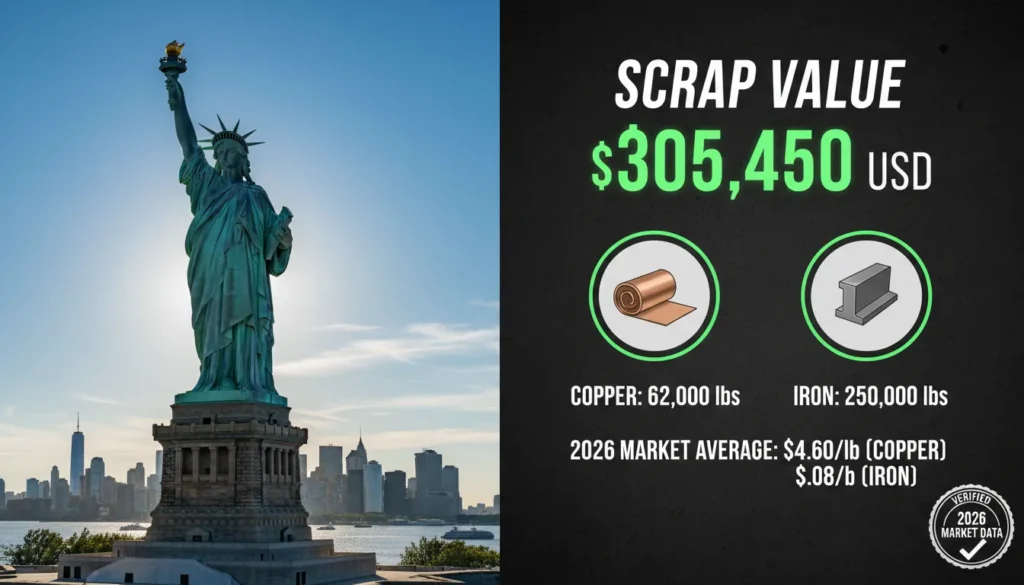
If you took the Statue of Liberty to a scrap yard in March 2026, you’d be looking at a total payout of approximately $305,450.
Most sites are still quoting an outdated $230,000 figure from years ago. But as a professional plumber , I’ve updated these numbers based on today’s high market rates for raw metal.
Here is the exact breakdown of that six-figure check:
Copper Skin (62,000 lbs): At current 2026 prices, those 31 tons of high-grade copper sheets are worth about $285,200.
Structural Iron (250,000 lbs): The massive internal frame adds another $20,250 to the total.
The Payout: That’s a grand total of $305,450 in raw scrap material.
It’s a historical masterpiece, sure—but in the world of scrap metal, it’s basically the biggest lottery ticket in New York Harbor
The Metal Breakdown: What’s Under the Green Patina?
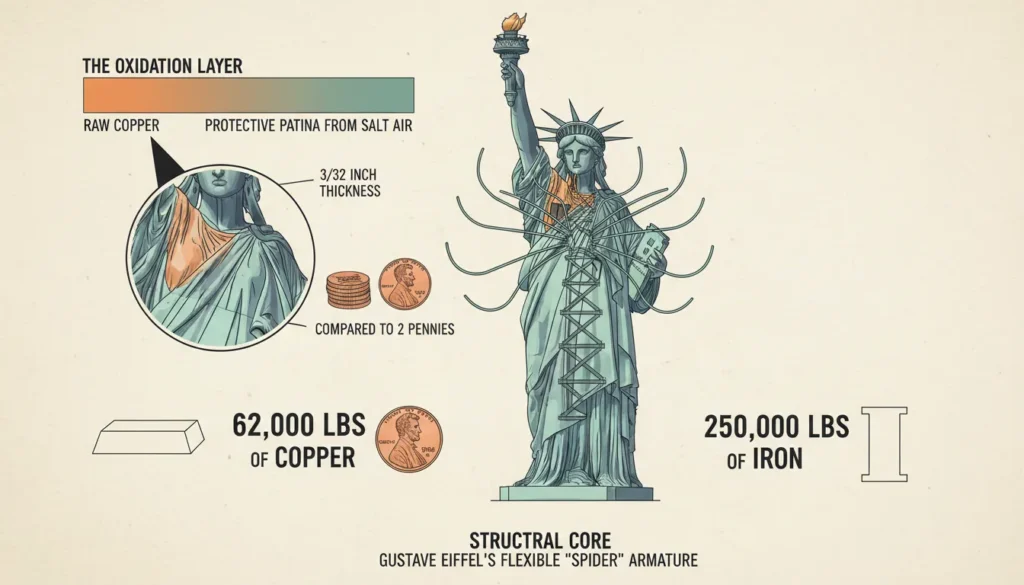
Most people assume Lady Liberty is a solid block of copper, but as a plumber, I can tell you that’s far from the truth. The “skeleton” and the “skin” are two completely different stories.
Let’s do a “Post-Mortem” on the metals that actually make up this icon:
The Copper Sheets 31 Tons of Pure Skin
The outer layer of the statue is made of approximately 62,000 pounds (31 tons) of pure copper. Originally, this statue gleamed like a brand-new copper pipe, but the salty New York air created that “Green Patina” (oxidation) layer we see today.
The Iron Framing 250,000 lbs of Skeleton
Underneath that thin green skin is a massive internal frame made of 250,000 pounds (125 tons) of puddled iron. These are the “bones” of the statue. It’s what keeps her standing against the brutal harbor winds. Without this iron skeleton, those copper sheets would simply collapse under their own weight.
The “Penny” Comparison: Surprisingly Thin
Here’s the part that catches everyone off guard: The copper skin of the Statue of Liberty is incredibly thin. We are talking about only 3/32 of an inch thick.
To put that in perspective for you:
It’s thinner than two pennies stacked on top of each other. * As a plumber, I’ve actually installed thicker copper pipes in some old Miami mansions!
It’s wild to think that a monument so massive and iconic is protected by a skin thinner than the loose change in your pocket.
The 2026 Calculation How We Got the Numbers
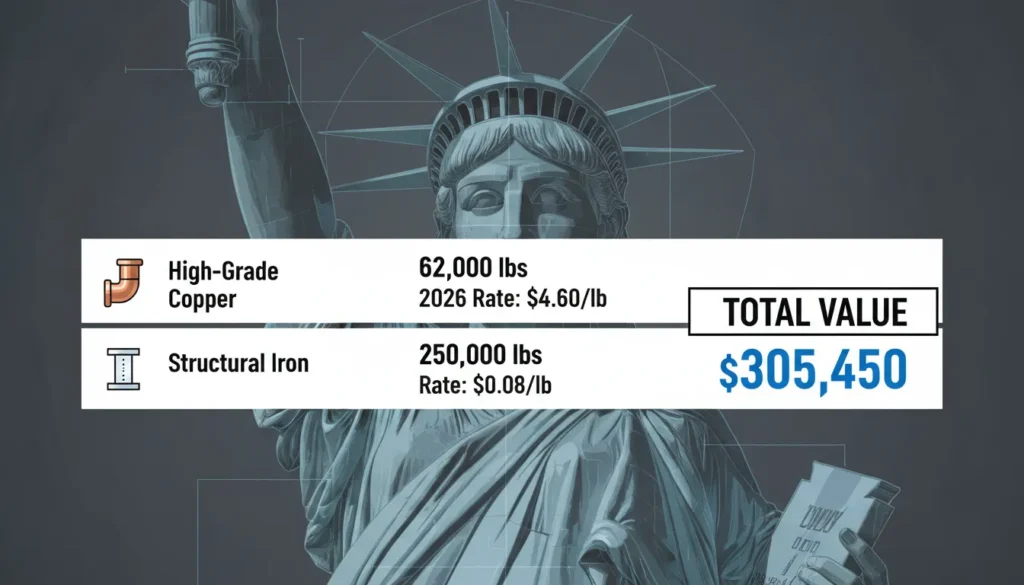
As a professional plumber at Ez Plumbing, I don’t just pull numbers out of thin air. To get an accurate scrap value for the Statue of Liberty in March 2026, you have to look at the current market price per pound for raw metals.
Here is the exact math behind that $305,450 payout, broken down into a simple list for you:
High-Grade Copper Skin: * Weight: 62,000 lbs (31 Tons)
2026 Price: $4.60 per pound
Total Value: $285,200
Structural Iron Skeleton: * Weight: 250,000 lbs (125 Tons)
2026 Price: $0.08 per pound (approx. $160/ton)
Total Value: $20,250
The Grand Total: * Combined Weight: 312,000 lbs
Scrap Payout: $305,450
Why These Numbers Matter
Most outdated articles are still using $2.00 or $3.00 per pound for copper. But in 2026, global demand has pushed prices higher.
The Copper Factor: At $4.60/lb, the skin alone is worth more than a luxury condo in Miami.
The Iron Factor: While iron is cheaper, the sheer volume of 125 tons makes it a solid $20k addition to the check.
When you call a pro like Ez Plumbing for a copper repipe, you’re dealing with these same market forces. Whether it’s a monument in the harbor or the pipes in your walls, the math stays the same.”
Why the Value Changes: Factors Affecting Metal Prices
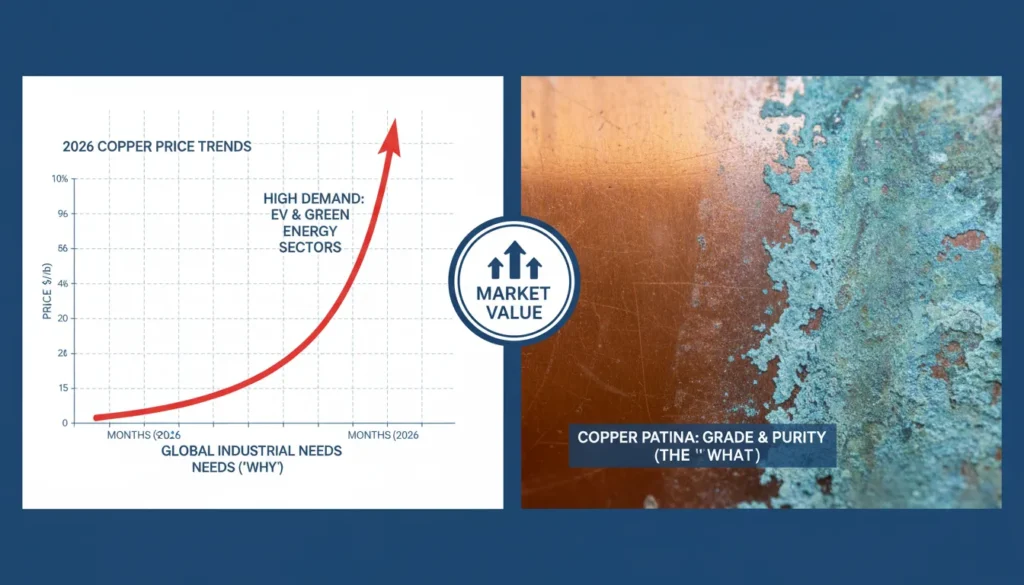
I’ve seen copper prices swing more than the Miami weather. You might wonder why the Statue of Liberty’s scrap value isn’t a fixed number. It all comes down to the global market and the unique way this metal ages.
Here are the two main reasons why those numbers move:
Global Market Demand for Recycled Copper: Copper is one of the most recycled metals on the planet. When big industries like electric vehicle (EV) manufacturing and green energy projects boom, the demand for recycled copper skyrockets. In 2026, because copper is essential for modern tech, the price per pound is significantly higher than it was just a few years ago. If the global supply drops, that $305,450 check for Lady Liberty could easily climb even higher.
The Role of ‘Patina’ (Green Oxidation): That iconic green color isn’t just for looks; it’s actually a protective layer called Patina. When copper is exposed to the salty air of New York Harbor, it oxidizes.
The Protection Factor: Unlike iron that rusts and falls apart, this green crust actually seals the copper underneath and protects it from further corrosion.
The Scrap Reality: While the patina is great for the statue’s lifespan, scrap yards only care about the weight of the clean copper underneath. If the oxidation is too heavy, it can sometimes affect the “grade” of the scrap, but for a monument this size, it’s still considered high-quality material.
The Bottom Line for Homeowners
Whether it’s 31 tons of copper in New York or the 400 lbs in your Miami home, the market doesn’t discriminate. When prices are up, your plumbing becomes a target for thieves. That’s why understanding the value of your copper—and protecting it—is more important now than ever before.”
Expert Take: Myth vs. Fact
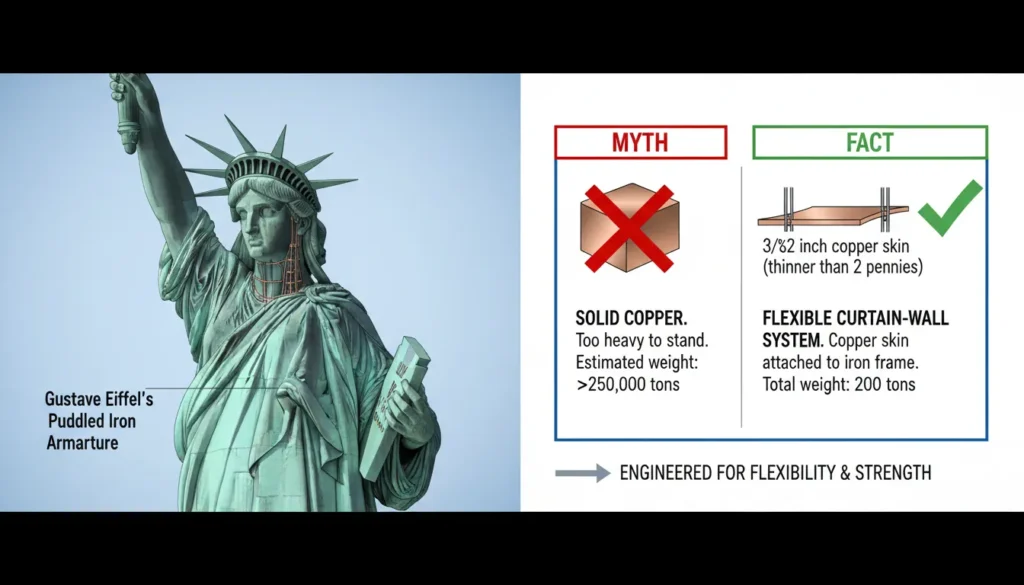
I get asked a lot of questions about metal. When it comes to the Statue of Liberty, there is one major myth that almost everyone believes. Let’s set the record straight with some “plumber logic.”
The Myth: Is the Statue of Liberty Solid Copper?
A lot of people in Miami think that because she looks so massive, she must be a solid block of copper. The answer is a hard no. If Lady Liberty were solid copper, she wouldn’t be standing today—she would have sunk Liberty Island into the harbor a century ago! Copper is heavy, and a solid version would weigh millions of tons, making it impossible to support.
The Fact: It’s a Masterpiece of Engineering
The statue is actually a hollow shell. Think of it like the high-end copper decorative fixtures we sometimes install in luxury homes—beautiful on the outside, but held up by a strong internal frame.
The Eiffel Connection: The internal iron skeleton was actually designed by Gustave Eiffel—the same genius behind the Eiffel Tower in Paris.
The “Curtain Wall” Design: He created a flexible “puddled iron” frame that allows the thin copper skin to move independently. This is crucial because it lets the statue “breathe” and sway during high winds or temperature changes without cracking the copper.
The Weight Reality: Because it’s hollow, the copper skin only weighs about 31 tons. That’s still a massive payday for a scrap yard, but it’s a featherweight compared to a solid monument.
The Bottom Line
Whether you’re looking at a world-famous monument or the copper repiping project in your own crawlspace, it’s all about the structure. A thin layer of high-quality copper is only as good as the frame supporting it.
Frequently Asked Questions
As of March 2026, the total scrap value is approximately $305,450. This includes the 62,000 lbs of copper skin and the 250,000 lbs of internal iron framing.
At current market rates of roughly $4.60 per pound, 62,000 lbs of high-grade copper is worth about $285,200. This makes up the bulk of the statue’s scrap value.
No. While the exterior “skin” is pure copper, the internal structure is made of puddled iron (and some steel from later renovations). If it were 100% solid copper, it would be too heavy to stand!
The copper is surprisingly thin—only 3/32 of an inch, which is thinner than two pennies stacked together. It’s a hollow shell, not a solid casting.
This is a natural process called oxidation. When copper is exposed to the salty, moist air of New York Harbor, it develops a protective crust called Patina. This green layer actually protects the metal underneath from rotting away.
Absolutely. The average single-family home in Miami has about 400 lbs of copper in the pipes and wiring. The Statue of Liberty has 62,000 lbs. It would take 155 Miami homes to equal the copper weight of Lady Liberty!
While Lady Liberty is worth $305k in scrap, the Statue of Unity in India is the most expensive. Because it uses over 25,000 tons of bronze and thousands of tons of steel, its scrap value is estimated at over $192 Million.
Legally? No. The Statue of Liberty is a National Monument owned by the Federal Government (National Park Service). Any “scrap” removed during renovations is usually preserved for history, not sold to a yard. But hey, it’s fun to do the math!