Expert Slab Leak Repair in Miami | Non-Invasive Detection & 24/7 Service
Hidden water leaks under your concrete slab are silent home killers. If left untreated, they compromise your home’s structural integrity, destroy premium flooring, and trigger toxic mold growth. At Ez Plumbing Repair Services, we use advanced electronic acoustic technology to pinpoint the exact leak without unnecessarily jackhammering your beautiful floors. We don’t just fix pipes; we rescue your foundation with surgical precision and transparent pricing.
Why Miami Homeowners Trust Our Foundation Rescue Protocol
🔍 Precision Leak Detection No-Mess Guarantee
We find the leak with 99% accuracy using state-of-the-art ultrasonic sensors. This eliminates “guesswork” and saves your home from unnecessary and messy demolition. We find it, we fix it, and we leave your home clean.
🛡️ Insurance Claim & Documentation Support
Slab leaks can be complex for insurance. We provide the detailed digital documentation, high-resolution photos, and thermal imaging reports your adjuster needs to approve your claim, helping you minimize out-of-pocket costs.
💰 $50 Instant Savings for New Customers
Quality service shouldn’t break the bank. Mention code “SLAB-SAVE-50” during your call and get an immediate discount on your professional leak detection service today.
- ✅ Licensed & Insured Professionals: Fully certified for South Florida’s specific residential and commercial plumbing codes.
- ✅ Structural Integrity Protection: We stop water erosion under your slab before it leads to permanent foundation shifting.
- ✅ A+ Rated Local Specialists: No call centers. You speak directly to a local expert who understands the Miami landscape.
Is Your House Hiding a Leak? 7 Warning Signs of a Slab Leak
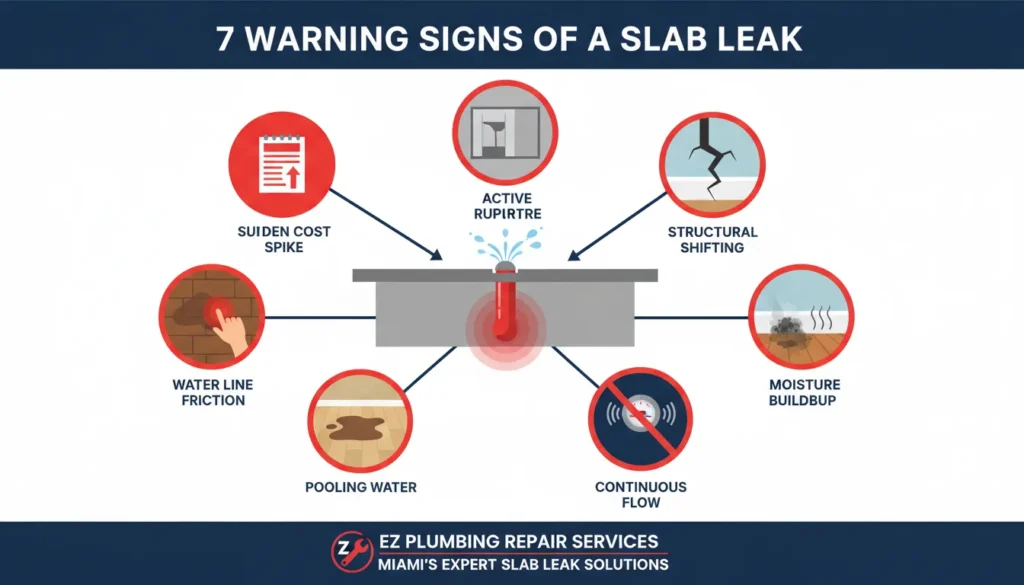
A slab leak is often called a “Silent Killer” because it happens beneath layers of concrete and flooring where it can remain undetected for months. By the time the damage becomes visible, the structural integrity of your home may already be at risk.
“Don’t ignore a warm floor—it’s not a coincidence; it’s a classic sign of a hot water line rupture beneath your feet.”
To protect your property, watch out for these 7 critical warning signs
1. Sudden Spike in Water Bills
If your monthly water bill has jumped significantly without a change in usage, you likely have a continuous leak. Even a pinhole rupture in a pressurized line can waste hundreds of gallons of water a day under your foundation.
2. The Sound of Running Water
If you hear a faint rushing, hissing, or gurgling sound coming from the walls or floors when all faucets and appliances (like the dishwasher or laundry) are turned off, water is actively escaping from your plumbing system.
3. Hot Spots on the Floor
When a hot water line leaks under the slab, the heat transfers through the concrete to your floor. If you notice a specific patch of tile, laminate, or wood that feels unusually warm to the touch, you have found the location of a hot water slab leak.
4. Excessive Moisture or Mildew Under Carpets
Water from a slab leak has nowhere to go but up. If your carpets feel damp, smell musty, or show signs of mildew without any visible spill, the water is likely seeping through cracks in the concrete slab.
5. Low Water Pressure
A significant leak diverts water away from your fixtures. If you’ve noticed a sudden drop in water pressure in your shower or kitchen sink, the water intended for your faucet is likely leaking into the soil beneath your home.
6. New Cracks in Foundation or Walls
As water saturates the soil under your home, it causes the earth to shift or swell. This movement puts immense pressure on your foundation, leading to new cracks in your flooring, baseboards, or even vertical cracks in your drywall.
7. Pooling Water Outside the Home
Sometimes the water travels outward. If you notice standing water or unusually “lush” and muddy patches of grass near your home’s exterior foundation—especially during Miami’s dry spells—the source is likely a broken line under the slab.
Why Slab Leaks Happen: Understanding the Causes
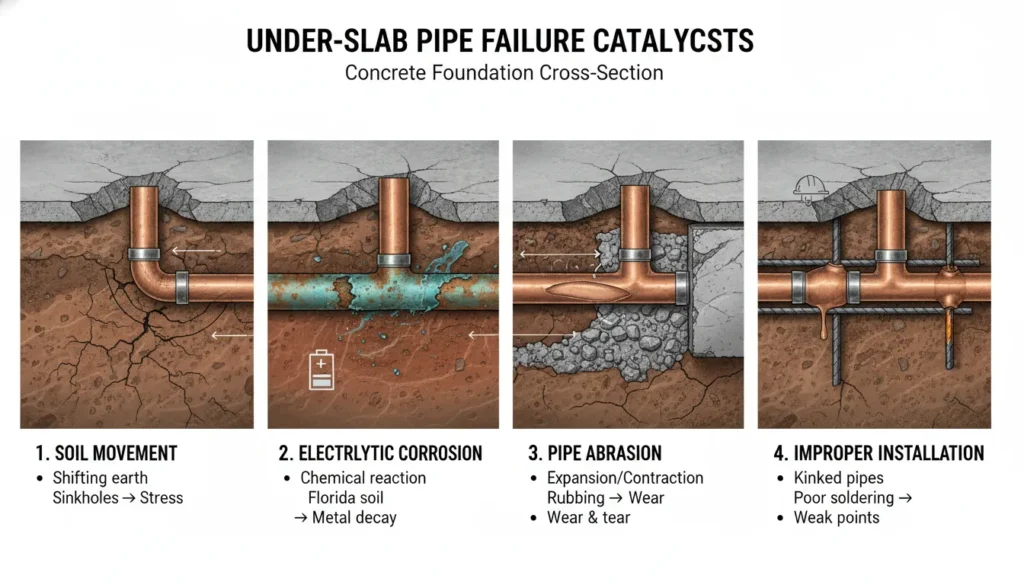
A slab leak is rarely a random occurrence. In South Florida’s unique environmental conditions, several hidden factors work together to compromise the integrity of the plumbing lines buried beneath your concrete foundation. Understanding the science of failure behind these leaks is the first step in preventing future structural disasters.
1. Pipe Corrosion: The Chemical Battleground
The most common cause of slab leaks in older Miami homes is galvanic or electrolytic corrosion. When copper pipes interact with the specific chemistry of South Florida’s soil and water, a chemical reaction occurs that thins the pipe walls from the outside in. Over time, this results in “pinhole leaks” that can release hundreds of gallons of water daily into your foundation.
2. Florida’s Soil Shifting: Pressure from Below
Our local geography plays a massive role in plumbing health. Florida’s soil is often expansive, meaning it shifts and settles significantly with changes in moisture levels and heavy tropical rainfall. This Soil Shifting puts immense physical pressure on the rigid pipes beneath your slab. When the ground moves but the concrete remains stationary, the pipes are forced to bend, eventually leading to a clean break or a catastrophic rupture.
3. Pipe Abrasion: The Friction Factor
Plumbing lines naturally expand and contract as hot or cold water flows through them. If the pipes were installed directly against rough concrete or jagged gravel without proper insulation, this constant movement causes Abrasion. Over thousands of cycles, the pipe literally “rubs itself raw” against the hard surfaces, creating a hole that allows water to escape directly under your flooring.
4. Poor Construction & Installation Errors
Sometimes the damage starts before the house is even finished. Poor Construction practices—such as using kinked pipes, over-tightening fittings, or damaging the protective coating of the lines during the initial pour of the concrete—create weak points. These minor “installation nicks” may take years to manifest, but they eventually give way under constant water pressure, resulting in a sudden under-slab leak.
How Much Does Slab Leak Repair Cost in Miami & Broward?
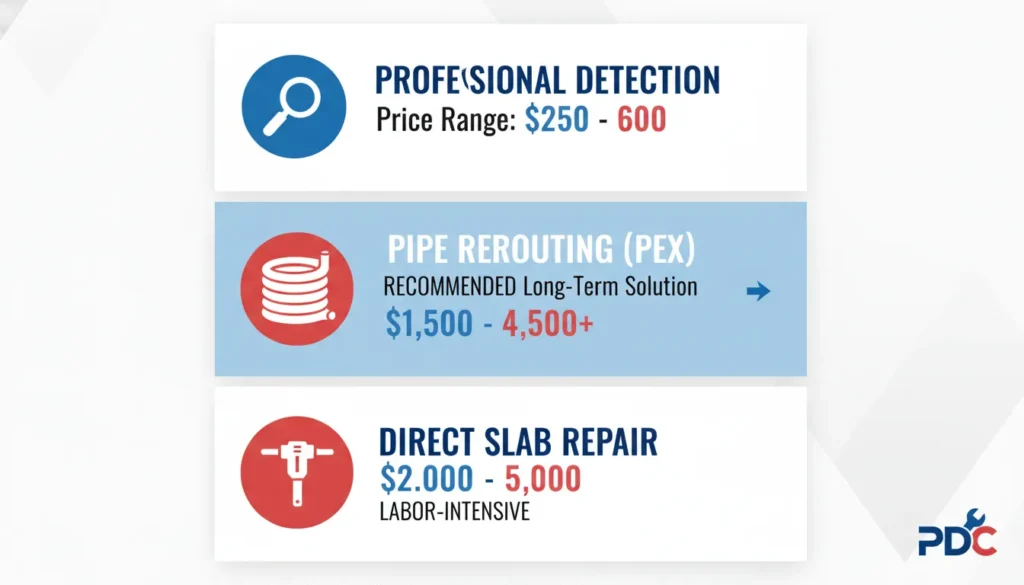
One of the biggest concerns for homeowners is the financial impact of an under-slab water leak. In South Florida, costs can vary based on the depth of the pipe, the type of flooring (tile vs. wood), and the extent of the damage. At Ez Plumbing Repair Services, we believe in upfront, honest pricing to help you make the best decision for your home’s foundation.
Estimated Slab Leak Service Costs 2026 Guide
Electronic acoustic sensors & thermal imaging to pinpoint the exact leak location without damage.
Bypassing old lines through walls or attic. This is the cleanest, most durable long-term foundation fix.
Jackhammering concrete to fix a single spot. Labor intensive and can be messy for your indoor flooring.
Trenchless coating applied inside the existing pipe to seal leaks. Non-invasive and fast.
*All prices are 2026 local estimates for Miami & Broward. Final quote provided after detection.
Why "Rerouting" is Your Most Cost-Effective Solution
While “Direct Repair” breaking the concrete might seem like a straightforward fix, it often leads to more problems and unexpected secondary costs. Choosing to reroute your plumbing lines through walls or the attic is the modern, non-invasive standard for South Florida homes. Here is why industry specialists recommend this approach:
Eliminates Future Failures: If one section of your copper pipe has corroded under the slab, the rest of the line is likely in the same fragile condition. Rerouting bypasses the entire compromised section with durable, flexible PEX piping, ensuring you won’t face another leak in the same area next month.
Preserves Structural Integrity: Jackhammering creates heavy vibrations that can weaken other parts of your concrete foundation and lead to hairline cracks. A professional reroute keeps your slab completely intact, protecting the long-term value of your property.
Protects Your Interior Aesthetics: One of the biggest hidden costs of slab repair is replacing expensive hardwood, marble, or custom tiles. By keeping the work “above ground,” you avoid the impossible task of matching old flooring materials, significantly reducing your total restoration bill.
Rapid Water Restoration: Most rerouting projects can be completed within a single day. This means less downtime for your family and a faster return to a safe, dry, and functional home environment.
Rerouting vs. Pipe Lining: Fixing Leaks Without the Mess
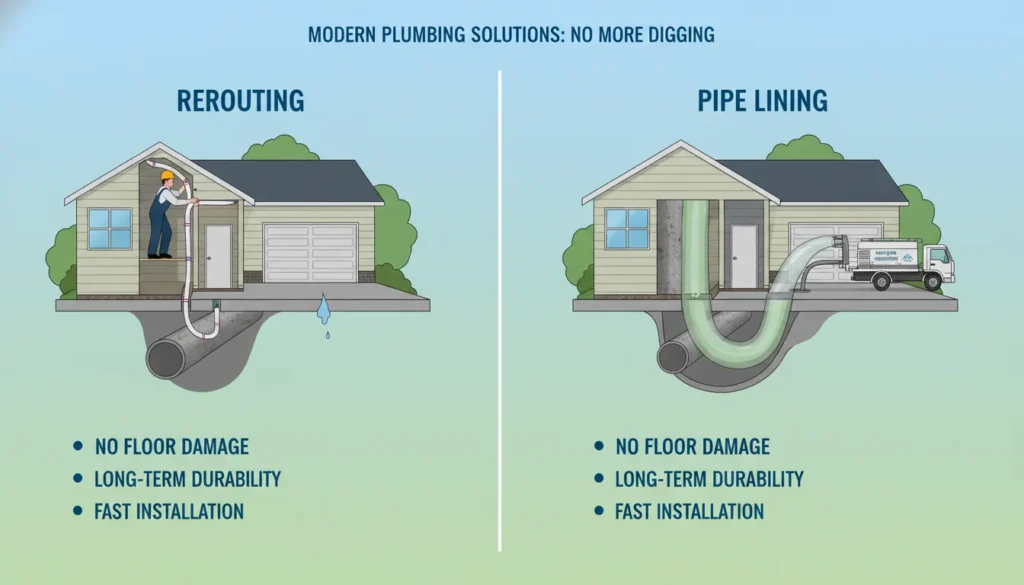
Gone are the days when a slab leak meant destroying your entire living room floor. Modern plumbing technology allows for high-precision repairs that prioritize your home’s aesthetics and structural health. Depending on the age of your pipes and the location of the rupture, there are three primary ways to restore your system.
1. Plumbing Reroute
Rerouting is widely considered the “Best Option” for long-term reliability in South Florida homes. Instead of digging through concrete to patch a single spot, a new, durable water line is installed through the walls or the attic.
Why it works: It completely bypasses the old, corroded pipe under the slab.
The Benefit: By using high-grade PEX piping, you eliminate the risk of a “neighboring leak” occurring in the same old copper line just a few months later.
2. Epoxy Pipe Lining
For homeowners who want a completely “trenchless” solution, epoxy lining is a sophisticated alternative. A specialized resin is coated inside your existing pipes, creating a new, seamless “pipe-within-a-pipe.”
How it works: This method seals pinhole leaks and cracks from the inside without moving any dirt or concrete.
The Benefit: It is exceptionally fast and requires zero demolition, making it ideal for high-end flooring or limited-access areas.
3. Direct Repair
While modern technology favors non-invasive routes, some situations require direct access to the pipe. This involves pinpointing the leak and carefully removing a small section of the concrete slab to perform a manual patch.
Why it’s avoided: Jackhammering is labor-intensive, creates dust, and can cause vibrations that lead to secondary leaks.
Our Policy: We only recommend direct repair as a last resort when rerouting is physically impossible or for very localized, non-corrosive damage.
Homeowners Insurance & Slab Leaks: What You Need to Know
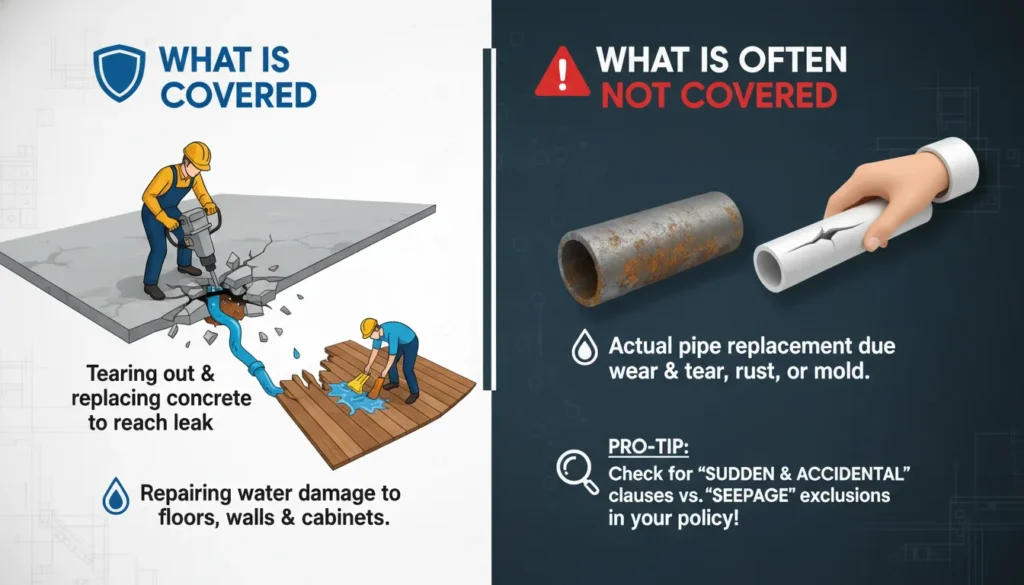
Navigating an insurance claim for an under-slab water leak can be more complex than the repair itself. Most standard homeowners insurance policies in Florida operate on a specific “Split Coverage” logic. Understanding these nuances before you call your provider can save you thousands of dollars in out-of-pocket expenses.
Does Insurance Cover the Repair? Access vs. Pipe
It is a common misconception that insurance covers the entire plumbing bill. In reality, most policies distinguish between two types of costs:
The Access Cost (Usually Covered): This is the cost of “tearing out and replacing” the portion of the concrete slab or flooring to reach the leak. Since this is considered a necessary part of mitigating water damage, insurance companies typically cover this expensive labor.
The Pipe Repair (Usually NOT Covered): Most adjusters view a corroded or old pipe as “wear and tear.” Therefore, the actual cost of the new copper or PEX pipe and the plumber’s time to solder or join it is often the homeowner’s responsibility.
Resulting Damage (Usually Covered): If the leak ruined your hardwood floors, cabinets, or drywall, these “resultant damages” are almost always covered under a standard HO-3 policy.
⚠️ Insider Tip: What NOT to Say to an Insurance Adjuster
To ensure your claim is processed fairly and not immediately denied, follow these expert guidelines when speaking with your insurance representative:
Avoid the word “Seepage”: In insurance language, “seepage” or “gradual leakage” implies a long-term problem that you neglected. Instead, use terms like “Sudden and Accidental discharge of water” to describe the event.
Don’t mention “Foundation Cracks” first: If you lead with foundation issues, the adjuster may classify the claim under “earth movement” or “settlement,” which are standard exclusions. Focus on the plumbing failure as the primary cause of the damage.
Never say “It’s been leaking for a while”: Even if you suspect a slow leak, speculating on the duration can lead to a denial based on “lack of maintenance.” Stick to the facts: when you first noticed the symptoms (like a high bill or warm floor).
Don’t start demolition before documentation: Before any concrete is broken, ensure you have high-resolution photos and a professional digital leak detection report. Without “proof of loss” at the source, an adjuster may deny the claim for lack of evidence.
Frequently Asked Questions About Under-Slab Leaks
Yes, a slab leak is a critical plumbing emergency. Unlike a leaking faucet, a pipe burst under your foundation is constantly eroding the soil that supports your home. Continuous water flow can lead to hydrostatic pressure buildup, causing the concrete slab to buckle or lift (heaving). If you notice a sudden spike in your water bill or warm spots on your floor, you should seek professional detection immediately to prevent permanent structural shifting.
While rare, a prolonged slab leak can absolutely cause localized sinkholes or “voids” beneath your foundation. In South Florida’s sandy and limestone-based soil, constant water pressure washes away the sediment that keeps your slab stable. Over time, this creates an empty pocket (void). Without support, the heavy concrete slab will eventually crack and drop into that void, leading to thousands of dollars in foundation repair costs.
The timeline depends on the chosen repair method:
Electronic Detection: Usually takes 1 to 3 hours to pinpoint the exact location.
Pipe Rerouting: This is the most common fix and typically takes 1 full day (8–10 hours). It is the least disruptive method for your family.
Direct Repair (Jackhammering): This can take 2 to 3 days, as it involves breaking concrete, repairing the pipe, and then patching the foundation and flooring.
Epoxy Pipe Lining: Often completed in one day, depending on the length of the line being treated.
Not necessarily. A small “pinhole leak” caused by pitting corrosion might not cause a noticeable drop in pressure initially, but it will still damage your foundation. However, a major rupture will lead to a significant decrease in water pressure throughout the house. This is why professional acoustic testing is vital—it catches the “silent” leaks before they become visible disasters.
When filing a slab leak claim, your choice of words can determine if your claim is approved or denied. Avoid these specific phrases:
“This has been leaking for a long time.” Why: Insurance covers “sudden and accidental” damage. If you imply the leak is an old, neglected issue, they will deny it as a “maintenance” or “wear and tear” problem.
“My house is flooding.” Why: In insurance terms, “Flood” refers to rising ground water from outside (like a storm). A slab leak is “Water Damage.” Using the word “flood” can lead to a denial if you don’t have separate flood insurance.
“The foundation is sinking.” Why: General policies often exclude “earth movement.” Focus on the plumbing failure first. Let a professional leak detection report define the structural impact later.
“I’ll take the initial settlement offer.” Why: Do not agree to a payout until a professional has performed Electronic Leak Detection. You don’t know the full extent of the sub-slab erosion or mold until the inspection is complete.
Schedule Your Professional Leak Detection Today
A slab leak is a race against time. Every gallon of water escaping under your foundation weakens the soil and increases the risk of structural failure. Don’t wait for a small pinhole leak to turn into a massive foundation disaster that costs tens of thousands to repair.
Whether you need precision detection, a durable pipe reroute, or comprehensive plumbing services to safeguard your home’s water system, our team is ready to help. At Ez Plumbing Repair Services, we provide the expertise, technology, and insurance documentation support you need to restore your home’s safety and your peace of mind.
Why Choose Our Expert Foundation Rescue Team?
- Instant Savings: Mention code "SLAB-SAVE-50" for a $50 discount on detection.
- Rapid Response: 24/7 emergency dispatch across Miami & Broward.
- Non-Invasive Technology: We find the leak without the mess of unnecessary jackhammering.
