Professional Grease Trap Cleaning & Pumping in Miami: Get $50 Off Today
At EZ Plumbing, we provide certified FOG (Fats, Oils, and Grease) management solutions tailored for Miami’s high-volume commercial kitchens. Our expert team ensures your facility remains 100% compliant with local environmental codes while eliminating the risk of costly sewer backups.
Why Choose EZ Plumbing for Your Kitchen?
✅Total Regulatory Compliance
We provide a signed service manifest with every pump-out, ensuring you pass every Miami-Dade health inspection without the threat of fines.
✅Operational Longevity
Regular 4K-verified cleaning prevents acidic grease from corroding your interceptor, saving you thousands in premature replacement costs.
✅ Odor-Free Environment
Our deep-scraping method removes the “sulfur-smelling” bacteria at the root, ensuring your dining area remains pleasant for customers.
- Instant $50 Discount – Applied to your first professional pump-out.
- Compliance Documentation – Official manifest provided for Miami-Dade inspectors.
- Zero-Downtime Service – Quiet, efficient pumping scheduled during your off-hours.
How Much Does Grease Trap Cleaning Cost in 2026?
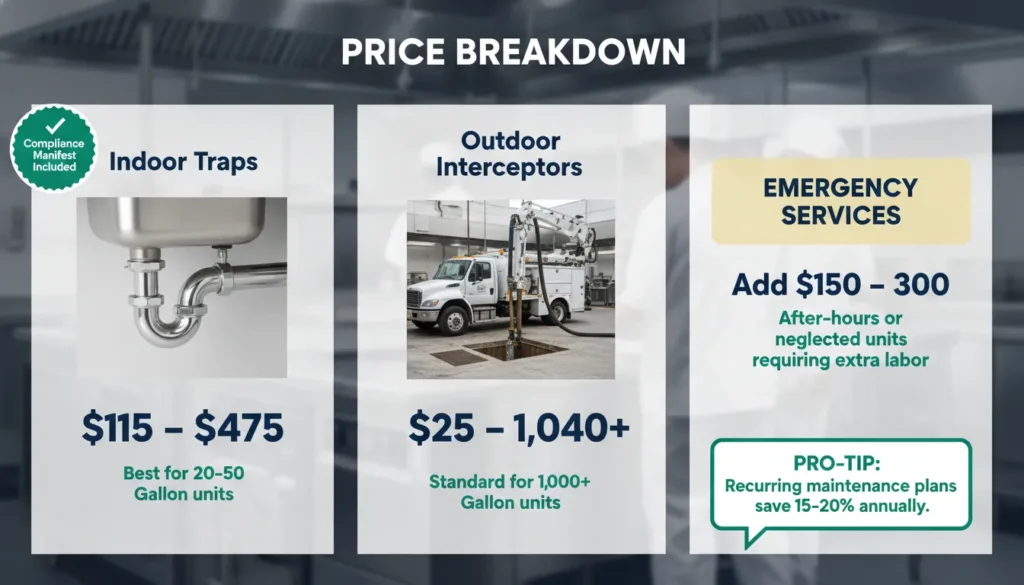
In 2026, professional grease trap cleaning in Miami typically costs between $115 and $1,040. Prices vary based on the unit’s size (Gallons), the volume of FOG (Fats, Oils, Grease) accumulated, and accessibility. Emergency after-hours pumping usually incurs an additional mobilization fee ranging from $150 to $300.
2026 Miami Grease Trap Service Price Guide
| Trap Type & Service | Avg. Price Range | Frequency Tip |
|---|---|---|
| Indoor Under-Sink Trap | $115 – $475 | Every 1–4 Weeks |
| Large Outdoor Interceptor | $325 – $1,040+ | Every 3 Months |
| Emergency/After-Hours | Add $150 – $300 | As Needed |
Why Regular Pumping is a Legal Mandate: Navigating the 25% Rule
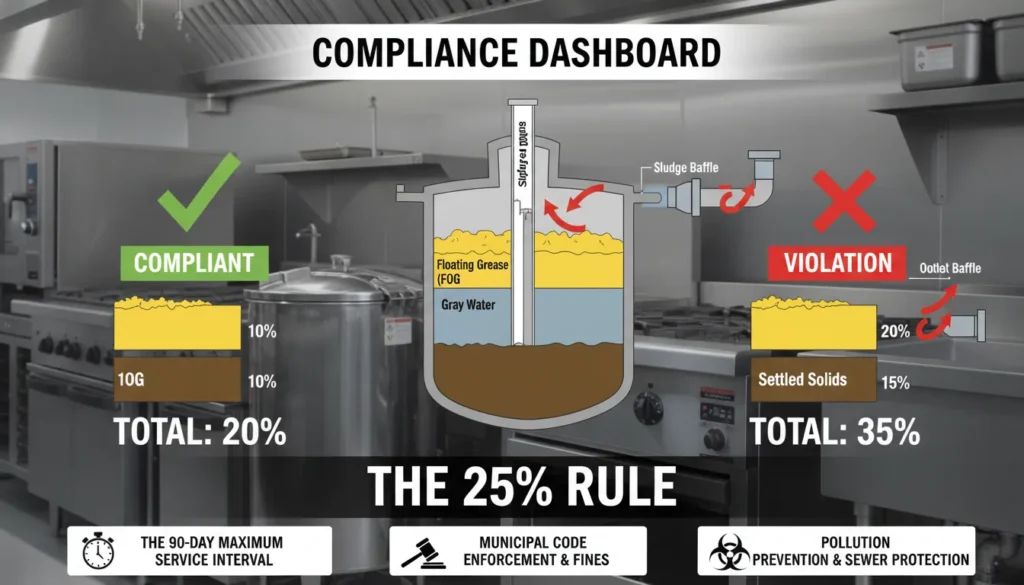
In Miami-Dade County, grease management is governed by strict environmental ordinances designed to protect the municipal sewer system. The most critical regulation for any commercial kitchen is the “25% Rule” (also known as the 1/4th Rule).
This mandate requires that every grease interceptor be professionally pumped once the combined volume of floating grease (FOG) and settled solids reaches 25% of the trap’s total capacity. Exceeding this limit is a direct violation of health and environmental codes, often leading to immediate administrative penalties.
Critical Compliance Factors for 2026
Maintaining your grease trap isn’t just about hygiene—it is a legal necessity. Under current regulations, local food service establishments must adhere to these three pillars of compliance:
Preventing Sewer Backups: When a trap exceeds 25% capacity, it can no longer effectively separate grease. This leads to solidified FOG entering the main lines, causing high-cost sewage overflows into your kitchen or the street.
Avoiding Municipal Fines: Local inspectors (DERM) use “dip-stick” audits to measure grease levels. If you are found over the 25% limit or have missed your 90-day mandatory pumping window, you may face automatic fines starting at $250 to $500.
Eliminating Foul Odors (Hydrogen Sulfide): A neglected trap becomes a breeding ground for bacteria that produce Hydrogen Sulfide gas. This “rotten egg” smell is not only unpleasant for customers but also indicates a dangerous buildup of corrosive gasses.
Visual Strategy: The "Danger Zone" Infographic
To help restaurant managers visualize compliance, we utilize the following diagnostic comparison:
Safe Level: 15% – 20 – The trap is functioning perfectly. Water flows freely, and grease is securely trapped in the primary chamber.
Compliance Limit: 25% – The Mandatory Pumping Point. Separation efficiency begins to drop.
Danger Zone: 50%+ – Critical Failure. Grease is now “short-circuiting” the baffles and entering the city sewer. High risk of immediate fines and emergency backups.
From Vacuum Pumping to Post-Repair Verification: Our Gold-Standard Workflow
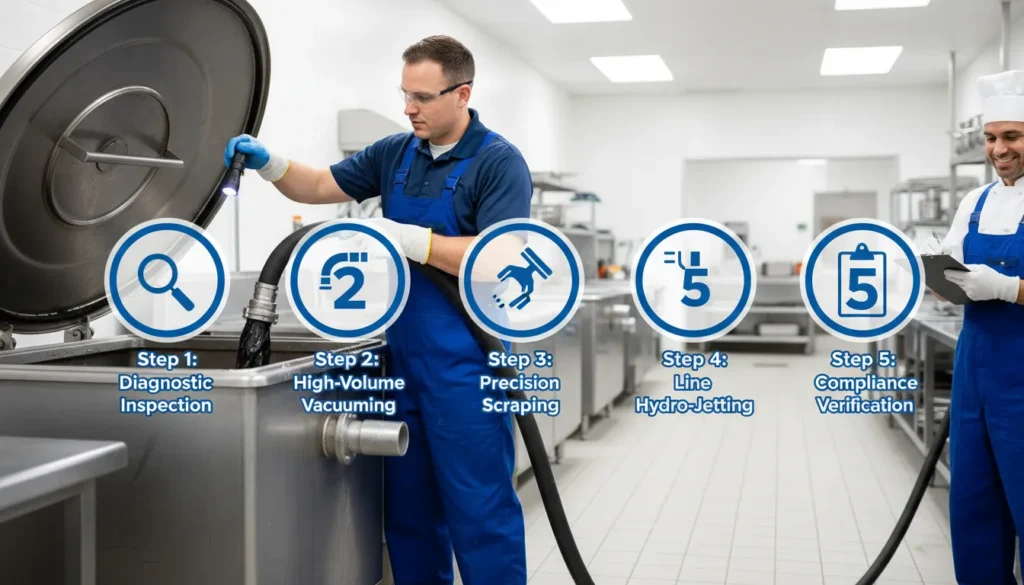
Most grease trap failures occur because “surface pumping” leaves hardened deposits behind. To ensure your kitchen meets Miami-Dade DERM standards, we follow a rigorous 5-step decontamination and maintenance process. This system restores your interceptor to its original flow capacity, preventing premature equipment failure and foul odors.
The Engineering-Grade Cleaning Sequence
We don’t just empty the tank; we restore the system. Here is the technical breakdown of our professional intervention:
Comprehensive Inspection: Before pumping, we perform a diagnostic check of the internal baffles and flow controls. We look for cracks, corrosion, or bypasses that could allow grease to escape into the main sewer line.
Total Vacuum Pumping: Using high-velocity suction, we perform a 100% removal of all contents. This includes the floating FOG (Fats, Oils, Grease) layer, the middle gray-water layer, and the heavy food solids (sludge) settled at the bottom.
Precision Manual Scraping: Vacuuming alone cannot remove “fossilized” grease. Our technicians manually scrape the interior walls, dividers, and lids to remove hardened buildup that harbors bacteria and produces Hydrogen Sulfide (H2S) gas.
Inlet/Outlet Hydro-Jetting: To ensure a complete system reset, we use high-pressure Hydro-Jetting to clear the connecting lines. This flushes out grease deposits within the inlet and outlet pipes that are often the hidden cause of slow drainage.
Compliance Documentation (Manifesting): We finalize the service by providing a detailed Service Manifest. This document includes the volume removed and proof of legal disposal at a licensed facility—essential for your next health inspection or GDO permit audit.
Signs Your Restaurant Grease Trap is Full: Don't Wait for a Backup
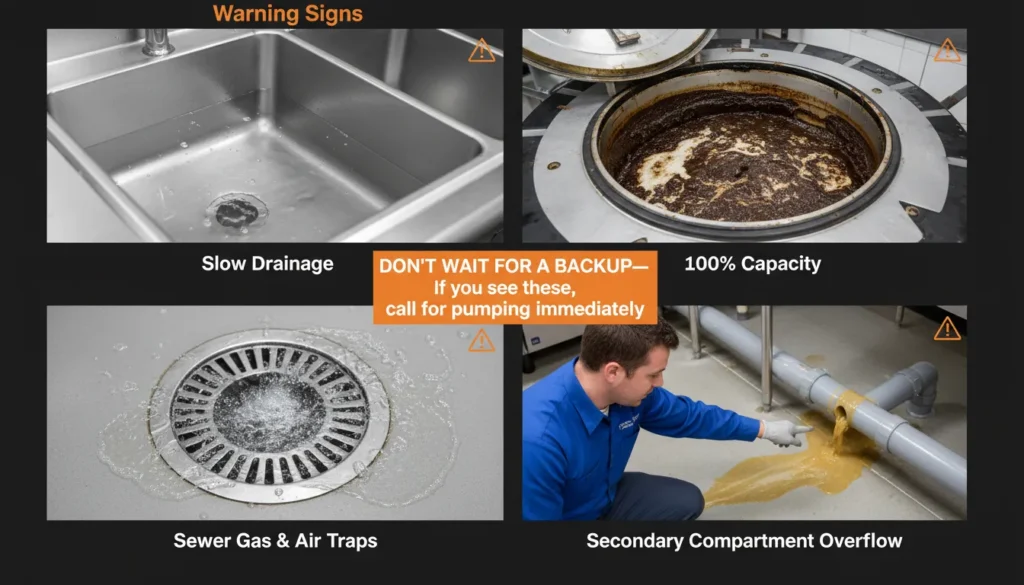
In a fast-paced commercial kitchen, a grease trap failure is more than an inconvenience—it is a business-stopping emergency. Recognizing the early warning signs of an overfilled interceptor can save you thousands in emergency plumbing repairs and prevent forced closures by health inspectors. If you notice any of the following “Red Flags,” your system has likely exceeded the 25% Rule and requires immediate professional pumping.
Critical Warning Signs Checklist
Check your kitchen for these symptoms today to avoid a total system failure:
🚫 Slow Drainage in Prep Sinks: If water takes longer than usual to disappear down the drain, it indicates that the grease cap in your trap has become so thick that it is restricting the flow of wastewater.
🤢 Strong “Rotten Egg” Odors: A persistent, foul smell in the kitchen or near the interceptor is a sign of Hydrogen Sulfide (H2S) gas buildup. This occurs when old grease and food solids begin to rot, signaling a severely neglected trap.
👁️ Grease in Secondary Compartments: If you open the lid and see a thick layer of FOG (Fats, Oils, Grease) in the second chamber of the trap, your system is already “short-circuiting.” This means grease is escaping into the municipal sewer line.
🔊 Gurgling Sounds from Floor Drains: Unusual “glugging” or gurgling noises when water is running elsewhere in the kitchen suggest that air is trapped behind a grease blockage, a precursor to a major sewage backup.
🪳 Increased Pest Activity: Excess organic waste in a full grease trap attracts roaches and flies. If you notice a sudden uptick in pests near your drains, the trap is likely the source.
Frequently Asked Questions About Grease Trap Maintenance
The industry standard is the “25% Rule.” You must clean your trap whenever the Fats, Oils, and Grease (FOG) occupy 1/4th (25%) of the tank’s capacity. For most high-volume kitchens, this is every 1 to 3 months. In Miami-Dade, there is a legal mandate to pump at least every 90 days, even if the 25% threshold hasn’t been reached.
A neglected grease trap emits a pungent, sour, and sulfuric odor, often described as “Rotten Eggs.” This is caused by the anaerobic breakdown of organic food waste and grease, which releases Hydrogen Sulfide (H2S) gas.
Yes. A grease trap is a “bridge” between your kitchen drains and the municipal sewer line. Its job is to slow down the water so grease can float to the top before the clean water exits into the city’s main sewer pipes.
In technical plumbing terms, a stale, musty, or floral-sweet smell often associated with old drains is usually Biofilm or Stagnant Water buildup. However, if it smells like rotting cabbage or garlic, it is often a sign of a Sewer Gas Leak.
The early symptoms of exposure to sewer gas (Hydrogen Sulfide) include:
Dizziness and Headaches
Nausea or Fatigue
Irritation of the eyes and throat
Shortness of breath
Note: If you smell “rotten eggs” and feel these symptoms, evacuate the area immediately.
Sewer Gas (Hydrogen Sulfide) and Cat Urine are considered the most difficult smells to remove because they penetrate porous materials like drywall, wood, and carpets. For sewer gas, the source (a dried P-trap or cracked vent pipe) must be fixed first, or the smell will never leave.
Three things happen:
System Failure: The grease solidifies into a “cap,” forcing new grease into the city sewer, leading to massive fines.
Backups: Sewage and greasy water will eventually back up into your kitchen floor drains.
Corrosion: The acidic nature of old grease eats away at the trap’s walls, leading to a total replacement cost of $5,000–$10,000.
Yes. In high concentrations, grease trap fumes contain Methane (flammable) and Hydrogen Sulfide (toxic). While a faint smell is just a nuisance, a heavy concentration in a confined space can be lethal as it displaces oxygen.
Secure Your Kitchen's Health with Professional Plumbing Services
A neglected grease trap is a ticking time bomb for your business. Between the risk of sudden sewage backups and the high cost of Miami-Dade environmental fines, waiting is the most expensive option. Our team specializes in comprehensive grease management and expert Plumbing Services that keep your kitchen running, your drains flowing, and your health inspector satisfied.
The Final Value Proposition: Zero Risk, Maximum Clean
Don’t wait for a backup to disrupt your service. We understand the high-pressure environment of the Miami restaurant industry, which is why we offer:
Free On-Site Estimates: Know your costs upfront with zero hidden fees for all your Plumbing Services.
No Extra Charge for Nights & Weekends: We work when you don’t. Schedule your pumping during off-hours at no additional cost to avoid disturbing your customers.
100% Compliance Guarantee: We handle the digital manifest uploads so you never miss a county deadline.
- ✨ Instant $50 Discount – Applied to your first professional pump-out.
- 📄 Compliance Documentation – Official manifest provided for Miami-Dade inspectors.
- 🚀 Zero-Downtime Service – Quick pumping scheduled during your off-hours.
