Commercial Backflow Preventer Services: Certified Testing, Installation & Compliance
Protect your business from costly fines and avoid immediate water disconnection. In Miami-Dade, staying compliant with municipal plumbing codes isn’t optional—it’s a legal necessity. From mandatory annual backflow testing and high-precision repairs to the installation of industry-leading Watts commercial backflow preventers, EZ Plumbing ensures your potable water supply is 100% protected. Whether you operate a restaurant, a medical facility, or a high-rise, our licensed specialists provide the same-day certification you need to keep your doors open and your water flowing safely.
Why Choose EZ Plumbing for Your Backflow Needs?
🛡️ Guaranteed Compliance
We don’t just test; we handle the paperwork. We submit your passing reports directly to the local water authority, ensuring you stay off the “violation list.”
⚡ Zero Business Downtime
Our “Rapid-Response” testing is designed to be minimally invasive. We verify your valves (DCV or RPZ) quickly so your operations never skip a beat.
💎 Expert Engineering
We specialize in high-grade 2-inch and 3/4-inch commercial systems. If your device fails, we provide on-the-spot repairs to restore safety within the 45-day legal window.
Special Offer: Get $50 OFF your certification when you book this week!
Understanding Commercial Backflow Prevention: The Science & The Law
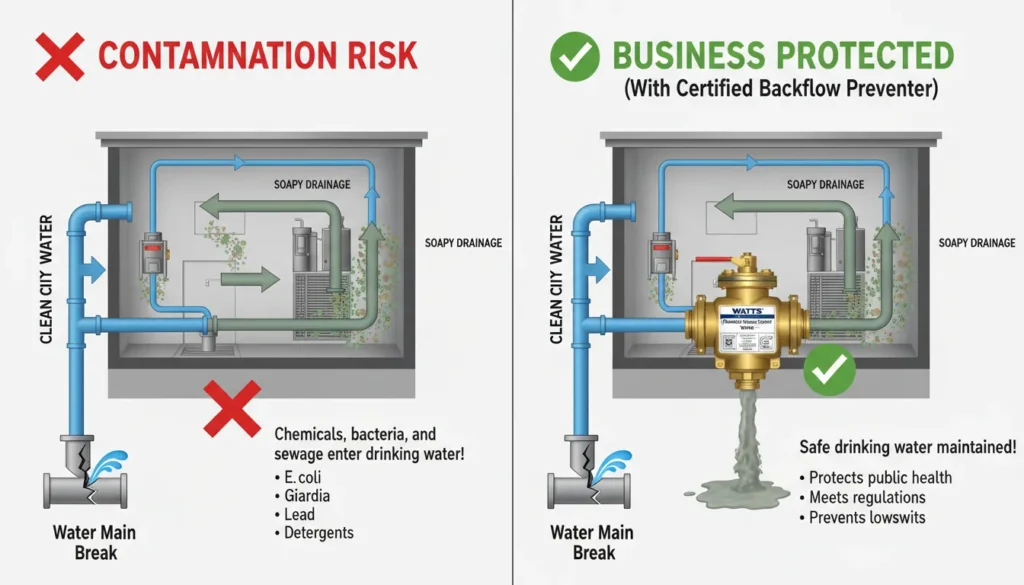
At its core, commercial backflow prevention is about one thing: keeping your facility’s water safe for human consumption. In a complex commercial plumbing environment, water pressure is never static. When a sudden drop in pressure occurs—due to a nearby fire hydrant use or a water main break—a “vacuum” effect is created.
The Science: What is Backflow?
Backflow is the unwanted reversal of water flow in a plumbing system. Without a certified backflow preventer, this pressure change can literally “suck” hazardous contaminants backward into the potable (clean) water supply.
Chemical Contamination: Pesticides, industrial soaps, and fertilizers from irrigation systems.
Biological Hazards: Bacteria, sewage, and stagnant water from fire sprinkler lines.
Health Risks: Once these enter the clean water line, they can cause serious illness to your customers, employees, and the surrounding community.
The Law: Why Compliance is Mandatory in Miami
Municipalities and water authorities (like Miami-Dade Water and Sewer Department) enforce strict codes for one reason: Public Safety. Commercial properties are legally required to have a functioning, certified backflow device installed at the water meter. The law mandates that these devices must be tested annually by a licensed professional to ensure they are still preventing cross-contamination. Failure to submit your passing report within the legal window often results in immediate water service termination and heavy municipal fines.
High-Risk Facilities: Who Needs Backflow Protection?
While almost all commercial buildings need some level of protection, certain “High-Risk” facilities are under constant scrutiny by water authorities:
Restaurants & Food Processing: To prevent grease and sanitizing chemicals from entering the main line.
Medical Offices & Hospitals: To stop biological waste and pharmaceutical contaminants.
Car Washes & Industrial Plants: To block soaps, heavy metals, and toxic chemicals.
Multi-Story Buildings & Hotels: High-rise structures with complex pumping systems.
Properties with Fire Sprinklers: Stagnant water in fire lines is a breeding ground for bacteria and must be isolated.
Specialized Backflow Devices for Your Property
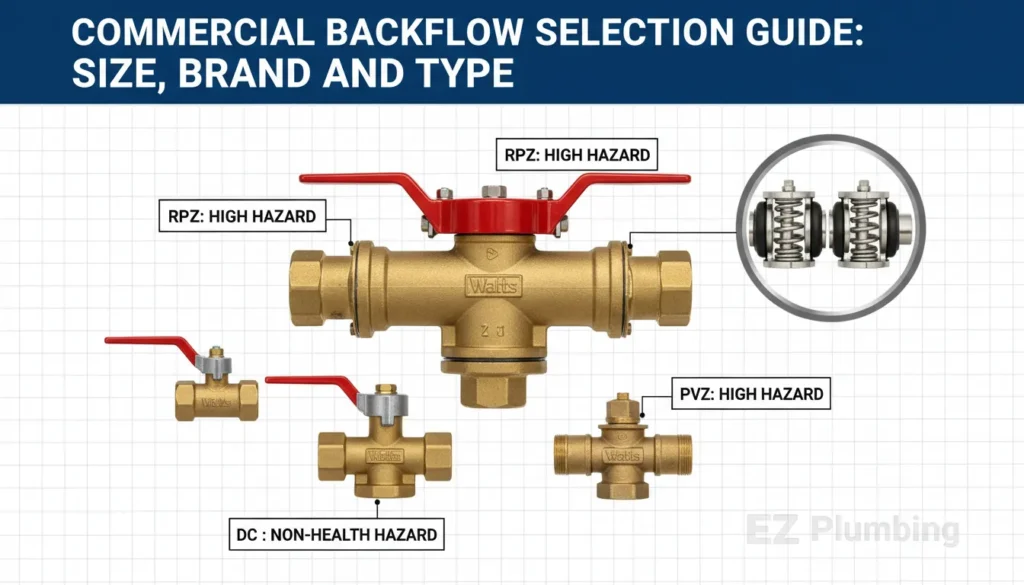
Not every commercial building requires the same level of protection. The type of device we install depends on your facility’s Hazard Level and the pipe diameter of your main water line. At EZ Plumbing, we specialize in the installation and maintenance of industry-leading brands like Watts, Wilkins, and Febco to ensure your system meets the highest safety standards.
Common Sizes for Commercial Applications
3/4-Inch Commercial Backflow Preventers: Typically used for smaller branch lines, such as dedicated soda fountains in restaurants or small irrigation systems.
2-Inch Commercial Backflow Preventers: The “Gold Standard” for medium-sized office buildings, retail centers, and multi-unit apartments.
Large Industrial Valves: Custom-sized assemblies for hospitals, car washes, and manufacturing plants with high-volume water needs.
The 4 Main Types of Backflow Preventers
To stay compliant with Miami-Dade codes, you must understand which of these four devices fits your specific use case:
Reduced Pressure Zone (RPZ) Assembly:
Best For: High-risk contamination areas (Hospitals, Car Washes, Laboratories).
How it works: It features a relief valve that dumps water if the internal check valves fail, providing the maximum level of safety.
Double Check Valve (DCV) Assembly:
Best For: Low-to-medium risk facilities (Retail stores, Office buildings).
How it works: Two independent check valves ensure that if one fails, the second one stops the reverse flow.
Pressure Vacuum Breaker (PVB):
Best For: Commercial irrigation and lawn sprinkler systems.
How it works: Designed specifically to prevent “Back-Siphonage” when the city water pressure drops.
Atmospheric Vacuum Breaker (AVB):
Best For: Individual plumbing fixtures and hose bibbs.
Note: These are simpler devices and are not typically used for whole-building protection.
Our Certified Commercial Backflow Testing Process: 4 Steps to Compliance
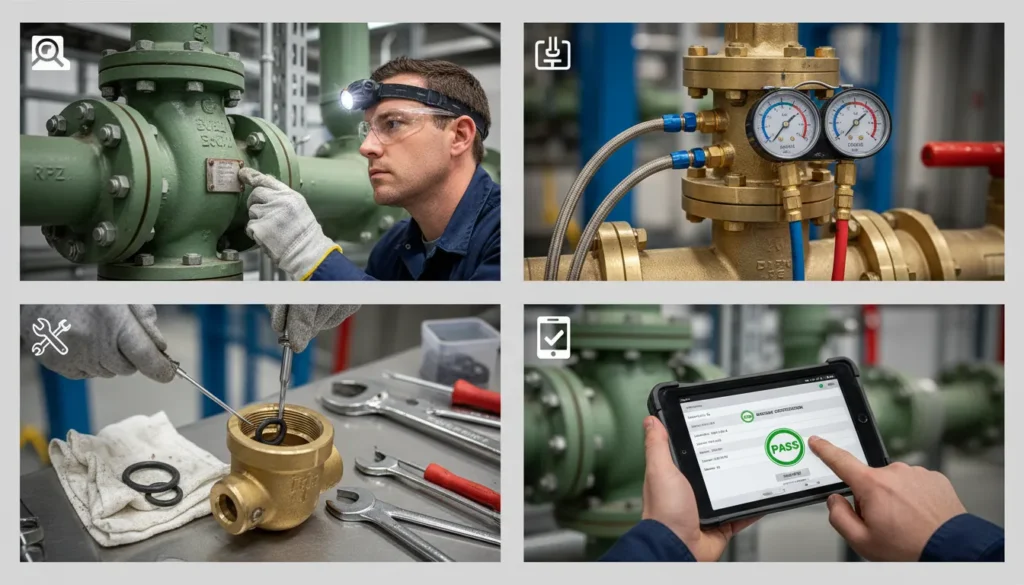
Annual testing isn’t just a recommendation—it’s a legal responsibility for property owners. At EZ Plumbing, we’ve refined our testing protocol to ensure your business remains compliant with Miami-Dade water standards without interrupting your daily operations. Our process is fast, thorough, and fully documented.
The 4 Main Types of Backflow Preventers
Step 1: Site Inspection & Device Identification
Our backflow-certified technician arrives on-site to locate your main service entrance. We identify the specific make, model, and size of your device—whether it’s a 2-inch Watts RPZ or a large-scale Double Check Valve (DCV). We inspect the exterior for visible rust, cracks, or worn components that could indicate a future failure.
Step 2: Precision Pressure Testing & Differential Analysis
Using NIST-calibrated gauges, we hook into the test ports of your backflow assembly. We perform a series of pressure differential tests to verify that the internal check valves are holding tight against reverse flow. This step ensures that even a minor drop in city pressure won’t compromise your building’s water safety.
Step 3: Immediate Repairs & Failure Mitigation
If your device fails the pressure test, we don’t just walk away. To help you avoid municipal fines, we offer immediate on-site repairs. Within the mandatory 45-day repair window, we can replace springs, rubber seals, or internal disks to restore your system to 100% functionality and pass the re-test on the same day.
Step 4: Official Compliance Documentation & Filing
Once the device passes, we handle the “Red Tape” for you. We generate an official Backflow Prevention Assembly Test Report and submit it directly to the local water authority (such as Charleston Water or Miami-Dade WASD). You receive a digital copy for your records, ensuring your business is shielded from legal penalties and service disconnection.
How Much Does a Commercial Backflow Preventer Cost? 2026 Estimates
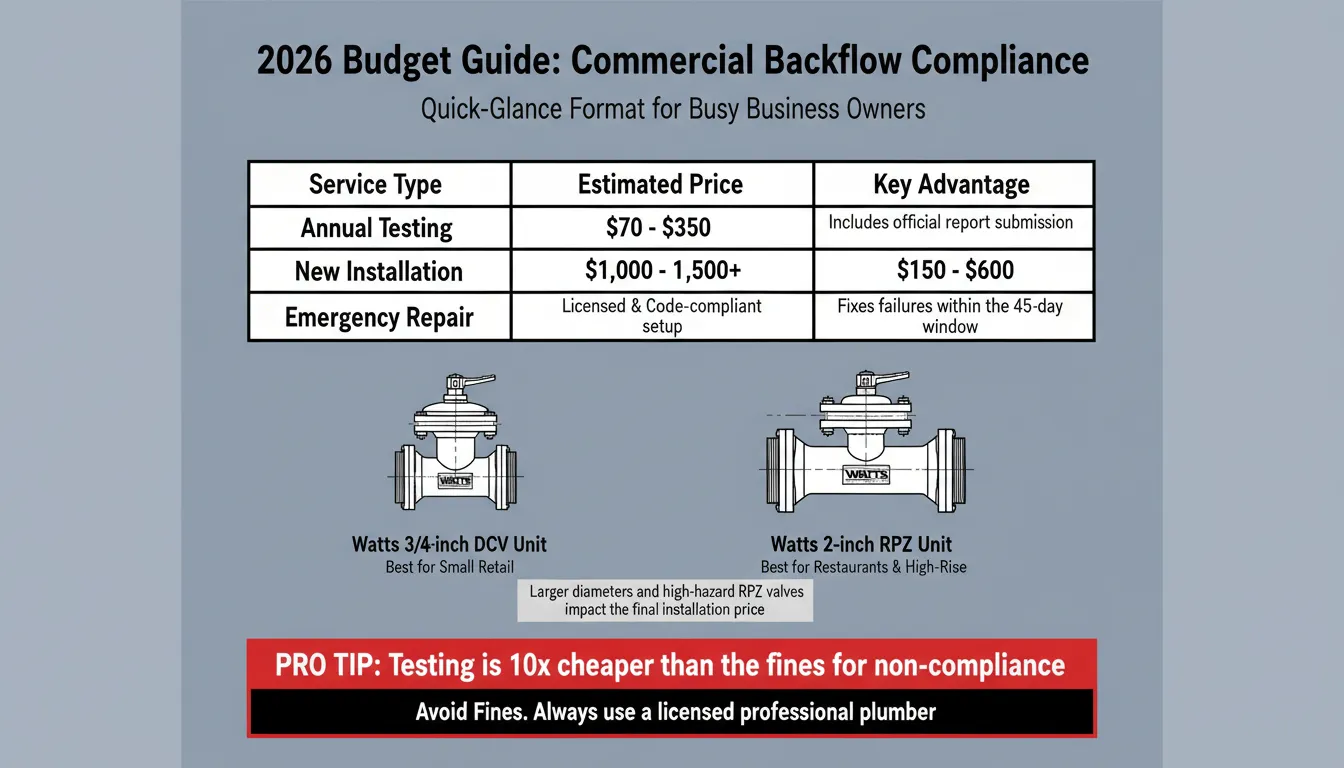
Budgeting for backflow compliance is essential for any Miami business. Costs vary based on the device size (3/4 inch to 10+ inches) and the level of hazard protection required (RPZ vs. DCV). At EZ Plumbing, we provide upfront pricing with no hidden trip charges.
1. Commercial Installation Costs
For new construction or system retrofits, a professional installation typically ranges from $1,000 to $1,500+.
Factors: The price depends on the pipe diameter (e.g., a 2-inch Watts preventer costs more than a 3/4-inch unit) and whether the installation is indoors or requires an outdoor protective “Hot Box” enclosure.
2. Mandatory Annual Testing Rates
To stay compliant with municipal codes, your device must be certified every year.
Standard Certification: Expect to pay between $70 and $350 per device.
The EZ Advantage: Our testing fee includes all the paperwork and direct electronic submission to the Miami-Dade water authority.
3. Backflow Repair vs. Full Replacement
If your device fails its annual test, you have a 45-day legal window to fix it.
Repairs ($150 – $600): Often, a simple “Rubber Kit” replacement or cleaning the internal check valves is enough to restore compliance.
Full Replacement ($1,200+): If the bronze body is cracked (common after a freeze) or the internal components are severely corroded, a full replacement is the most cost-effective long-term solution.
When to Replace Your Commercial Backflow Valve
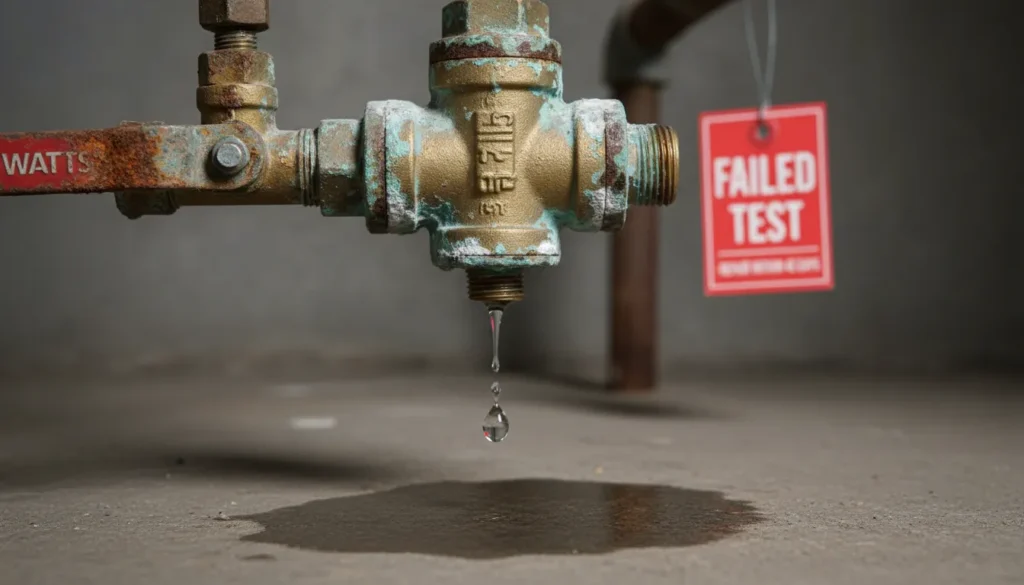
A backflow preventer is a mechanical device with moving parts, springs, and rubber seals that degrade over time. Ignoring the warning signs doesn’t just risk a failed annual inspection—it risks your entire facility’s water access. At EZ Plumbing, we help Miami business owners identify these “Red Flags” before the water authority issues a violation.
1. Visible Symptoms of Mechanical Failure
If you notice any of the following during a routine walk-through, your device requires immediate professional attention:
Constant Leaking or Dripping: While RPZ valves may occasionally spit water due to pressure fluctuations, a steady stream from the relief valve or atmospheric vent indicates internal seal failure.
Visible Rust & Corrosion: Miami’s humid salt air accelerates “pitting” on the valve body. Deep rust or cracks in the brass or iron casing are signs of structural compromise.
Mineral Deposit Buildup: White, crusty buildup around the test cocks or shut-off valves suggests slow, persistent leaks that can lead to a catastrophic burst.
2. Performance Red Flags
Sometimes the problem isn’t visible; it’s felt throughout the building:
Drop in Water Pressure: If your facility is experiencing a noticeable decrease in PSI (pounds per square inch) that cannot be explained by municipal work, the internal check valves of your backflow assembly may be fouled or stuck.
Discolored or “Rusty” Water: If water appearing at the tap has a metallic taste or brownish tint, it may be due to internal corrosion within an aging backflow unit.
3. The Age Factor: The 10–15 Year Rule
Most commercial backflow preventers (like Watts or Wilkins models) have a reliable service life of 10 to 15 years. Beyond this window, the cost of frequent repairs and part replacements often exceeds the price of a modern, more efficient unit. Upgrading ensures you meet the latest Miami-Dade plumbing codes and prevents surprise failures during annual testing.
4. The 45-Day Compliance Window
Time is of the essence. If your device fails its annual certified test, the water authority typically grants a 45-day window for mandatory repair or replacement. Failure to submit a passing “Recertification Report” within this period will lead to immediate water service disconnection and heavy non-compliance penalties.
Commercial Backflow FAQ: Expert Answers to Common Compliance Questions
Yes. In Miami-Dade and most municipalities, a commercial backflow preventer must be installed and certified by a licensed plumber with a specific backflow certification. An uncertified installation will not be recognized by the water authority, leading to failed compliance reports and potential water shut-offs.
A backflow preventer is a mechanical “one-way gate” for your plumbing. It uses a series of internal check valves to ensure that water only flows into your building. If the city’s water pressure drops, the device automatically closes, preventing contaminated water (chemicals, soaps, or waste) from being sucked backward into the clean public water supply.
The cost of commercial backflow repairs typically ranges from $150 to $600, depending on the size of the device (e.g., a 2-inch vs. 4-inch valve) and the parts needed. Common repairs include replacing worn rubber seals, internal springs, or cleaning out debris from the check valves. If the internal bronze body is cracked, a full replacement ($1,000+) may be more cost-effective.
While rare in Miami, extreme weather can happen. To drain the device:
Turn off the main water supply valve.
Open the test cocks (small nozzles on the side) using a flat-head screwdriver to release internal pressure.
Leave the test cocks at a 45-degree angle to allow any remaining water to expand without cracking the internal components.
Final Compliance & Local Authority
Compliance isn’t just a checkbox; it’s the safety of your community. A single failed inspection or a missed deadline can disrupt your entire operation. As a premier provider of Commercial Services in Miami, EZ Plumbing specializes in high-stakes infrastructure management. Whether you need an emergency repair or a comprehensive system overhaul, you can explore our full range of solutions on our main Plumbing Services hub. Let Miami’s licensed experts handle your certification, so you can focus on running your business.
