Hydrojet Drain Cleaning: The 2026 Guide to Blasting Commercial Sludge & Pebbles
FAST FACT
Why Hydrojetting Beats Traditional Snaking
Standard plumbing snakes only poke holes through clogs. If your drain is plagued by commercial grease, heavy pebbles, or invasive roots, you need a full system restoration. This guide breaks down:
How high GPM volume flushes physical rocks and heavy sediment that snakes leave behind.
Removing the “wall of grease” to restore your pipes to their original factory diameter.
A deep dive into Vibra-Pulse technology and specialized “Root Ranger” nozzles.
Why investing in one jetting session saves you thousands in recurring plumbing calls.
2026 Expert Insight
“Don’t just clear the clog—restore the flow. Learn the difference between temporary fixes and permanent solutions.”
Have you ever spent $200 on a professional drain snake only to have the clog return three days later? Most property owners face this “Half-Clean Trap” because mechanical augers only poke a hole through the mess—they don’t remove it. If you are dealing with commercial sludge, heavy sediment, or outdoor pebbles, you don’t just need a snake; you need a restoration.
In this guide, we’ll reveal why hydrojet drain cleaning is the gold standard for 2026 and how it uses physics (not just pressure) to return your pipes to a “like-new” state.
The Direct Answer
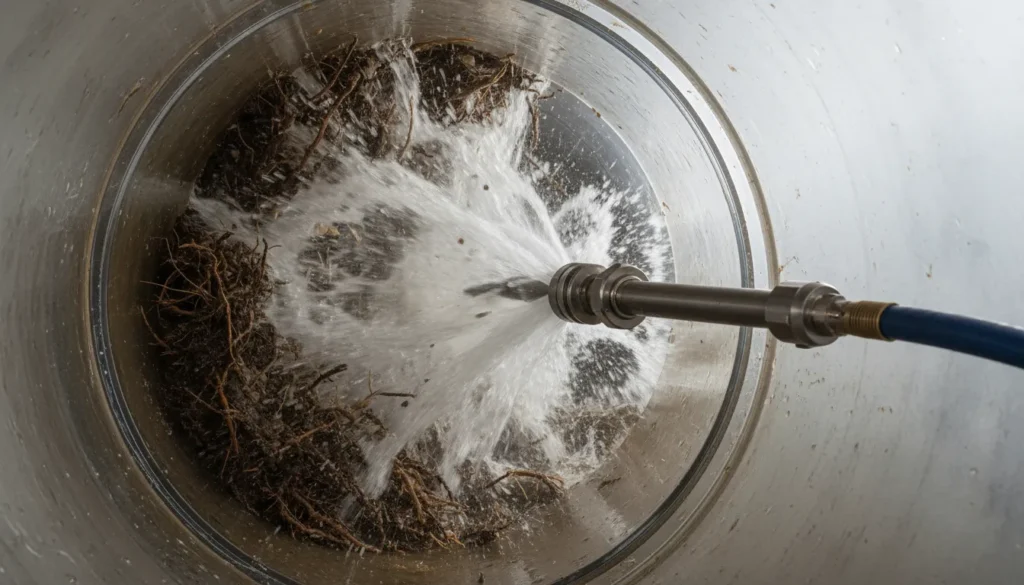
What is hydrojet drain cleaning? Hydrojet drain cleaning is a high-pressure (up to 4,000 PSI) pipe restoration method that uses a specialized sewer jetter to scour pipe walls. Unlike traditional snaking, it combines high pressure with High GPM (Gallons Per Minute) to physically flush out heavy debris like pebbles, sand, and grease, restoring 100% of the pipe’s internal diameter.
The Reality of Modern Drain Failures
If your drain is outside or in a commercial kitchen, you aren’t just fighting hair clogs. You are fighting sediment stratification. Over time, dirt, rocks, and hardened fats settle at the bottom of your pipes. A standard plumbing snake is simply too thin to move this weight.
To achieve a permanent fix, you must use a method that:
Scours the full 360-degree surface of the pipe.
Pulverizes tree roots into fine organic matter.
Flushes heavy solids (like pebbles) out to the main city line.
Why Your Drain Snake Failed: The Science of “Hard” vs. “Soft” Clogs
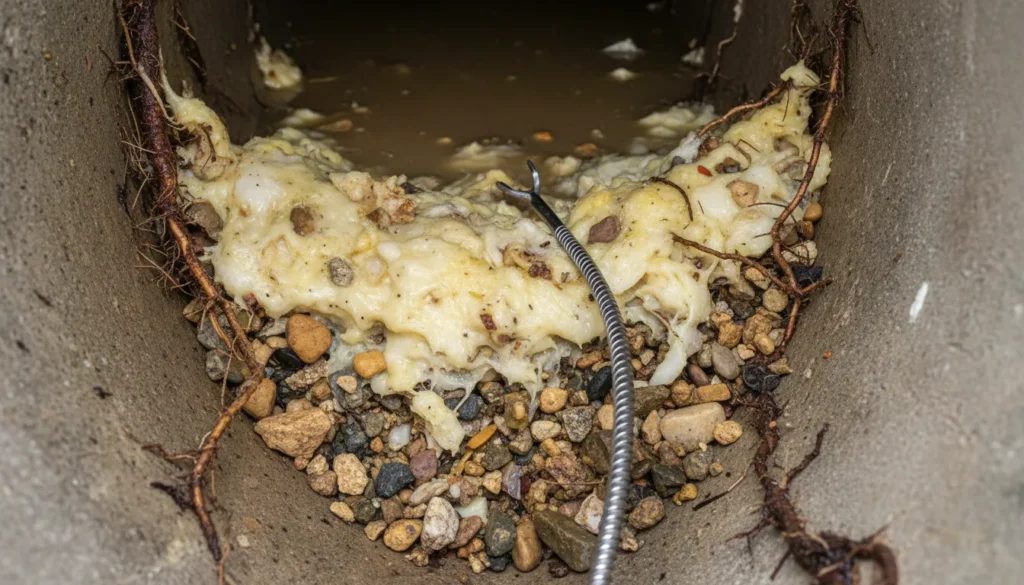
Most people assume a clog is just a solid “plug” sitting in the pipe. In reality, clogs are usually sediment layers or structural blockages. A mechanical snake (auger) is a great tool for “Soft Stoppages,” but it is almost useless against the heavy debris found in outdoor or commercial lines.
The “Corkscrew” Effect
A drain snake works like a corkscrew. It spins through the center of the pipe to hook hair or toilet paper. However, it fails in these three scenarios:
The Grease Wall: In commercial kitchens, grease coats the entire pipe wall. A snake pokes a 1/2-inch hole through the grease, but within hours, the “sludge” settles back and closes the hole.
The Pebble & Sand Trap: Outside drains collect dirt and rocks. A snake simply slides over the top of these pebbles, leaving the blockage untouched at the bottom of the pipe.
Elastic Roots: High-tensile tree roots often “bounce” away from a snake’s blade. Even if cut, the snake doesn’t clear the root’s entry point, allowing it to grow back twice as fast.
Restoration vs. Poking Holes
The reason your bounce rate on previous DIY attempts was so high is that you weren’t actually cleaning the pipe—you were just bleeding the pressure. To solve the problem, you need to transition from “poking holes” to pipe restoration.
Hydrojetting doesn’t just clear the path; it scours the walls using high-velocity water, removing the “bio-film” that clogs stick to. By the time the sewer jetter is finished, your cast iron or PVC pipe is as smooth as the day it was installed.
Hydrojetting vs. Snaking: Which One Saves You Money?
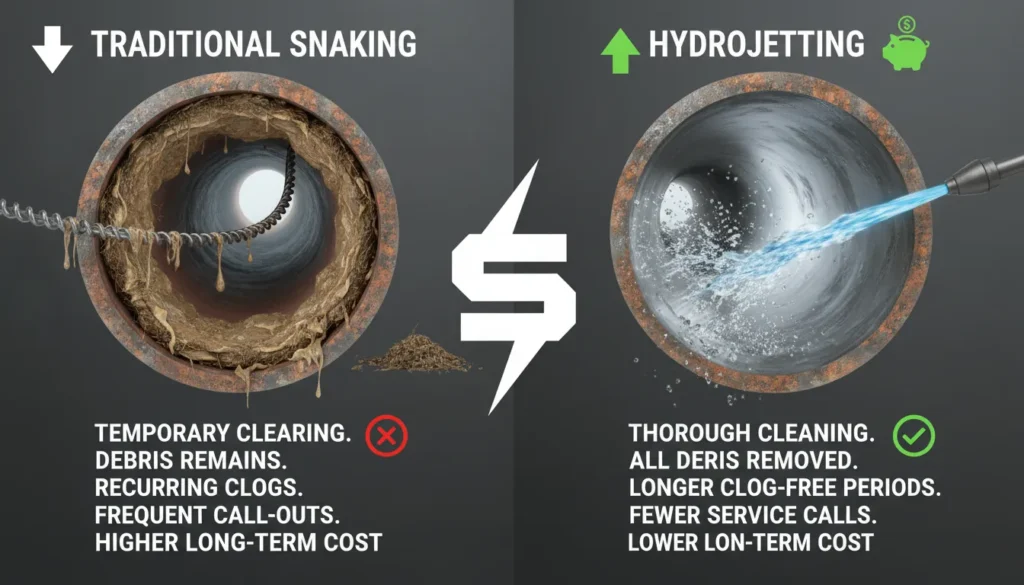
When homeowners compare hydro jetting vs snaking, they usually look at the immediate price tag. However, the true cost isn’t what you pay today; it’s how many times you have to call the plumber back over the next three years.
The Financial Trap of “Cheap” Snaking
A standard rooter service might cost $150 to $300, while a professional hydrojet drain cleaning session typically ranges from $600 to $1,300. On paper, snaking looks cheaper. In reality, snaking is often a “recurring subscription” to a clogged drain.
Snaking (Temporary): Leaves 70% of grease and scale behind. Clogs usually return within 3–6 months. Total 3-year cost: $1,200+ in repeat calls.
Hydrojetting (Permanent): Removes 100% of debris and descales the pipe. Clogs typically don’t return for 2–5 years. Total 3-year cost: $800 (one-time).
When is Snaking the Right Choice?
To be an honest hydrojet plumbing expert, I’ll tell you a secret: you don’t always need the big guns.
Choose Snaking for: Simple toilet clogs, hair in shower drains, or very fragile, paper-thin pipes that can’t handle pressure.
Choose Hydrojetting for: Main sewer lines, commercial kitchen grease, septic jetting, and recurring tree root intrusions.
Comparison Table: Snaking vs. Hydro Jetting
| Feature | Mechanical Snake (Auger) | Hydro Jetting Service |
| Primary Goal | Poke a hole through clogs | Scour pipes to “Like-New” |
| Best For | Hair, Paper, Soft clogs | Grease, Roots, Pebbles, Sludge |
| Wall Cleaning | No (leaves residue) | Yes (360-degree descaling) |
| Pipe Safety | Safe for all pipes | Best for structurally sound pipes |
| Effective Life | Short-term (Months) | Long-term (Years) |
Real-World Comparison
This video from Twin Home Experts perfectly illustrates why a snake is just a temporary fix compared to the flushing power of a jetter.
Why GPM Matters More Than PSI for Outdoor Drains
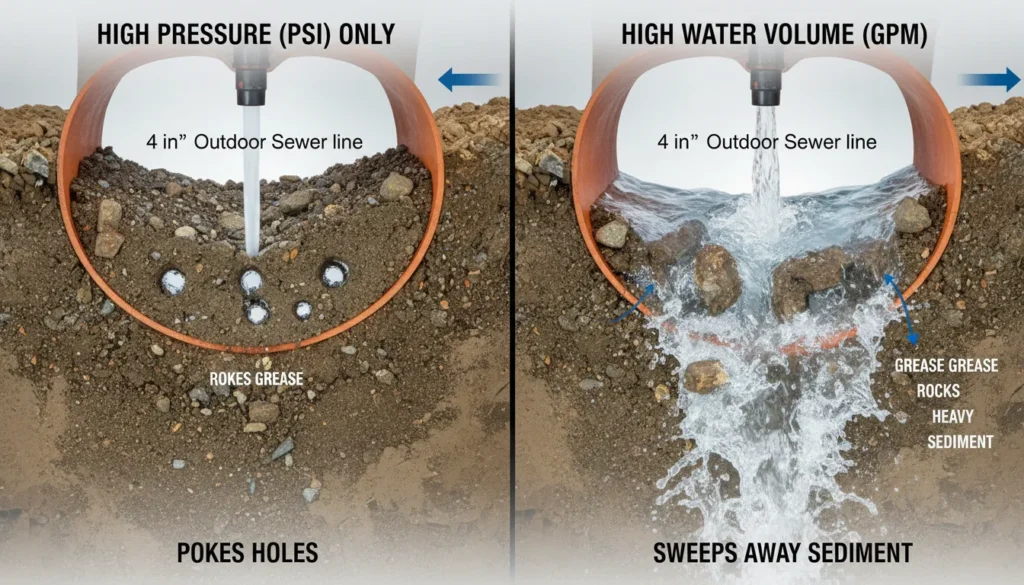
If you talk to a rookie plumber, they will brag about their 4,000 PSI machine. But pressure is only half the story. To clear heavy pebbles, sand, and sludge, the secret is GPM (Gallons Per Minute).
The “Cutting” vs. “Flushing” Logic
Pressure (PSI) is what cuts through a clog. Water volume (GPM) is what carries the debris out of the pipe.
High PSI / Low GPM: This is like a laser. It can cut a hole through a tree root, but the debris just stays at the bottom of the pipe because there isn’t enough water to push it out.
High PSI / High GPM: This is like a river. It cuts the clog and then uses a “wall of water” to sweep the sediment all the way to the city main. For commercial drains filled with pebbles, you need at least 12 to 15 GPM.
Navigating Bends with Vibra-Pulse Technology
One reason homeowners fail when using a rental sewer jetter is that the hose gets stuck at the first 90-degree elbow. Professionals use Vibra-Pulse technology.
This feature creates a deliberate vibration in the hose, causing it to “dance” inside the pipe. This reduces friction and allows the jetting head to “climb” around sharp corners and deep traps that a stiff mechanical snake could never navigate.
The “Reverse Flush” Technique
A pro never just pushes the hose forward. They pulse the water as they slowly pull the hose back. This “Reverse Flush” creates a vacuum effect that sucks grease and scale backward toward the cleanout, ensuring nothing is left behind to start a new clog.
The Expert Nozzle Guide: Which One Fixes Your Problem?
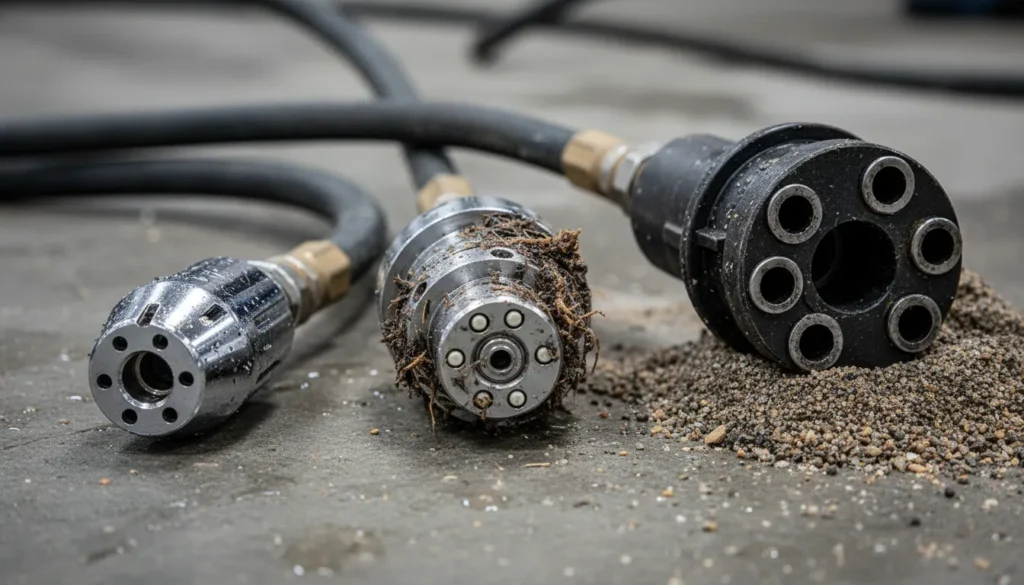
Most people think a sewer jetter uses just one standard tip. In reality, the nozzle is the “brain” of the operation. Using the wrong nozzle is like trying to cut a steak with a spoon—it’s inefficient and potentially dangerous.
To clear commercial sludge or heavy pebbles, a pro will switch between these three specialized heads:
1. The Penetrator (The “Wall Breaker”)
This nozzle has one high-velocity forward-firing jet and three to six rear-firing jets.
Best For: Total blockages where water isn’t moving at all.
How it works: The front jet acts like a drill to blast a hole through the “wall of grease,” while the rear jets propel the hose forward.
2. The Root Ranger™ (The “Slicer”)
This is a high-performance nozzle designed specifically for tree root intrusions.
Best For: Heavy root masses that have cracked old clay or cast iron pipes.
How it works: It uses a concentrated, oscillating rear-facing circular spray that acts like a buzzsaw, shaving roots flush against the pipe wall.
3. The Sand & Sludge Nozzle (The “Vacuum”)
If your outdoor drain is filled with pebbles and dirt, a standard nozzle will just swim over them.
Best For: Outdoor area drains, parking lot drains, and heavy sediment.
How it works: This nozzle is heavy and designed to stay at the bottom of the pipe. All its jets are directed backward at a steep angle to create a “shoveling” effect, pushing rocks and sand out of the line.
Pro Tip: If your plumber doesn’t change nozzles at least once during a tough job, they aren’t doing it right. A “One-Size-Fits-All” approach is a sign of an amateur.
Safety Warning: Can 4,000 PSI Destroy Old Pipes?
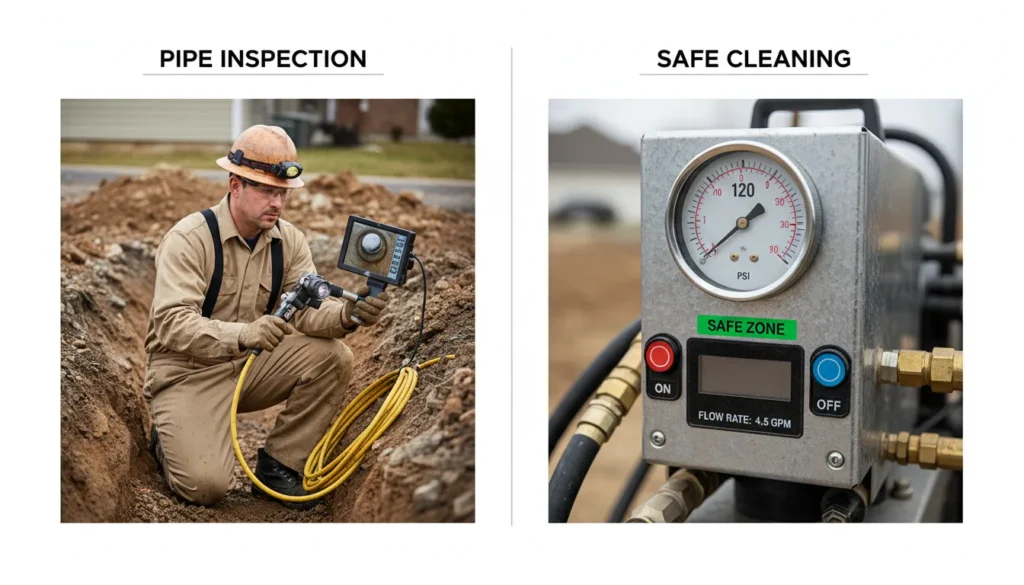
One of the most common fears is that hydrojet drain cleaning will blow a hole through old plumbing. While the pressure is immense, it is generally safe—if your plumber follows the “Rules of the Road.”
The danger isn’t the water; it’s the condition of the pipe.
The Non-Negotiable Step: Video Camera Inspection
You should never allow a sewer jetter into your line without a pre-inspection. A professional will use a waterproof camera to check for:
Structural Cracks: If a pipe is already split, high pressure can force water into the surrounding soil, causing a “sinkhole” effect.
Orangeburg or Thin-Wall Pipe: Some older pipes are made of tar-paper (Orangeburg) or very thin plastic. These cannot handle 4,000 PSI and will disintegrate.
Complete Collapses: If the pipe has already caved in, jetting won’t help; you need a trenchless repair.
Safe PSI Limits for Different Materials
A skilled technician adjusts the pressure based on the material they are “cleaning”:
| Pipe Material | Recommended PSI Range | Risk Level |
| PVC / ABS Plastic | 3,000 – 4,000 PSI | Low |
| Cast Iron | 2,500 – 3,500 PSI | Medium (Scaly) |
| Clay / Terra Cotta | 1,500 – 2,500 PSI | High (Brittle) |
| Orangeburg | DO NOT JET | Extreme |
The “Pin-Hole” Myth
Many people think jetting causes leaks. In reality, jetting often reveals leaks. Over years, heavy sludge and corrosion act like a “scab” over a hole. When the jetter removes that sludge, the underlying hole is exposed. This is actually a good thing—it’s better to find a leak during a controlled service than during a sewage backup in the middle of the night.
Commercial Property Owner’s Checklist: Managing Recurring Clogs
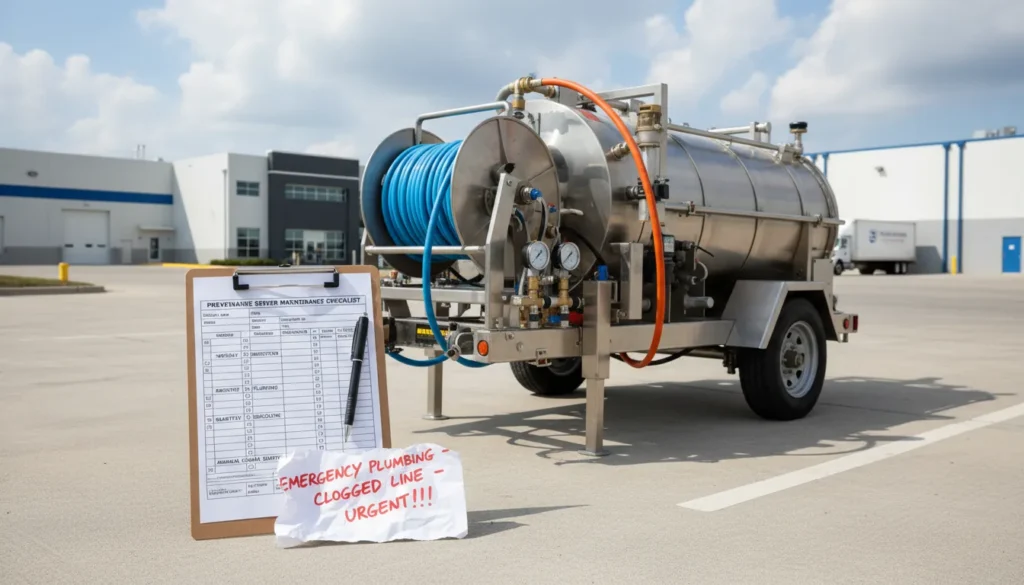
For rental properties and commercial buildings, a clogged drain isn’t just an annoyance—it’s a liability. If you are managing a property where tenants frequently report slow drains, you need a strategy that moves beyond emergency repairs and into preventative maintenance.
The $20 DIY “Blow Bag” vs. $600 Hydrojetting
Before you call a professional for hydrojet plumbing, there is a middle-ground tool many owners use: the Drain Bladder (Blow Bag).
The Blow Bag: This is a rubber expansion bag that connects to a garden hose. It fills the pipe and “pulses” water to move soft clogs.
The Limit: It works for light hair or paper, but it has zero effect on commercial sludge, pebbles, or grease.
The Risk: If used in a pipe with a pre-existing crack, a blow bag can actually expand the crack and cause a burst.
Why Outdoor Drains Need “Sediment Audits”
Outdoor drains in parking lots or courtyards are “Sediment Magnets.” Every rainstorm washes dirt and pebbles into the line.
The Pro Secret: If your property has outdoor drains, schedule a high-GPM flush every 2 years. This prevents the sediment from “cementing” into a solid mass that requires expensive excavation later.
Restoration Maintenance Schedule
To maximize your ROI and keep your hydrojet drain cleaning guide results lasting for years, follow this 2026 expert schedule:
Monthly: Flush high-use drains with 5 gallons of boiling water to soften grease.
Quarterly: Use an enzyme-based cleaner (like Bio-Clean) to “eat” the bio-film that traps hair.
Bi-Annually: Perform a quick camera inspection of main sewer lines if you have large trees on the property.
People Also Asked
Is hydrojetting worth the cost?
Yes. While the upfront cost is higher than snaking, it prevents recurring blockages by returning the pipe to its original diameter. One hydrojetting session usually lasts 3 to 5 times longer than a standard rooter service.
How long does hydrojetting take?
For a standard residential main line, the process takes 1.5 to 2 hours. This includes the pre-inspection, the actual jetting, and a final camera “proof” to ensure all debris is gone.
Can I hydrojet my own sewer line with a pressure washer?
It is not recommended. Consumer pressure washers lack the GPM (Gallons Per Minute) to flush debris. Without a “Pulse” feature, a DIY hose will likely get stuck in a bend, leading to a much more expensive plumbing bill to retrieve the equipment.
Will hydrojetting clear tree roots permanently?
No method is permanent for roots because trees never stop growing. However, hydrojetting shaves roots closer to the pipe wall than a snake, buying you significantly more time (usually 18–24 months) before a follow-up is needed.