Copper-Pipe-Burst: 10 Emergency Fixes, 8,000 PSI Pressure Facts & Pro Repair Guide
Stop the Surge: Immediate Response for a Water Pipe Burst Inside House
Neutralizing the Flood and Electrical Risks
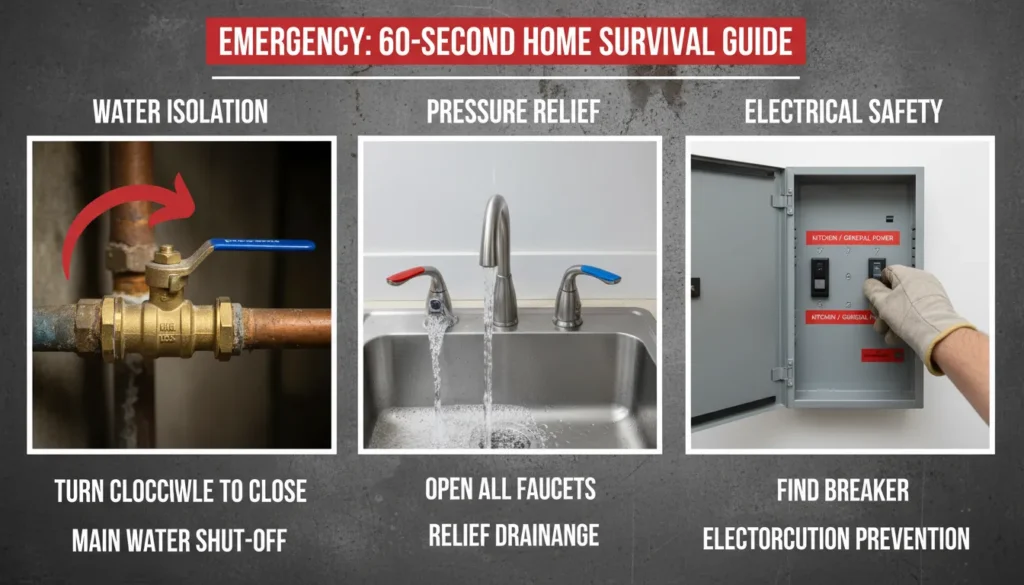
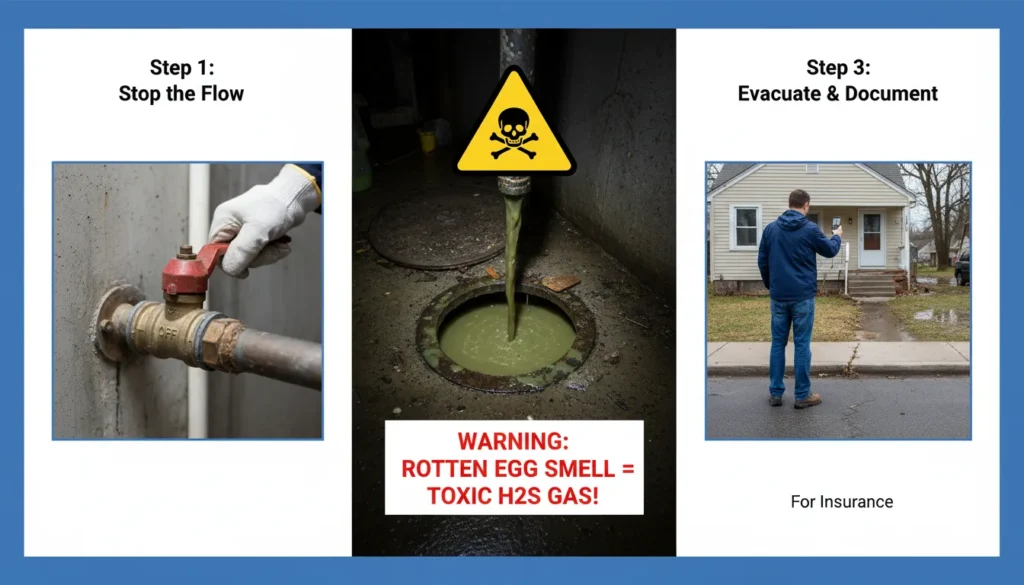
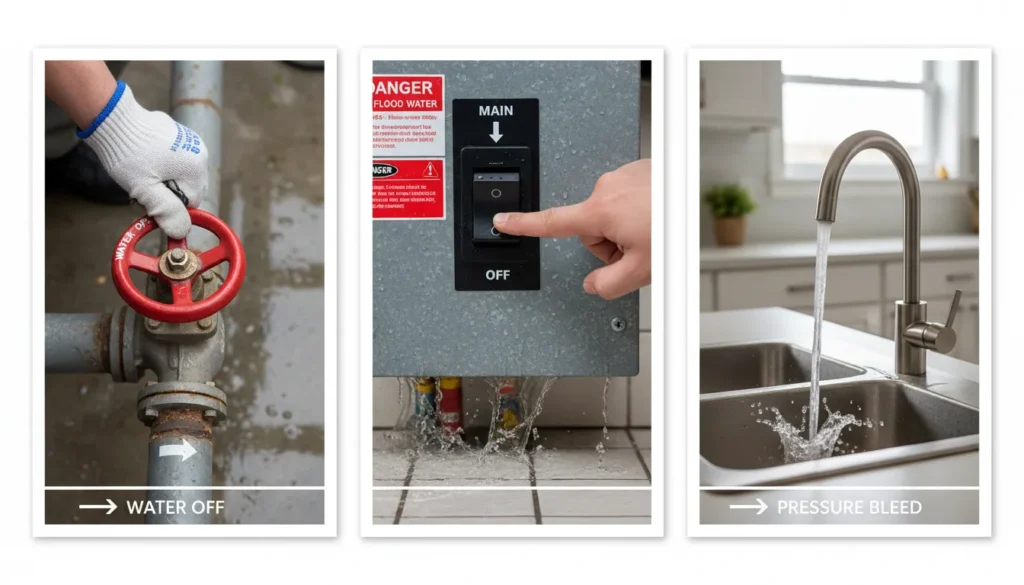
If you discover a copper-pipe-burst inside your home, your first thirty seconds are critical for minimizing structural rot. Head directly to your basement, garage, or water meter and turn the main valve clockwise until it hits the stop; this kills the pressure feeding the leak. If you see water pooling near outlets or your electrical panel, don’t step in the puddle—go straight to the breaker box and shut off power to the affected zones to prevent a lethal electrocution.
Depressurizing the Line and Protecting Your Claim
Once the main flow is dead, you need to clear the “dead water” still sitting in your ceilings and walls. Open the lowest faucets in the house and flush every toilet to pull the remaining volume out of the pipes and into the drains. Before you bring in the wet/dry vacuum for cleanup, grab your phone and take clear photos of the split. According to The Red Cross, quick stabilization and documentation are the most effective ways to prevent long-term mold growth and ensure your insurance provider has the evidence they need.
Expert Analysis: The Physics of the Split
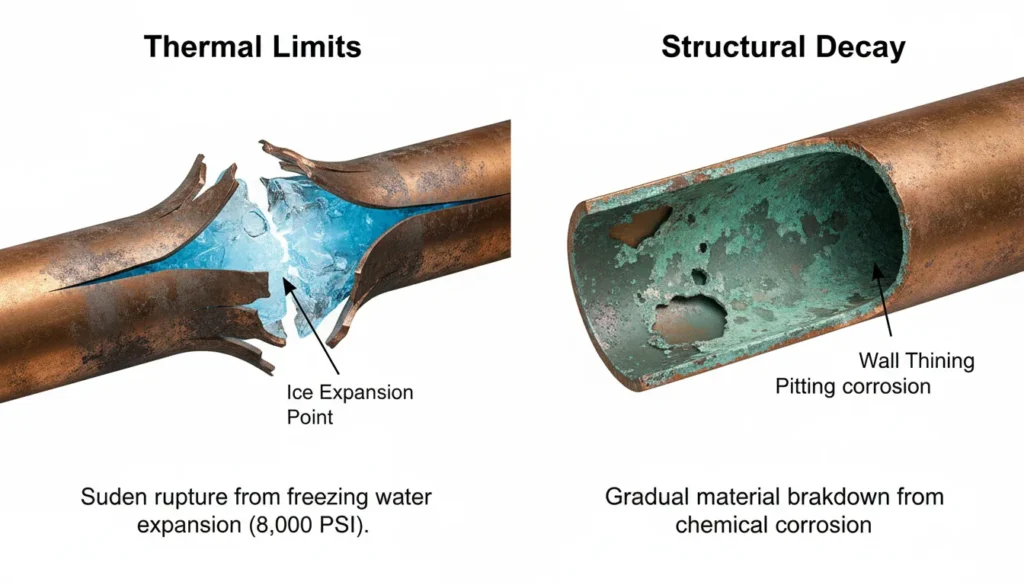
The 8,000 PSI Reality: Most homeowners don’t realize that freezing water generates over 8,000 psi of internal pressure. This massive force is what causes the metal to fail, making it a “primary source” of data for your insurance adjuster.
Reading the Damage Pattern: Look closely at the break before you cut it out. A long, longitudinal split usually confirms a sudden freeze-thaw event, whereas a tiny pinhole indicates long-term chemical corrosion. Showing this specific “burst pattern” to your agent helps verify that the damage was a sudden accident rather than a neglected maintenance issue.
The Insurance Pressure Trap
The advice to “just shut off the water” can fail if your main valve is old and seized. If the handle won’t budge, do not force it with a wrench, or you risk snapping the stem and creating a second, larger flood. In this edge case, you must locate the street-side curb key or call the city utility line immediately. Additionally, if the burst happened behind a finished wall, simple drainage might not be enough; trapped moisture in insulation can cause the ceiling to collapse hours after the water is officially “off.”
Thermal Limits and Structural Decay: Why Your Plumbing Fails
The Thermodynamics of Frozen Metal
Plumbing failure isn’t just about the cold; it’s about the physics of rigid materials. Unlike plastic, copper cannot stretch when water transitions into ice. When your local environment stays below 32°F for an extended period, the water inside the line expands with enough force to overwhelm the metal’s tensile strength. This is precisely why industry standards, such as those maintained by the International Code Council (ICC), emphasize that interior environments must never dip below 55°F. If your thermostat fails or is set too low during a winter storm, the rigid nature of the line turns it into a ticking time bomb.
The Hidden Threat of Internal Scouring
Beyond the weather, your water’s chemistry and velocity play a silent role in structural integrity. Over years of service, hard water initiates chemical reactions that manifest as tiny, pinpoint leaks. This “pitting corrosion” is often the deal-breaker when deciding whether you should buy a house with copper pipes.
High-Velocity Erosion: Aged systems often suffer from internal turbulence. High water pressure causes the flow to act like sandpaper, “scouring” the inner pipe wall until it is paper-thin.
The Final Breach: Once the wall is thinned by this internal scouring, even a minor pressure spike causes the copper water pipe to fail completely, often in a section that previously looked perfectly fine from the outside.
The Latent Damage Variable
The common belief that pipes only fail during the freeze is a dangerous misconception. The actual breach often remains sealed by a plug of ice, only revealing itself as a massive flood once the thaw begins. If you find a section of plumbing that has “bowed” or changed shape during a cold snap, consider it compromised. Even if it didn’t leak this time, the metal has been “work-hardened” and weakened, making it significantly more susceptible to a future rupture during the next minor temperature dip.
Emergency Containment: High-Performance Sealants and Clamps
Rapid-Response Wraps and Clamps
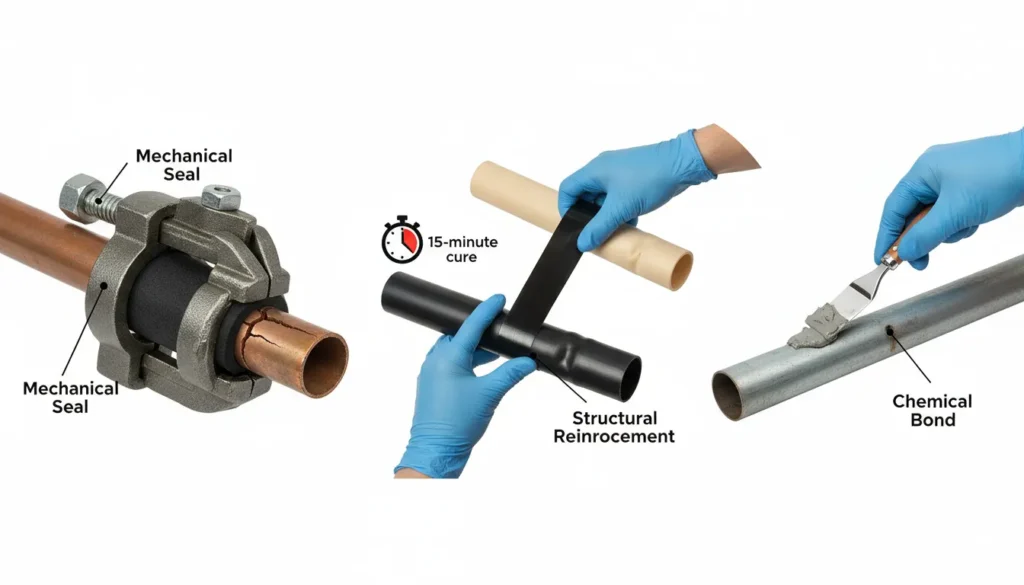
When a line splits, your priority is a “stop-gap” fix to restore essential services while waiting for a plumber. The Rothenberger Kibosh stands out as a premier instant-fit clamp specifically engineered for 1/2″ or 3/4″ lines. Unlike traditional patches, it can be snapped directly over the leak even while water is still spraying. For a more rigid, permanent-feeling temporary fix, products like Fernco Pow-R Wrap and J-B Weld FiberWeld use fiberglass tape that reacts with water to harden like steel in roughly 15 minutes. These are vital components in any modern plumbing emergency kit.
Sealing Pinhole Leaks and Weeping Cracks
Not every failure is a massive blowout; many manifest as small, weeping cracks. In these scenarios, hand-moldable epoxy putty is your best friend. You simply knead the putty until the colors blend and press it firmly into the breach. This creates a waterproof plug that is ideal for those managing a burst pipe repair kit for copper. For the best results, ensuring the area is as clean as possible is recommended by industry leaders like ASPE, as debris can prevent the resin from bonding to the metal surface.
The “Dry Surface” Dependency
The biggest failure point with fiberglass wraps and epoxy putties is their requirement for a relatively dry surface during the initial bond. If the pipe is continuously sweating or if you cannot fully stop the drip, these chemical-based seals often slide right off under pressure. This is where the Kibosh clamp becomes a “Primary Source” of reliability—it is the only tool in this lineup that is completely reusable and doesn’t care if the pipe is 100% bone-dry. If you can’t get the moisture under control, skip the tape and go straight for the mechanical clamp.
Engineering a Lasting Fix: Splicing and Soldering Damaged Lines
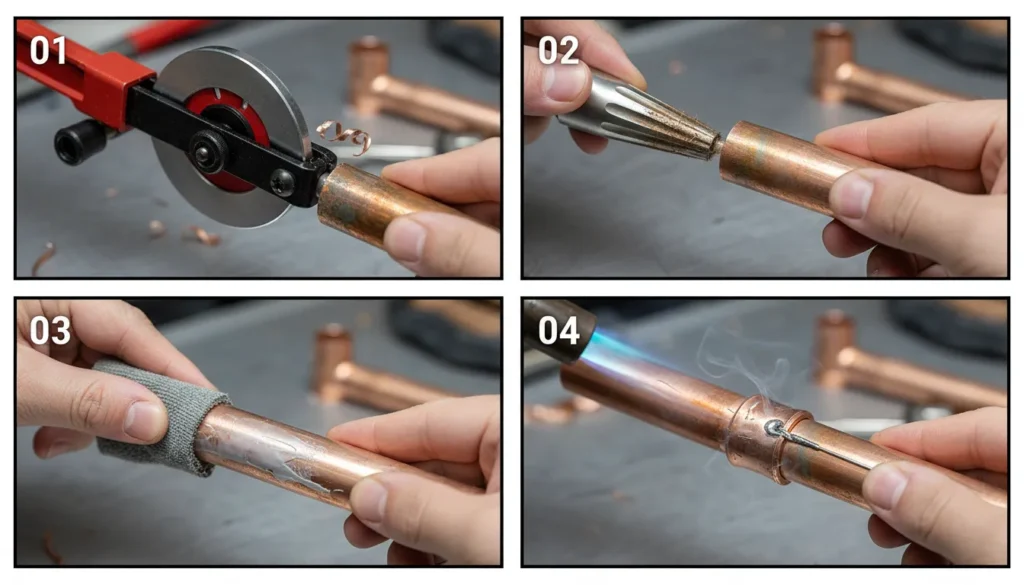
Heat-Free Mechanical Joins for Tight Spaces
When you are dealing with a leak in a cramped crawlspace or near flammable joists, fire safety is the priority. SharkBite push-to-connect fittings are the fastest DIY solution, allowing you to bridge a gap between copper and even PEX without ever striking a match. If the repair is in a location where you need mechanical reliability without the bulk of push-fittings, compression couplings are the answer. These use a brass nut and a ferrule (internal ring) to squeeze onto the pipe, creating a watertight seal through sheer tension—no heat required.
The Gold Standard: Traditional Sweat Soldering
For a repair that will outlast the house, most pros stick to “sweating” the lines. You start by using a tubing cutter to remove the jagged split, ensuring every cut is perfectly square. After you deburr the inside edges to prevent water turbulence, clean the exterior with an emery cloth until it shines. Apply a thin layer of flux, slide on your couplings, and use a propane torch to draw the solder into the joint. According to the Copper Development Association (CDA), a properly soldered joint is technically stronger than the pipe itself.
The Subterranean Pressure Trap
The biggest mistake in outdoor repairs is using standard interior-grade plumbing. If you are digging up a line, you must use Type K copper. This variant has significantly thicker walls compared to the standard Type M found inside walls. Standard thin-walled copper can easily crush or “oval” under the weight of wet soil or shifting frost, leading to a repeat failure within months. Additionally, if your soil has high acidity, even a perfect solder job won’t save a thin pipe from a secondary collapse; always go for the heavy-duty gauge when going below the frost line.
Technical Tutorial: Step-by-step restoration of a copper line split.
Winterization Defense: Shielding Your System Against Extreme Cold
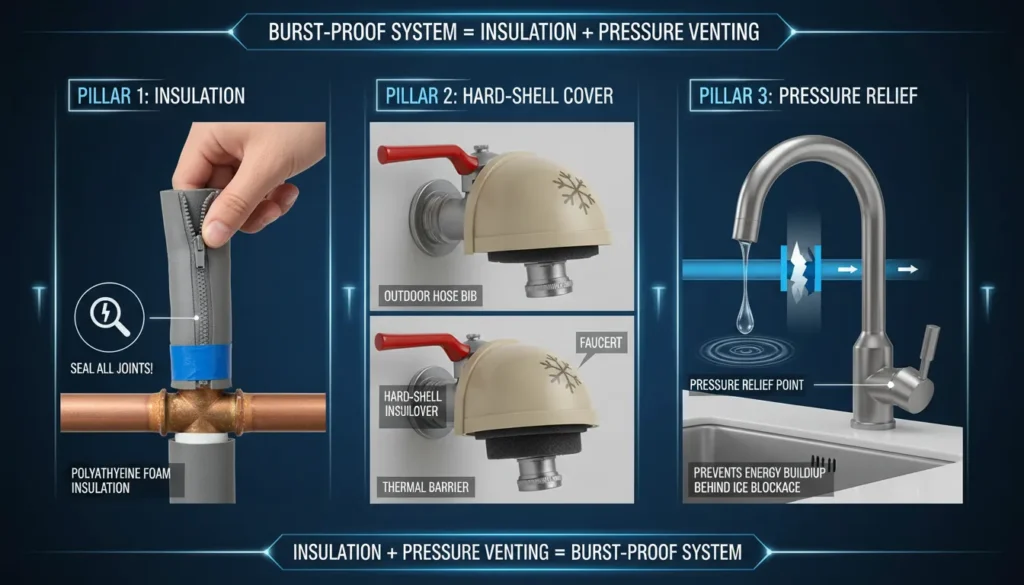
The Pressure Relief Strategy
Most people think they let faucets drip to keep water moving, but that’s a common misconception. In reality, a slow drip acts as a manual pressure relief valve. When ice forms inside a line, it creates a massive pressure spike between the ice blockage and the closed faucet. By allowing a single drip per second, you provide an escape route for that energy, preventing the 8,000 psi surge that would otherwise shatter the metal. Combined with high-quality foam insulation on all exposed runs, this simple tactic significantly lowers the odds of a catastrophe.
Long-Term Asset Management and Remediation
Understanding the potential financial impact of a failure helps you prioritize maintenance before an emergency hits. If you are dealing with aged plumbing in a crawlspace or behind finished drywall, the burst pipe repair cost is often the smallest part of the bill; the real expense comes from structural mold and water damage. According to FEMA, early mitigation is the most cost-effective way to protect a property’s value. If a section is in an area you can’t easily reach, don’t gamble with DIY patches—call a professional to replace the run entirely before the next deep freeze.
The Circulation Fallacy
The “faucet drip” advice can fail if you only crack the hot water side. Because hot and cold lines are separate, a dripping hot tap does nothing to protect the cold line sitting inches away. During extreme cold, you must ensure both lines have a way to vent pressure. Furthermore, if your home’s main supply line enters through an uninsulated slab, even a dripping faucet might not save you if the freeze happens “upstream” of your relief point. In these cases, consistent ambient heat is the only fail-safe.