The Ultimate Guide to Sewer Pipe Sleeve & Trenchless Pipe Lining
Sewer Problems & Modern Solutions
Dealing with a leaking sewer pipe or a sudden sewer backup is a nightmare for any homeowner. Whether it’s an old, cracked sewer pipe or invasive tree roots causing a blockage, these issues are more than just a nuisance—they are dangerous. Ignoring these signs can lead to severe water damage, mold growth, and even structural compromise to your home’s foundation.
Traditionally, the only way to fix these problems was “excavation”—digging a massive trench through your beautiful yard or driveway. It was slow, messy, and incredibly expensive.
The Modern Solution: No-Dig Repair
Fortunately, 2026 technology offers a much better way. Instead of destroying your property, we now use a sewer pipe sleeve (also known as trenchless sewer pipe lining). This advanced method allows for a fast sewer repair solution by creating a brand-new, durable pipe inside your old one.
The goal of sewer pipe relining is simple: to provide a permanent sewer pipe repair that is root-proof, leak-proof, and installed in a fraction of the time. If you want to repair your sewer line without digging, a professional sewer pipe repair sleeve is the ultimate expert solution.
What is a Sewer Pipe Sleeve & Pipe Lining?
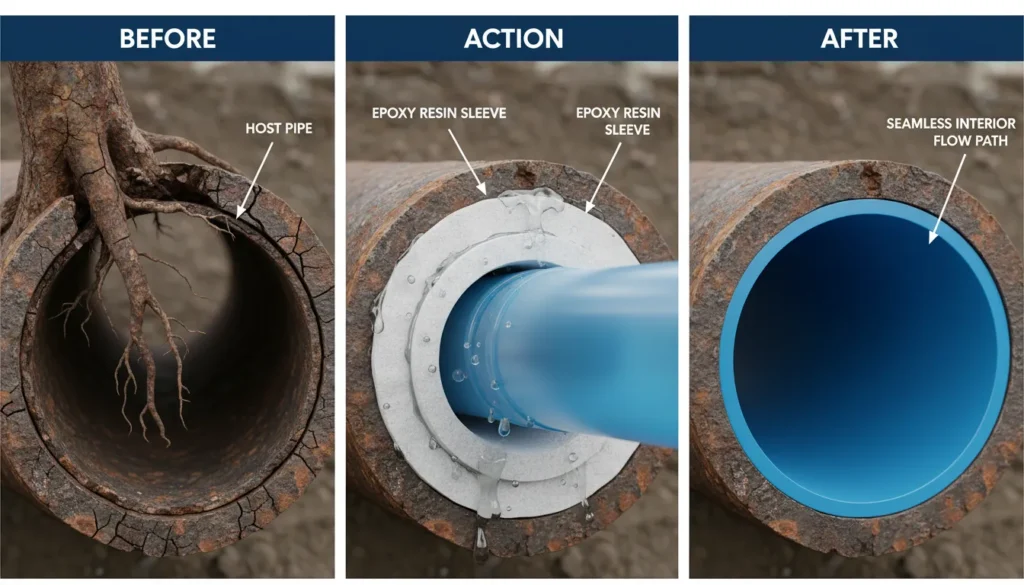
If you are hearing terms like sewer pipe sleeve or sewer pipe lining for the first time, the concept is actually very simple. Think of it as a “pipe-within-a-pipe” repair method.
A sewer sleeve meaning refers to a high-strength, flexible liner that is inserted into your existing, damaged pipe. Once inside, this liner is inflated and hardened, essentially creating a brand-new, structural pipe inside the old, decaying one.
The “New Inner Layer” Concept
Instead of digging up the ground to pull out the old pipe, sewer pipe lining uses the old pipe as a “host.” We slide a specialized tube—soaked in high-grade epoxy resin—into the line. This is formally known as CIPP lining (Cured-In-Place Pipe).
How it creates a permanent fix:
The Insertion: The soft sleeve is guided into the pipe through a small existing opening.
The Bond: It is pressed against the inner walls of your old pipe, filling in every crack, hole, and gap.
The Cure: Within hours, the resin hardens into a rock-solid, seamless inner layer that is just as strong as a brand-new PVC pipe.
By the time the process is finished, your sewer pipe sleeve has eliminated all joints and seams where roots usually grow, leaving you with a smooth, high-flow drainage system that can last for 50 years or more.
Types of Sewer Pipe Lining & Sleeves
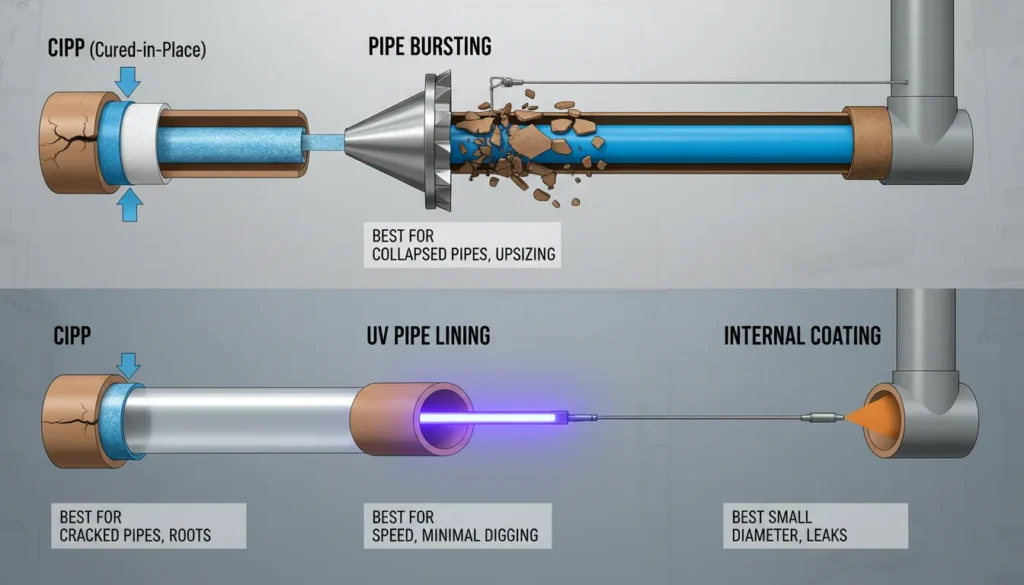
Not every broken pipe requires the same fix. Depending on the depth of the line, the severity of the cracks, and the pipe material, different trenchless sewer pipe lining methods are used. Here is a breakdown of the modern solutions available in 2026:
CIPP (Cured-In-Place Pipe)
This is the most popular sewer pipe lining method. A flexible felt or fiberglass “sock” is saturated with epoxy resin and pulled or blown into the pipe. Once it’s in place, it is inflated and left to “cure” (harden). It creates a seamless, joint-free pipe inside the old one.
Epoxy Pipe Lining
Specifically refers to the high-grade resin used to create the new pipe wall. Epoxy pipe lining is incredibly durable, chemically resistant, and can last over 50 years. It is the gold standard for residential sewer repair.
Pull-In-Place (PIP)
This method is perfect for pipes with multiple bends or transitions. Two small access points are used to literally “pull” the resin-soaked sewer pipe sleeve into the exact position needed before it is inflated and cured.
Sliplining
One of the oldest trenchless techniques. A smaller, rigid carrier pipe (usually HDPE) is “slipped” inside the larger, older pipe. The gap between the two is then filled with grout. It is best for very large main lines where a slight reduction in diameter isn’t an issue.
Pipe Bursting
Technically a “replacement” rather than a “lining,” but still trenchless. A heavy bursting head is pulled through the old pipe, shattering it outward while simultaneously pulling a brand-new HDPE pipe in behind it. This is best for pipes that have completely collapsed and cannot be lined.
Internal Pipe Coating
For smaller branch lines or vertical stacks inside walls, we use a rotating brush or sprayer to apply a thin, smooth layer of epoxy directly to the pipe’s interior. This is the best solution for pinhole leaks and minor corrosion in cast iron.
UV Pipe Lining
The fastest modern method. Instead of waiting hours for the resin to air-cure, a “light train” of UV LEDs is pulled through the pipe. The UV light hardens the sewer pipe sleeve instantly. It’s the best choice for emergency repairs or high-traffic areas.
How a Sewer Pipe Sleeve Works: The Step-by-Step Process
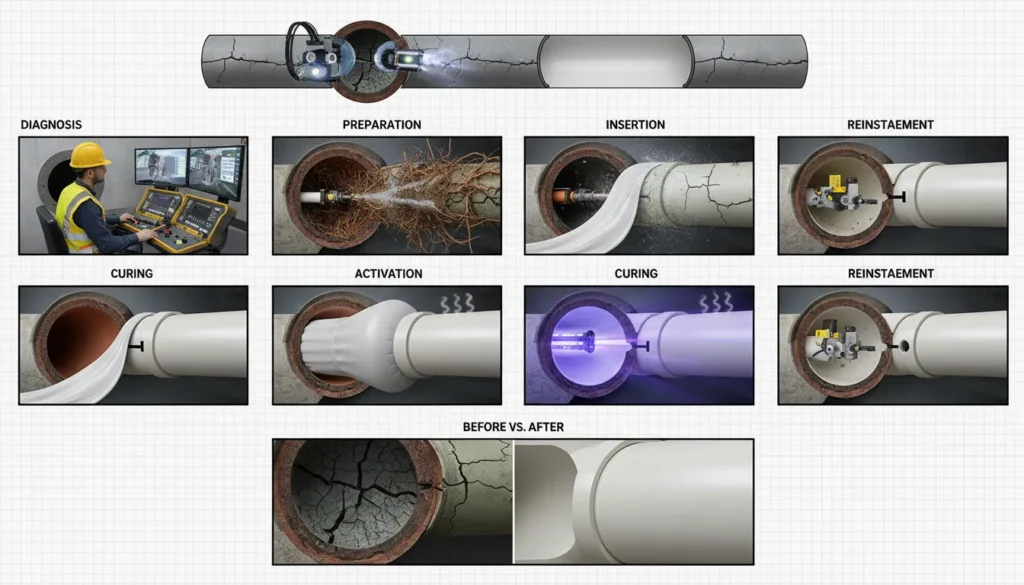
Installing a sewer pipe sleeve is a high-precision engineering task. While the process is “trenchless,” it requires advanced equipment and expert handling. Here is exactly how a professional trenchless sewer pipe lining is performed in 2026:
Step 1: High-Definition Sewer Camera Inspection
Before any work begins, we perform a thorough sewer camera inspection. Using a specialized, waterproof pipe inspection camera, we navigate the entire line to identify the exact location of cracks, root intrusions, or bellies. This visual data is critical for sizing the liner correctly.
Step 2: Professional Pipe Cleaning & Debris Removal
A sewer pipe lining will only bond to a clean surface. We use high-pressure hydro jetting for cleaning sewer pipes, removing years of scale, grease, and invasive tree roots. Total debris removal ensures the new sleeve fits perfectly against the original pipe wall.
Step 3: Preparing the Resin-Coated Liner
We measure and cut a felt or fiberglass sleeve to the exact length of your sewer line. This sleeve is then saturated (impregnated) with a high-strength, two-part resin coated liner. This resin is what will eventually become your new, rock-hard pipe.
Step 4: Liner Installation & The Inflatable Packer
The wet liner is pulled into the damaged pipe using a “pull-in-place” method or pushed in via an inversion drum. An inflatable packer or calibration tube is used to guide the liner installation through any bends or elbows in the pipe.
Step 5: Pipe Inflation & Curing
Once the sleeve is in position, we use compressed air to trigger pipe inflation. The sleeve expands, pressing the resin tight against the old pipe’s interior. We then begin curing—using steam, hot water, or UV light—to harden the resin. Depending on the method, this can take anywhere from a few minutes (UV) to a few hours (Steam).
Step 6: Robotic Cutting (Reinstating Connections)
If the sewer pipe sleeve covered up any “lateral” lines (pipes from your kitchen or bathrooms that connect to the main line), we use a specialized robotic cutting tool. This tiny remote-controlled robot travels down the pipe and precisely cuts openings to restore flow to the rest of the house.
Step 7: Final Inspection & Quality Assurance
The job isn’t done until we see the results. We perform one last final inspection with the pipe inspection camera to ensure the new lining is seamless, smooth, and 100% leak-proof.
Common Sewer Problems & Causes
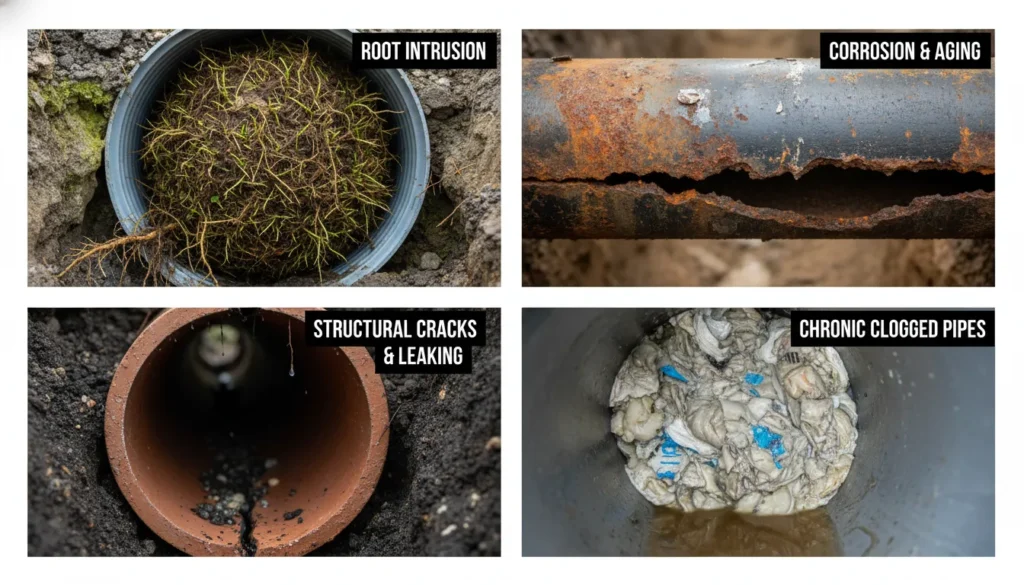
Before a sewer pipe sleeve can be installed, it is important to understand what went wrong. Sewer lines are buried underground, subjected to constant pressure, chemical exposure, and nature’s elements. In 2026, we see these common failures most frequently:
Root Intrusion (The #1 Enemy)
In South Florida, root intrusion is the leading cause of a broken sewer line. Tiny hair-like tree roots find microscopic cracks or loose joints in search of moisture. Once inside, they grow into massive “root balls” that act like a net, catching grease and debris, eventually shattering the pipe from the inside.
Cracked & Leaking Sewer Pipe
A cracked sewer pipe often starts small. Over time, shifting soil or heavy vehicle traffic above the line creates enough pressure to cause a structural fracture. A leaking sewer pipe is dangerous because the escaping water washes away the soil supporting the pipe, leading to “bellies” or total collapse.
Corrosion & Aging
If your home was built several decades ago, corrosion is likely eating away at your lines. Cast iron pipes rust and develop “scales,” while clay pipes become brittle. This aging process turns a smooth pipe into a rough surface that catches waste, leading to chronically clogged pipes.
Ground Movement & Pressure
The ground is not static. Fluctuating water tables and soil expansion put immense “shear pressure” on buried lines. This often results in “offset joints,” where two sections of the pipe no longer align, causing immediate sewer backup issues and structural failure.
Why These Problems are Urgent
Foundation Damage: Leaking sewage can erode the dirt under your home’s slab.
Health Risks: Raw sewage contains harmful bacteria and pathogens.
Pest Attraction: Cracks in sewer lines are “highways” for rodents and cockroaches to enter your home.
Signs You Need Sewer Pipe Relining
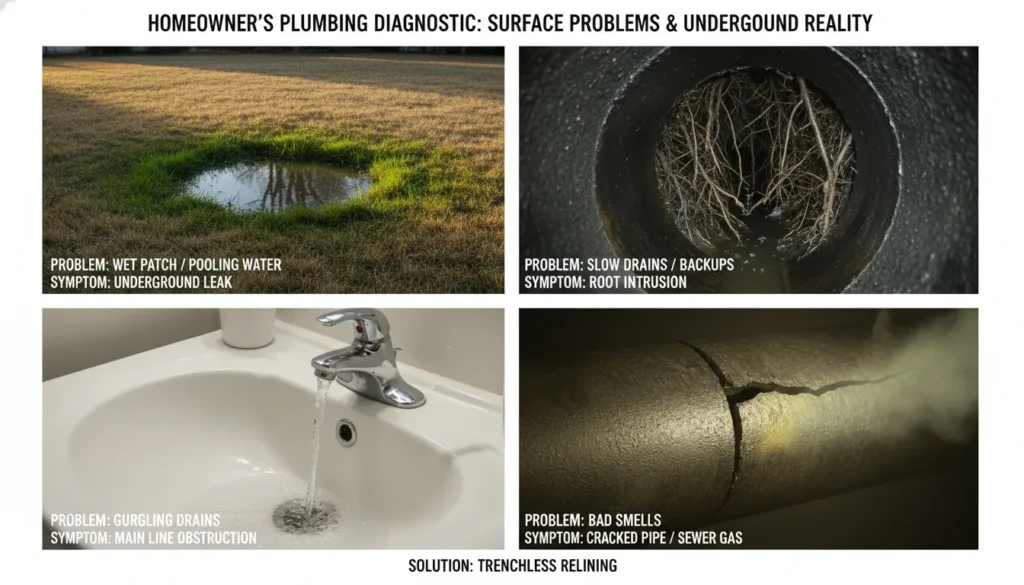
Many homeowners wonder, “How do I know if I need pipe relining?” Because your sewer system is buried underground, the signs of failure aren’t always obvious until a major backup occurs. However, there are four “red flags” that indicate your pipes are failing and a sewer pipe sleeve is necessary to prevent a total collapse.
1. Persistent Bad Smells (Sewer Gas)
A healthy sewer system is airtight. If you notice a persistent “rotten egg” or bad smell in your yard, basement, or bathrooms, it’s a clear sign of a cracked sewer pipe. Sewer gas escapes through these cracks, and if gas can get out, raw sewage is likely leaking into the soil around your home.
2. Chronic Slow Drainage
If multiple sinks, tubs, or toilets in your home have slow drainage, the problem isn’t a simple clog in the P-trap—it’s deep in the main line. This is often caused by root intrusion or internal corrosion catching debris. If plunging doesn’t provide a long-term fix, you likely need trenchless sewer pipe lining to smooth out the interior of the pipe.
3. Unexpected Water Pooling in the Yard
Have you noticed a patch of grass that is greener than the rest, or actual water pooling in your lawn during dry weather? This “localized flooding” often indicates a broken sewer line that is saturating the ground. Over time, this stagnant water can attract pests and create a structural hazard for your foundation.
4. Unexplained High Water Bills
While most people associate high water bills with fresh water leaks, a damaged sewer line can also contribute to rising costs. If your sewer system uses a lift pump or if the leak is causing secondary issues with your plumbing’s pressure balance, you may see a spike in your monthly expenses.
The “Expert Solution” Diagnostic
If you are experiencing even one of these signs, the best next step is a pipe inspection camera test. This is the only way to move from guessing to knowing exactly where the damage is and if a sewer pipe repair sleeve is the right fit for your home.
Sewer Pipe Lining vs. Replacement
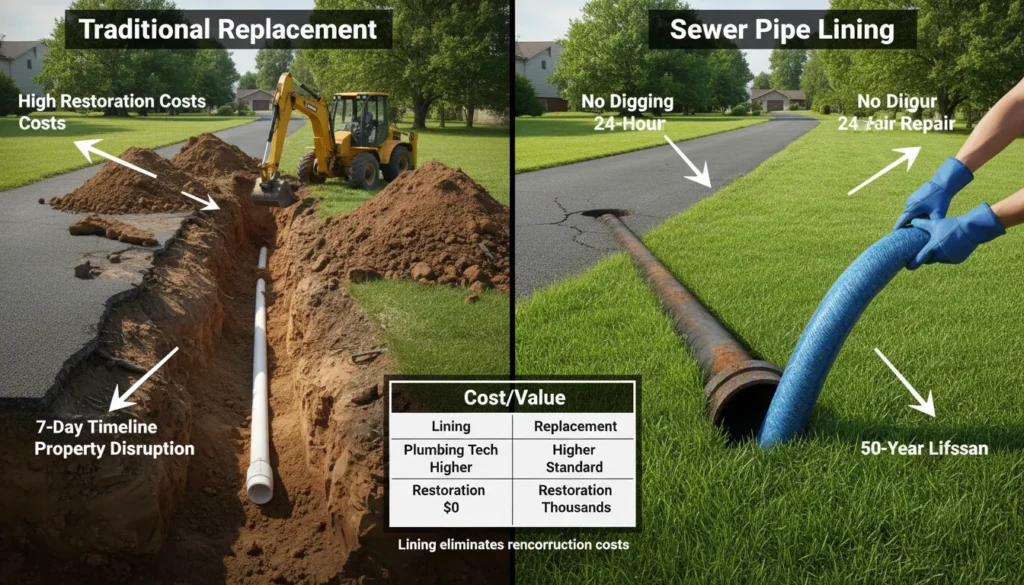
When your sewer system fails, you generally face two choices: trenchless vs traditional sewer repair. Understanding the difference between a sewer sleeve vs excavation is the key to saving thousands of dollars and protecting your property’s integrity.
Trenchless Pipe Lining (The Modern Approach)
Sewer pipe lining is a “no-dig” technology. Instead of removing the old pipe, we rehabilitate it from the inside.
Property Damage: Zero to minimal. We use existing cleanouts or one small access point.
Time: Usually completed in 6 to 24 hours.
Durability: The epoxy liner is essentially a brand-new structural pipe with a 50+ year lifespan.
Best For: Cracked pipes, root intrusion, and aging cast iron pipe replacement where the exterior shell is still intact.
Traditional Pipe Replacement (The Invasive Approach)
Traditional sewer repair requires excavation. This means using backhoes and shovels to dig a trench along the entire length of the sewer line.
Property Damage: Extreme. This often involves tearing up driveways, destroying expensive landscaping, and cutting through concrete patios or indoor flooring.
Time: Can take 5 to 10 days or more, depending on the depth and length of the line.
Restoration Costs: Beyond the plumbing bill, you must pay to repair your yard, sod, and pavement.
Best For: Completely collapsed pipes or “back-pitched” lines where the slope of the pipe must be physically changed.
Comparison at a Glance
| Feature | Sewer Pipe Lining (Sleeve) | Traditional Replacement |
| Digging Required | None (Trenchless) | Full Trench (Excavation) |
| Installation Speed | 1 Day | 1 Week+ |
| Yard/Driveway Impact | Preserved | Destroyed |
| Main Material | Epoxy CIPP Liner | PVC Replacement / HDPE |
| Total ROI | High (No restoration costs) | Low (High restoration costs) |
The Verdict: Which is Better?
In 2026, pipe lining vs pipe replacement is usually a simple choice. If your pipe is still structurally round, a sewer pipe repair sleeve is the superior solution. It offers the same longevity as a full PVC replacement without the headache of a destroyed property. However, if the pipe has pancaked or “collapsed,” traditional excavation may be the only remaining option.
Sewer Pipe Lining Cost Complete Breakdown 2026
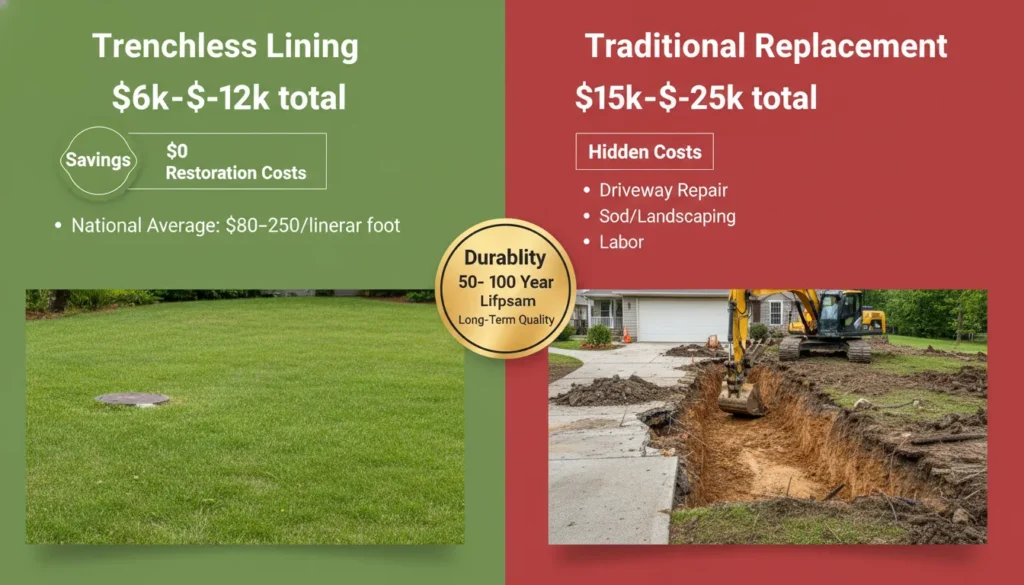
When calculating your sewer line repair cost estimate, it is important to look at the “Total Project Cost,” not just the plumbing bill. While the high-tech equipment used in trenchless repair has a higher upfront price, the savings on property restoration make it the most cost-effective choice for most homeowners.
Typical Pricing for 2026
The average trenchless sewer repair cost typically ranges from $6,000 to $12,000 for a standard residential line. In contrast, a full traditional replacement can cost between $15,000 and $25,000 once you factor in the cost of excavating and rebuilding your driveway, patio, or landscaping.
Sewer Pipe Lining Cost Per Foot
If you are looking for a more granular breakdown, most professional contractors charge by the linear foot:
Sewer pipe lining cost per foot: $80 – $250 per foot.
Sectional “Point Repair” Sleeve: $1,500 – $4,000 (for small, localized cracks).
Why is a Sewer Pipe Sleeve Expensive?
The sewer pipe sleeve cost is driven by three main factors:
Advanced Materials: The epoxy resins used in CIPP lining are industrial-grade polymers designed to last 50+ years.
High-Tech Equipment: The use of HD cameras, hydro-jetters, pneumatic inversion drums, and UV curing lights requires significant investment and maintenance.
Specialized Labor: Trenchless technicians require extensive training and certification to ensure the liner is installed without wrinkles or failures.
How to Save on Sewer Repair Costs
Catch it Early: A “Point Repair” (sectional sleeve) is much cheaper than lining an entire 100-foot run. If you smell gas or see slow drains, call for an inspection immediately.
Camera First: Never agree to a repair without a pipe inspection camera report. This prevents you from paying for a full replacement when a simple sleeve would have worked.
Maintenance: Regular hydro-jetting every few years can prevent the scale buildup and root growth that lead to expensive structural failures.
Time Required for Sewer Repair: Hours vs. Weeks
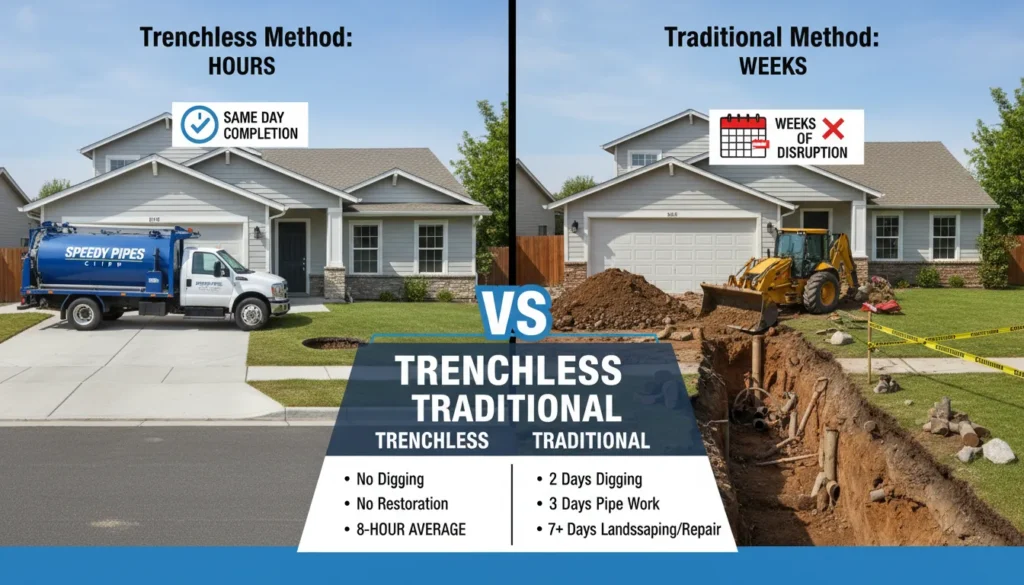
When your main sewer line is down, every hour feels like a day. One of the most common questions homeowners ask is, “How long does pipe relining take?” In 2026, the difference in sewer repair time between traditional digging and a modern sewer pipe sleeve is staggering.
The Trenchless Advantage: Done in a Day
For most residential properties, the trenchless repair time is typically between 6 to 10 hours. Because there is no major excavation, the process moves quickly:
Preparation (1–2 Hours): Camera inspection and high-pressure hydro-jetting to clear the line.
Installation (1 Hour): Inserting the resin-saturated sewer pipe sleeve.
Curing (2–4 Hours): Depending on the method (UV light is the fastest, while steam or ambient curing takes longer), the pipe needs time to harden.
Final Inspection (30 Minutes): A quick HD camera walkthrough to ensure the new liner is perfect.
The Traditional Timeline: A Week of Chaos
If you choose traditional excavation, you aren’t just looking at a “plumbing job”—you are looking at a “construction site.”
Digging (1–2 Days): Bringing in heavy machinery to break through concrete and soil.
Replacement (1 Day): Removing the old pipe and laying new PVC.
Inspections (1–2 Days): Waiting for city inspectors to approve the work before the trench can be filled.
Backfilling & Restoration (2–4 Days): Filling the hole, compacting soil, and then the long process of hiring separate contractors to fix your driveway or landscaping.
Comparison at a Glance
| Phase | Sewer Pipe Sleeve (Trenchless) | Traditional Replacement |
| Total Labor Time | 6 – 24 Hours | 5 – 10 Days |
| Water Shut-off | Minimal (Few hours) | Extended (Days) |
| Property Restoration | Immediate | Weeks (Waiting for contractors) |
Why Speed Matters
Choosing a fast sewer repair solution like a pipe sleeve means your life returns to normal almost immediately. You don’t have to move into a hotel, you don’t have to stare at a giant hole in your yard, and most importantly, your family has access to working toilets and showers by dinner time.
Benefits of Sewer Pipe Sleeve & Lining
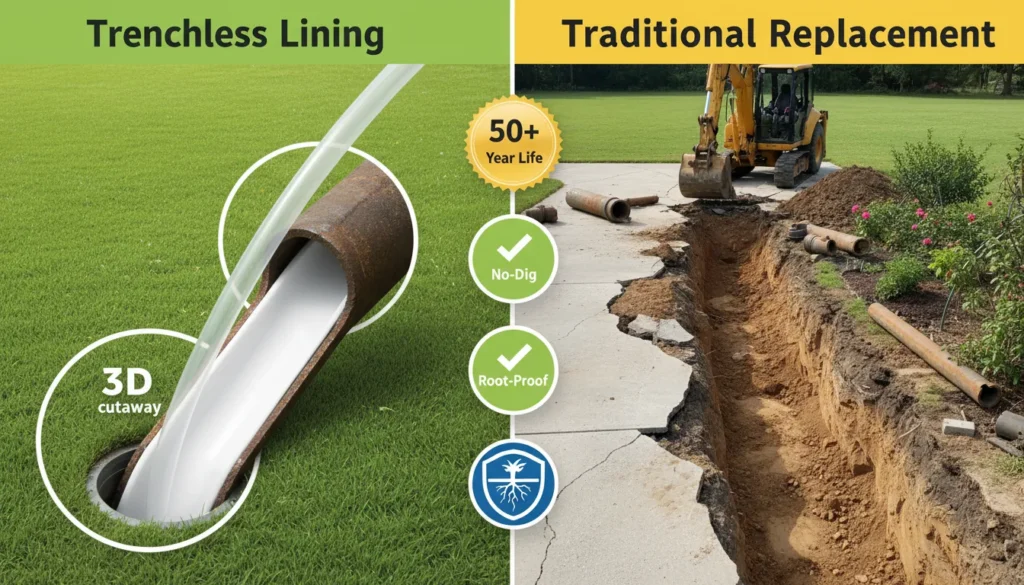
Choosing a sewer pipe sleeve isn’t just about fixing a leak; it’s about choosing the most advanced, cost-effective pipe repair available today. Here is why thousands of homeowners are switching to trenchless sewer pipe lining:
1. No-Digging Sewer Repair
The most obvious benefit is no digging sewer repair. Traditional methods require a massive trench through your property. With a sleeve, we use minimal excavation—often just a single existing access point—to rehabilitate your entire line.
2. Protects Your Landscaping & Property
Why spend thousands on a new driveway or professional landscaping only to have a backhoe tear it up? Trenchless sewer pipe lining allows you to protect your landscaping, patios, and expensive interior flooring. Your home stays beautiful while your pipes get a permanent upgrade.
3. Fast Repair & Minimal Disruption
Time is money. As we’ve seen, a sewer pipe sleeve can be installed in a single day. This fast repair means minimal disruption to your family’s routine. No moving to a hotel, no long-term water shut-offs, and no construction noise for a week.
4. Improves Pipe Flow & Efficiency
The epoxy resin used in sewer pipe relining is incredibly smooth. This reduces friction, which actually improves pipe flow compared to old, rough cast iron or clay. Waste moves faster, and the chance of future clogs is significantly reduced.
5. Eco-Friendly Plumbing Solution
Trenchless technology is a “green” choice. By avoiding heavy machinery, we reduce carbon emissions. Furthermore, because we aren’t digging up old, potentially contaminated soil and hauling it to a landfill, it is a much more eco-friendly plumbing solution.
6. Long-Lasting Durability (50–100 Years)
A sewer pipe sleeve isn’t a temporary patch; it’s a structural replacement. Modern epoxy liners are tested to last between 50 to 100 years. They are immune to corrosion and, because they are seamless, they are 100% root-proof.
Disadvantages & Limitations of Sewer Pipe Sleeves
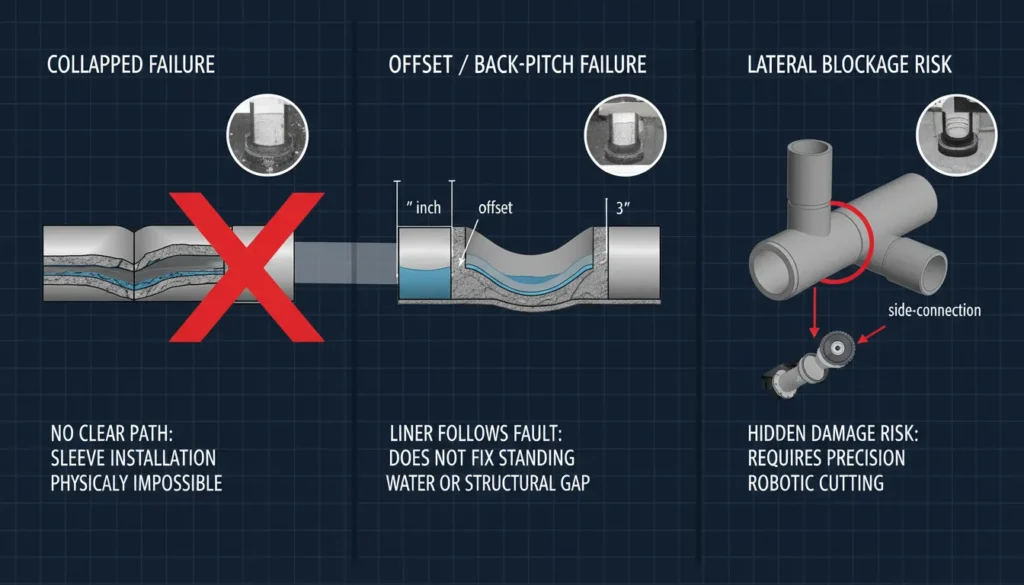
While trenchless technology is the preferred choice for most 2026 homeowners, it is not a “magic wand” for every plumbing disaster. Understanding what is a disadvantage of pipe relining helps you make an informed decision and avoid wasting money on a repair that might not work for your specific pipe condition.
1. Not Suitable for Collapsed Pipes
The biggest limitation is that a sewer pipe sleeve requires a “host pipe” to guide it. If your sewer line has completely collapsed (pancaked) or has sections missing, there is no path for the liner to travel through. In cases of a total collapsed pipe, traditional excavation or pipe bursting is the only way to restore flow.
2. Structural Integrity Required
For sewer pipe lining to be successful, the existing pipe must still have its basic circular shape. If the pipe is severely “back-pitched” (sloping the wrong way) or has a massive “belly” (sagging), a sleeve will follow that same bad shape. A sleeve fixes leaks and roots, but it cannot fix a pipe that was installed at the wrong angle.
3. Severe Damage Limitations
While a sleeve can bridge small gaps and cracks, it cannot repair a pipe that has “offset joints” where the two sections of pipe have moved inches apart. In these cases of severe damage, the liner may not be able to bridge the gap without creating a weak spot or a blockage.
4. Higher Upfront Equipment Cost
When looking at the higher upfront cost, some homeowners are surprised that the plumbing bill for a sleeve can be more than the plumbing bill for a dig. This is because of the expensive resins and high-tech UV or steam curing equipment required. The savings only become clear when you realize you don’t have to spend $10,000 to fix your driveway afterward.
5. Hidden Damage Risk
If a sewer camera inspection is not performed perfectly, there is a hidden damage risk. If a technician misses a secondary crack or a weak lateral connection, the sleeve might not cover the entire problem area. This is why choosing an expert team with high-definition diagnostic tools is non-negotiable.
When to Choose Lining vs. Replacement
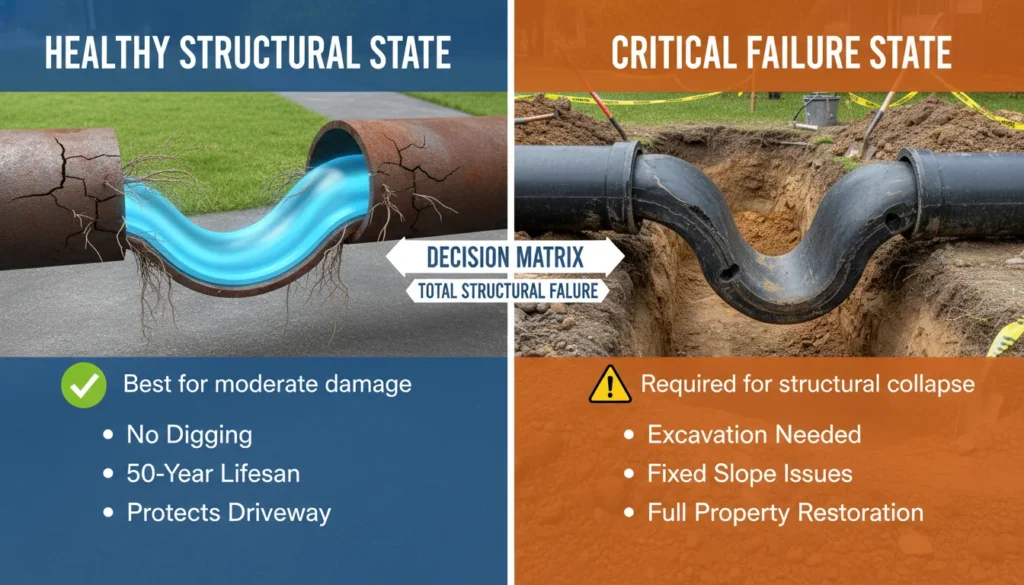
Deciding between a sewer pipe sleeve and a full traditional replacement depends entirely on the current “health” of your underground pipes. While 2026 trenchless technology is incredibly advanced, there are specific scenarios where one method is clearly superior to the other.
Choose a Sewer Pipe Sleeve When:
If your pipe is still structurally sound but suffering from “surface” issues, a sleeve is your best friend.
Moderate Root Intrusion: If roots have entered through joints but haven’t crushed the pipe yet.
Pinholes & Hairline Cracks: Perfect for sealing leaks in aging cast iron or clay.
Missing Bottoms (Channeling): If the bottom of your cast iron pipe has eroded, a liner can create a new, smooth flow path.
To Protect Assets: When the pipe runs directly under a swimming pool, a heavy driveway, or expensive interior tiling.
Choose Traditional Replacement When:
Sometimes, there are no alternatives to pipe relining other than digging. You should choose replacement if:
Severe Damage or Collapse: If the pipe has “pancaked” or lost its circular shape, a liner cannot pass through.
Back-Pitching (Slope Issues): If your pipe was installed at the wrong angle and water is sitting still (bellying), a sleeve will not fix the gravity problem. You must dig to reset the pipe’s slope.
Extensive Offsets: If two sections of pipe have shifted so far apart that they no longer align, a sleeve cannot bridge the gap safely.
Decision Matrix: The “Rule of Thumb”
| Condition | Recommended Action | Why? |
| Cracks/Small Leaks | Sewer Pipe Sleeve | Faster, cheaper, and seals all leaks. |
| Heavy Root Growth | Sewer Pipe Sleeve | Creates a seamless, root-proof barrier. |
| Fully Crushed Pipe | Full Replacement | No path for the liner to enter. |
| Improper Gravity Slope | Full Replacement | Physical relocation of the pipe is required. |
The Role of the Professional Inspection
The only way to truly know when to use a sewer pipe sleeve is through a high-definition camera diagnostic. An expert technician can measure the internal diameter and check the structural “roundness” of the line. If the pipe is more than 50% collapsed, we will always recommend a traditional replacement to ensure the safety of your home.
Pipe Materials, Strength & Lifespan
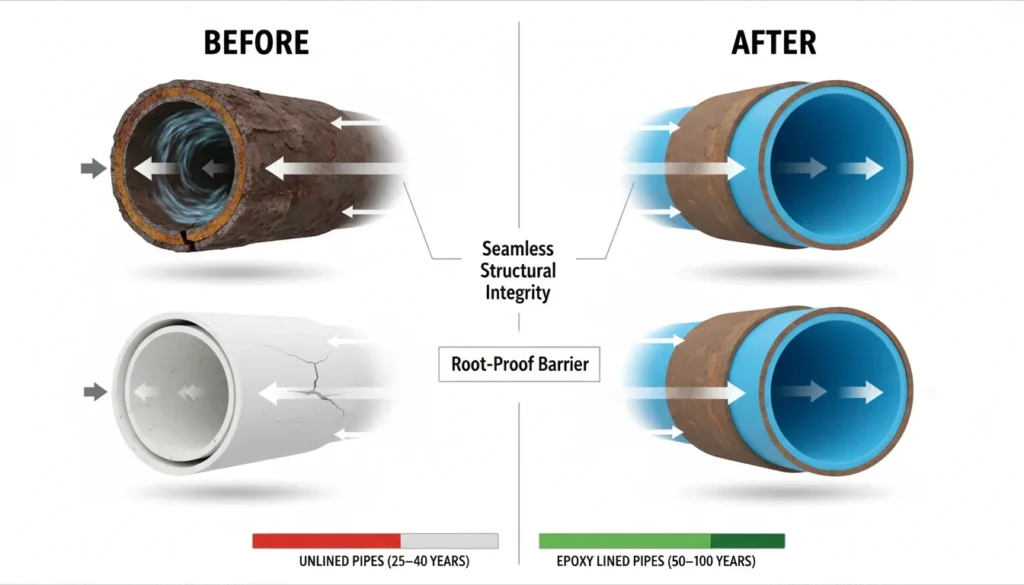
A common question we hear in 2026 is, “How strong is pipe relining?” Many homeowners worry that a “sleeve” might be flimsy compared to a brand-new pipe. In reality, the epoxy resin used in trenchless sewer pipe lining is designed to be a structural replacement that is often stronger and more chemically resistant than the original pipe material.
How Long Does a Sewer Pipe Sleeve Last?
Once cured, a professional-grade sewer pipe sleeve has an expected lifespan of 50 to 100 years. Because the new liner is seamless (no joints), it eliminates the #1 cause of pipe failure: root intrusion at the joints.
Relining Different Pipe Materials
Trenchless technology is incredibly versatile and can be used to rehabilitate almost any type of existing drainage system:
Cast Iron Pipes: These are the most common candidates for relining. As cast iron ages, it rusts and develops “scales” that catch waste. A sleeve covers the internal corrosion and prevents the “channeling” (rotting out of the bottom) that eventually destroys metal pipes
Clay Pipes: While clay is naturally resistant to corrosion, it is very brittle. Ground shifts or tree roots easily crack clay joints. A liner creates a smooth, flexible “inner skeleton” that protects the clay pipe from external pressure.
Can PVC Pipes be Relined? Yes! While PVC is a modern material, it can still experience “crushing” or joint failure. CIPP lining bonds perfectly to PVC, allowing us to bridge broken sections without digging up the entire line.
Orangeburg & Concrete: Even outdated materials like Orangeburg (tar-paper pipes) or old concrete can often be saved with a sleeve, provided they haven’t completely collapsed.
Durability & Corrosion Resistance
The “strength” of a relined pipe comes from its corrosion resistance. Unlike cast iron, epoxy resin does not rust. Unlike clay, it is not brittle. The result is a smooth, high-flow interior that:
Resists Chemical Damage: Withstands household cleaners and acidic waste.
Prevents Root Penetration: Since there are no gaps or joints, roots have nowhere to enter.
Handles Ground Shift: The material has a slight flexibility that allows it to survive minor soil movement without cracking.
Cost, Insurance & Responsibility
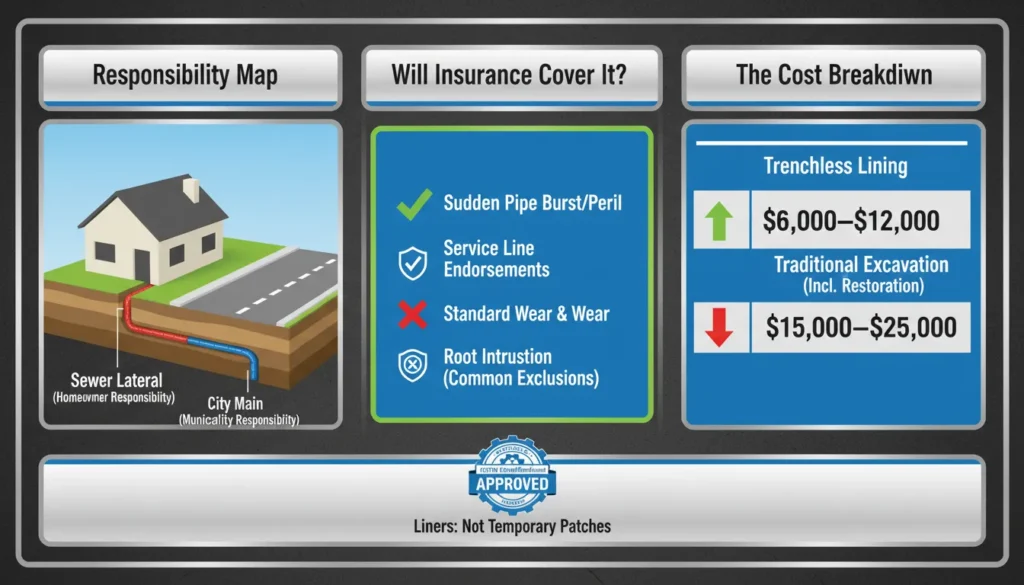
When a sewer line fails, the first two questions are usually: “Who is responsible for this?” and “Will my insurance pay for it?” Navigating the legal and financial side of sewer repair can be tricky, but here is the expert breakdown for 2026.
Who Pays for a Broken Sewer Pipe?
Many homeowners assume the city is responsible for any pipe that leaves their house. However, the responsibility for a broken sewer pipe usually falls on the homeowner for the entire “Sewer Lateral.”
Homeowner Responsibility: You are responsible for the pipe from your house all the way to the connection point at the city’s main line (even if it runs under the sidewalk or street).
City Responsibility: The city only pays for repairs to the large “Sewer Main” that services the entire neighborhood.
Will Homeowners Insurance Cover Sewer Line Repair?
The short answer is: Usually not, unless you have a specific rider.
Standard Policies: Most basic policies cover damage caused by a backup (like ruined floors), but they do not cover the cost of repairing the pipe itself if the damage is due to wear and tear, age, or tree roots.
The “Sudden & Accidental” Rule: If a pipe breaks due to a “covered peril” (like a lightning strike or a vehicle driving over your yard and crushing the line), you might be covered.
Service Line Endorsements: In 2026, many insurance companies offer “Buried Utility” or “Service Line” coverage for about $50–$100 a year. If you have this add-on, your insurance will likely cover the sewer pipe sleeve cost.
Legal & Safety: Are Sewer Liners Illegal? (Myth vs. Fact)
There is a common myth that “sewer liners are illegal.” This is False. Sewer pipe lining (specifically CIPP) is fully recognized and approved by the International Plumbing Code (IPC) and the Florida Building Code. However, there are two reasons why people get confused:
Non-Compliant Methods: Some “brush-on” coatings or “epoxy-only” sprays do not meet structural standards. EZ Plumbing only uses CIPP (Cured-In-Place Pipe) that meets ASTM F1216 standards, which is the legal gold standard.
Permitting: Some low-quality contractors try to install liners without a permit. For a liner to be legal and safe, it must be permitted and inspected by the city using a post-installation camera video.
Expert Tip: Always ask your contractor for a copy of the city permit. A legal sewer pipe sleeve installation protects your home’s value and ensures you are compliant with local building codes.
FAQs & Expert Trenchless Solutions Near You
If you are searching for sewer pipe lining near me, you need a team that understands the local soil conditions, high water tables, and the specific building codes of 2026. Choosing the right trenchless sewer repair near me can save you thousands in future repairs.
Frequently Asked Questions
Absolutely. While the upfront cost of the resin and tech is higher, you save a fortune by not having to replace your driveway, deck, or landscaping. Plus, a sewer pipe sleeve lasts 50+ years, making it a permanent “one-and-done” fix.
In 2026, most homeowners pay between $125 and $250 per linear foot. A standard residential project typically falls between $6,000 and $12,000, depending on the diameter and length of the line.
Yes. Modern pull-in-place and inversion liners are flexible enough to navigate 45-degree and even 90-degree bends without wrinkling, ensuring a smooth flow throughout the entire system.
Yes, they are the best solution for roots. Because a sewer pipe repair sleeve is seamless (jointless), there are no gaps for roots to enter. It creates an impenetrable barrier that stops root intrusion forever.
The 135 rule refers to the maximum total change in direction allowed in a single run of pipe (using three 45-degree elbows to equal 135 degrees). This rule ensures that cleaning cables and pipe inspection cameras can still navigate the line without getting stuck.
For specialized trenchless work, rates typically range from $150 to $350 per hour for a master technician and a high-tech equipment rig. However, most lining projects are quoted as a “flat rate” based on the length of the pipe.
Looking for Sewer Pipe Lining Companies Near Me?
Don’t let a cracked sewer pipe destroy your property’s value or your peace of mind. At EZ Plumbing, we specialize in the latest no-dig technology to get your home back to normal fast.
Step 1: Stop the guesswork.
Step 2: See the damage for yourself with our HD camera tech.
Step 3: Get a permanent, trenchless fix that lasts a lifetime.