- Home
- Water Damage Restoration
- Mold Remediation
Expert Mold Remediation & Air Quality Restoration | 24/7 Response
Visible mold is just the tip of the iceberg. At Ez Plumbing Repair Services, we understand that surface cleaning isn’t enough to protect your home. Our IICRC-certified specialists use advanced moisture mapping to identify the root cause, contain toxic spores, and restore your indoor air quality to safe, natural levels. We don’t just hide the problem; we eliminate the biological threat permanently.
Why Choose Our Certified Remediation Team?
✅ Rapid 30-Minute Emergency Response
Mold colonizes in as little as 24 hours. Our local Miami teams are on standby 24/7 to provide immediate containment, preventing costly structural damage and health risks before they spread.
✅Industrial-Grade HEPA Air Scrubbing
We don’t just scrub walls; we clean the air you breathe. Using professional HEPA filtration and negative air pressure, we capture 99.97% of microscopic spores, ensuring your family’s safety.
✅ Guaranteed Moisture Source Elimination
Mold returns if the water source remains. We specialize in “Full-Circle Restoration”—fixing the leak, drying the structure, and applying antimicrobial shields to guarantee a mold-free future.
- ✅ Stop Health Risks Instantly: Prevent respiratory issues and toxicity symptoms before they worsen.
- ✅ Insurance Billing Expertise: We document everything and work directly with your adjuster to maximize your claim.
- ✅ $50 Instant Savings: Get professional-grade service at the best value in Miami if you call within the next hour.
Why "Mold Removal" Is Only Half the Solution
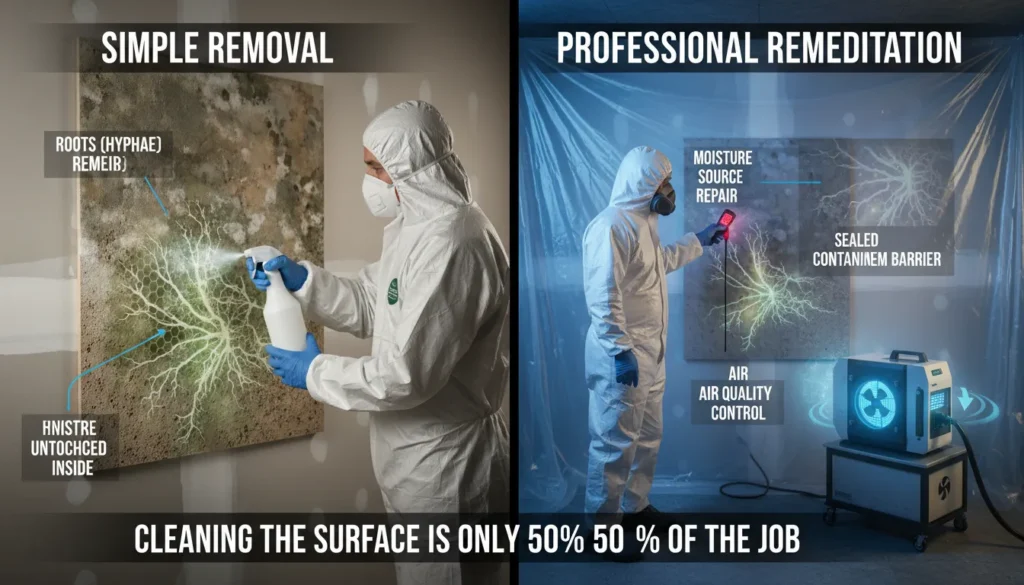
Most homeowners make the mistake of thinking that if they can’t see the mold, it’s gone. However, simply scrubbing a surface is like cutting the top off a weed without pulling the root. To truly protect your property, you must understand the difference between a temporary fix and a permanent solution.
The Bleach Trap: Why DIY Spraying Backfires
The most common mistake is spraying bleach on “Black Mold.” While bleach kills mold on non-porous surfaces (like tiles), it fails on porous materials like drywall, wood, and insulation.
The Science: Bleach contains 90% water. When applied to drywall, the chlorine stays on the surface while the water soaks deep into the material.
The Result: You end up “feeding” the mold roots with moisture, causing it to grow back faster and more aggressively than before.
Physical Removal vs. Environmental Remediation
The most common mistake is spraying bleach on “Black Mold.” While bleach kills mold on non-porous surfaces (like tiles), it fails on porous materials like drywall, wood, and insulation.
The Science: Bleach contains 90% water. When applied to drywall, the chlorine stays on the surface while the water soaks deep into the material.
The Result: You end up “feeding” the mold roots with moisture, causing it to grow back faster and more aggressively than before.
The 10-Sq-Ft Rule: When to Call the Professionals
Following EPA (Environmental Protection Agency) Standards is vital for maintaining a healthy home. Not every mold issue is a safe DIY project.
The DIY Threshold: If the affected area is less than 10 square feet (roughly a 3×3 foot patch) and resulted from a simple, clean water leak, homeowners may handle the cleanup using proper personal protective equipment (PPE).
The Professional Mandate: If the infestation exceeds 10 square feet, is located inside your HVAC system, or originated from “Category 3” (contaminated) water, professional intervention is required. Attempting to disturb large mold colonies without specialized containment can release millions of spores into your home’s ventilation, spreading the contamination to every room.
Our Standardized Mold Remediation Protocol: Science Over Scrubbing
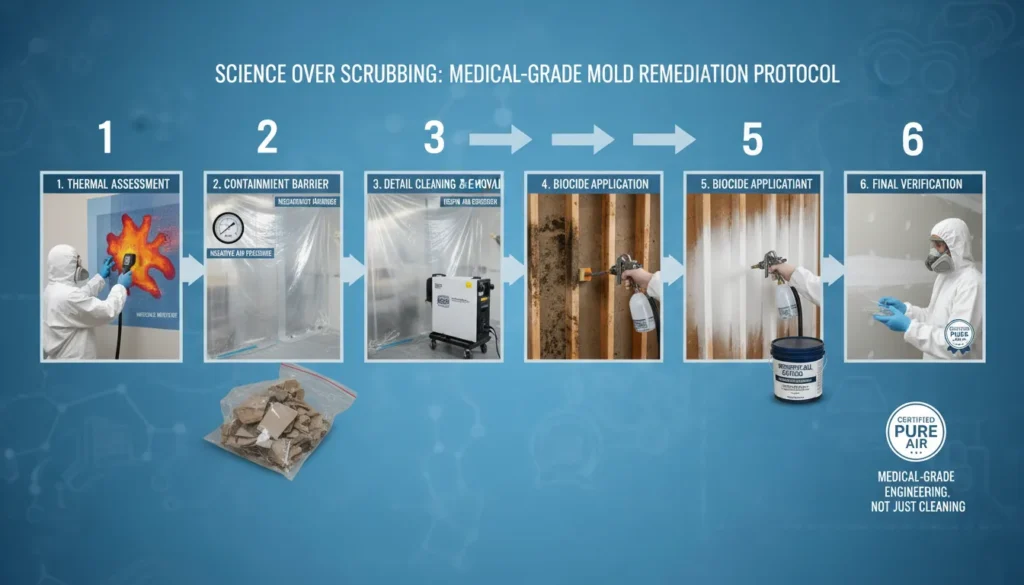
Effective restoration is a systematic discipline, not a cleaning task. To ensure a home returns to a safe, healthy state, a rigorous 7-step protocol must be followed. This scientific approach ensures that every spore is accounted for and the environmental conditions that allowed the growth are permanently altered.
1. Assessment & Moisture Mapping
Before any physical work begins, specialists must identify the “Fuel Source.” Using infrared thermal imaging and advanced moisture meters, technicians map out hidden leaks behind walls or under flooring. Finding the exact entry point of water is the only way to prevent the mold from returning after the job is done.
2. Containment: Isolation of the Affected Area
To prevent cross-contamination, the work zone is sealed using heavy-duty polyethylene sheeting. By creating a physical barrier and maintaining Negative Air Pressure, we ensure that disturbed spores are trapped within the containment area and do not drift into clean living spaces or the home’s ventilation system.
3. HEPA Air Filtration & Scrubbing
Visible mold is often less dangerous than the invisible spores suspended in the air. Industrial-grade HEPA (High-Efficiency Particulate Air) scrubbers are deployed to cycle the indoor air multiple times per hour. These machines are designed to capture microscopic particles as small as 0.3 microns, effectively “washing” the air you breathe.
4. Safe Disposal of Contaminated Materials
Porous materials such as saturated drywall, fiberglass insulation, and certain types of carpeting often cannot be salvaged once deeply infested. These materials are carefully removed, double-bagged, and disposed of according to hazardous waste protocols to ensure no spores are released during transit out of the building.
5. Antimicrobial Disinfection
Non-porous surfaces like studs, concrete, and framing are scrubbed using EPA-registered biocides and fungicides. This chemical treatment doesn’t just clean; it neutralizes the biological structure of the mold, ensuring that the roots are completely inactive.
6. Structural Encapsulation
After cleaning, structural components are often treated with a specialized mold-resistant coating known as an encapsulant. This serves as a final shield, sealing the material and providing a moisture-resistant surface that prevents new colonies from finding a foothold in the future.
7. Post-Remediation Verification
The process is only complete when environmental conditions are stabilized. Technicians verify that the relative humidity in the area is below 50%. This final check ensures the “drying goal” has been met, making it safe for the reconstruction phase and preventing any latent spores from germinating.
How Much Does Mold Remediation Cost in 2026?
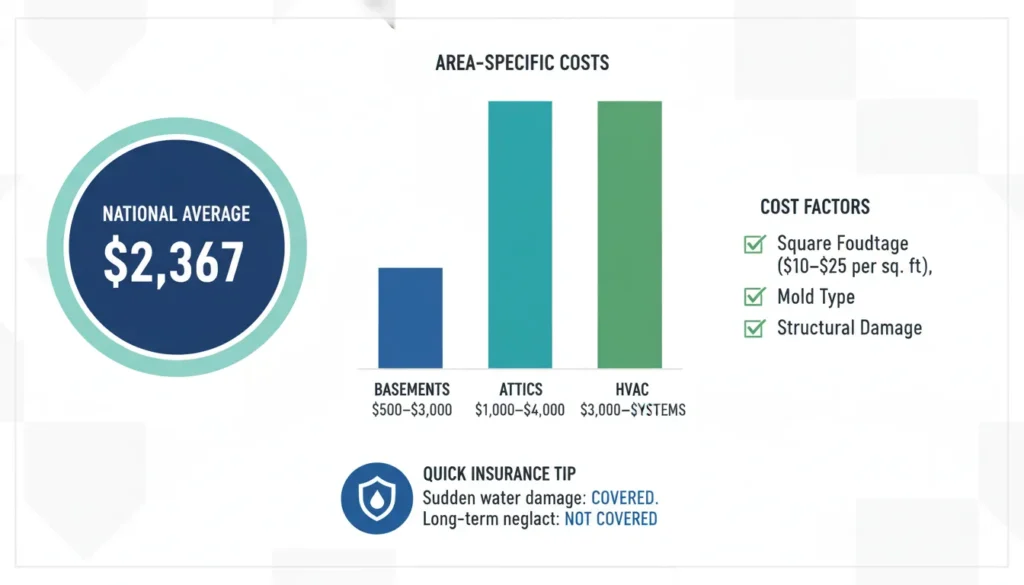
Transparency in pricing is essential when dealing with property restoration. While every situation is unique based on the mold species and the extent of the moisture damage, current 2026 industry data provides a clear framework for what homeowners can expect to invest in a healthy, mold-free environment.
Average Remediation Price Ranges
Based on comprehensive market analysis for 2026, the average professional mold remediation project typically falls between $1,223 and $3,753.
Minor Infestations: Small, localized areas on non-porous surfaces may cost as little as $500 to $1,000.
Major Restoration: Extensive projects involving structural drying and hazardous material disposal can exceed $6,000, with the national average settling around $2,367.
Per Square Foot: Professionals generally calculate costs between $10 and $25 per square foot, depending on the labor-intensity of the containment required.
Remediation Costs by Specific Area
The location of the growth significantly impacts the equipment needed and the difficulty of the labor involved:
Attics ($1,000 – $4,000): High costs are often due to limited accessibility, the need for specialized insulation removal, and wood sheathing treatment.
Basements ($500 – $3,000): Costs vary depending on whether the area is finished (drywall) or unfinished (concrete), and the complexity of the industrial dehumidification needed.
HVAC Systems ($3,000 – $10,000): Cleaning ductwork is highly technical as it requires specialized tools to prevent spores from circulating through the entire home’s ventilation system.
Whole-House Remediation: For severe neglect or post-flood scenarios, professional costs can range from $10,000 to $30,000+.
Insurance Guidance: Who Pays for Mold Remediation?
Navigating insurance claims for mold can be complex. The general rule in the industry is based on the “Source of the Moisture”:
Covered Claims: Most homeowners’ policies cover remediation if the mold is a direct result of a “sudden and accidental” peril, such as a burst pipe, a water heater failure, or a sudden roof leak.
Exclusions: Mold resulting from long-term neglect, high humidity due to lack of maintenance, or repeated seepage is typically not covered by standard policies.
Direct Billing Strategies: To simplify the recovery process, it is vital to choose a provider that offers detailed “Proof of Loss” documentation—including moisture maps and thermal imaging. This data allows for smoother communication with insurance adjusters, often facilitating direct billing where the restoration firm works straight with the insurance company on your behalf.
10 Warning Signs of Mold Toxicity in Your Home
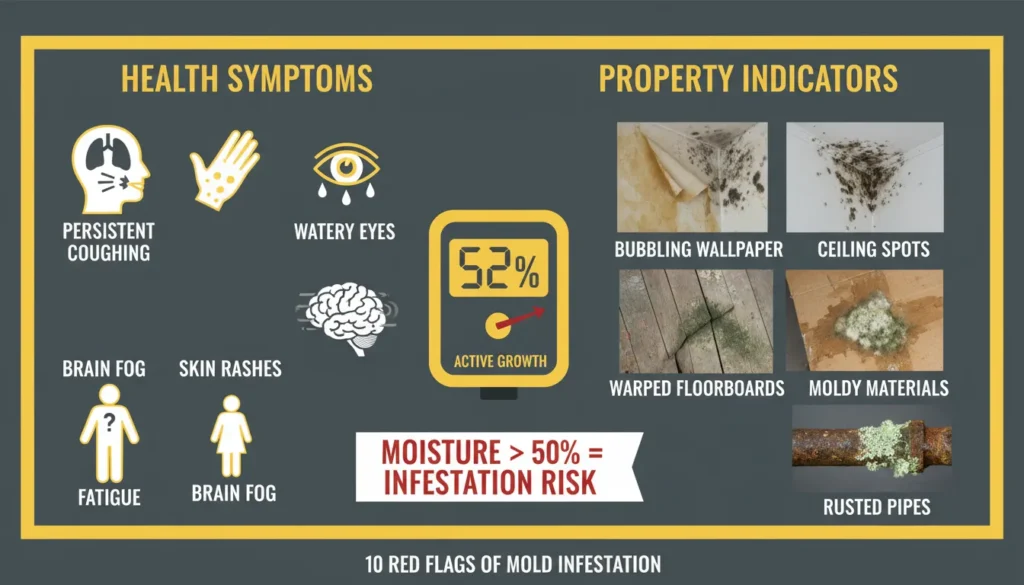
Detecting mold early is the only way to prevent chronic health issues and expensive structural repairs. Mold often hides behind walls or inside ventilation systems, but it almost always leaves subtle clues. If you notice any of the following symptoms, your home’s air quality may already be compromised.
Physical & Health-Related Red Flags
The human body often reacts to microscopic spores long before the mold becomes visible to the naked eye.
Persistent Allergic Reactions: Sneezing, runny nose, or red eyes that only occur when you are inside the house.
Unexplained Respiratory Issues: A sudden onset of asthma symptoms or a “dry cough” that clears up when you spend time outdoors.
Chronic Fatigue & Headaches: Mycotoxins (toxic chemicals produced by mold) can affect the neurological system, leading to “brain fog” or recurring migraines.
Skin Irritation: Rashes or hives that don’t respond to typical treatments and seem linked to specific rooms.
Hidden Property Indicators
Mold doesn’t always look like a black stain; sometimes, it manifests as structural decay or “phantom” smells. 5. The “Basement” Odor: A sharp, musty, or earthy smell that persists even after deep cleaning. This is the scent of microbial volatile organic compounds (mVOCs). 6. Bubbling or Peeling Paint: When moisture is trapped behind a wall, the paint or wallpaper will lose its adhesion and start to “bubble.” 7. Soft or Discolored Drywall: If a wall feels “spongy” to the touch or shows yellow/brown staining, mold is likely growing on the backside of the gypsum board. 8. HVAC Mustiness: If a sour or damp smell comes out of your air vents when the AC turns on, the cooling coils or ductwork are likely contaminated. 9. Warping Woodwork: Baseboards or door frames that are pulling away from the wall often indicate a hidden moisture source fueling fungal growth. 10. High Humidity Levels: If windows consistently show condensation (fogging) on the inside, the indoor humidity is likely above 60%, making mold growth inevitable.
Moisture Control: The Only Permanent Way to Kill Mold
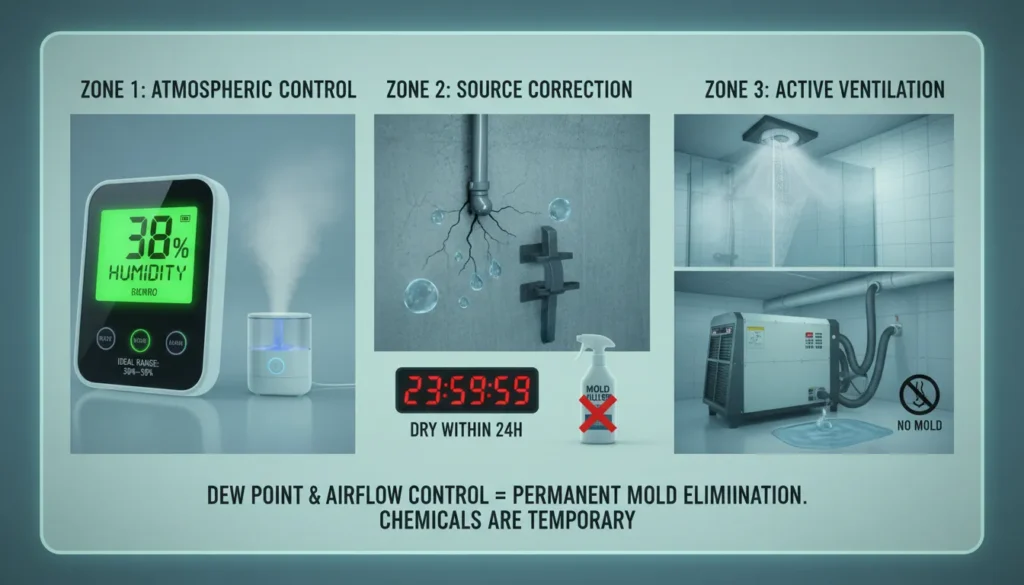
Mold is a biological symptom of a moisture problem. While professional remediation eliminates existing colonies, the only way to ensure they never return is through proactive environmental management. By controlling the “fuel” (water) that mold needs to survive, you can maintain a sterile and healthy indoor atmosphere indefinitely.
Maintaining Ideal Humidity EPA Guidelines
The most critical factor in mold prevention is atmospheric moisture. According to EPA (Environmental Protection Agency) standards, indoor relative humidity should ideally be kept between 30% and 50%.
The Growth Threshold
Once humidity levels exceed 60%, porous materials like drywall and wood begin to absorb moisture from the air, creating a “micro-climate” perfect for spore germination.
The Solution
Use high-capacity dehumidifiers in high-risk areas and ensure your air conditioning system is properly sized for your square footage to pull excess moisture effectively.
The 24-48 Hour Critical Drying Window
Speed is your best defense against fungal growth. Mold spores are opportunistic and can begin to colonize within 24 to 48 hours of a moisture event.
The Rule of Urgency: Whether it is a minor pipe leak, a spilled bucket, or condensation from a window, every wet surface must be professionally dried or discarded within this 48-hour window.
Deep Drying: Remember that surfaces might feel dry to the touch, but moisture trapped inside wall cavities can still trigger “hidden” mold. Using moisture meters to verify total dryness is a professional-grade prevention tactic.
Targeted Ventilation for High-Moisture Zones
Bathrooms and kitchens are the primary “hotspots” for mold due to steam and high-temperature water usage. Proper airflow is non-negotiable in these zones:
Exhaust Systems: Always run exhaust fans during and for at least 20 minutes after showering or cooking. These fans should always be vented to the outside of the building—never into the attic or crawlspace.
Air Circulation: In areas with poor natural airflow, such as laundry rooms or walk-in closets, keep doors open and use small circulation fans to prevent stagnant, humid air from settling in corners.
Mold Remediation: Your Top Questions Answered
Navigating a mold crisis often leads to more questions than answers. To provide clarity and help you protect your property, we have compiled the most frequent inquiries based on current environmental standards and homeowner concerns.
The only way to kill mold permanently is to eliminate the moisture source. While antimicrobial treatments and fungicides can kill active spores, mold is opportunistic. If the underlying cause—such as a pipe leak, high humidity (above 50%), or poor ventilation—is not corrected, new spores will inevitably settle and regrow. Permanent remediation requires a combination of structural drying and moisture control.
In many cases, yes, you can remain in your home, but it depends on the location and extent of the infestation. Professionals use high-grade polyethylene sheeting and negative air pressure machines to create a “containment zone.” This prevents toxic spores from traveling to clean areas of the house. However, if the mold is located in the HVAC system or covers a massive portion of the living area, temporary relocation is advised for respiratory safety.
You should never spray bleach on black mold, especially on porous surfaces like drywall or wood. While bleach may remove the surface stain, its high water content (90%) actually penetrates the material and “feeds” the mold roots (hyphae). This often leads to a much more aggressive return of the colony. Furthermore, avoid mixing different household cleaners, as this can create toxic chlorine gas.
Mold is incredibly fast-acting and can begin to colonize within 24 to 48 hours of water exposure. Because spores are microscopic and always present in the air, they only need a food source (like organic drywall or wood) and moisture to begin growing. This is why “Rapid Extraction” and immediate dehumidification are the most critical steps in preventing a full-scale mold outbreak after a basement flood or leak.
Technically, killing 100% of mold spores in a normal indoor environment is nearly impossible because microscopic spores exist naturally in the air. However, you can permanently eliminate a mold colony and return your home to a safe, “mold-free” state by following this two-step professional standard:
Professional-Grade Biocides & Fungicides: To kill active mold growth 100% on a surface, you must use EPA-registered antimicrobial or fungicidal treatments. Unlike household bleach (which only cleans the surface), these professional chemicals penetrate porous materials to neutralize the mold’s root system (hyphae).
Total Moisture Elimination (The “Permanent” Kill): Even if you kill 100% of the current growth, new spores will land and grow within 24–48 hours if the environment is damp. The only way to “permanently” kill a mold problem is to reduce indoor humidity below 50% and fix the water source. Without moisture, mold cannot physically survive or colonize.
Secure Your Home’s Air Quality with Miami’s Trusted Experts
Mold is more than just a stain on the wall; it is a biological hazard that requires professional precision. Because mold is almost always the result of an unresolved leak or flooding event, effective remediation is often the final critical step of a larger water damage restoration strategy. Without addressing the underlying moisture that fuels fungal growth, any cleaning effort will be temporary.
At Ez Plumbing Repair Services, we provide a comprehensive approach to property recovery. By integrating advanced mold protocols with professional water damage restoration techniques, we ensure that your structural integrity is preserved and your indoor ecology is returned to a safe, healthy state. We don’t just fix the damage you see; we eliminate the invisible threats that compromise your home’s safety.
Licensed, Bonded, and IICRC-Certified. Our team is dedicated to providing peace of mind through technical excellence and transparent service. We handle the spores and the complex restoration process so you can focus on what matters most—taking care of your family.