- Home
- Water Damage Restoration
24/7 Emergency Water Damage Restoration in Miami | On-Site in 30 Mins
When water invades your property, every second counts. At Ez Plumbing Repair Services, we provide an immediate, industrial-grade response to stop mold growth and salvage your infrastructure. From catastrophic burst pipes to storm-driven flooding, our Miami-based rapid response teams are equipped with advanced thermal technology to restore your peace of mind and your property’s integrity instantly.
Why Miami Homeowners Trust Our Recovery Teams
✅ Zero-Stress Insurance Handling
We take the financial burden off your shoulders by providing direct-bill insurance documentation. Our experts work with your adjuster to ensure your claim is maximized with $0 out-of-pocket costs for most sudden water emergencies.
✅ Advanced Structural Drying
Standard fans aren’t enough for Miami’s humidity. We utilize industrial-grade dehumidifiers and psychrometric drying techniques to extract moisture from deep within your walls, prevents secondary rot and long-term structural failure.
✅Certified Mold Prevention
Within 24 hours, standing water becomes a breeding ground for toxins. Our IICRC-certified technicians apply hospital-grade antimicrobials immediately after extraction, guaranteeing a safe, breathable environment for your family or employees.
- ✅ 30-Minute Guaranteed Arrival: We are already in your neighborhood.
- ✅ Free On-Site Inspection: $0 initial assessment to map the damage.
- ✅ Licensed & IICRC Certified: Professional-grade equipment only.
Water Emergency? Follow These 4 Immediate Steps to Protect Your Property
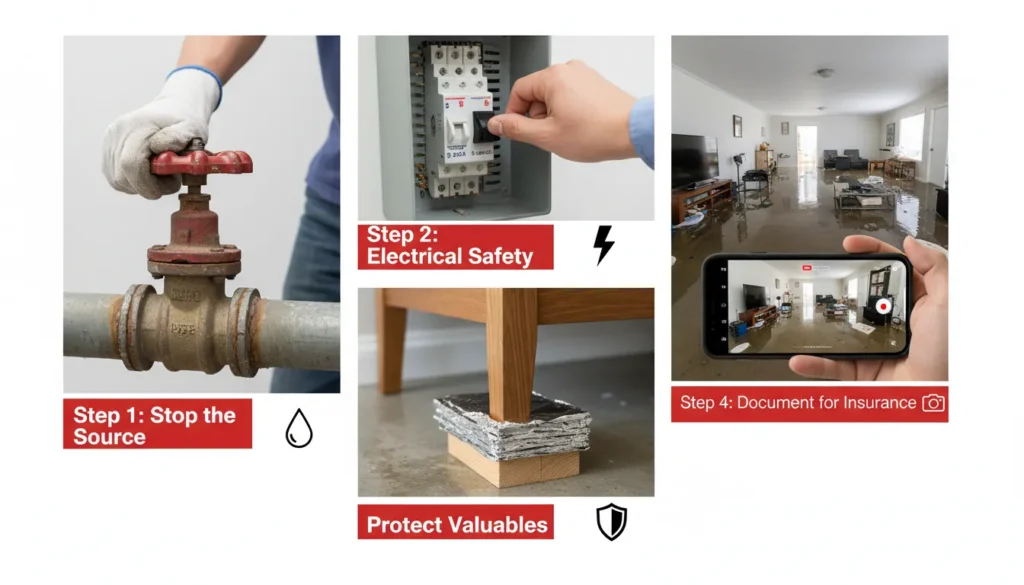
The first 60 minutes after a pipe bursts or a flood occurs are known as the “Golden Hour” of restoration. Taking these immediate actions can reduce your total repair costs by thousands of dollars and prevent permanent structural rot. Use this checklist to stabilize your home while professional help is in transit.
1. Stop the Source & Mitigate the Flow
If the water is coming from an internal plumbing failure, locate your main water shut-off valve and turn it clockwise until the flow stops. If you are dealing with a localized leak (like a toilet or sink), use the individual supply valve. Stopping the “active” water is the only way to contain the damage area and prevent it from spreading to other rooms.
2. Neutralize Electrical Hazards
Water and electricity are a lethal combination. If the water has reached electrical outlets or your HVAC system, head to your breaker box and shut off the power to the affected zones. Do not walk through standing water if the electricity is still on. Safety is the priority; if you cannot reach the breaker box safely, evacuate the area immediately.
3. Rescue Your High-Value Assets
Miami’s humidity accelerates the damage to porous materials like wood, paper, and fabric. Move electronics, important documents, and small furniture to a dry, elevated area. For heavy furniture that cannot be moved, place aluminum foil or wood blocks under the legs to prevent “wicking”—a process where water travels up the wood grain and causes permanent swelling and staining.
4. Document Evidence for Your Insurance Claim
Before the extraction process begins, take high-resolution photos and videos of the standing water and affected items. This visual evidence is crucial for your insurance adjuster to prove the “Sudden and Accidental” nature of the event. Comprehensive documentation in the first hour ensures a smoother claims process and helps maximize your recovery settlement.
Beyond the Surface: Why Standard Drying Fails in Miami’s Humidity
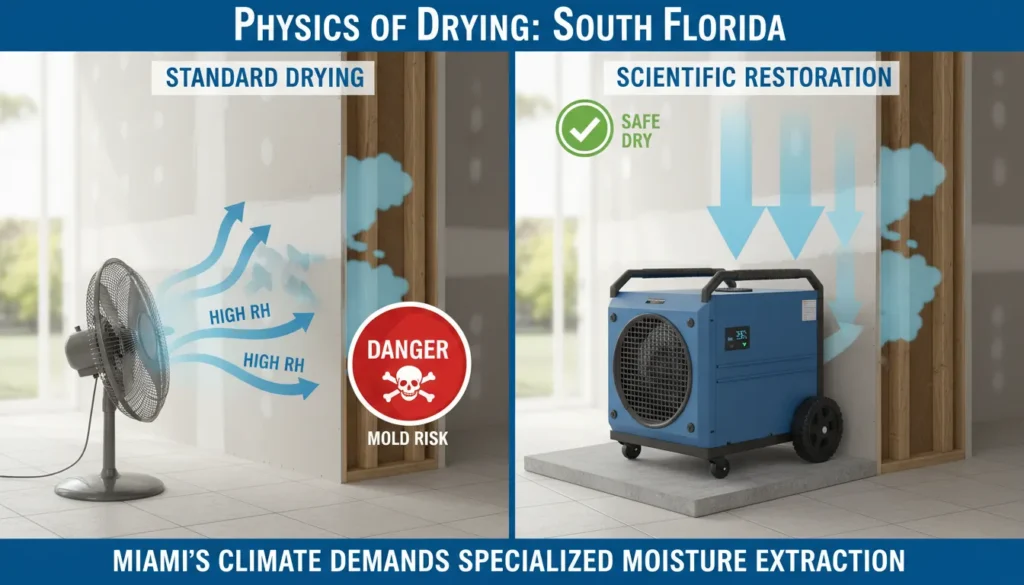
In Miami, the environment is your biggest obstacle during a water emergency. With average Relative Humidity (RH) levels often exceeding 70-80%, the air is already saturated with moisture. When a leak occurs, the laws of physics work against you: air that is already “full” of water cannot easily absorb more from your wet floors or walls. This is why placing a few household fans is not just ineffective—it’s dangerous.
The "Iceberg Effect" of Water Damage
Water is invasive by nature. It doesn’t just sit on top of your tile or laminate; it travels through capillary action into the “unseen” areas of your infrastructure:
Concrete Slabs: In South Florida homes, water seeps into porous concrete and gets trapped.
Insulation & Drywall: Moisture wicks upward, creating a “vapor trap” behind your paint.
Wall Cavities: Dark, humid spaces that become mold factories within 24 hours.
Authority Tech: The Science of Thermal Imaging
How do you dry what you cannot see? We eliminate the guesswork using Infrared Thermal Imaging. Water changes the temperature of the materials it inhabits. By scanning your property with thermal cameras, we can see the exact “moisture map” behind your walls and under your floors.
This technology allows us to pinpoint the exact boundaries of the damage, ensuring we don’t tear down more drywall than necessary while guaranteeing that no hidden “pockets of humidity” are left to rot.
Industrial-Grade Psychrometrics: Controlling the Air
To overcome Miami’s humidity, we use the science of Psychrometrics—the study of air-water vapor mixtures.
LGR Dehumidification: We deploy Low-Grain Refrigerant (LGR) dehumidifiers. Unlike standard units, LGRs are designed to pull moisture out of the air even in extremely low humidity environments, creating a “thirsty” atmosphere that literally pulls water out of deep structural wood and concrete.
High-Velocity Air Movers: These aren’t fans; they are high-pressure units designed to break the “boundary layer” of air on wet surfaces, accelerating the evaporation process before mold spores can colonize.
Is Professional Restoration Worth It? Cost vs. Long-Term Value
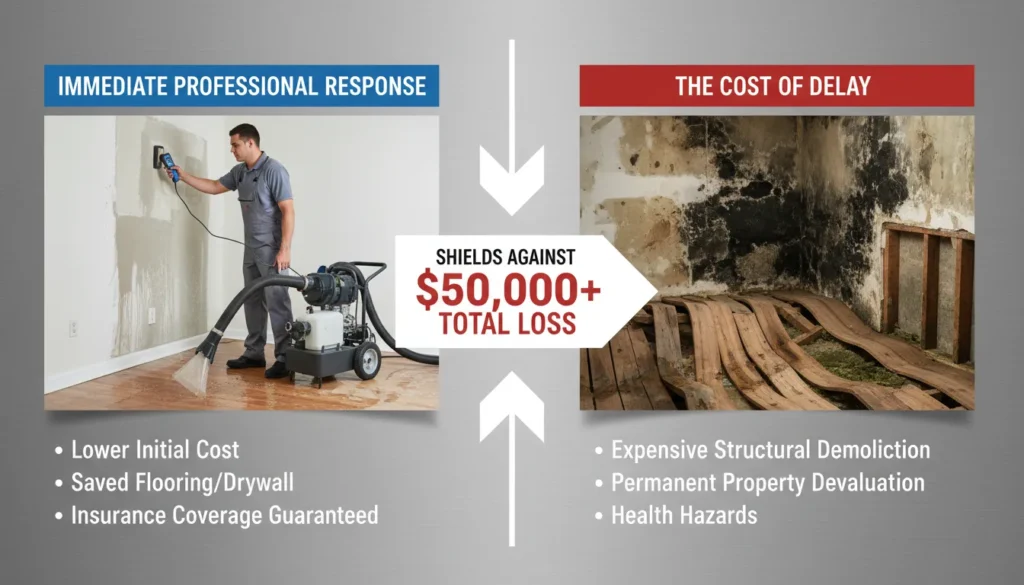
Many property owners hesitate to call professionals because they fear the invoice. However, the true cost of water damage isn’t the restoration service—it’s the long-term structural failure and health risks that occur when water is left to sit. In Miami’s tropical climate, an untreated leak can lead to a total loss of drywall, flooring, and air quality within just 48 hours.
Understanding the Costs: $1,500 – $5,000 vs. Total Loss
While a typical professional restoration project ranges between $1,500 and $5,000, this investment prevents a much larger financial catastrophe.
The DIY Risk: Using household fans only dries the surface. Moisture trapped in concrete slabs or behind baseboards leads to “Secondary Damage”—warped subfloors and black mold—which can push repair costs well over $10,000 to $20,000.
Professional Efficiency: Industrial-grade extraction and psychrometric drying save your original materials, meaning you don’t have to pay for expensive reconstruction and new flooring.
The "No-Cost" Hook: How Your Insurance Works for You
The most important fact for Miami homeowners is that most “Sudden and Accidental” water events—such as burst pipes, water heater failures, or appliance leaks—are 100% covered by standard homeowners’ insurance policies.
Direct Insurance Advocacy: We don’t just dry your home; we manage the financial recovery. Our experts handle the complex documentation required by Florida insurers, including moisture maps and thermal evidence.
$0 Out-of-Pocket Potential: By working directly with your insurance adjuster, we aim to ensure the claim covers the entire restoration process. In many cases, this means you face zero upfront costs for emergency services.
Stress-Free Billing: We speak the language of adjusters. While we focus on saving your property, we also focus on saving your bank account by billing the insurance company directly.
From Standing Water to "Like It Never Happened"
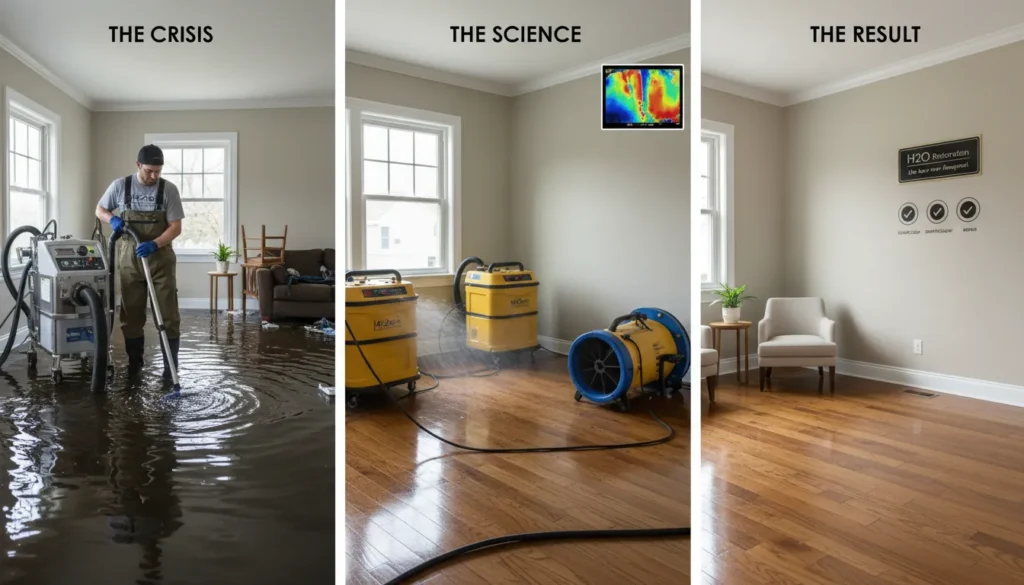
Restoration is a precise engineering process, not just a cleanup job. To ensure your property returns to its pre-loss condition, we follow a rigorous, scientific 5-step protocol designed to eliminate moisture and prevent future structural decay.
Step 1: Advanced Thermal Inspection
The process begins with “finding the invisible.” Using high-resolution Infrared Thermal Cameras, we map out the moisture migration behind your walls and under your flooring. This data-driven approach ensures we target the exact areas of saturation without unnecessary demolition of dry materials.
Step 2: High-Volume Industrial Extraction
Once the damage is mapped, the priority is bulk water removal. We utilize truck-mounted, industrial-strength vacuum units that extract hundreds of gallons of water in minutes. By removing the standing water immediately, we stop the “wicking” process and drastically reduce the risk of structural swelling.
Step 3: Clinical Sanitization & Antimicrobial Treatment
In the humid South Florida climate, microbial growth can trigger within 24 hours. We apply EPA-approved, hospital-grade Antimicrobial Treatments to all affected surfaces. This step is critical for neutralizing odors and ensuring that the environment remains sterile and safe for inhabitants.
Step 4: Deep-Seated Dehumidification
After surface water is gone, “bound water” remains trapped inside drywall, wood studs, and subfloors. We deploy LGR (Low-Grain Refrigerant) Dehumidifiers and high-velocity air movers. This setup creates a controlled “drying vortex” that pulls moisture from the core of your infrastructure, bringing it back to safe, dry equilibrium levels.
Step 5: Full Structural Reconstruction
The final step is the complete restoration of your home’s aesthetics and integrity. Whether it’s replacing water-damaged drywall, expert paint matching, or installing new flooring, we handle the transition from a “mitigation site” back to a beautiful, livable space.
Frequently Asked Questions: Miami Water Damage & Recovery
Finding the right answers during a flood emergency can save your property from total loss. Below are the most critical questions Miami homeowners ask our restoration experts.
In Miami’s tropical climate, mold spores can begin to colonize within 24 to 48 hours of initial water exposure. Because our local relative humidity (RH) is consistently high, the organic materials in your home (drywall, wood, and carpet) stay damp longer, providing the perfect breeding ground for toxic black mold. Immediate extraction is the only way to stop this window of growth.
Yes, most standard Florida insurance policies cover water damage that is “Sudden and Accidental.” This typically includes burst pipes, water heater failures, and appliance leaks. However, gradual damage caused by “deferred maintenance” (leaks you ignored for months) may be denied. We provide the thermal imaging documentation required to prove the sudden nature of your claim.
While you can mop up surface water, you cannot dry out the infrastructure yourself. Household fans only move air across the surface; they do not remove the moisture trapped inside your walls or concrete slabs. Without industrial-grade LGR dehumidifiers to pull the humidity out of the air, you risk Secondary Damage, which includes warped structural studs and hidden mold.
Not necessarily, but it depends on the material. Plywood subfloors are resilient if dried within 24 hours, but Particle Board (OSB) subfloors often swell and lose structural integrity the moment they get saturated. If you notice “spongy” spots or “crowning” in your flooring, it’s a sign that the subfloor is compromised and requires professional high-pressure drying.
Water damage becomes permanent when materials begin to lose their structural “memory” or chemical bond. Signs of permanent damage include:
Delamination: When layers of plywood or laminate start to separate.
Efflorescence: White, powdery salt deposits on brick or concrete.
Dry Rot: When wood fibers become brittle and crumble after drying. If we reach your property during the “Golden Hour,” most of these materials can be saved through scientific psychrometric drying.
Don’t Let a Leak Destroy Your Miami Home or Business
Time is the biggest enemy of your property’s infrastructure. A small drip or a major burst can quickly escalate into a structural nightmare if not handled with professional precision. At the heart of our mission is a commitment to South Florida’s residents: we don’t just provide equipment; we provide a total recovery solution.
By integrating our expert restoration techniques with our comprehensive Plumbing Services, we offer a seamless transition from stopping the initial leak to full-scale structural drying and repair. Whether you are dealing with an aging pipe in a historic Coral Gables home or a high-pressure failure in a Brickell high-rise, we ensure the root cause is fixed and the damage is erased.
Why Choose the Miami Restoration Experts?
- Licensed, Bonded, and Insured: Full protection for your residential or commercial investment.
- Mastery of Miami Infrastructure: We understand the unique challenges of South Florida’s salt air and concrete construction.
- Peace of Mind Guarantee: We don't just dry the surface; we restore your property to its pre-loss condition, ensuring a safe and healthy environment.
- Available 24/7/365 – Because emergencies don't keep office hours.
- 30-Minute Rapid Response – We are mobile and ready in Miami-Dade.
- Direct Insurance Billing – Let us handle the paperwork for you.