- Home
- Water Softener & Filtration Systems
Specialized Water Softener & Filtration Systems: Engineering Pure Water for Miami Homes & Businesses
EZ Plumbing delivers industrial-grade water purification engineered specifically for South Florida’s limestone-heavy groundwater, ensuring your property’s infrastructure remains scale-free and your water remains contaminant-clean.
Why Choose EZ Plumbing
✅Precision Engineering
We don’t just “install” pipes; we analyze your water chemistry to calibrate your system for maximum mineral extraction and minimum salt waste.
✅Asset Protection
Our systems extend the lifespan of your high-end appliances (dishwashers, water heaters, espresso machines) by up to 40% by eliminating corrosive scale.
✅ Health-First Filtration
Beyond softness, we integrate multi-stage carbon blocks to strip “Forever Chemicals” (PFAS) and chlorine that damage skin, hair, and digestive health.
Why "Off-the-Shelf" Systems Often Fail in Miami
Most systems found at big-box retailers like Amazon or Lowe’s are designed for average national water hardness levels. Miami’s unique hydrogeology—characterized by the Biscayne Aquifer’s high mineral content—requires precise calibration. A generic system often leads to “Resin Fouling” within months, whereas an EZ Plumbing Engineered Solution is calibrated to Miami-Dade’s specific GPG (Grains Per Gallon) count.
- Guaranteed Compliance: Installed to exceed Miami-Dade plumbing and safety codes.
- Certified Expertise: WQA (Water Quality Association) trained technicians only.
- Local Resilience: Designed to handle the high-volume demands of Miami estates and businesses.
The Science of Miami’s Water: Hardness, Scale, and Forever Chemicals PFAS
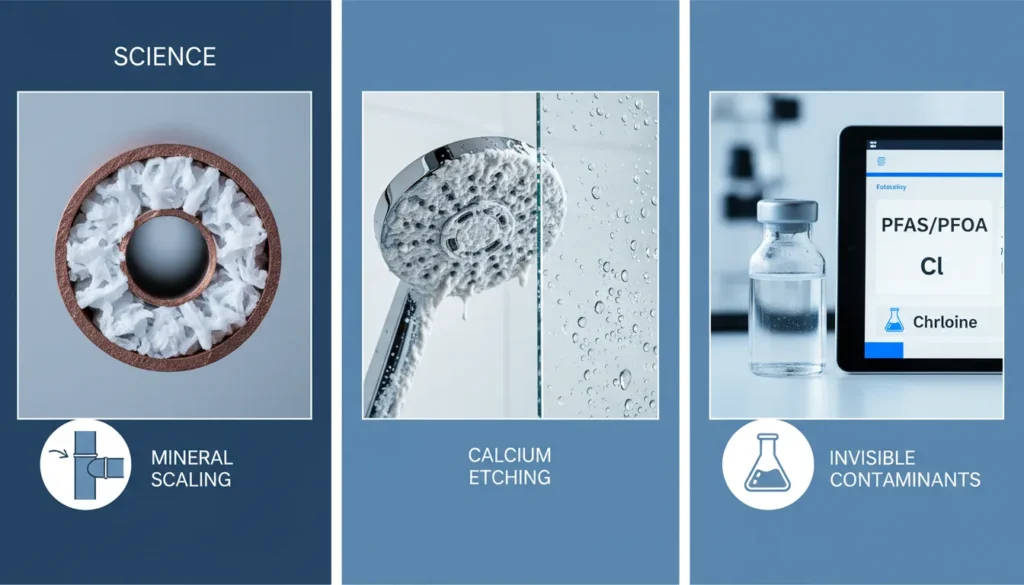
Understanding the water quality in South Florida requires an analysis of the Biscayne Aquifer. Because the region sits on a foundation of porous limestone, the groundwater is naturally saturated with high concentrations of dissolved minerals and industrial byproducts that standard municipal treatment often leaves behind.
Hard Water & Mineral Scaling: The Engineering Impact
Miami’s water is classified as “Very Hard,” often exceeding 10 to 15 grains per gallon (GPG). This hardness is primarily composed of dissolved Calcium and Magnesium carbonates.
When this water is heated or sits in pipes, these minerals undergo a chemical precipitation process, creating Limescale Calcium Carbonate.
Thermal Efficiency Loss: Even 1/4 inch of scale buildup in a water heater can increase energy consumption by up to 24% as the system struggles to heat through the mineral insulation.
Pipe Longevity: Over time, “Scale Encrustation” reduces the internal diameter of copper and PEX piping, leading to restricted flow, increased hydraulic pressure, and eventual pinhole leaks or total system failure.
Signs Your Facility Needs Treatment: Clinical Indicators
Beyond the pipes, hard water leaves undeniable physical evidence. If you observe the following “Mineral Indicators,” your water chemistry is actively damaging your property and health:
Epithelial Irritation: Hard water minerals strip the natural lipid barrier from skin and hair, leading to chronic dryness, eczema flare-ups, and brittle hair breakage.
Insoluble Soap Scum: Calcium reacts with soap to create “Synthetic Curd” (scum) that doesn’t rinse away, leaving a film on shower glass, fixtures, and human skin.
Fabric Degradation: “Dingy” laundry is the result of mineral fibers becoming trapped in clothing, causing colors to fade and fabric life to decrease by up to 30%.
Beyond Hardness: Addressing Lead, Chlorine, and PFAS
While minerals damage infrastructure, chemical contaminants impact biological safety. Modern water analysis in Miami-Dade has identified three primary areas of concern:
Forever Chemicals PFAS/PFOA
These synthetic chemicals do not break down in the environment or the human body. Linked to long-term health risks, these require specialized High-Density Carbon Filtration or Reverse Osmosis for effective removal.
Residual Chlorine
Used by municipal plants to disinfect water, residual chlorine causes a distinct “bleach” odor and reacts with organic matter to create Trihalomethanes (THMs).
Heavy Metals
Aging urban infrastructure can leach Lead and Copper into the water supply, necessitating a final mechanical barrier at the entry point of your home or business.
High-Performance Water Treatment Technologies: Choosing the Right System
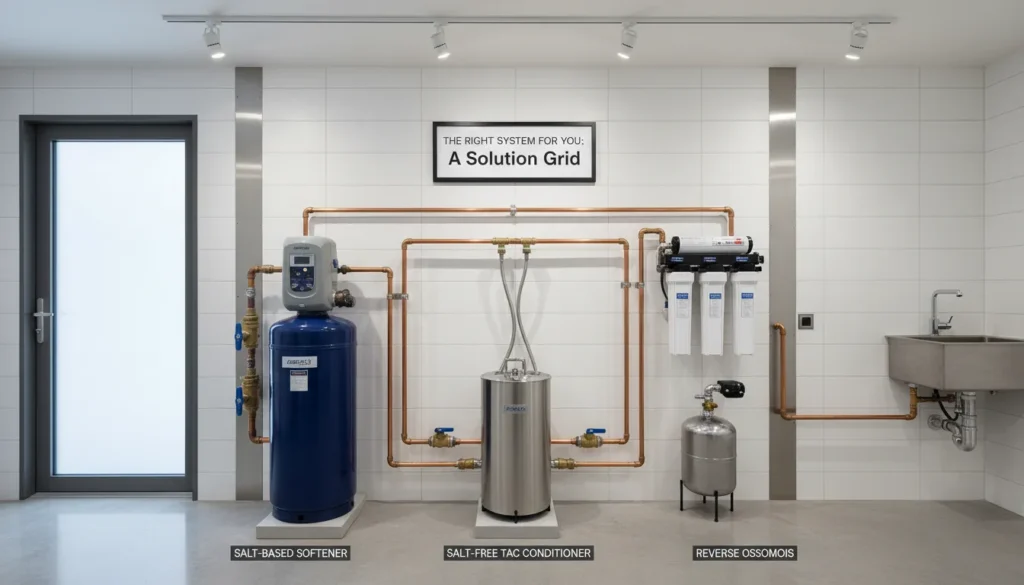
Selecting a water treatment architecture requires balancing your property’s specific mineral load with your health and maintenance preferences. There is no “one-size-fits-all” solution; rather, there is an engineered match for every water profile.
Ion-Exchange Water Softeners Salt-Based: The Industry Standard
For absolute mineral removal, Ion-Exchange technology remains the most effective method globally. These systems utilize a high-capacity resin bed charged with sodium ions. As hard water passes through, the resin acts as a chemical magnet, capturing calcium and magnesium and releasing a negligible amount of sodium in its place.
Performance Benchmarks: High-efficiency units, such as those utilizing Fleck 5600SXT control valves or SoftPro Elite technology, offer demand-initiated regeneration. This means the system only cleans itself based on actual water usage, saving up to 50% in salt and water compared to traditional timed units.
Primary Benefit: Eliminates 99% of scale, resulting in “slick” water that maximizes soap lather and provides the highest level of protection for plumbing infrastructure.
Salt-Free Water Conditioners & Descalers: Maintenance-Free Scale Control
Unlike softeners, Salt-Free Conditioners do not remove minerals. Instead, they use a process called Template Assisted Crystallization (TAC). This technology changes the chemical structure of hardness minerals, turning them into microscopic crystals that remain suspended in the water rather than sticking to surfaces.
The “No-Waste” Advantage: These systems require no salt refills, no electricity, and produce zero wastewater (no backwash).
Ideal Use Case: Perfect for eco-conscious homeowners or those on sodium-restricted diets who want to protect their pipes and water heaters without changing the “feel” of their water.
Multi-Stage Reverse Osmosis RO Systems: Pharmaceutical-Grade Purity
While softeners handle “working water” (for bathing and cleaning), Reverse Osmosis (RO) is the gold standard for “drinking water.” By forcing water through a semi-permeable membrane, these systems strip away 99.9% of dissolved solids.
Point-of-Use vs. Whole-House: Most RO systems are “Point-of-Use” (installed under the kitchen sink), but “Whole-House RO” is available for those requiring ultra-pure water at every tap.
Contaminant Target: These are the only residential systems capable of effectively removing fluoride, arsenic, nitrates, and the “Forever Chemicals” (PFAS) discussed in the previous section.
Specialized Solutions for Well Water: Addressing Complex Profiles
Homes and businesses relying on private wells face challenges that municipal systems do not. Well water often contains Ferrous Iron (which causes orange staining), Hydrogen Sulfide (the “rotten egg” smell), and potential microbial pathogens.
Oxidation & Air Injection: Specialized systems use air pockets or oxidizing media to convert dissolved iron and sulfur into particles that can be mechanically filtered out.
UV Sterilization: To ensure biological safety, high-intensity Ultraviolet (UV) lamps are integrated to neutralize 99.99% of bacteria and viruses without the use of harsh chemicals like chlorine.
The Financial ROI of Professional Water Softening
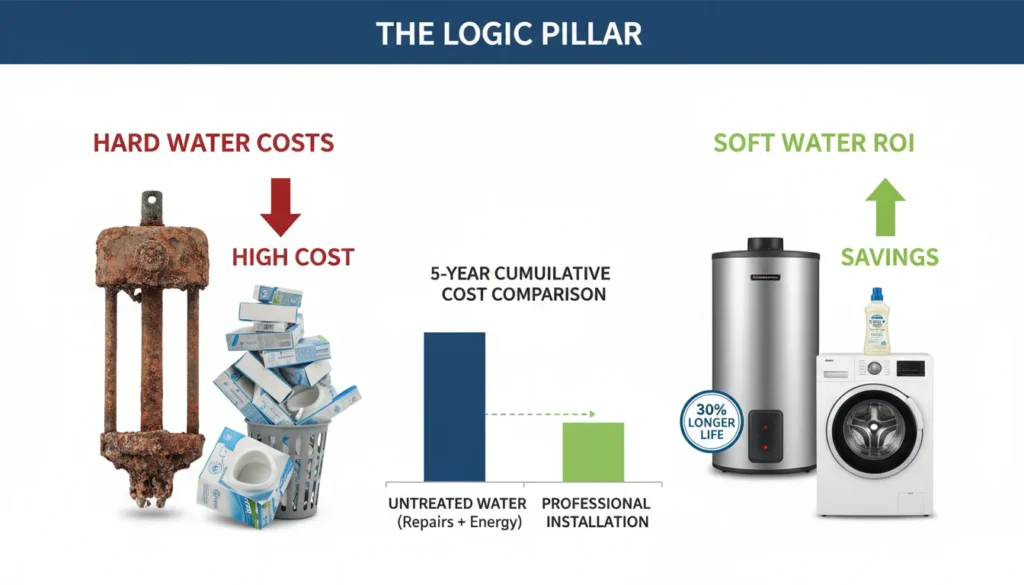
Investing in a water treatment system is a capital expenditure for your property. When engineered correctly, the system pays for itself through “Asset Life Extension” and “Operational Efficiency.” A professional installation is not merely a labor cost—it is a performance guarantee.
Professional Installation vs. Big-Box Retail: The Calibration Gap
While retail giants like Costco, Lowe’s, or Home Depot offer accessible “DIY” systems, there is a fundamental “Calibration Gap” that often leads to premature system failure in high-mineral environments.
The Custom Settings Advantage: Big-box units are pre-programmed for national averages. A professional installation includes a Water Chemistry Analysis to set the grain-capacity, salt-dosage, and regeneration cycles specifically for your local water hardness.
Hydraulic Integrity: Professional installers ensure that the system’s “Flow Rate” (measured in GPM) matches your home’s peak demand. A mismatched retail unit can cause a significant drop in shower pressure and appliance performance.
Warranty & Compliance: Professional installations come with “Workmanship Bonds” and meet strict local plumbing codes, ensuring your homeowner’s insurance remains valid in the event of a leak—a protection often lost with DIY setups.
The Cost-Benefit Matrix: Offsetting the $2,000 – $5,000 Investment
While a high-performance system requires an initial investment of $2,000 to $5,000, the “Return on Investment” (ROI) is realized across four primary financial pillars:
Energy Efficiency (Water Heaters): According to the Battelle Memorial Institute, water heaters maintained with soft water retain their original factory efficiency for 15+ years. Hard water can cause a 24% increase in energy consumption annually due to scale insulation.
Appliance Replacement Cycles: Washing machines and dishwashers last up to 30% longer when minerals are removed, potentially saving you $3,000+ in premature replacement costs over a decade.
Chemical & Detergent Savings: Soft water requires 50% less soap and detergent to achieve the same cleanliness as hard water, reducing monthly grocery expenses significantly.
Plumbing Maintenance: Eliminating scale prevents the need for expensive hydro-jetting or pipe descaling services, which can cost thousands in labor.
Consumer Reports Analysis: 2026 Industry Leaders
Based on recent industry performance data and independent consumer analysis, the following brands have set the benchmark for reliability and filtration efficiency in 2026:
SpringWell (Overall Performance): Recognized for the highest flow rates and a lifetime warranty on tanks and valves. Their hybrid systems are the top recommendation for large luxury estates.
Aquasana (Filtration Depth): Leading the market in “Forever Chemical” (PFAS) removal, Aquasana’s whole-house systems are the primary choice for health-conscious homeowners.
iSpring (Value & Versatility): Ranked as the best value for Reverse Osmosis (RO) integration, particularly for households prioritizing pharmaceutical-grade drinking water at the kitchen tap.
Managing Your Water Quality Infrastructure
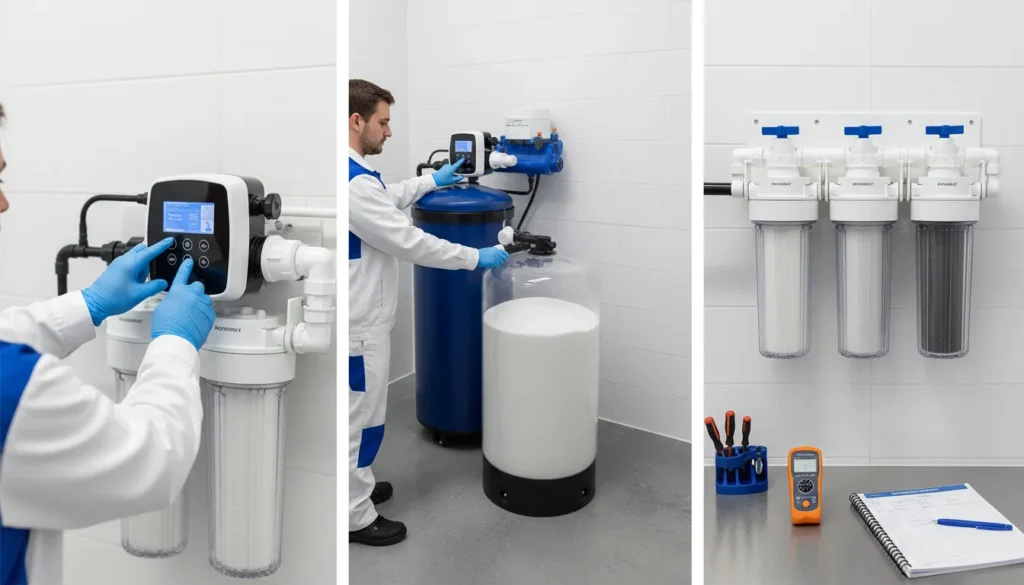
A water treatment system is a precision mechanical asset. To maintain the 99% mineral extraction rate and pharmaceutical-grade filtration levels established during installation, a structured lifecycle maintenance protocol is required. Proper logistics prevent “System Drift” and ensure the highest water quality index.
The Maintenance Blueprint: Lifecycle Schedules
Predictive maintenance is the key to avoiding emergency plumbing failures. Following a calibrated schedule ensures the internal resins and membranes function at peak osmotic pressure.
Salt Replenishment (Ion-Exchange): Check the brine tank monthly. For optimal performance, the salt level should remain at least 3-4 inches above the water level. We recommend high-purity evaporated salt pellets to prevent “mushing” at the bottom of the tank.
RO Membrane & Filter Replacement: Reverse Osmosis pre-filters (sediment and carbon) should be exchanged every 6–12 months. The semi-permeable RO membrane—the heart of the system—typically requires replacement every 2–3 years to maintain a 98%+ rejection rate of contaminants like PFAS and Lead.
UV Sterilization Cycles: UV lamps have a functional life of approximately 9,000 hours (1 year). Even if the bulb is still glowing, the mercury vapor loses its ability to emit the specific UVC wavelength required to deactivate bacteria and viruses.
Troubleshooting Common Problems: Technical Solutions
Even the most advanced systems can encounter operational anomalies due to fluctuations in municipal water pressure or environmental factors.
Salt Bridging: In high-humidity environments like Miami, a hard crust (bridge) can form in the brine tank, preventing the salt from dissolving. Solution: Gently break the crust with a blunt tool and switch to high-quality pellet salt.
Resin Bed Fouling: If your water feels “hard” despite salt being present, the resin beads may be coated in iron or silt. Solution: Perform a manual “Iron-Out” regeneration cycle using a specialized resin cleaner.
Water Pressure Drops: A sudden loss in pressure often indicates a saturated sediment pre-filter or a clogged “Injector/Venturi” valve. Cleaning these components usually restores full hydraulic flow.
Puronics & Legacy System Support: Overrides & Resets
Many properties in the region utilize legacy systems such as Puronics or older digital control valves. Managing these requires specific technical knowledge of manual overrides.
Manual Regeneration: If you have had high guest occupancy or a leak, you may need to force a “Manual Regen.” Most digital heads require holding the “Regen” or “Diamond” button for 5 seconds to initiate an immediate cleaning cycle.
Power Outage Resets: Modern systems have battery backups, but older units may lose their “Time of Day” settings after a surge. Ensure the clock is set correctly so the system doesn’t regenerate while you are using water (usually 2:00 AM).
Bypass Valve Operation: In the event of a system leak, identify the three-valve bypass or the push-pull bypass located behind the unit. Turning these allows you to isolate the system while maintaining untreated water flow to the rest of the facility.
Water Quality & Softening: Frequently Asked Questions
Yes. In fact, combining both is the “Gold Standard” for home water treatment. A water softener only removes minerals (calcium/magnesium), while a filtration system (like Carbon or RO) removes chemicals (chlorine/PFAS). Installing them together ensures your pipes are protected and your drinking water is safe.
The “best” system depends on your water profile, but for 2026, the SpringWell SS-1 and the Aquasana Rhino Whole House are the highest-rated hybrid systems. They combine high-capacity softening with multi-stage filtration, offering a 99.9% removal rate of both scale and contaminants.
The average professional installation cost ranges between $2,500 and $5,500. This includes the hardware, professional plumbing labor, and system calibration. While DIY big-box units are cheaper, professional systems offer a 15–20 year lifespan compared to the 3–5 years of retail units.
Professional plumbers overwhelmingly recommend systems utilizing Fleck 5600SXT or Clack control valves. These are favored because they are “Non-Proprietary,” meaning parts are easily available, they are highly durable, and they offer precise digital calibration for local water hardness.
Generally, no, a water softener is considered a personal home improvement. However, if the system is medically necessary (documented by a physician for a specific skin condition) or if it is installed in a rental property or home office, it may qualify as a capital improvement or business expense. Always consult a tax professional.
For scale prevention, there is nothing more effective than a Salt-Based Ion-Exchange softener. However, for those who want to avoid salt, Template Assisted Crystallization (TAC) conditioners are an excellent alternative. They manage scale without removing minerals or adding sodium.
Hard water is technically healthier for drinking as it contains essential calcium and magnesium. However, soft water is significantly healthier for your skin and hair. The ideal solution is to soften your “utility water” (showers/laundry) and use a remineralizing Reverse Osmosis system for your drinking water.
Neither is “better” because they perform different jobs. A whole house filter is better if your goal is removing odors, chlorine, and chemicals. A water softener is better if your goal is stopping limescale and protecting appliances. Most high-end properties require both to achieve total water quality.
Partner with Miami’s Certified Water Quality Experts
Securing your property’s water quality is a long-term investment that requires more than just basic hardware—it requires specialized plumbing services engineered for South Florida’s unique environment. At EZ Plumbing, we go beyond standard installations. We analyze the precise chemical profile of your water to deliver a customized purification strategy that protects your health and your home’s infrastructure.
The EZ Plumbing Precision Guarantee
Every system we deploy is backed by our expert plumbing services team. We ensure your equipment is calibrated to the exact Grains Per Gallon (GPG) count of your specific Miami neighborhood, maximizing system efficiency and preventing premature appliance failure.
LIMITED TIME OFFER: ACTIVATE YOUR WATER SECURITY
Take the first step toward pure, engineered water with our professional plumbing services incentive package
Free 15-Point Water Hardness Audit: We perform a professional on-site analysis of your mineral levels—at zero cost.
$100 Instant Discount: Get an immediate discount when you choose EZ Plumbing for your full system installation.
Expert Precision: Every system is calibrated to Miami-Dade’s specific water grain count