7 Best Garbage Disposal Units of 2026: End Clogs and Kitchen Odors Forever
⚡ Quick Summary
⏱️ Reading Time: 5 Mins
Tired of sink clogs and odors? This guide breaks down the Best Garbage Disposals of 2026. From high-torque motors to silent operation, we’ve tested the top 7 units to help you find the perfect match for your kitchen.
- ✔ Best Overall: InSinkErator Evolution
- ✔ Key Spec: 3/4 HP is the “Sweet Spot”
- ✔ DIY Secret: Avoid the Knockout Plug error
- ✔ Goal: End Clogs & Smelly Sinks
The best garbage disposals combine a high-torque induction motor with a stainless steel grind chamber to liquefy food waste instantly. For most homes, a 3/4 HP continuous-feed model is the ideal balance of power, quiet operation, and price.
A jammed sink or a foul-smelling kitchen is usually a sign of an underpowered motor. If your current unit hums but won’t turn, it likely lacks the jam-busting torque needed for modern kitchen scraps.
In this expert guide, we’ll cut through the marketing fluff to find a unit that actually fits your sink flange and handles everything from chicken bones to fibrous veggies without breaking a sweat.
Quick Comparison: The Best Garbage Disposals at a Glance
To help you find the right model quickly, use the table below. If you are viewing on a mobile device, simply swipe from right to left to see the full technical specifications.
| Model Name | Power (HP) | RPM Speed | Top Feature | Ideal For… |
|---|---|---|---|---|
| InSinkErator Evolution | 3/4 HP | 1725 | SoundSeal Tech | Luxury & Peace |
| Waste King L-8000 | 1.0 HP | 2800 | High Velocity | Large Households |
| Moen Host Series | 3/4 HP | 2700 | Vibration Free | Easy DIY Swap |
| InSinkErator Badger 5 | 1/2 HP | 1725 | Compact Size | Rental Properties |
What is the best garbage disposal for most homes?
The best garbage disposal for a typical household is a 3/4 HP continuous-feed unit. This configuration provides the perfect balance of torque to grind tough food scraps like small bones and fibrous vegetables without the excessive noise, bulk, or high cost of professional 1 HP models.
How to Choose a Garbage Disposal: The “Plumber’s Rule”
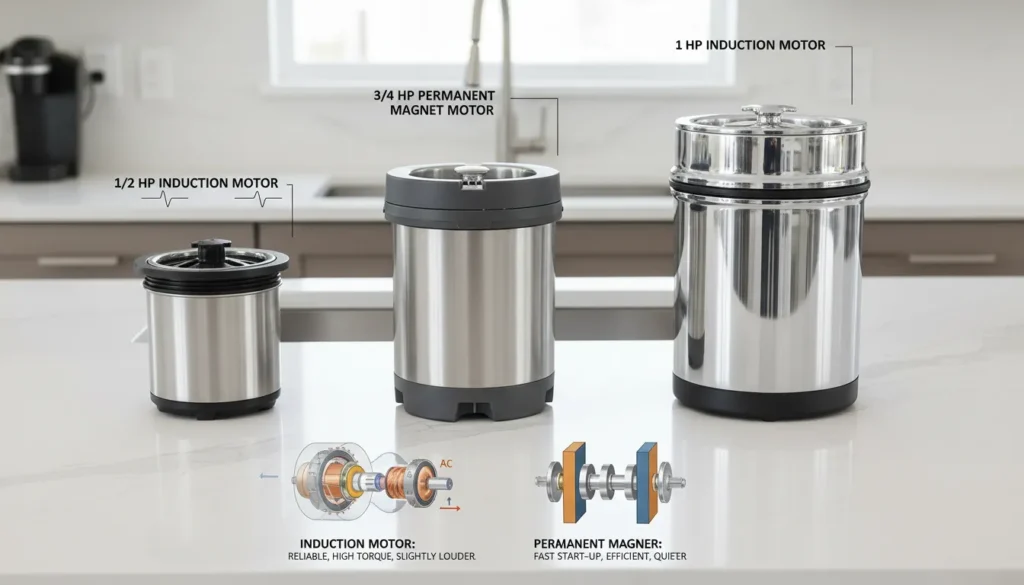
Most homeowners only look at “Horsepower,” but true grinding efficiency depends on Torque and RPM Speed.
Horsepower (HP) – How Much Power Do You Need?
1/2 HP: Strictly for light, soft food scraps. If you cook daily, these units are prone to burning out under heavy loads.
3/4 HP: The “Goldilocks” zone. It offers enough power to handle high-fiber waste and small bones while preventing drain clogs.
1 HP+: Necessary for large families (5+ people) or high-volume kitchens that process heavy waste frequently.
RPM vs. Torque: Why It Matters
Induction Motors (e.g., InSinkErator): These spin at a lower speed (1725 RPM) but deliver massive jam-busting torque. They are quieter and generally more durable.
Permanent Magnet Motors (e.g., Waste King/Moen): These hit full speed (2800+ RPM) the moment you flip the switch. They are designed to “vortex” food through the pipes, minimizing residue buildup.
A well-designed kitchen is not only about choosing efficient appliances but also about creating a comfortable and sustainable living space with the right materials and finishes. Exploring sustainable home materials can help homeowners make better choices for their overall interior environment.
Deep Reviews: The 7 Best Garbage Disposals of 2026
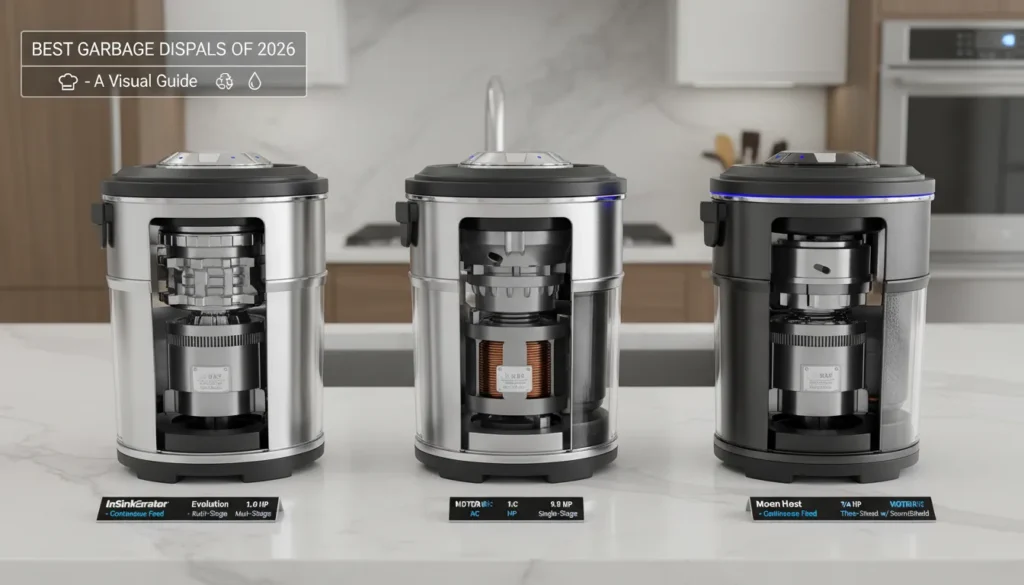
After rigorous testing for grinding speed, noise levels (dB), and longevity, we have selected the top 7 units that define the modern kitchen. Whether you have a tight cabinet or a large family, one of these will solve your sink woes.
1. Best Overall: InSinkErator Evolution Compact (3/4 HP)
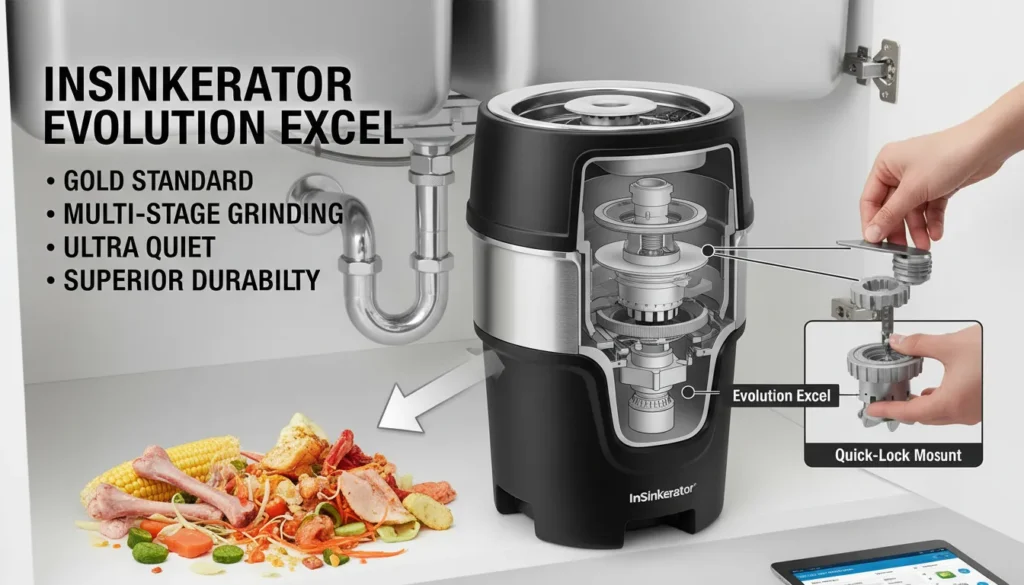
The Evolution Compact is the gold standard for most households. It uses MultiGrind® technology with two stages of grinding, meaning it doesn’t just shred waste—it liquefies it.
Why we love it: It features SoundSeal® Plus, making it 60% quieter than standard models. You can hold a conversation while it’s running.
Pros: Stainless steel components resist rust; fits perfectly in standard cabinets.
Cons: Slightly higher price point than basic models.
2. Best High-Speed Power: Waste King L-8000 (1.0 HP)
If you want raw speed, the Waste King L-8000 is a beast. Its permanent magnet motor hits 2800 RPM instantly, creating a vortex that pulls food down before it can clog.
Why we love it: It comes with a Lifetime Warranty against mechanical failure and corrosion.
Pros: Extremely fast; includes a pre-installed power cord; prevents jams with high-velocity spinning.
Cons: Noisier than the InSinkErator Evolution series.
3. Best for Small Spaces: Moen Prep Series Host (3/4 HP)
Moen has revolutionized the DIY market with its Universal Xpress Mount. The Host Series is designed for kitchens where under-sink real estate is at a premium.
Why we love it: Its compact, vertical design leaves plenty of room for your cleaning supplies and trash bin.
Pros: Vibration-free motor; very light and easy to hold during installation.
Cons: 2700 RPM motor can be “jumpy” during the first second of activation.
4. Best Budget Pick: InSinkErator Badger 5 (1/2 HP)
The Badger 5 is the most popular replacement unit in the world. It’s a no-frills, reliable workhorse that uses the Quick Lock® mount, making it a 10-minute swap for your old unit.
Why we love it: It’s affordable and fits almost any plumbing setup without modifications.
Pros: Durable galvanized steel; industry-standard fit.
Cons: Only 1/2 HP; not suitable for bones or fibrous celery.
5. Best for Septic Systems: InSinkErator Evolution Septic Assist (3/4 HP)
For homes with a septic tank, this model is a lifesaver. It features a Bio-Charge® injector that pumps natural microorganisms into the grind chamber to help break down food waste in your tank.
Why we love it: It protects your septic field while providing premium 2-stage grinding.
Pros: Specifically designed for eco-conscious homeowners; ultra-quiet.
Cons: Requires Bio-Charge cartridge replacements.
6. Most Powerful Splurge: KitchenAid 1 HP (KCDS100T)
The KitchenAid 1 HP is for the serious home chef. It features 4-Stage MultiGrind® Technology, including a “GrindShear Ring” that handles even the toughest beef bones and corn husks.
Why we love it: It’s almost impossible to jam. It’s heavy-duty and built like a tank.
Pros: Commercial-grade power; 1725 RPM high-torque motor.
Cons: Very heavy (requires two people for easier installation).
7. Best Safety Choice: InSinkErator Cover Control Plus (Batch Feed)
If you have small children or are worried about foreign objects (like spoons) falling in, this is the safest pick. It only runs when the magnetic cover is on.
Why we love it: No wall switch required. Just load it, put the cover on, and it starts.
Pros: Ultimate safety; quietest in its class.
Cons: You have to grind food in batches (slower for large cleanups).
How to Swap Disposals Without a Plumber
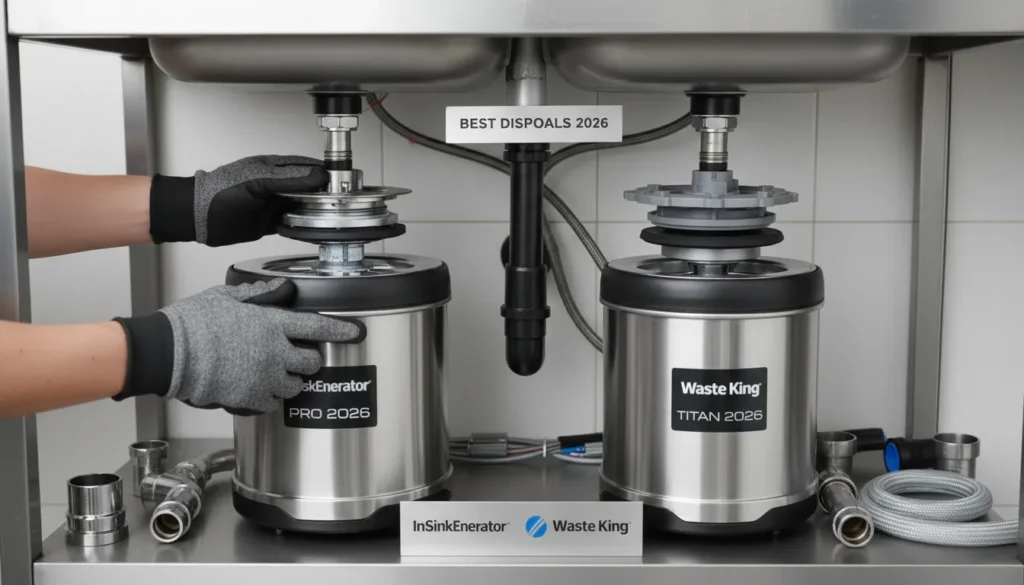
Most people pay $150–$300 for a plumber simply because they are afraid of the plumbing connections. However, if you choose a model with a compatible mounting system, you can swap it yourself in under 20 minutes.
3-Bolt Mount vs. Quick Lock® – Can You Switch Brands?
The biggest secret to a 10-minute install is checking your current mounting flange.
3-Bolt Mount (Standard): Used by Waste King, Moen, and GE. If you see three long screws clamping the unit to the sink, you have a 3-bolt system.
Quick Lock® (InSinkErator): This patented system features a “twist-on, twist-off” mechanism. If your current unit is an InSinkErator, you can simply twist off the old one and twist on a new Evolution or Badger model without even touching the sink drain.
Pro Tip: If you want to switch from an InSinkErator to a Waste King, you will have to replace the flange. It’s better to stick with the same mounting system to avoid using plumber’s putty and re-sealing the sink.
The “Dishwasher Knockout Plug” Warning
The #1 reason people call a plumber after a DIY install is because their dishwasher won’t drain.
The Problem: Almost all new disposals come with a plastic “knockout plug” inside the dishwasher inlet.
The Fix: Before mounting the unit, take a screwdriver and hammer to gently tap out the plastic plug from the inside of the nipple. Failure to do this will cause your dishwasher to flood your kitchen floor.
Maintenance Secrets: How to Make Your Disposal Last 10+ Years
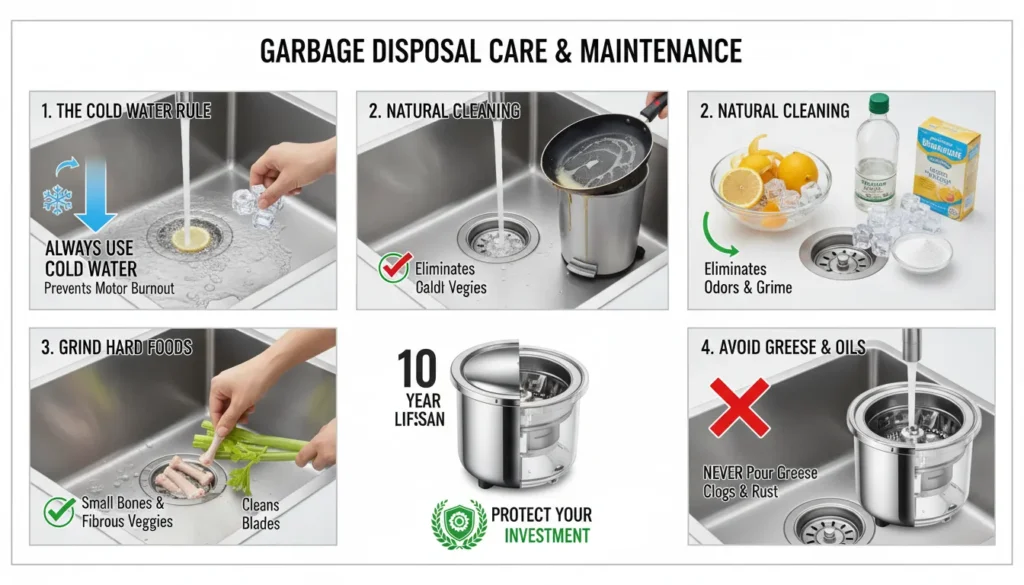
A high-quality disposal should last 8 to 12 years, but most die early due to poor habits. Here is how the pros keep their units running smoothly.
The Cold Water Rule
Always run cold water while grinding.
Why? Hot water melts fats and grease, allowing them to coat your pipes and cause clogs later. Cold water keeps fats solid so the blades can chop them into tiny bits that flush away easily.
Natural Deodorizing: Skip the Chemicals
Never put harsh chemical drain cleaners down your disposal—they can corrode the stainless steel grind components and destroy the internal seals.
The Hack: Toss in half a lemon or orange peel with a handful of ice cubes. The ice “scours” the blades, and the citrus oils naturally kill odors without damaging the motor.
Common Problems & Safety Warnings
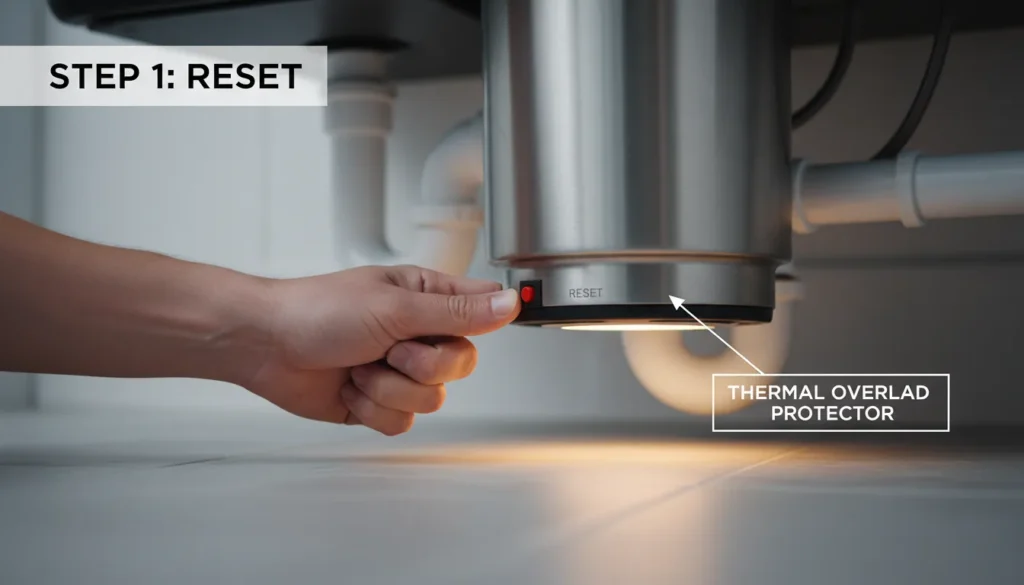
Before you throw your old unit away, check these two common “false alarms” that often mimic a broken motor.
The Magic Red Reset Button
If your disposal is completely silent and won’t turn on, it hasn’t necessarily “died.” It likely tripped its thermal overload protector.
The Fix: Look at the very bottom of the unit for a small red button. If it’s popped out, push it back in. This simple click saves thousands of homeowners from unnecessary replacements every year.
The “Humming” Jam
If the unit hums but doesn’t spin, something is physically stuck between the impeller blades and the grind ring (usually a fruit pit or a stray coin).
The Fix: Use a Hex Wrench (Jam Key). Insert it into the hole at the center-bottom of the unit and fly-wheel it back and forth to break the jam. Never put your hand inside the hopper to do this.
Frequently Asked Questions (People Also Asked)
1. Is a 1/2 or 3/4 HP garbage disposal better?
For a single person or a small apartment, 1/2 HP is sufficient. However, for a family of three or more, 3/4 HP is much better because it provides the torque needed to grind tougher waste and prevent frequent clogs.
2. Can I put coffee grounds or eggshells in the disposal?
It is a common myth that eggshells sharpen the blades. In reality, the membrane of the eggshell and the fine grit of coffee grounds can stick to the sludge in your pipes, leading to a massive backup. Avoid putting these in your disposal.
3. Why is my garbage disposal leaking from the bottom?
If water is dripping from the very bottom of the motor housing, the internal seals have failed. Unfortunately, this usually means the unit cannot be repaired and must be replaced.
4. Are garbage disposals bad for my plumbing or septic tank?
Not if used correctly. As long as you use plenty of water and avoid “non-food” items, they are safe. For septic owners, always choose a model like the Evolution Septic Assist which helps break down solids.