Why is PEX Plumbing Bad? The 2026 Forensic Reality Check (Risks & Lawsuits)
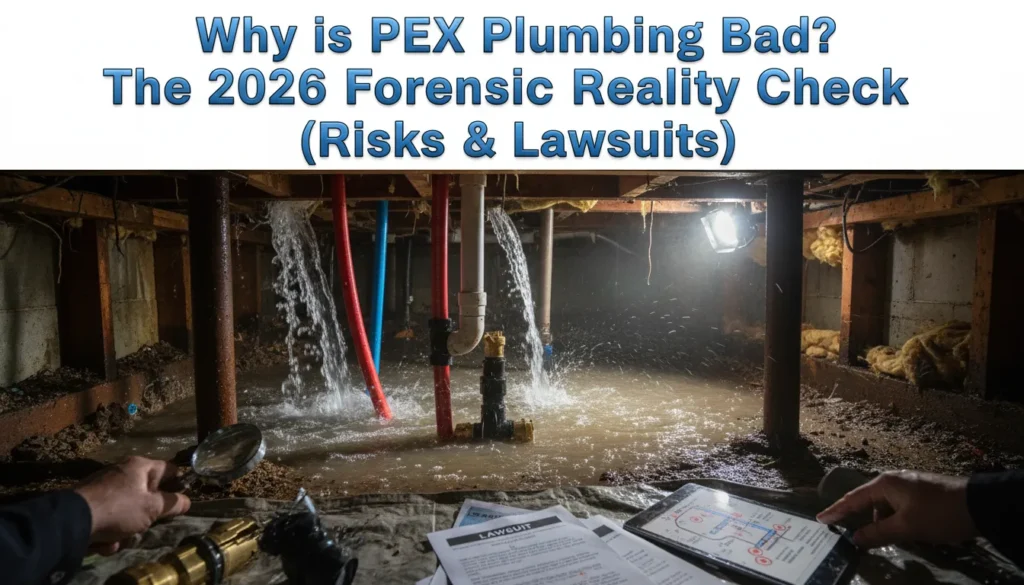
PEX plumbing (cross-linked polyethylene) has become the “go-to” choice for modern homes due to its flexibility and low cost. But as we enter 2026, many homeowners are discovering that what was once called a “miracle material” has a dark side. From high-profile class-action lawsuits to sudden oxidative failures, the question isn’t just “is PEX bad?”—it’s whether it’s the right fit for your specific water chemistry.
While PEX is easier for plumbers to install, forensic experts have identified critical vulnerabilities that can lead to catastrophic property damage or health concerns. Before you approve a repipe or buy a PEX-plumbed home, you need to understand the “Big Three” failure points that the industry rarely discusses.
The “Big Three” Engineering Failures of PEX Plumbing
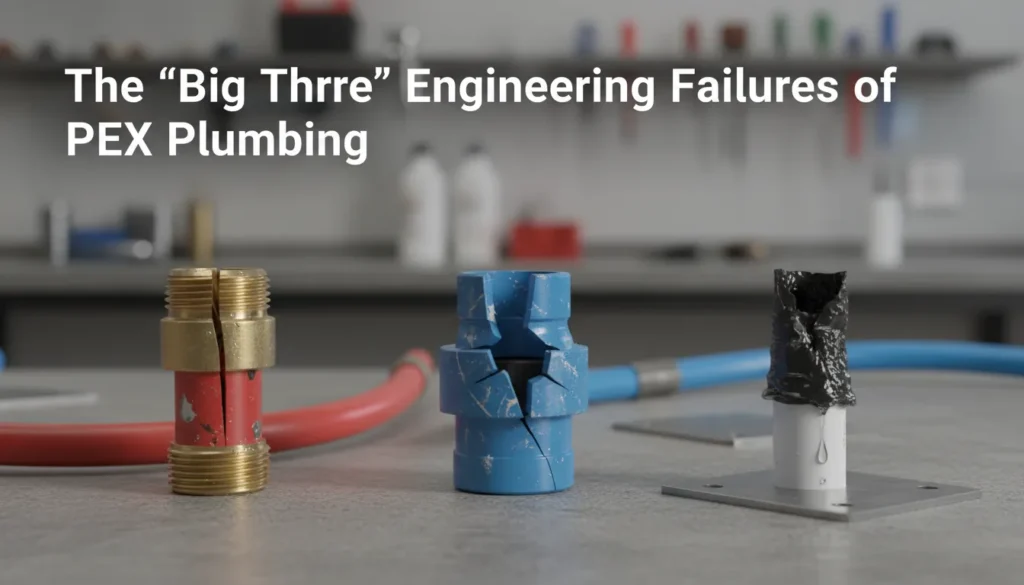
Most PEX problems don’t happen because the pipe is “cheap”; they happen because of how the material reacts to its environment. Here are the three most significant risks:
1. Oxidative Degradation: The Chlorine “Time Bomb”
PEX pipes are treated with sacrificial antioxidants to protect the plastic from the disinfectants (chlorine and chloramine) found in city water. However, forensic studies show that in areas with high chlorine levels, these antioxidants are “used up” faster than expected.
Once the antioxidants are depleted, the chlorine begins to eat the polymer matrix from the inside out. This leads to micro-cracking and a brittle pipe wall that can burst without warning.
Visual Evidence: How PEX Fails Under Microscopic Analysis
Disclaimer: This forensic analysis shows the internal degradation of PEX-A pipes due to chemical oxidation.
2026 Expert Note: If your local water report shows high chlorine or a pH below 6.5, your PEX system’s lifespan could be cut from 50 years to less than 15.
2. VOC Leaching: What’s in Your Drinking Water?
Unlike copper, PEX is a permeable plastic. Research has confirmed that PEX can leach Volatile Organic Compounds (VOCs) into your water supply, especially when new. Compounds like MTBE (Methyl tert-butyl ether) and Toluene have been detected in concentrations that exceed EPA taste and odor thresholds..
The “Plastic” Taste: This isn’t just a nuisance; it’s a sign of chemical migration.
Permeability Risk: Because PEX is semi-permeable, if a pipe is buried near a soil contaminant (like a gasoline spill or heavy pesticides), those toxins can actually migrate through the pipe wall and into your drinking water.
3. The “Chew Toy” Effect: Rodent Damage
One of the most frustrating “bad” traits of PEX is its softness. To a mouse or a rat, PEX tubing feels like a chew toy. Unlike rigid copper or thick PVC, rodents can bite through a PEX line in seconds, leading to “silent leaks” inside walls or attics that can cause thousands of dollars in mold and structural damage before they are discovered.
PEX-A vs. PEX-B—The Secret Villain?
When you ask, “Is PEX plumbing bad?” the answer often depends on which letter is printed on the pipe. The plumbing industry usually markets PEX-A as the “premium” choice, but 2026 data suggests a more complicated truth.
The Chlorine Resistance Paradox
PEX-B (The Underdog): Surprisingly, PEX-B (manufactured via the Silane method) typically has higher chlorine and oxidative resistance than PEX-A. Its molecular structure is denser, making it harder for city disinfectants to penetrate the polymer.
PEX-A (The Flexible Favorite): While PEX-A is famous for its “thermal memory” (you can fix kinks with a heat gun), it is more susceptible to antioxidant depletion. In high-chlorine environments, PEX-A can become brittle faster than PEX-B.
The Fitting Failure: ASTM F1960 vs. F1807
The “bad” reputation of PEX often stems from the joints.
ASTM F1960 (Expansion): Used primarily with PEX-A. It expands the pipe and lets it shrink over the fitting. The 2026 Risk: Some recent forensic reports highlight “stress-crack propagation” in the expansion rings if installed in near-freezing temperatures.
ASTM F1807 (Crimp): Used with PEX-B. It uses a copper ring to crush the pipe onto the fitting. The 2026 Risk: If the plumber uses “low-lead” brass instead of Dezincification Resistant (DZR) brass, the fitting itself can corrode into a white powder, blocking your water flow entirely.
The “Hidden” Health Risk—Biofilm & Bacteria

Many homeowners choose PEX because it doesn’t “rust” like iron or “pit” like copper. However, recent 2025/2026 microbiological studies have revealed a trade-off: PEX provides a more “comfortable” home for bacteria.
The Biofilm Advantage (or Disadvantage)
Unlike copper, which has natural bacteriostatic properties (it actively kills or inhibits many bacteria), PEX is biologically inert. This means it doesn’t fight back.
Organic Food Source: Some lower-quality PEX brands can leach Total Organic Carbon (TOC). In the plumbing world, TOC is essentially “fast food” for bacteria, allowing colonies to grow faster inside the pipe.
Legionella & Mycobacterium: Studies from late 2025 show that in stagnant or “warm” water lines, PEX can develop a thicker biofilm (a slimy protective layer) than copper. This biofilm can harbor opportunistic pathogens like Legionella—the cause of Legionnaires’ disease.
The 2026 “Plastic Taste” Verdict
If your water smells like “medicine” or “plastic,” it’s often Antioxidant leaching. While the EPA maintains that these levels are usually below safety limits, the long-term effects of ingesting these chemical “manufacturing byproducts” (like TBA and MTBE) are still a major concern for wellness-focused homeowners in 2026.
Forensic Checklist—Is Your Home at Risk?
Don’t panic—assess. Use this 2026 Forensic Checklist to determine if your PEX system is “bad” or just needs maintenance.
1. Check Your Water Report (The “Chlorine” Test)
Search for your city’s Consumer Confidence Report (CCR).
The Danger Zone: If your city uses Chloramines or has chlorine levels consistently above 2.0 ppm, your PEX antioxidants are being depleted at 2x the normal rate.
2. Identify the Brand and Year
Look for the printed text on your pipes (usually found in the basement or water heater closet).
High Risk: Pre-2015 Uponor (Wirsbo) with red/blue coating, or any NIBCO PEX-A from the “1006” formulation era.
Lower Risk: Modern PEX-B (like Zurn or Apollo) using DZR brass or polymer fittings.
3. Inspect the “Fittings” for White Powder
If you have brass fittings, look at the joints. Do you see a white, crusty buildup?
The Diagnosis: This is Dezincification. The zinc is leaching out of the brass, leaving a brittle copper shell that will eventually crack and flood your home.
4. The “Sunlight” Audit
Check any PEX lines near windows or in crawlspaces. If the pipe looks faded, chalky, or has a “matte” finish instead of being glossy, it has UV Damage. A UV-damaged pipe can burst even under normal water pressure.
The 2026 Verdict—Is PEX Right for Your Home?

After analyzing the forensic failures and legal landscapes of 2026, the answer to “Why is PEX plumbing bad?” isn’t a simple “yes.” Instead, it is a matter of application vs. environment.
When to Avoid PEX (The “No-Go” Zones):
High-Chlorine Municipalities: If your city water has chlorine levels above 2.0 ppm, PEX is at high risk for antioxidant depletion.
Pest-Prone Areas: If you have a history of rodents in crawlspaces, PEX is a liability.
High-Value Resale Homes: In the 2026 real estate market, savvy buyers often view copper as a “premium” asset and PEX as a “builder-grade” risk, which can impact your home’s valuation.
How to “Save” an Existing PEX System:
If your home already has PEX, you don’t necessarily need to rip it out. You can mitigate 90% of the risks with these two 2026 professional upgrades:
Install a Whole-House Carbon Filter: This is the most important step. Removing chlorine before it enters your PEX lines stops the chemical oxidation process in its tracks.
Stainless Steel Sleeving: For exposed lines in attics or basements, use stainless steel mesh sleeves to prevent rodent damage.
Frequently Asked Questions (People Also Ask 2026)
Q: Is PEX plumbing being phased out in 2026?
A: No. In fact, PEX demand is projected to grow by 5.8% through 2026. However, certain types of PEX (like the older Uponor red/blue dyed lines) are being replaced by newer, high-density PEX-B formulations that offer better chemical resistance.
Q: Does PEX cause a permanent plastic taste in water?
A: Not usually. While “leaching” is a concern with new pipes, most VOC levels drop significantly after 30 days of consistent use. If the taste persists, it often indicates high water temperatures or a reaction with local water chemistry.
Q: Which is better for resale value: PEX or Copper?
A: In 2026, Copper still holds the edge. Home inspectors and high-end buyers prioritize copper for its 70+ year lifespan and natural antimicrobial properties. PEX is seen as a cost-saving measure, not a value-add.
Q: What is the latest update on the Uponor PEX Lawsuit for 2026?
A: As of January 2026, several class-action investigations (such as those by Berger Montague and Ahdoot & Wolfson) are active. Homeowners with Aqua PEX (Red/Blue/White) installed after 2010 who have experienced cracking or leaks are urged to document their damage and check current settlement filing deadlines.
Conclusion: Making the Right Choice with EZ Plumbing Repair Services
When it’s all said and done, PEX plumbing isn’t “bad” by design—it is simply a material that requires a specific environment and expert oversight to succeed. Whether you are worried about 2026 lawsuit updates, chemical leaching, or a sudden burst pipe due to rodent damage, the key to protecting your home’s value is professional assessment.
Ignoring the warning signs of PEX failure can lead to catastrophic water damage and expensive structural repairs. Don’t leave your home’s safety to chance or builder-grade guesswork.
Protect Your Home with EZ Plumbing Repair Services
At EZ Plumbing Repair Services, we specialize in forensic plumbing audits and high-durability repiping solutions. Our team doesn’t just “fix leaks”—we analyze your water chemistry and system health to ensure your plumbing lasts for decades, not just years.
Why Choose EZ Plumbing Repair Services?
Forensic Audits: We identify high-risk PEX brands and fitting types before they fail.
Water Quality Experts: We install advanced filtration systems to stop chlorine from eating your pipes.
Transparent Solutions: Whether you need a full copper repipe or a reinforced PEX-B upgrade, EZ Plumbing Repair Services provides the honest advice you deserve.
Ready for a plumbing system you can trust? Contact EZ Plumbing Repair Services today for a comprehensive risk assessment. Let us help you turn your plumbing “time bomb” into a secure, high-value asset.
👉 Call EZ Plumbing Repair Services Now – Schedule Your 2026 Risk Audit!