How to Snake Plumbing: The Expert’s Guide to Clearing Any Clog Safely
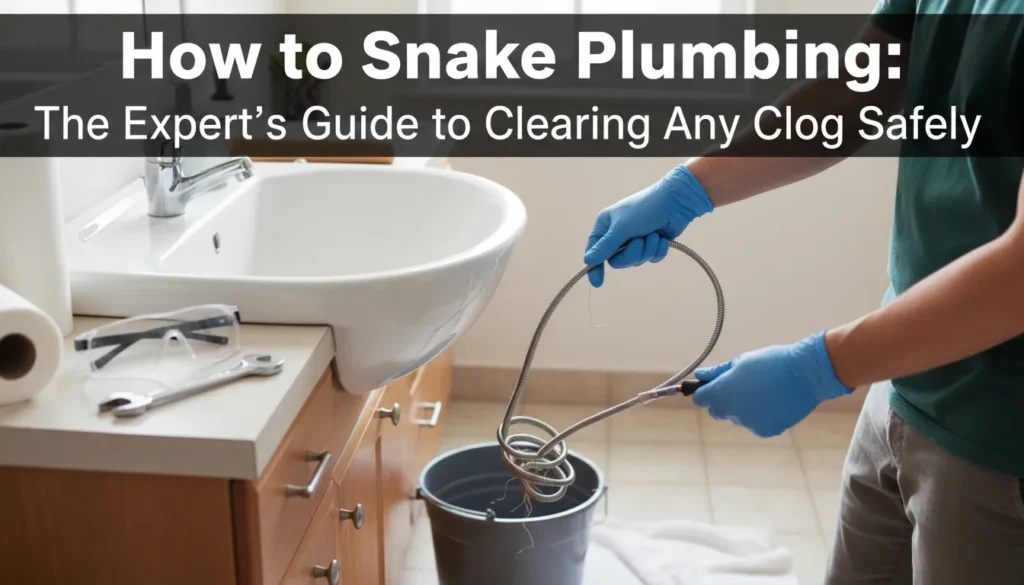
Ah, the dreaded slow drain. Whether it’s a kitchen sink backing up during dinner or a shower that’s turned into a footbath, a clog is a high-stress household emergency. Before you spend $200+ on a professional plumber, you likely want to know: “Can I snake this myself?”
The answer is yes—if you do it correctly. Most homeowners fail at snaking because they treat it like a “brute force” task. In reality, successful plumbing snaking is about tactile feedback and choosing the right mechanical tool for the specific pipe geometry.
1. Assessment: Is Your Clog “Snake-Ready”?
Before you grab a tool, you must diagnose the blockage. Not every clog requires a snake, and using one prematurely can actually push a clog deeper or damage fragile PVC joints.
The “Plunger vs. Snake” Decision
The Plunger: Best for “Soft Clogs” (toilet paper, fresh food scraps) located near the drain entrance. If three firm plunges don’t move the water, stop. Forced plunging can blow out the wax ring on a toilet or loosen slip-nuts under a sink.
The Snake (Drain Auger): Required for “Hard Clogs” (hair binds, solidified grease, or foreign objects) located deep in the P-trap or Sanitary Tee.
Risk vs. Cost Analysis
| Factor | DIY Snaking | Professional Service |
| Average Cost | $25 – $50 (Tool purchase) | $175 – $450 |
| Time Investment | 30 – 60 Minutes | 2 – 4 Hour window |
| Risk Level | Moderate (Pipe scratching) | Low (Insured) |
| Success Rate | 85% for localized clogs | 99% (Hydro-jetting capability) |
Critical Safety Warning (E-E-A-T Priority): If you have already poured liquid chemical cleaners (like Drano or Liquid-Plumr) down the drain, DO NOT use a snake yet. The mechanical action of the snake can cause Chemical Splash-back, leading to severe skin burns or permanent eye damage. Flush the drain with water for 24 hours before attempting a mechanical snake.
Choosing Your Weapon:

In the world of plumbing, “one size fits all” is a myth. Using the wrong snake won’t just fail to clear the clog—it can permanently ruin your fixtures. Here is the breakdown of the specific entities you need for your toolkit. This is the standard plumbing snake most homeowners need. It features a cable (usually 1/4″ or 5/16″ thick) coiled inside a plastic drum.
A. The Handheld Drum Auger (Best for Sinks, Showers, & Tubs)
This is the standard “plumbing snake” most homeowners need. It features a cable (usually 1/4″ or 5/16″ thick) coiled inside a plastic drum.
Key Entity: The Thumb Screw (the bolt that locks the cable in place).
Best For: Hair clogs in bathroom drains or grease buildup in kitchen P-traps.
Pro Tip: Look for a “power-ready” model that can attach to a cordless drill for extra torque.
B. The Closet Auger (The Only Tool for Toilets)
Warning: Never use a standard drum auger in a toilet. The metal cable will leave permanent, ugly grey scratches on the porcelain.
The Difference: A Closet Auger (or Toilet Auger) has a long, rigid steel rod with a Rubber Shroud (protective boot) at the bend.
Function: The rubber shroud sits at the bottom of the toilet bowl, protecting the finish while the cable navigates the internal S-trap.
C. The Flat Tape Auger
Design: A flat, ribbon-like metal strip rather than a coiled wire.
Best For: Long, straight pipes with very narrow diameters.
Weakness: It lacks the “hooking” power of a coiled snake, making it less effective for hair clogs.
D. The Power Drum Auger (Main Line Machine)
If your entire house is backing up, a handheld tool won’t reach. You need a rental machine.
Technical Entity: 1/2″ to 3/4″ Industrial Cable.
Function: These are motorized and designed to cut through Tree Roots or massive main-line blockages.
Safety Note: These machines have high torque. If the cable binds and you aren’t wearing Heavy-Duty Leather Gloves, it can result in broken fingers.
Quick Comparison: Which Snake Do You Need?
| Clog Location | Recommended Tool | Cable Length |
| Kitchen/Bathroom Sink | Handheld Drum Auger | 15 – 25 Feet |
| Toilet Only | Closet Auger | 3 – 6 Feet |
| Bathtub / Shower | Drum Auger (via Overflow) | 25 Feet |
| Main Sewer Line | Power Drum Machine | 50 – 100 Feet |
How to Snake a Sink or Bathtub (The “Overflow” Method)

When you are learning how to snake plumbing, the path you take is more important than the force you use. For kitchen and bathroom fixtures, the entry point determines your success.
Snaking a Sink: The P-Trap Access
Most sink clogs occur in the P-Trap (the U-shaped pipe under the cabinet).
Remove the Trap: Place a bucket underneath and unscrew the Slip Nuts by hand or with channel locks.
Inspect the Bend: Often, the clog is sitting right in the U-bend. If it is, simply clean it out and reassemble.
Go into the Wall: If the trap is clear, the clog is further in. Insert your drum auger directly into the Wall Pipe (Sanitary Tee). This gives you a straight shot at the blockage.
Snaking a Bathtub: Use the Overflow Plate
The #1 DIY Mistake: Attempting to snake through the bathtub floor drain. This path has a sharp 90-degree turn (the drain shoe) that often causes the snake to kink or get permanently stuck.
The Pro Method:
Remove the Overflow Plate: This is the circular metal plate on the wall of the tub, usually held by two screws.
Extract the Linkage: If your tub has a lever-operated stopper, gently pull out the metal rod assembly (the Linkage) attached to the plate.
The Direct Path: The overflow pipe leads directly down into the main drain line, bypassing the difficult floor drain curves.
Insert the Snake: Feed the cable into the overflow hole. This provides a much smoother angle to reach the P-trap located under the floor.
Pro-Tip: The “Wet Rag” Seal
If you decide to plunge before snaking a double-basin kitchen sink or a tub with an overflow, you must plug the other opening with a wet rag. Without sealing the overflow or the second sink basin, the air pressure will just escape through the hole instead of pushing the clog.
The “Art of the Feel”: Mastering the Cable Feed

The most common question homeowners ask is: “How do I know if I’ve hit the clog or just a bend in the pipe?” This is where DIYers either give up too early or push too hard and break a joint. To snake plumbing effectively, you must learn to “read” the cable.
Differentiating Resistance: Soft vs. Hard
As you feed the cable into the drain, you will feel tension. Here is how to diagnose it:
The “Rubbery” Bounce: If the cable bounces back or feels “springy,” you are likely hitting a Pipe Elbow or a 90-degree turn.
The “Dead Stop” Resistance: If the cable stops moving forward and feels solid, you have reached the Mechanical Obstruction (the clog).
The “Grinding” Sensation: If you feel a vibration or a scraping sound, you might be hitting Cast Iron Scaling or tree roots.
The “Clockwise Rule” for Penetration
Once you hit the blockage, do not simply push.
Tighten the Thumb Screw: Lock the cable so it cannot slide back into the drum.
Rotate Clockwise: Always turn the handle clockwise. This uses the Auger Head like a drill bit to “corkscrew” into the debris.
The Push-Pull Maneuver: While cranking, apply steady forward pressure. If the cable binds (starts to twist on itself), stop immediately, reverse a few inches, and try again.
Avoiding “Cable Kinking”
A kinked cable is a ruined tool. This happens when there is too much Slack between the tool and the drain opening.
The 6-Inch Rule: Keep the drum of the snake no more than 6 inches away from the drain entrance. This prevents the cable from looping and snapping back on your hands.
Identifying a “False Clear”
Sometimes the snake will pass right through the clog. This happens often with Grease Blockages. The snake pokes a small hole through the grease, the water drains for a minute, and then the hole closes back up.
The Pro Solution: Once you feel the resistance break, continue feeding the cable another 3–4 feet to ensure you’ve cleared the entire “slug” of debris.
How to Snake a Toilet: The Porcelain Protection Guide
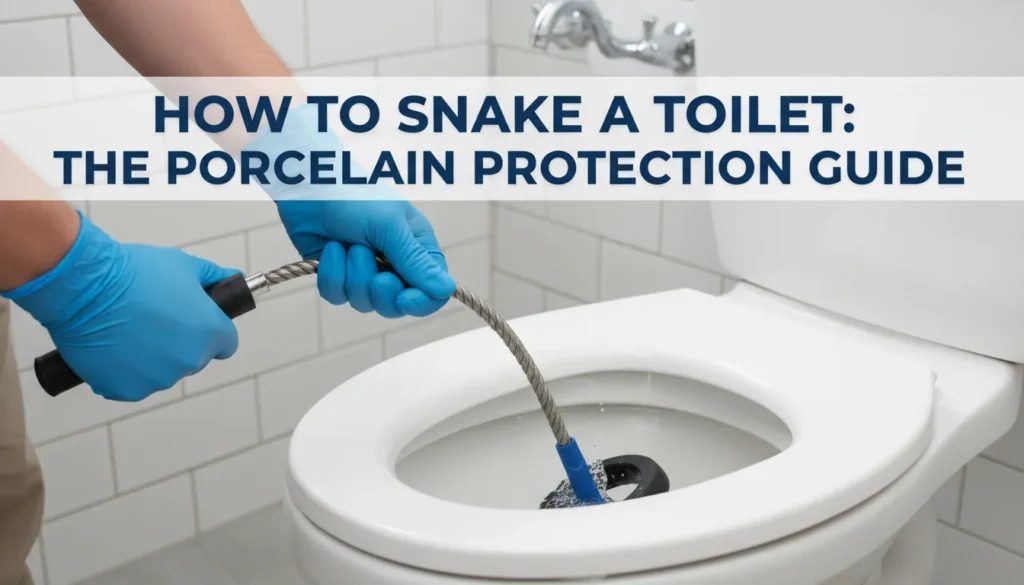
Toilets are the most common source of household clogs, yet they are the easiest to damage. Unlike a metal sink pipe, a toilet is made of vitreous china. If you use a standard plumbing snake, you will leave permanent grey “snake trails” (scratches) that can never be removed.
Why the “Closet Auger” is Non-Negotiable
To snake a toilet properly, you must use a Closet Auger. This tool is specifically engineered with two features that a standard snake lacks:
The J-Bend Tube: The steel rod is pre-bent to match the internal Trap way of a standard toilet.
The Rubber Boot: The “elbow” of the tool is covered in rubber. This sits against the bottom of your bowl, acting as a buffer so the metal cable never touches the porcelain.
Step-by-Step: Clearing the Toilet Clog
Position the Boot: Pull the handle of the auger all the way up so the cable is retracted. Place the rubber-covered bend at the very bottom of the toilet hole.
The Crank & Push: While holding the steady bar, push the handle down while cranking in a Clockwise Direction.
Navigate the S-Bend: You will feel a “hump” as the cable enters the internal trap. This is the S-Bend. Keep cranking until the full 3 to 6 feet of cable is deployed.
The Retrieval: Don’t just pull the snake back. Continue cranking as you slowly pull the handle up. This helps “hook” any foreign objects (like wet wipes or toys) so they can be pulled back out into the bowl rather than pushed further into the Sewer Lateral.
When Snaking Fails: The “Pulling the Toilet” Decision
If a 6-foot closet auger does not clear the blockage, the object is likely stuck in the Wax Ring or the Flange. At this point, you may need to “pull the toilet” (remove it from the floor).
Pro-Tip: If the water in the toilet bowl is rising when you run the bathroom sink, the clog isn’t in the toilet—it’s in the Common Vent or the Main Line. No amount of toilet snaking will fix this.
Troubleshooting: “I Snaked it, but it’s still Clogged!”
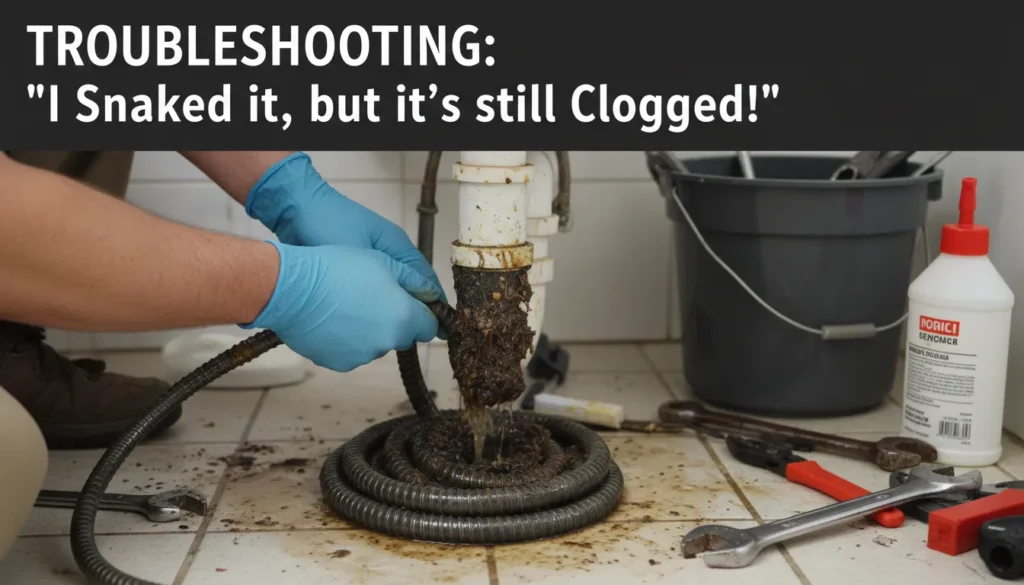
It is incredibly frustrating to run a 25-foot cable down a drain only to have the water back up again five minutes later. If your DIY efforts aren’t sticking, you are likely dealing with one of these three professional-grade issues.
A. The “Tunneling” Effect (Grease & Fat)
In kitchen drains, clogs are often made of Solidified Cooking Fats. When you run a snake through grease, the small auger head simply pokes a hole through the center of the “slug.”
The Symptom: The drain works perfectly for 2 minutes (while the hole is open) and then slows down as the soft grease collapses back into the hole.
The Fix: You must use a Bulb Auger head and run hot water simultaneously to flush the grease walls as you scrape them.
B. The “False Clear” (The Snake Went Around the Clog)
If your pipe diameter is 3 inches but you are using a 1/4 inch snake, the cable can literally “swim” past the clog without hooking it.
The Fix: If you feel no resistance but the drain is still blocked, you need a thicker cable or a larger Cutter Head to ensure the cable makes contact with the pipe walls.
C. The “Main Line” Indicator
If you snake your shower and the water starts backing up into the toilet, or if you hear “gurgling” in the tub when you wash laundry, the clog is not in the fixture. It is in the Main Sewer Lateral.
Diagnostic Entity: Check your External Cleanout (usually a white or black pipe cap in your yard). If there is standing water in that pipe, the blockage is toward the city sewer/septic tank, and a small handheld snake will never reach it.
What to do if the Snake Gets Stuck?
This is the “Nightmare Scenario” every DIYer fears. If your snake won’t budge:
Do Not Yank: Pulling hard can snap the cable or break a pipe joint behind the wall.
Reverse the Rotation: Switch your drill or hand-crank to Counter-Clockwise. This “unscrews” the auger head from whatever it has latched onto (usually a root or a pipe crack).
Lubricate: Pour a small amount of dish soap down the pipe to help the cable slide past tight bends.
Decision Framework: DIY vs. Calling a Professional
Knowing how to snake plumbing is a great skill, but knowing when to stop is what saves you thousands of dollars in emergency repairs. Use this matrix to decide your next move.
| Scenario | Recommendation | Why? |
| Single fixture backup (Sink/Tub) | DIY | High success rate with a handheld drum auger. |
| Clog returned 3 times in a week | PRO | Likely a Structural Pipe Defect or heavy grease buildup. |
| Water backing up in multiple rooms | PRO | Indicates a Main Line blockage requiring heavy machinery. |
| Old Galvanized/Clay Pipes | CAUTION | These pipes are brittle; a power snake can shatter them. |
| Snake is stuck or bound | STOP | Forcing it will result in a “broken snake in a wall,” doubling the repair cost. |
FAQ: Frequently Asked Questions
Q: Can I use a wire hanger instead of a plumbing snake?
A: While a hanger can reach very shallow clogs (like hair in a pop-up stopper), it is not a substitute for a snake. Hangers are rigid and can scratch modern finishes or get permanently stuck in a P-trap. A $5 Plastic Zip-Tool is a safer, more effective DIY alternative.
Q: Can a plumbing snake break my PVC pipes?
A: Yes, if used improperly. If you use a high-torque motorized snake and the cable “whips” inside a thin-walled PVC pipe, it can crack the joints. Always start with a manual hand-crank to feel the resistance before applying power.
Q: Should I run water while snaking?
A: Yes. Running a small stream of warm water (not boiling) while you work helps flush away the debris as the snake breaks it up. It also lubricates the cable, allowing it to slide through tight bends more easily.
Q: Why does my drain smell like “rotten eggs” after snaking?
A: You likely disturbed Bio-film or organic buildup (sewer gas). Once the clog is clear, flush the drain with a mixture of hot water and dish soap to neutralize the odor and clear the remaining bacteria.
Conclusion: Master Your Pipes with EZ Plumbing Repair Services
Learning how to snake plumbing is an essential skill for any homeowner, but it requires a balance of patience, the right tools, and a “feel” for your home’s internal pipe structure. By following this guide, you can successfully clear most minor obstructions, protect your porcelain fixtures, and avoid the dangerous pitfalls of chemical splash-back.
However, plumbing systems are complex. If you’ve encountered a “False Clear,” a stubborn main line blockage, or you simply don’t feel comfortable navigating the high torque of a power auger, you don’t have to face it alone.
When DIY Isn’t Enough, Call EZ Plumbing Repair Services
At EZ Plumbing Repair Services, we specialize in resolving the “impossible” clogs that standard handheld snakes simply can’t reach. Whether you need a professional camera inspection to find a hidden pipe defect or high-pressure hydro-jetting to clear years of grease buildup, our team is ready to restore your home’s flow.
Don’t risk a broken pipe or a stuck snake. Contact EZ Plumbing Repair Services today for a professional drain diagnostic and permanent plumbing peace of mind.