The Ultimate Guide to Plumbing House Cost: From Rough-In to Final Fixtures
Breaking Down New Construction Plumbing & Rough-In Estimates
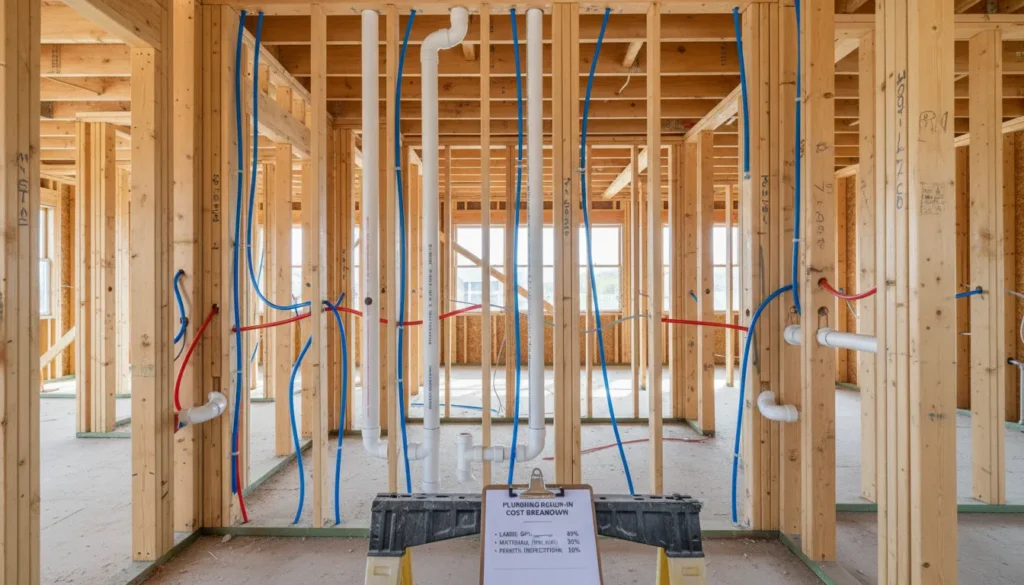
Total Project Investment for Modern Homes
Plumbing a 2,000 sq. ft. house typically requires a budget between $8,000 and $20,000. This comprehensive figure accounts for the entire lifecycle of the installation, moving from the initial underground lines to the moment you turn on your kitchen faucet. The final price fluctuates based on the number of bathrooms and the complexity of the architectural layout.
The financial weight is split between the unseen infrastructure and the visible hardware. While the pipes themselves are a fixed necessity, your choice of high-end tubs or designer sinks will push the total toward the higher end of the $20,000 spectrum.
The Critical Rough-In Phase and Layout Strategy
The rough-in plumbing phase focuses specifically on the network of pipes installed behind your walls and under the subfloor, averaging approximately $4.50 per square foot. For a 2,000 sq. ft. layout, this foundational work necessitates a dedicated budget of $8,000 to $12,000. It is the most labor-intensive portion of the project, as it sets the stage for every drainage and supply point in the building.
Industry data reveals that a rough in plumbing cost per fixture calculator provides more surgical accuracy than flat-rate estimates. For instance, designing a “wet wall”—where two bathrooms share the same vertical plumbing stack—drastically reduces labor and material waste. This shared-wall strategy is a primary way to lower the overall expenses without sacrificing quality.
Expert Resource: You can review the universal standards for safe pipe installation and pressure testing at the International Code Council (ICC).
The Layout Efficiency Variable
The biggest mistake homeowners make is assuming every square foot is priced equally. In reality, a “stacked” floor plan where the upstairs bathroom sits directly above the kitchen is significantly cheaper than a sprawling ranch-style home. If your design spreads water points across four different corners of the house, expect your labor costs to climb as the plumber spends more time running long horizontal lines.
Strategic Financials for Whole-House System Overhauls
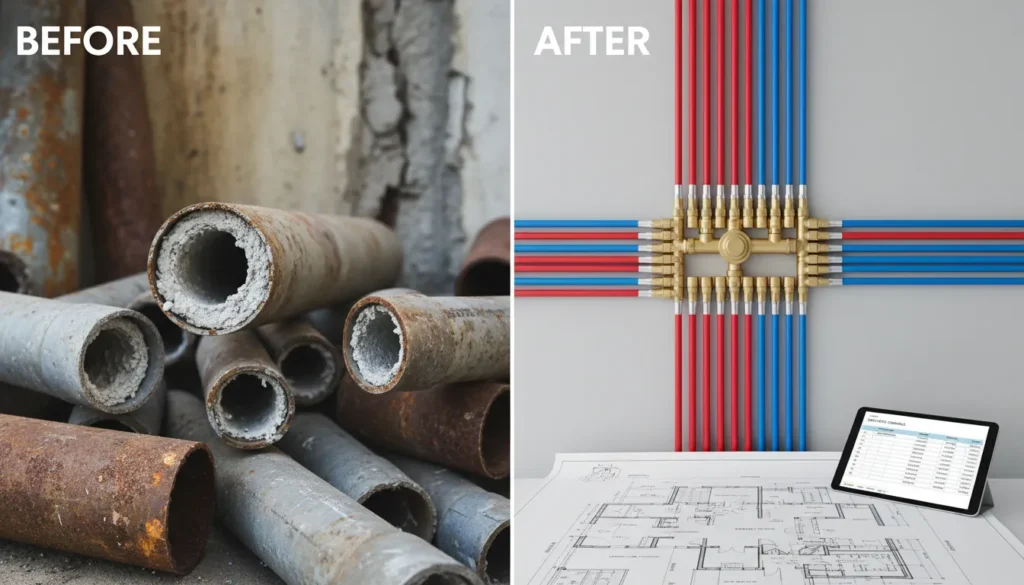
Scaling Your Budget by Square Footage
The total investment to replace plumbing in an old house is primarily dictated by the footprint of the building. For smaller residences ranging from 1,000 to 1,500 sq. ft., owners should anticipate costs between $4,500 and $12,000. As the scope expands to larger estates over 3,000 sq. ft., the technical complexity and material volume can push the final invoice past the $27,000 mark.
When homeowners evaluate if a $100,000 budget is sufficient for a total home transformation, they often overlook the mechanical core. A realistic redoing plumbing in house cost can absorb up to 15% of that renovation fund. This is especially true if your vision involves structural changes, such as moving a kitchen or adding a master suite, which forces a complete rerouting of the existing drainage and supply network.
Factoring in the Invisible Restoration Costs
A standard house repiping cost calculator usually provides a quote for the plumber’s labor and pipe materials, but it leaves out a massive expense. In the field, we call this the “drywall tax”—the secondary cost to patch, sand, and finish every wall or ceiling that was opened for access. This often adds a 20% surcharge to the total bill that most online estimators fail to mention.
Navigating the replacement of aged infrastructure requires more than just new pipes; it requires a plan for the structural repairs that follow. If you are dealing with historic plaster or custom wallpaper, these finishing costs can grow even higher, making early coordination with a general contractor essential for budget accuracy.
Industry Standard: For official guidelines on maintaining structural integrity and water safety during major residential pipe replacements, you can reference the National Association of Home Builders (NAHB).
The “Slab vs. Crawl” Structural Barrier
The logic of square-foot pricing often falls apart if the property is built on a concrete slab rather than a crawl space or basement. In slab-on-grade homes, the technician may have to jackhammer through the floor to reach failed lines, which can double the labor hours compared to a standard installation. Always verify your foundation type before assuming the lower end of the pricing spectrum.
Comparing PEX and Copper: Performance vs. Price Point
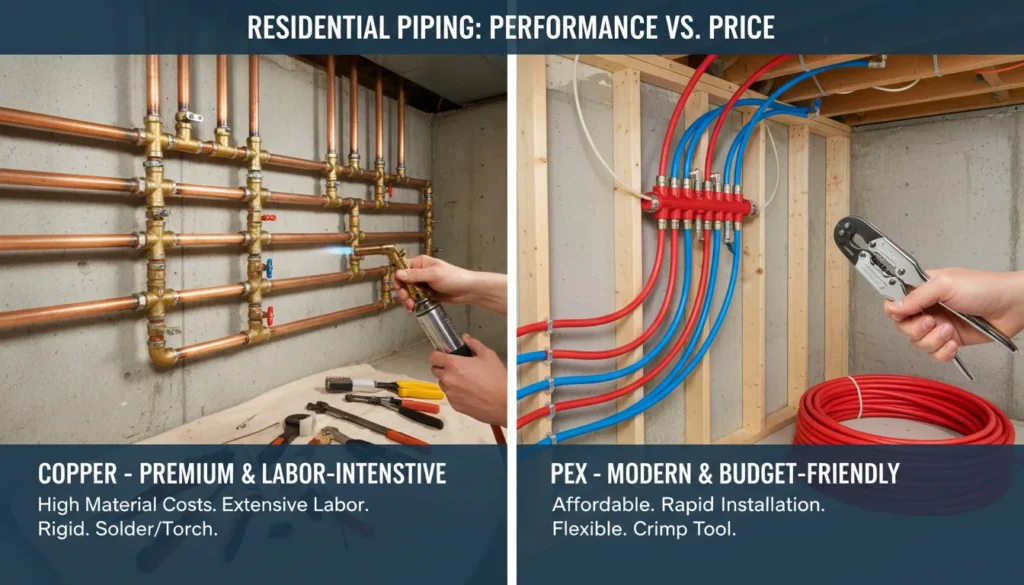
The Dominance of PEX in Modern Construction
For those looking to minimize the plumbing a whole house cost, PEX (cross-linked polyethylene) is the most efficient choice available. Priced between $0.50 and $2 per foot, it is significantly more affordable than traditional metals. Because it is flexible and can be snaked through wall frames like electrical wire, it requires far fewer fittings and joints, which slashes the total hours a professional spends on-site.
This material isn’t just a cost-saver; it changes the way water is distributed. By using a central manifold system, PEX allows for faster hot water delivery and easier maintenance, making it the top recommendation for new builds where speed and budget are the primary concerns.
The Financial Reality of the Copper Premium
While copper is widely respected for its extreme longevity, opting for it makes your plumbing work in house cost roughly 58% to 68% more expensive than a PEX system. This price hike isn’t just about the raw material. Installing copper is a craft that requires cleaning, fluxing, and soldering every single connection with a torch.
This labor-intensive process demands a higher tier of technical skill and significantly more time. However, for homeowners worried about long-term degradation or those who prefer a material with a proven 50-year track record, the higher initial investment in copper provides a level of durability and “heft” that plastic alternatives struggle to match in high-end luxury markets.
Expert Resource: You can analyze the current mechanical performance and safety benchmarks for various piping materials through the American Society of Mechanical Engineers (ASME).
The Frozen Pipe Vulnerability Check
Traditional logic says copper is “better,” but in extreme climates like Saskatchewan or Melfort, SK, that advice can lead to disaster. In sub-zero environments, PEX is actually superior because it possesses the unique ability to expand slightly if the water inside freezes. Copper is rigid; when the pressure of expanding ice hits its limit, the pipe splits. In these specific cold-weather regions, choosing the cheaper material is actually a strategic move to prevent catastrophic winter bursts.
Valuation of Plumbing Fixtures and Sub-Foundation Logistics
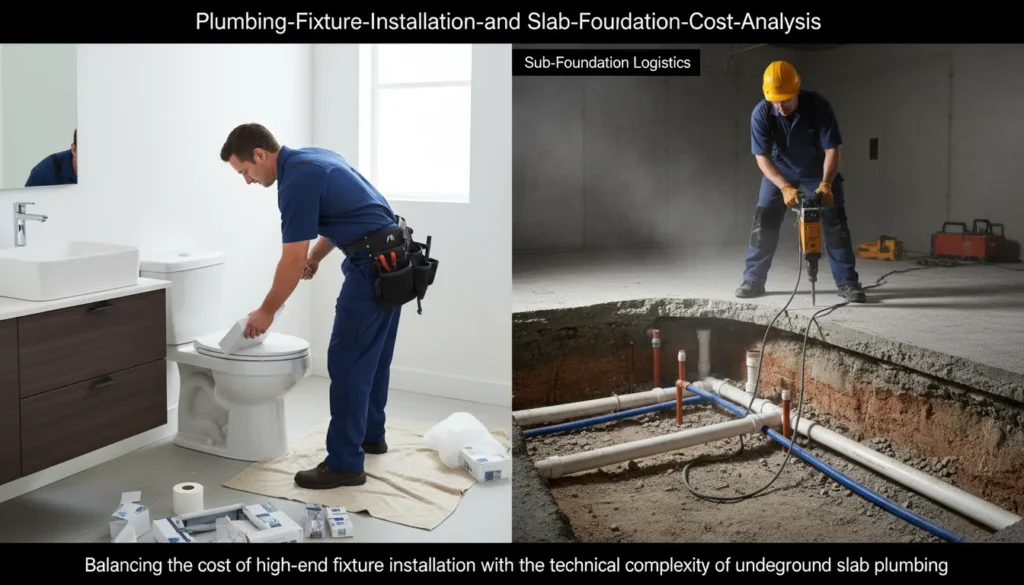
Individual Unit Pricing and Finish Labor
The final stage of your project involves connecting the visible elements that facilitate water usage. Installing separate components like sinks, toilets, and tubs typically adds $450–$1,800 per fixture to your bottom line. This price covers both the physical hardware and the specialized labor needed to ensure every seal is watertight and code-compliant.
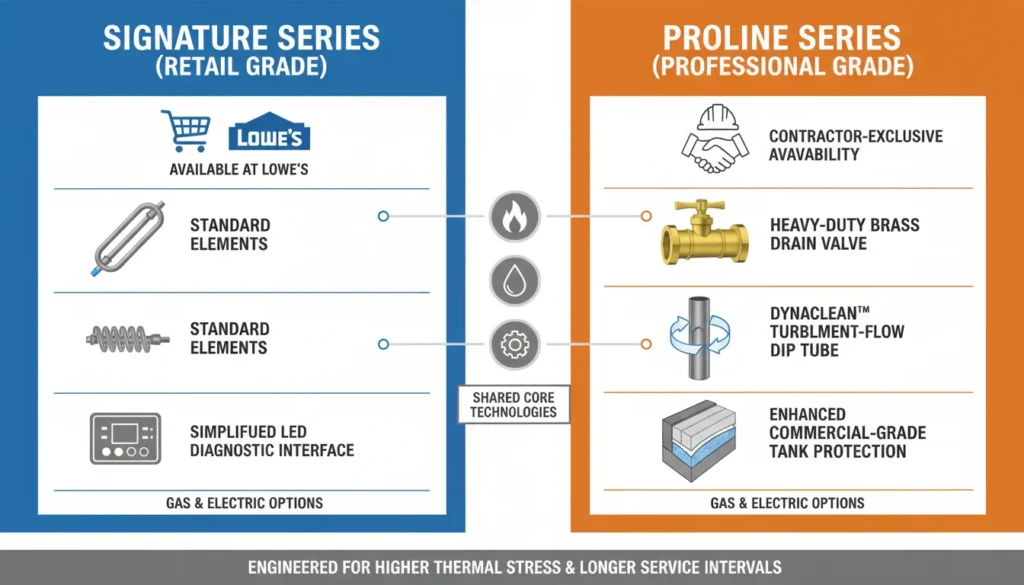
Central appliances require a dedicated budget as well. A standard water heater installation generally falls between $600 and $1,300. These costs fluctuate based on the unit type and the venting requirements of your specific home layout. Because these units are the primary “engines” of your water system, the quality of this installation directly impacts your daily utility efficiency.
Hidden Infrastructure and Foundation Challenges
If you are investigating the plumbing under house cost, you must account for potential sub-surface complications. Issues like slab leaks are among the most expensive to rectify, with repair bills ranging from $500 to $4,000. These costs are driven by the difficulty of accessing pipes encased in concrete, often requiring specialized detection equipment and invasive demolition.
A detail that most online estimators overlook is how your home’s foundation type alters the base price. If your residence is built on a concrete slab rather than a crawl space, your new construction plumbing rough-in cost per square foot will likely increase by 15% to 20%. This “slab premium” is the direct result of the intensive trenching and specialized backfilling required to secure pipes before the concrete is poured.
Expert Resource: For verified standards regarding safe installation and appliance efficiency, you can consult the American National Standards Institute (ANSI).
The Foundation Access Limitation
While square-foot averages are useful, they can be misleading if the soil under your slab is highly expansive or rocky. In these scenarios, the difficulty of trenching can push labor costs well beyond the standard 20% increase. If the ground is too hard for manual tools and requires heavy machinery for interior trenching, the “under house” portion of your budget may need to be doubled to cover the mechanical overhead.
Insight: This walkthrough visually demonstrates the **sub-foundation logistics** discussed above. At [00:04:16], notice how the trenching depth impacts the final labor invoice.
Geographic Influences on Total Plumbing Expenditures

Universal Benchmarks and International Disparity
When analyzing the financial requirements for a residential system, international benchmarks show a wide spectrum of results. For instance, the cost of plumbing a house in Ireland, Nigeria, or Uganda fluctuates significantly based on the local availability of specialized materials like PEX or high-grade copper. Despite these regional differences in currency and supply chains, the “per fixture” logic remains the gold standard global metric for builders trying to maintain a consistent budget.
Whether you are building in a European suburb or an emerging African market, the complexity of the installation—calculated by the number of drain and supply points—is the most reliable way to forecast your needs. This ensures that even when material costs are unstable, the labor-to-fixture ratio provides a steady baseline for your expectations.
Decoding Local Quotes and Travel Variables
For homeowners searching for plumbing-a-house-cost near me, the most volatile part of the invoice is the local labor rate, which generally sits between $50 and $200 per hour. This range is influenced by the cost of living in your specific area and the current demand for licensed tradespeople. In dense urban centers, you might pay a premium for the plumber’s time, whereas semi-rural areas might offer lower hourly rates but introduce other logistical fees.
A critical point that generic national averages often ignore is the “travel surcharge” found in specific local markets like Melfort. If your property is situated outside the primary service hub, contractors often apply a flat fee or a mileage rate to cover the transport of heavy tools and machinery to the site. These localized fees can add hundreds of dollars to a project that otherwise seems standard on paper.
Expert Resource: You can compare international building standards and labor safety protocols through the World Plumbing Council (WPC).
The Rural Accessibility Constraint
The standard hourly rate of $50-$200 can effectively double if your project is located in a remote area with limited road access. In these cases, the “travel surcharge” isn’t just a small fee; it reflects the lost time the plumber spends commuting rather than working. If your site requires off-road transport for heavy materials like drainage stacks, the logistical overhead can sometimes rival the cost of the actual plumbing work.
Addressing Common Concerns in Residential Plumbing Valuations

Navigating Cost Myths and Expert Safeguards
Many homeowners wonder if the pipework is the most expensive part of a house build. While structural framing or foundations often cost more, plumbing remains one of the most critical stages because a single failure in a plumbing cost for 1000 sq ft house can lead to water damage repairs that far exceed the original installation price. Skipping the professional estimation step puts the entire structure at financial risk.
To ensure you aren’t being overcharged, always confirm that your contractor’s quote explicitly includes all necessary municipal permits. A reliable way to verify the fairness of a bid is to apply a rough in plumbing cost per fixture calculator to your floor plan. This allows you to cross-reference the plumber’s quote against the actual number of drainage and supply points in your home, preventing “padding” on simpler layouts.
Maximizing Home Value through Strategic Upgrades
If your goal is to increase home value by $50,000, the most effective strategy is focusing your budget on the “finish plumbing” phase. While hidden pipe upgrades are necessary for function, high-end fixtures in the kitchen and master bath provide a much higher return on investment (ROI). Appraisers and buyers place a premium on visible quality, such as luxury rainfall showerheads or professional-grade kitchen faucets.
Focusing on these aesthetic and functional touchpoints during the final installation stage creates a “wow factor” that impacts the property’s marketability more than the unseen piping behind the walls. By balancing a solid infrastructure with premium finishes, you secure both the safety and the resale potential of the residence.
Expert Resource: You can research the official plumbing codes and safety certification requirements for residential fixtures through the International Association of Plumbing and Mechanical Officials (IAPMO).
The “Hidden Pipe” Value Gap
The strategy of focusing on high-end finishes for a $50,000 value boost fails if the underlying infrastructure is neglected. If you install a $2,000 designer faucet on top of corroding or poorly installed “rough-in” pipes, the luxury finish becomes a liability. The ROI on expensive fixtures only holds true if the core system is sound; otherwise, a future leak will require tearing out that high-end work to fix a $10 pipe deep in the wall.