What Is Pipe Bursting and Is It the Best Way to Replace a Sewer Line Without Digging?
What is Pipe Bursting?
Pipe bursting is a trenchless method used to replace old, damaged, or broken sewer and water pipes without digging up your yard or driveway. Instead of removing the existing pipe through traditional excavation, a special bursting tool breaks the old pipe apart while simultaneously pulling in a new pipe in its place. This method is faster, less disruptive, and often more cost-effective than traditional digging.
Pipe Bursting vs CIPP Cured-in-Place Pipe Lining:
- Pipe Bursting replaces the old pipe completely, increasing the pipe diameter if needed.
- CIPP relines the existing pipe by inserting a resin-saturated liner, which does not replace the pipe but creates a new inner layer.
- Use pipe bursting if the pipe is collapsed, severely damaged, or needs upsizing.
- Use CIPP if the pipe is structurally intact but leaking or corroded.
Key Types of Pipe Bursting:
- Hydraulic Pipe Bursting – Uses hydraulic pressure to pull the bursting head and new pipe through the old pipe. Ideal for larger projects.
- Pneumatic Pipe Bursting – Uses compressed air to hammer and split the pipe while inserting a new one.
- Static Pipe Bursting – Involves manually pulling a bursting head through the pipe, suitable for smaller residential jobs.
- Pipe Splitting Method – The old pipe is split apart along its length while the new pipe is pulled in behind it.
Use Cases:
- Residential: Replacing old sewer or water lines in homes without destroying landscaping or driveways.
- Commercial: Trenchless repair for business buildings, apartments, or complexes with minimal disruption.
- Municipal Lines: Large-scale sewer or water main replacement in cities using specialized hydraulic or pneumatic equipment.
User Takeaway: Pipe bursting is fast, durable, and minimally invasive, making it a top choice when pipes are severely damaged or need upsizing.
How Does Pipe Bursting Work?
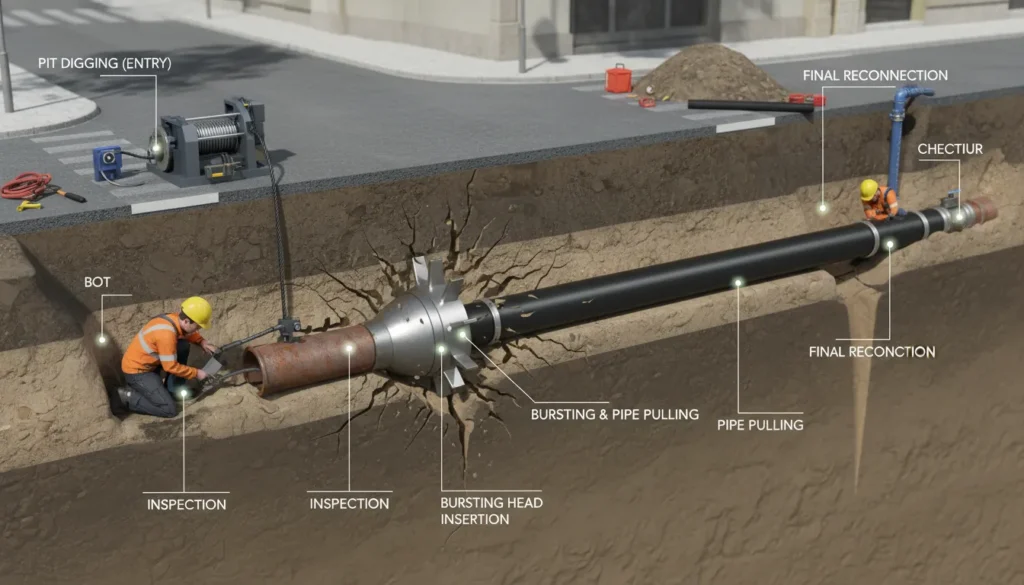
Pipe bursting follows a clear, step-by-step process. The goal is simple: replace the old damaged pipe with a new one in the same path, without digging up the entire area. Here’s how it works from start to finish:
Step 1: Sewer Camera & Video Pipe Inspection
First, a plumber inspects the pipe using a small camera. This helps them see the exact condition of the pipe, locate cracks or blockages, and measure the depth and length. This step is important to decide if pipe bursting is the right solution.
Step 2: Entry and Exit Pits
Instead of digging the whole yard, only two small holes (called pits) are dug—one at the start and one at the end of the pipe. These pits give access to insert equipment and pull the new pipe through.
Step 3: Bursting Head Insertion
A special tool called a bursting head is inserted into the old pipe. This is usually cone-shaped and designed to break the old pipe outward as it moves forward. At the same time, it creates space for the new pipe.
Step 4: Winch System & Pipe Pulling
A powerful winch system pulls the bursting head through the pipe. As it moves, it breaks the old pipe and pulls a new HDPE pipe behind it. This means the old pipe is replaced in one continuous process.
Step 5: Pipe Fusion Welding
Before installation, the new HDPE pipe sections are joined together using heat (fusion welding). This creates a joint-free pipe, which is stronger and less likely to leak compared to traditional pipes with joints.
Step 6: Pipe Reconnection & Final Inspection
Once the new pipe is in place, it is connected to the existing plumbing system. After that, a final inspection is done—often using a camera again—to make sure everything is working perfectly.
Tools & Equipment Used
Pipe bursting uses specialized equipment to make the process efficient and safe:
- Hydraulic Systems: Use steady, powerful force to pull the pipe through
- Pneumatic Systems: Use compressed air with a hammer-like action to break the pipe
- Winch Machines: Pull the bursting head and new pipe
- Pulling Rods & Cables: Help guide and move the equipment
- Fusion Machines: Join HDPE pipes into one continuous line
Why HDPE Pipes Are Used
Most pipe bursting projects use HDPE (High-Density Polyethylene) pipes because:
- They are flexible and can handle ground movement
- They resist corrosion and rust
- They last 50+ years
- They are joint-free, reducing the risk of leaks
Safety Considerations
Pipe bursting is safe when done by professionals, but some precautions are always taken:
- Checking for nearby underground utilities before starting
- Ensuring proper soil conditions to avoid ground movement
- Using controlled force to prevent damage to surrounding structures
- Following local codes and safety standards
When Should You Use Pipe Bursting?

Pipe bursting is not needed for every plumbing issue. It is usually recommended when the pipe is too damaged to repair and needs full replacement. Knowing the right signs and situations can help you decide when this method is the best option.
Signs Your Pipes Need Replacement
Some problems clearly show that your pipes are beyond simple repair:
- Collapsed Pipes: If a pipe has caved in or lost its shape, water cannot flow properly, and replacement is often the only solution.
- Corroded or Rusted Pipes: Older materials like cast iron can weaken over time, leading to leaks and structural failure.
- Slow Drains: If water drains slowly throughout your home, it could mean serious internal pipe damage or blockage.
- Bad Odors: A strong sewage smell often indicates cracks or leaks in the sewer line.
These signs usually mean the pipe is in poor condition and may not last much longer.
Frequent Clogs or Backups
If you are dealing with repeated clogs or sewer backups, it is often more than just a simple blockage.
- Tree roots may have entered the pipe
- The pipe may be cracked or misaligned
- Internal buildup may be too severe
In these cases, temporary fixes won’t solve the problem. Pipe bursting provides a long-term solution by replacing the entire pipe.
Ideal Situations for Pipe Bursting
Pipe bursting works best in certain conditions where traditional digging would cause damage or inconvenience:
- Pipes Under Landscaping: Lawns, gardens, or trees stay protected since there is no major digging
- Under Driveways or Sidewalks: No need to break concrete or rebuild surfaces
- Urban or Tight Spaces: Limited space makes trenchless methods more practical
Best for Older Pipe Materials
Pipe bursting is especially useful for replacing outdated or weak pipe materials such as:
- Clay Pipes
- Cast Iron Pipes
- Orangeburg Pipes
These materials are more likely to crack, collapse, or corrode over time, making them ideal candidates for full replacement.
When Pipes Are Too Damaged for Relining
CIPP relining is a good option for minor cracks, but it has limits.
Pipe bursting is the better choice when:
- The pipe is completely collapsed
- There is severe structural damage
- The pipe has lost its shape or alignment
In these situations, inserting a liner is not possible, so replacing the pipe using pipe bursting is the most effective solution.
Pipe Bursting vs Other Methods

When choosing a sewer or water line repair method, it is important to understand that each option works differently. Some methods repair the existing pipe, while others fully replace it. The best choice depends on the pipe’s condition, location, and how much damage is present.
Pipe Bursting vs CIPP (Relining)
Pipe bursting fully replaces the old pipe. The damaged pipe is broken apart underground, and a new pipe is pulled into its place. This makes it a strong option when the existing pipe is badly damaged, collapsed, or too weak to keep using.
CIPP relining does not remove the old pipe. Instead, a liner coated with resin is inserted inside the damaged pipe. The liner hardens and creates a new pipe within the old one. This works well when the pipe still has enough shape and strength to hold the liner.
In simple words, pipe bursting is better for full replacement, while CIPP is better for repairing a pipe that is still mostly intact.
Pros of Pipe Bursting
- Fully replaces the damaged pipe
- Can sometimes increase pipe size
- Strong, long-lasting result
- Good for badly damaged or collapsed pipes
Cons of Pipe Bursting
- Needs entry and exit pits
- May not suit every soil condition
- Requires more equipment
Pros of CIPP Relining
- Very little digging
- Good for pipes with cracks or leaks
- Faster in some situations
- Less surface disruption
Cons of CIPP Relining
- Does not fully replace the old pipe
- Not suitable for collapsed pipes
- May slightly reduce the inside diameter of the pipe
Pipe Bursting vs Traditional Excavation
Traditional excavation is the old method where the ground is fully dug open to remove and replace the damaged pipe. This approach can still be necessary in some cases, especially when trenchless methods are not possible.
Pipe bursting is less invasive because only small access pits are needed. This means there is much less damage to lawns, driveways, sidewalks, and landscaping.
In simple terms, traditional excavation is more disruptive, while pipe bursting is cleaner and usually faster.
Pros of Pipe Bursting
- Minimal digging
- Less damage to property
- Faster completion in many cases
- Lower restoration work afterward
Cons of Pipe Bursting
- Not ideal in every site condition
- Specialized equipment is needed
- May require careful planning around utilities
Pros of Traditional Excavation
- Direct access to the pipe
- Useful for very complex site conditions
- Works when trenchless methods are not suitable
Cons of Traditional Excavation
- Major digging and mess
- More damage to landscaping and hard surfaces
- Longer project time
- Higher restoration costs in many cases
Pipe Bursting vs Sliplining
Sliplining is another trenchless method where a smaller new pipe is inserted inside the existing old pipe. It is simpler than pipe bursting, but it reduces the inside diameter of the pipe because the new pipe fits within the old one.
Pipe bursting, on the other hand, breaks the old pipe and replaces it with a new one, often the same size or even larger. This helps maintain or improve flow capacity.
So, sliplining is a repair-through-insertion method, while pipe bursting is a replacement method.
Pros of Pipe Bursting
- Fully replaces the old pipe
- Maintains or increases pipe size
- Good for heavily damaged pipes
Cons of Pipe Bursting
- More planning and equipment needed
- May not suit shallow or crowded utility areas
Pros of Sliplining
- Less aggressive process
- Can work well in some stable pipe conditions
- Trenchless with limited digging
Cons of Sliplining
- Reduces pipe diameter
- Not ideal for badly collapsed pipes
- May not be the best option where full capacity is needed
Pipe Bursting vs Other Methods
| Method | Cost | Time | Disruption | Durability | Best Use Case |
|---|---|---|---|---|---|
| Pipe Bursting | $60–$250/ft | 1–3 days | Minimal | 50–100 years | Collapsed or undersized pipes |
| CIPP / Relining | $50–$200/ft | 1–3 days | Minimal | 30–50 years | Pipes with minor damage |
| Traditional Excavation | $100–$500/ft | 3–7 days | High | 50–100 years | Fully collapsed pipes, large repairs |
| Sliplining | $50–$150/ft | 1–2 days | Low | 30–50 years | Structurally sound but smaller flow |
Which Method Is Best?
There is no single method that is best for every situation.
- Choose pipe bursting when the pipe is badly damaged and needs full replacement with minimal digging.
- Choose CIPP relining when the pipe can still support a liner and does not need complete replacement.
- Choose traditional excavation when the site conditions make trenchless methods impossible.
- Choose sliplining when a trenchless option is needed and a smaller inner pipe is acceptable.
Cost of Pipe Bursting

The cost of pipe bursting can vary depending on the size of the job and site conditions. However, it is often considered a cost-effective solution in the long run because it avoids major digging and expensive property repairs.
Average Cost of Pipe Bursting
- Cost per foot: $60 to $200
- Total project cost: $3,500 to $25,000
Smaller residential jobs usually fall on the lower end, while longer or deeper sewer lines can increase the total cost.
Factors That Affect the Cost
Several factors influence how much you will pay:
- Pipe Length & Diameter: Longer and wider pipes require more materials and effort
- Soil Conditions: Rocky or hard soil can make the process more difficult and increase costs
- Depth of the Pipe: Deeper pipes require more preparation and equipment
- Labor & Permit Rates: Costs vary depending on your location and local regulations
- Obstacles: Trees, sidewalks, driveways, and underground utilities can increase complexity
Detailed Cost Breakdown
To better understand where your money goes, here’s a simple breakdown:
- Labor: Skilled professionals and crew work
- Equipment: Hydraulic or pneumatic machines, winch systems
- Inspection: Camera inspection before and after the job
- Pipe Material: HDPE pipes and fusion welding
- Permits: Local city approvals and regulations
Each of these elements adds to the overall cost, depending on the project size.
Cost Comparison with Other Methods
It’s helpful to compare pipe bursting with other repair options:
- Pipe Bursting: Medium to high upfront cost, but lower restoration costs
- Traditional Excavation: May seem cheaper initially, but expensive due to digging and landscaping repairs
- CIPP Relining: Similar or slightly higher cost, but only repairs the pipe instead of replacing it
👉 In many cases, pipe bursting saves money overall because you avoid rebuilding driveways, lawns, or sidewalks.
Affordable Options & Financing Tips
If the cost feels high, there are ways to manage it:
- Get multiple quotes from local contractors
- Ask about financing or payment plans
- Check if insurance covers part of the repair
- Fix the issue early to avoid bigger, more expensive damage
Benefits of Pipe Bursting

Pipe bursting has become a popular choice because it offers a cleaner, faster, and more reliable way to replace damaged pipes. Here are the main benefits explained in simple terms:
No Trenching, Minimal Excavation
One of the biggest advantages is that there is no need to dig up your entire yard. Only small access points are required, which means less mess and less damage to your property.
Fast Repair (1–3 Days)
Pipe bursting is a quick process compared to traditional methods. Most projects are completed within 1 to 3 days, so your plumbing system is back to normal much faster.
Durable HDPE Pipes (50–100 Years)
The new pipes used are usually made of HDPE (High-Density Polyethylene), which is strong, flexible, and long-lasting. These pipes can last 50 to 100 years with proper installation.
Joint-Free, Leak-Proof System
HDPE pipes are fused together to create a single continuous pipe with no joints. This reduces the risk of leaks, cracks, or weak points in the future.
Can Upsize Pipes to Improve Flow
Pipe bursting allows you to install a same-size or larger pipe. This helps improve water or sewage flow, especially if your old pipes were too small or frequently clogged.
Protects Landscaping & Reduces Surface Damage
Since there is minimal digging, your garden, driveway, sidewalks, and lawn stay mostly intact. This also saves you money on repairs and restoration after the job.
Eco-Friendly Method
Pipe bursting is considered an environmentally friendly option because it reduces soil disturbance, construction waste, and heavy machinery use.
Limitations & Risks

Pipe bursting is a strong and reliable method, but it is not suitable for every situation. Understanding its limitations helps you make the right decision and avoid costly mistakes.
Soil Conditions Matter
The type of soil plays a big role in whether pipe bursting will work properly.
- Rocky soil can make it difficult to break and expand the old pipe
- Sandy or loose soil may shift too much during the process
- Very shallow pipes can cause surface movement or damage
- Very deep pipes may require more complex equipment and higher cost
If the ground conditions are not suitable, other methods may be safer.
Access Pit Requirements
Even though pipe bursting is trenchless, it still requires two access pits (entry and exit points).
- Space must be available to dig these pits
- In tight areas or indoor locations, this can be difficult
- Concrete or structural areas may increase complexity
So, it’s not completely “dig-free”—just much less digging than traditional methods.
Risk of Ground Movement
During the process, the old pipe is broken outward, which can cause ground displacement.
- This may slightly affect nearby soil
- In rare cases, it can impact driveways, sidewalks, or nearby structures
That’s why proper planning and professional handling are important.
Utility Interference
Underground utilities can create challenges.
- Nearby gas, water, or electrical lines may be at risk
- Crowded underground spaces make the process more complex
A detailed inspection is always needed before starting to avoid damage.
Municipal Restrictions & Permits
In some areas, pipe bursting may be limited by local rules.
- Certain cities require special permits
- Some locations may restrict trenchless methods
- Approval may be needed before starting the project
Always check local regulations before choosing this method.
What NOT to Do (High-Risk Situations)
Pipe bursting should be avoided or carefully reconsidered in these cases:
- Extremely rocky or unstable soil conditions
- Pipes located too close to other utilities
- Severely misaligned or collapsed pipes that block access
- Areas where proper entry and exit pits cannot be created
- Projects done without proper inspection or planning
Materials Used in Pipe Bursting Durable, Leak-Proof & Long-Lasting Solutions

Choosing the right material is very important in pipe bursting because it directly affects the strength, lifespan, and performance of your new pipe system.
HDPE Pipes (Flexible, Corrosion-Resistant & Long-Lasting)
Most pipe bursting projects use HDPE (High-Density Polyethylene) pipes because they offer the best performance.
- Flexible: Can handle ground movement without cracking
- Corrosion-resistant: Does not rust or weaken over time
- Long lifespan: Typically lasts 50–100 years
- Strong & durable: Suitable for both sewer and water lines
This makes HDPE the most reliable option for long-term pipe replacement.
PVC vs HDPE vs Cast Iron (Simple Comparison)
Here’s a quick comparison of common pipe materials:
- HDPE Pipes
- Very flexible
- Joint-free (fusion welded)
- Highly durable
- Best for trenchless methods
- PVC Pipes
- Rigid structure
- Lower cost
- Can crack under pressure or movement
- Not ideal for pipe bursting in many cases
- Cast Iron Pipes
- Strong but heavy
- Prone to rust and corrosion over time
- Common in older homes
- Usually replaced during pipe bursting
👉 In simple terms:
HDPE = best performance,
PVC = budget option,
Cast Iron = outdated material
When HDPE Is Preferred
HDPE is usually the first choice in pipe bursting when:
- The pipe needs full replacement
- Ground movement is expected
- Long-term durability is required
- Leak prevention is important
- The project involves trenchless installation
Fusion Welding Advantages Joint-Free Strength
One of the biggest benefits of HDPE is how it is connected.
- Pipes are joined using heat fusion welding
- This creates a single continuous pipe
- No weak joints or connection points
- Much lower risk of leaks or failures
👉 This joint-free design is one of the main reasons HDPE pipes last longer and perform better than traditional materials.
Real-World Case Studies Real Results, Time & Cost Savings

Seeing how pipe bursting works in real situations helps you understand its true value. Here are simple before-and-after examples that show how effective this method can be.
Before & After Example
Before:
A homeowner was facing constant sewer backups. The inspection showed a collapsed and heavily damaged sewer line under the driveway. Traditional repair would have required breaking the driveway and digging up a large area.
After:
Using pipe bursting, the damaged pipe was replaced with a new HDPE pipe without removing the driveway. Only two small access pits were used, and the property remained mostly untouched.
👉 Result: Problem solved with minimal damage and faster recovery.
Collapsed Sewer Line Replaced in 2 Days (No Digging)
In another case, a 40–50 ft sewer line had completely failed due to age and corrosion.
- Pipe bursting was selected instead of excavation
- The entire pipe was replaced in just 2 days
- No major digging or landscaping damage occurred
👉 This shows how pipe bursting can handle even serious pipe damage quickly and efficiently.
Cost & Disruption Savings
These real cases highlight two major benefits:
- Lower restoration costs: No need to rebuild driveways, lawns, or sidewalks
- Less disruption: Daily life continues with minimal inconvenience
- Faster completion: Saves time compared to traditional digging
👉 Even if the upfront cost is similar, pipe bursting often saves money overall by avoiding extra repair and restoration expenses.
Permits & Legal Considerations Avoid Delays, Stay Compliant

Before starting a pipe bursting project, it’s important to understand the legal and permit requirements in your area. Following the correct rules helps you avoid fines, delays, or future problems.
Local Plumbing Codes
Every city or region has its own plumbing codes that must be followed.
- These codes define how pipes should be installed and replaced
- They ensure safety, proper connections, and long-term performance
- Some areas have specific rules for trenchless methods like pipe bursting
👉 A licensed plumber will usually know these codes and make sure your project meets all requirements.
HOA or Municipal Approvals
If your property is part of a Homeowners Association (HOA) or located in a regulated area, additional approvals may be needed.
- HOA may have rules about digging, access points, or property changes
- Municipal authorities may require approval for work near public sewer lines
- Projects in urban or shared spaces often need extra permissions
👉 It’s always better to check approvals before starting work to avoid interruptions.
Permit Requirements for Pipe Replacement
Most pipe bursting projects require a permit from the local authority.
- Permits confirm that the work meets safety and construction standards
- Inspections may be required before, during, or after the project
- Permit costs vary depending on location and project size
In some cases, the contractor handles the permit process for you, but it’s important to confirm this in advance.
Insurance Coverage What’s Covered & What’s Not

Before moving forward with pipe bursting, many homeowners ask if insurance will help cover the cost. The answer depends on the cause of the damage and your policy details.
Does Insurance Cover Pipe Bursting?
In most cases, insurance does not directly cover the pipe bursting method itself. Instead, it may cover the damage that made the repair necessary.
👉 For example:
If a pipe suddenly fails and causes water damage, your insurance may cover the repair and related damage. However, upgrading or replacing the pipe as a long-term solution may not always be fully covered.
Sudden Damage vs Gradual Wear
This is the most important factor in insurance decisions:
- Sudden Damage (Often Covered):
- Burst pipe due to freezing
- Unexpected pipe failure
- Accidental damage
- Gradual Wear (Usually Not Covered):
- Old or corroded pipes
- Long-term leaks
- Slow damage over time
👉 Insurance companies usually cover unexpected events, not problems caused by aging or lack of maintenance.
What Is Typically Included?
Depending on your policy, insurance may cover:
- Emergency plumbing repairs
- Water damage inside the home
- Damage to walls, floors, or furniture
- Cleanup and drying costs
What Is Usually Excluded?
Most policies do not cover:
- Full pipe replacement due to old age
- Preventive upgrades or improvements
- Damage outside the home (yard, landscaping, etc.)
- Neglected or poorly maintained plumbing
Choosing the Right Contractor Trusted Experts for Safe & Quality Work

Selecting the right contractor is one of the most important steps in a pipe bursting project. A skilled professional ensures the job is done safely, correctly, and with long-lasting results.
How to Find Local Pipe Bursting Experts
Start by looking for contractors who specialize in trenchless pipe repair and replacement.
- Search online for experienced plumbing companies
- Check their website for trenchless services
- Look for companies that clearly mention pipe bursting experience
👉 Choosing a specialist is better than hiring a general plumber with limited experience in trenchless methods.
“Pipe Bursting Near Me” (Local Search Tip)
When searching online, use terms like:
- pipe bursting near me
- trenchless sewer repair near me
- local pipe bursting contractors
This helps you find professionals in your area who understand local soil conditions, permits, and plumbing systems.
Important Questions to Ask a Contractor
Before hiring, ask a few key questions:
- Do you have experience with pipe bursting projects?
- Will you perform a camera inspection before starting?
- What type of pipe material do you use (HDPE, PVC, etc.)?
- How long will the project take?
- What is included in the total cost?
- Do you handle permits and inspections?
👉 These questions help you understand their expertise and avoid hidden costs.
Reviews & Certifications to Check
Always verify the contractor’s credibility:
- Read online reviews and customer feedback
- Check ratings on Google or other platforms
- Confirm licenses and certifications
- Look for insurance coverage and warranties
👉 A well-reviewed and certified contractor gives you peace of mind.
DIY vs Professional Work
Pipe bursting is not a DIY project.
- It requires heavy equipment and technical knowledge
- Mistakes can damage nearby utilities or property
- Safety risks are high without proper training
👉 Hiring a professional ensures the job is done safely, correctly, and according to local regulations.
Frequently Asked Questions About Pipe Bursting
Yes, it is a proven method. It fully replaces damaged pipes and gives long-term results when done by professionals.
Usually 50 to 100 years, especially when HDPE pipes are used.
Mostly HDPE pipes because they are flexible, strong, and leak-resistant.
Yes, many old pipes like PVC, clay, and concrete can be replaced using pipe bursting, depending on their condition.
Yes, it is safe when done by trained professionals with proper planning and inspection.
When pipes are collapsed, badly damaged, or causing repeated problems, and digging is not preferred.
Typically $60–$200 per foot, or around $3,500–$25,000 total, depending on the project.
Pipes often burst in basements, crawl spaces, attics, or exterior walls, especially in cold conditions.
- Keep your home warm
- Insulate exposed pipes
- Let faucets drip in cold weather
- Disconnect outdoor hoses
Preventive Tips & Maintenance Avoid Costly Repairs & Emergencies
Taking simple preventive steps can help you avoid major pipe damage and expensive repairs in the future. Regular maintenance keeps your plumbing system in good condition and reduces the risk of sudden failures.
Insulate Pipes & Keep Your Home Warm
Cold temperatures are one of the main causes of pipe damage.
- Insulate exposed pipes in basements, garages, and crawl spaces
- Keep your home temperature stable, especially in winter
- Open cabinet doors to allow warm air to reach pipes under sinks
Let Faucets Drip in Freezing Weather
During very cold weather:
- Let a small amount of water drip from faucets
- This keeps water moving and reduces pressure buildup inside pipes
👉 This simple step can prevent pipes from freezing and bursting.
Winterize Outdoor Faucets
Outdoor plumbing is more exposed to cold and needs extra care:
- Disconnect garden hoses
- Shut off outdoor water supply if possible
- Cover outdoor faucets with insulation
Routine Inspection & Maintenance
Regular checks can help catch problems early:
- Schedule periodic plumbing inspections
- Use camera inspection for older pipes
- Fix small leaks before they become major issues
Conclusion: Fast, Cost-Effective & Minimal-Disruption Pipe Replacement
Pipe bursting is a fast, cost-effective, and low-disruption solution for replacing damaged or aging sewer and water lines. In most cases, it offers better results than traditional methods with less damage and quicker completion.
👉 If you’re facing ongoing pipe issues, it’s best to get a professional inspection to choose the right solution.