
Septic Tank Pumping: The Ultimate Homeowner’s Guide to Signs, Process, and Costs
Most Miami homeowners live by a “set it and forget it” rule when it comes to their plumbing—until the yard starts smelling like a swamp. Let’s be honest: septic tank pumping is one of those household tasks that feels stressful, confusing, and honestly, a bit gross. You might be wondering, “Is my tank full?” or “Am I about to face a massive repair bill?”
The truth is, delaying this simple maintenance is a gamble you don’t want to take in South Florida’s humid climate. Waiting too long leads to the ultimate homeowner’s nightmare: sewage backing up into your shower, foul odors taking over your property, and those dreaded wet patches of wastewater pooling over your lawn. Worst of all, a neglected tank can lead to permanent drain field damage, turning a routine service into a $5,000+ catastrophe.
Don’t wait for a messy disaster to strike. In this 2026 guide, we’re taking the mystery out of the septic tank pumping process. We’ll cover exactly how it works, the 7 warning signs you can’t ignore, the right timing for your family size, and how to prepare your yard so the service is fast and “Ez.”
Why Septic Tank Pumping Matters
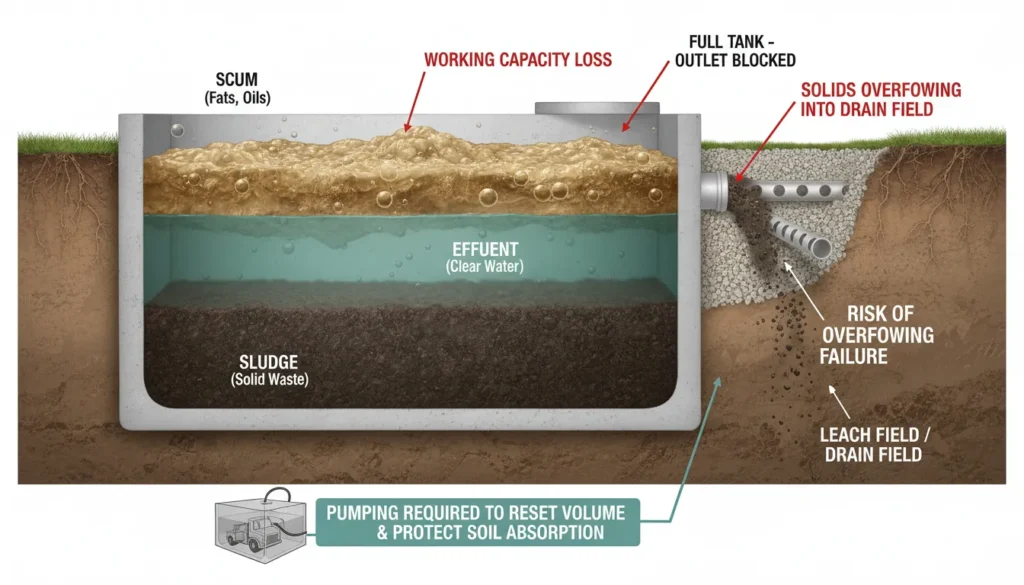
Most homeowners think their septic tank is like a never-ending hole, but it’s actually a delicately balanced treatment system. Here is why regular pumping is the most important maintenance task for your property:
1. The Build-up of Sludge and Scum
Every time you flush or run the dishwasher, waste enters the tank. Over time, heavy solids settle at the bottom to form the sludge layer, while fats and oils float to the top as the scum layer. These layers don’t just disappear; they build up month after month. Without professional pumping, these layers continue to grow until there is no room left for water treatment.
2. Reduced Working Capacity
As the sludge and scum layers get thicker, the “working capacity” of your tank shrinks. Instead of having 1,000 gallons of space to process wastewater, a full tank might only have 200 gallons of effective space. This leads to water moving through the tank too fast, which doesn’t give bacteria enough time to break down the waste properly.
3. Protecting the Drain Field (The $5,000+ Risk)
This is the most critical point. When a tank is overfull, the solid waste has nowhere to go but out through the outlet pipe. These solids then flow directly into your drain field (leach field), clogging the soil and the pipes. Once a drain field is choked with sludge, it stops absorbing water, leading to “pooling” in your yard. Fixing a failed drain field is a massive, expensive repair that often requires a total system replacement.
4. Avoiding a “Costly Mess”
Regular pumping is a small investment that prevents a costly mess. Waiting until you have a sewage backup in your bathtub means you aren’t just paying for pumping; you’re paying for emergency cleanup, potential pipe repairs, and property damage. In simple terms: $300-$500 for pumping now saves you $5,000+ later.
How a Septic Tank Works
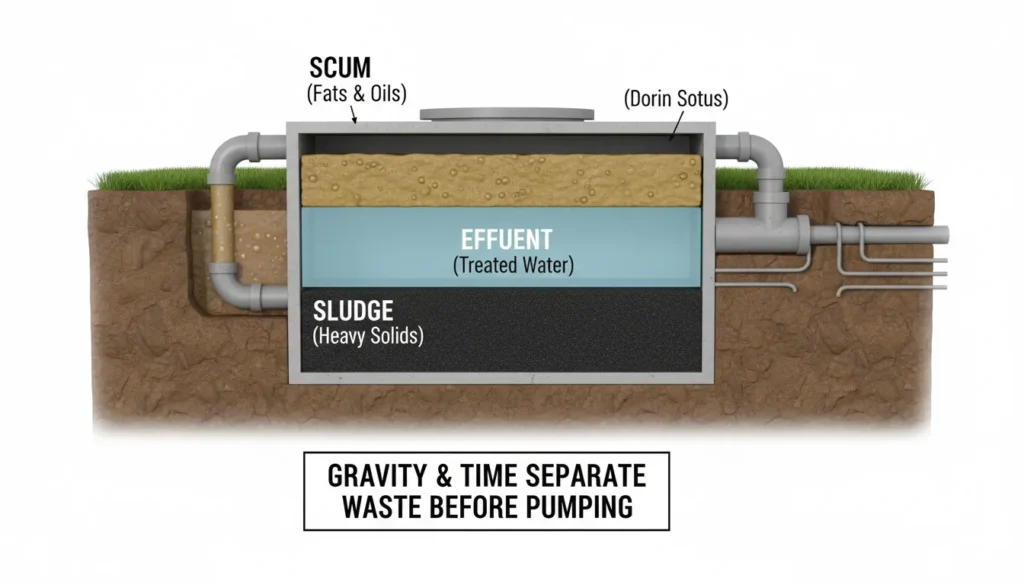
Before we talk about the pumping process, you need to understand the “3-Layer Rule” inside your tank. Every time you flush a toilet or run a faucet, the wastewater enters the tank and naturally separates:
The Sludge Layer (Bottom): Heavy solids sink to the base of the tank. Over months and years, these solids build up into a thick “sludge” that cannot leave the tank on its own.
The Scum Layer (Top): Lighter materials like grease, fats, and oils (FOG) float to the surface, creating a crusty top layer.
The Effluent (Middle): This is the relatively clear liquid sandwiched between the sludge and scum. This treated water is the only thing that is supposed to exit the tank and flow into your drain field (leach field) for final filtration into the soil.
The Problem: When the sludge and scum layers get too thick, there isn’t enough room for the effluent to settle. That’s when solids start escaping into your drain field—and that’s exactly why the pumping process is required to “reset” the system.
7 Warning Signs Your Septic Tank is Full
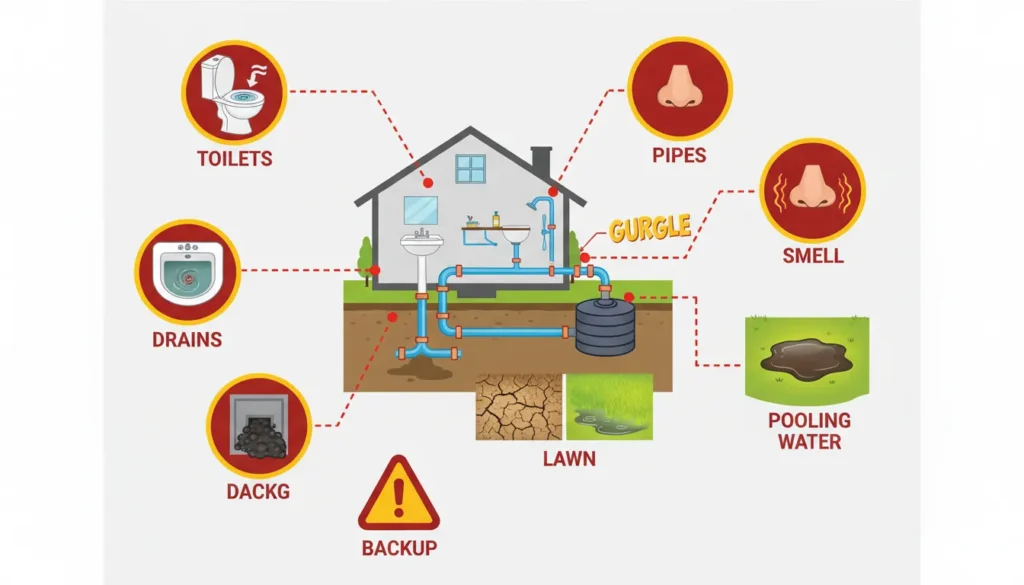
Most homeowners don’t look inside their tanks, but your plumbing will “talk” to you when it’s full. If you notice any of the following red flags, it’s time to call a professional before a small issue turns into a $5,000 disaster.
Toilets Won’t Flush Properly: If your toilets are struggling to flush or require multiple attempts, the tank might be reaching its maximum capacity, leaving no room for new waste.
Slow-Draining Fixtures: Are your sinks, tubs, or showers draining slower than usual? While it could be a simple clog, widespread slow drains across the house usually point to a full septic tank.
Gurgling Sounds in the Pipes: If you hear strange “gurgling” or bubbling noises coming from your drains or toilets after you run water, it’s often air being trapped by a backup in the system.
Foul Odors Near the Tank or Yard: A healthy septic system should be odorless. If you smell “rotten eggs” or raw sewage near the tank or over your drain field, the gases are escaping because the tank is overfilled.
Wet Patches Above the Leach Field: In the dry Miami heat, your yard should be consistent. If you see “spongy” grass, muddy patches, or standing water over your leach field, the soil is likely saturated and can’t absorb more effluent.
Surface Effluent Outside: Seeing dark, standing water on top of the ground near your septic area is a major red flag. This is untreated wastewater that has nowhere else to go.
Sewage Backups: This is the ultimate nightmare. If raw sewage starts backing up into your lowest drains (like the shower or basement), your tank is officially beyond its limit.
It’s Been a Long Time Since the Last Pump: Even if you don’t see signs, if it has been more than 3 to 5 years since your last service, your sludge levels are likely dangerously high.
How Often Should a Septic Tank Be Pumped?
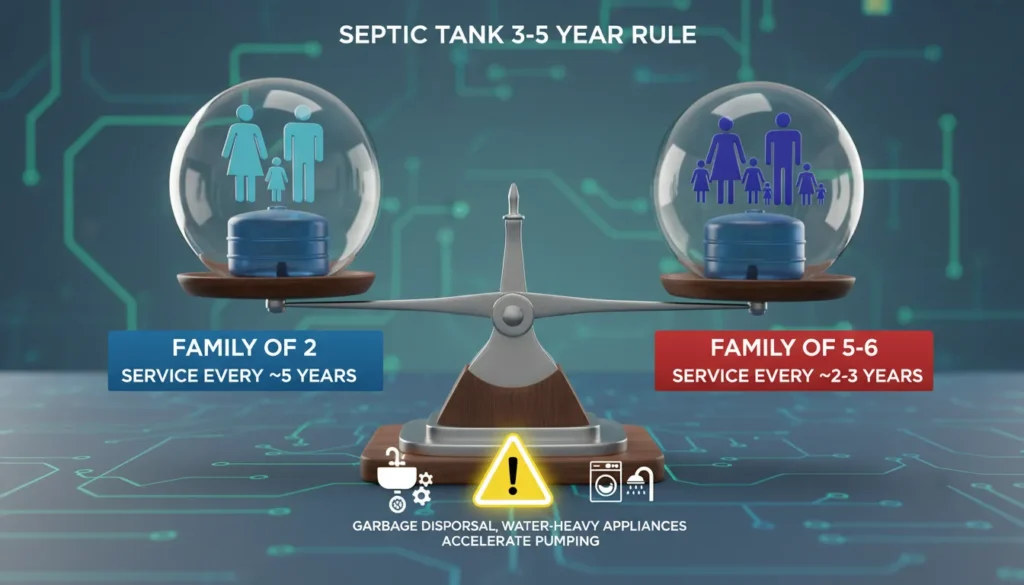
The most common question homeowners ask is: “When was the last time this was done?” While the general rule of thumb for most households is every 3 to 5 years, there is no “one size fits all” answer. The actual frequency depends on several critical factors:
1. Household Size & Usage
The more people living in your home, the faster the tank fills up. For example, a family of 2 living in a standard home might only need a pump-out every 5 years. However, a larger family using more water daily will significantly shorten that timeline.
2. Septic Tank Size
Your tank’s capacity is the biggest factor. A 1,000-gallon septic tank is very common, but if it’s servicing a 4-bedroom house with heavy water usage, it will reach its sludge limit much faster than a 1,500-gallon tank.
3. Garbage Disposal Use
If you use a garbage disposal frequently, you are adding a lot of “undigested” organic solids to the tank. This can increase the sludge buildup by up to 50%, meaning you might need to pump every 2 years instead of 4.
4. What Goes Down the Drain
The “Don’t Flush” list is real. If your household frequently flushes grease, wet wipes, or sanitary products, these items do not break down. They sit in the scum or sludge layers, taking up valuable space and forcing you to schedule a professional pumping much sooner.
5. Water Usage Habits
Constant “hydraulic loading” (running multiple loads of laundry and the dishwasher at the same time) doesn’t give solids enough time to settle. This turbulence keeps the tank “full” of moving particles, which can push waste into your drain field prematurely.
The Expert Advice: Don’t wait for a backup to tell you it’s time. If you can’t remember your last service, or if you’ve recently moved into a new home, an inspection is the safest way to determine if you are overdue.
What Happens During Septic Tank Pumping? Step by Step
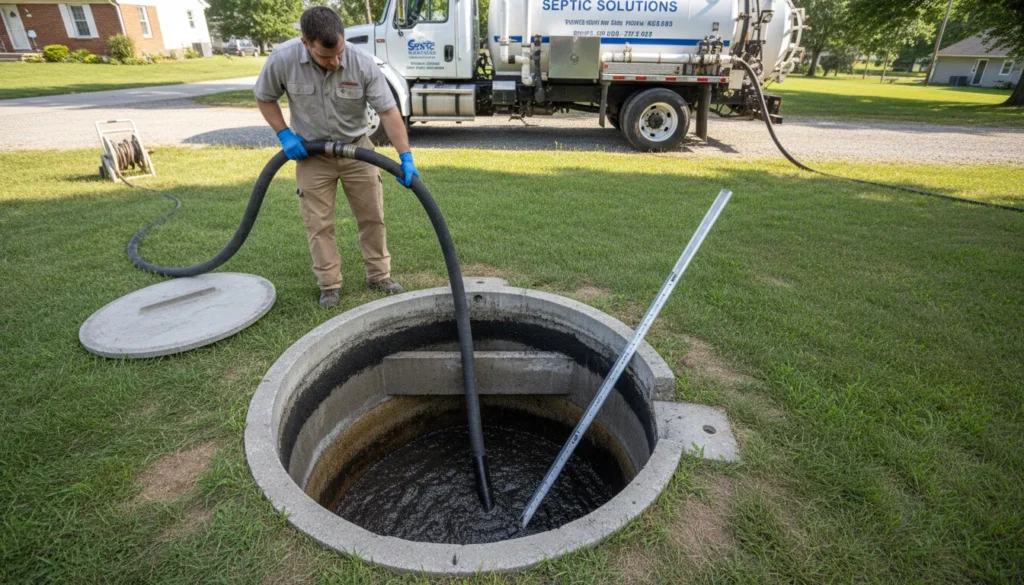
Many homeowners are curious about what actually happens when the big truck pulls into the driveway. The septic tank pumping process is a systematic professional service designed to “reset” your system’s health. Here is exactly what you can expect:
1. Locating the Tank and Access Lid
The first step is finding where the tank is buried. A professional technician will use a soil probe or an electronic locator to find the main tank lid. In some modern homes, risers (plastic or concrete pipes that extend to the surface) make this step easy. If your lid is buried deep, the technician may need to dig a small area to expose the main access point.
2. Opening the Lid or Risers Safely
Once located, the technician carefully removes the heavy concrete or plastic lid. Safety is the priority here because septic tanks contain harmful gases (like methane) that can be dangerous if inhaled. A pro will never leave an open tank unattended and will ensure the area is secure before the pump truck starts its work.
3. Measuring Sludge and Scum Levels
Before the vacuum starts, the technician often uses a “Sludge Judge” or a measuring pole to check the thickness of the scum layer (top) and the sludge layer (bottom). This helps determine if the tank was overdue and if there is any risk that solids have already moved toward the outlet pipe.
4. Pumping Out the Waste With a Vacuum Truck
This is the core of the service. A heavy-duty vacuum truck connects a large-diameter hose to the tank. The high-powered suction removes all the liquid (effluent) and the solid waste.
Pro Tip: A good technician will use a process called “back-flushing” or “sludge agitation” to break up the thick, dried-out solids at the bottom so they can be completely sucked out.
5. Inspecting the Tank, Baffles, and Visible Components
A “pump and run” service is never enough. Once the tank is empty, the technician performs a visual inspection:
Baffles: They check the inlet and outlet baffles to ensure they aren’t cracked or blocked.
Cracks/Leaks: They look at the tank walls for any signs of structural damage or root intrusion.
Backflow: They watch to see if water starts flowing back into the tank from the drain field—a major sign of a failing system.
6. Cleaning Up and Securing the Tank Again
After the inspection, any filters are cleaned, and the interior might be hosed down to remove remaining debris. The technician then hauls the pumped waste to an approved municipal waste disposal facility. Finally, the lid is replaced and secured tightly to prevent any accidents or odors.
How to Prepare Before the Septic Pumping Crew Arrives
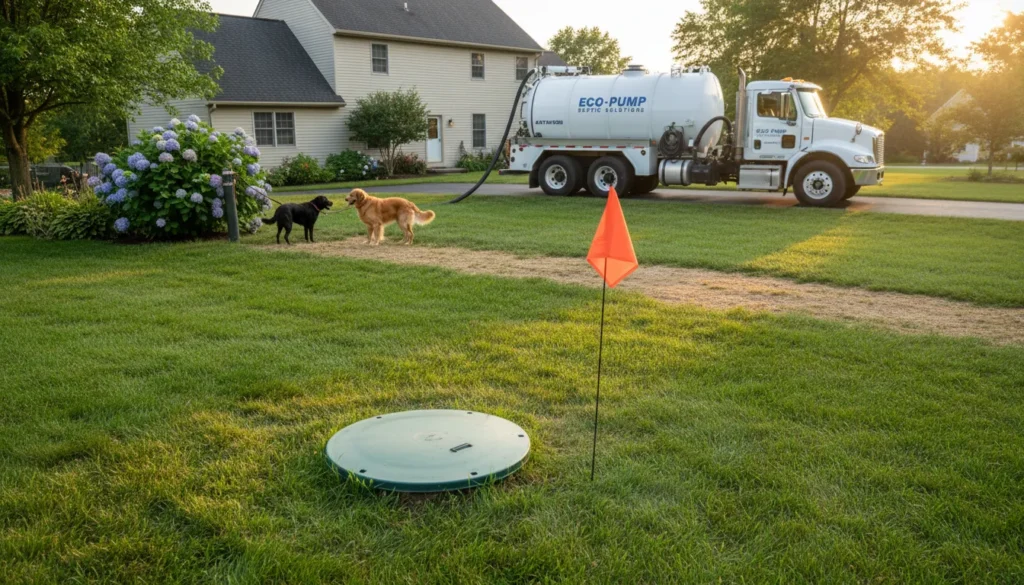
To make the septic tank pumping process as smooth and “Ez” as possible, a little preparation goes a long way. Professional crews work fast, but if they have to spend an hour just finding your tank, it could add to your service cost.
Follow this quick checklist before the pump truck pulls into your driveway:
1. Identify and Expose the Tank Location
If you know where your tank lid or risers are, mark them with a small flag or a garden stake. If the lid is buried under a few inches of soil, digging it out yourself can save the technician time and ensure they get straight to work.
2. Clear the Area and Remove Debris
Ensure there is a clear, unobstructed path from the street or driveway to the septic tank. Move any lawn furniture, potted plants, or decorative landscaping that might be in the way. The vacuum hoses are heavy and long, so they need a direct line of sight to the tank.
3. Secure Your Pets and Kids
Septic pumping involves heavy machinery, long hoses, and an open tank with hazardous gases. For safety, keep your pets and children inside the house until the technician has officially secured the lid and finished the job.
4. Reduce Water Usage
Try to minimize your water usage 24 hours before the appointment. Avoid running multiple loads of laundry or the dishwasher. A “resting” tank is much easier to pump and inspect than one that is currently being flooded with new wastewater.
5. Have Your Service History Ready
If you have records of when the tank was last pumped or a map of your septic system, keep them handy. Knowing the tank size (e.g., a 1,000-gallon vs. 1,500-gallon tank) helps the crew prepare the right equipment for disposal.
6. Demand Main Access Lid Usage (Expert Tip)
This is the most important “Pro Tip”: Ensure the technician uses the main access lid (usually 20-24 inches wide) to pump the tank. Some lazy providers try to pump through the smaller 4-inch inspection ports or baffles. Never allow this. Pumping through small pipes can damage your baffles and prevents the technician from properly “agitating” and removing the heavy sludge at the bottom.
How Long Does Septic Tank Pumping Take?
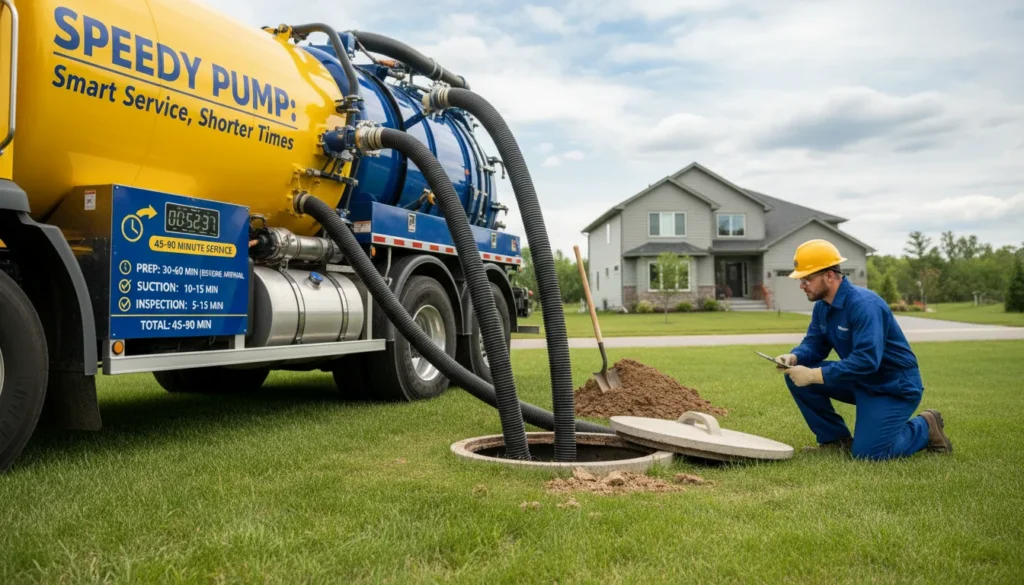
One of the most common questions homeowners ask is: “How much of my day will this take?” On average, a professional septic tank pumping service takes between 45 to 90 minutes. However, the “clock” starts only after the tank is located and accessed.
Several factors can influence the duration of your appointment:
1. Tank Size and Sludge Build-up
Naturally, a 1,500-gallon tank will take longer to empty than a 750-gallon one. Additionally, if you haven’t pumped in a decade, the sludge buildup at the bottom might be so thick that it requires “back-flushing” or “agitation” to break up the solids. This extra effort to ensure the tank is truly clean can add 15-20 minutes to the process.
2. Access Difficulty and Buried Lids
If the tank lid is buried 2 feet underground and the technician has to dig through roots or heavy clay, the time increases. Similarly, if the pump truck cannot park close to the tank, the crew has to haul and connect multiple sections of heavy vacuum hose, which adds to the setup time.
3. Additional Inspection Findings
A quality service isn’t just about sucking out waste; it’s about checking the system’s health. If the technician finds broken baffles, root intrusion, or a severely clogged effluent filter, they will need extra time to clean the filter or discuss repair options with you.
4. System Readiness
If you followed our preparation tips (Section 7) and have the area clear and the lid exposed, the process will be significantly faster. On the other hand, if the crew has to move lawn furniture or search for the tank location from scratch, expect a longer visit.
The Bottom Line: While the actual pumping is fast, a thorough job includes inspection and cleanup. Never trust a “15-minute pump-out”—it usually means they skipped the essential inspection steps.
What Happens If a Septic Tank Is Never Pumped?

It’s tempting to think, “If it’s not backed up, it’s working fine.” But the reality is that a septic tank is a ticking time bomb if left unserviced. Here is the chain reaction of what happens when you skip the septic tank pumping process:
1. Solids Move into the Drain Field
The most dangerous consequence happens out of sight. When the tank is full of sludge, there is no space for solids to settle. These solids move into the drain field (leach field), where they shouldn’t be. Once there, they clog the perforated pipes and the soil, effectively “suffocating” your system.
2. Complete Leach Field Blockage
As the sludge builds up in the soil, the drain field stops absorbing water. This leads to wet, messy ground and standing “effluent” in your yard. Once a leach field is totally blocked, it usually cannot be “cleaned”—it often has to be dug up and replaced, which is expensive to rectify.
3. Sewage Backup into Your House
This is the moment every homeowner dreads. When the tank and pipes are full, the wastewater has nowhere to go but back up. You’ll start seeing raw sewage backing up into your toilets, showers, and sinks. This isn’t just a plumbing issue; it’s an expensive emergency cleanup that requires professional biohazard remediation.
4. Hazardous Waste and Bad Smells
A full tank begins to vent bad smells (rotten egg odor) around the yard and even inside the home. This isn’t just a nuisance; septic waste contains hazardous waste and harmful gases (like hydrogen sulfide). Exposure to these gases and untreated sewage can pose serious health risks to your family and pets.
5. Financial Disaster
A routine pump-out costs a few hundred dollars. A failed drain field or a complete system replacement can cost anywhere from $5,000 to $15,000. By the time you see the “signs” of a full tank, the damage to the drain field might already be done.
The Reality Check: You can either pay for a scheduled maintenance visit now or pay for a massive, messy emergency later. In the world of septic systems, prevention is the only way to save your wallet.
Can a Septic Tank Be Pumped Too Often?
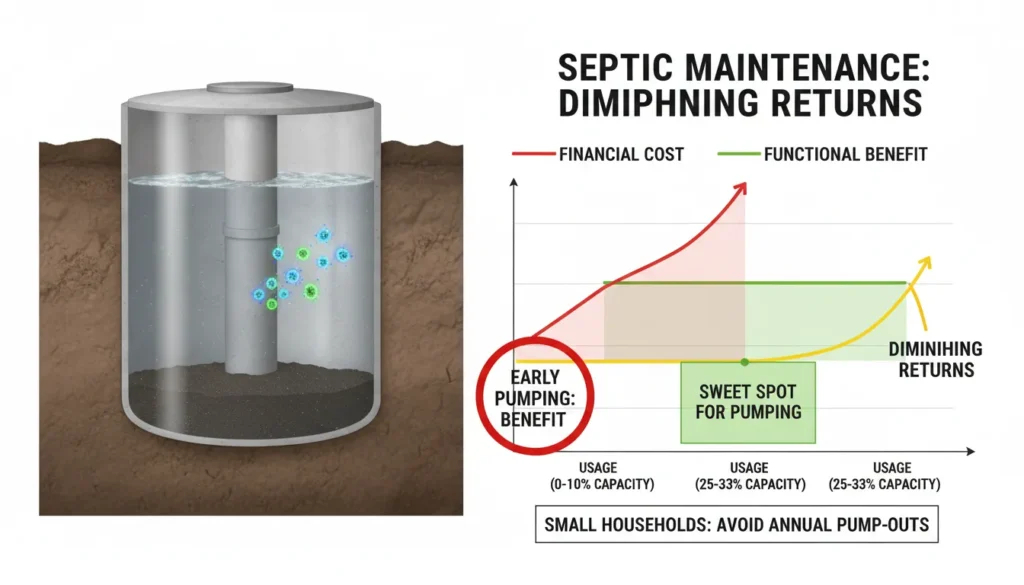
In the world of home maintenance, “more” isn’t always “better.” While regular service is critical, many homeowners wonder if they can overdo it. Here is the short answer to this common septic tank pumping mystery:
No, but it’s a Waste of Money
Technically, pumping your septic tank too often is not harmful to the system’s mechanical structure. Unlike some myths suggest, removing the waste doesn’t “kill” the bacterial balance forever; the natural bacteria in your household waste will quickly repopulate the tank. However, pumping a tank that is only 10% full is simply an unnecessary cost that doesn’t provide any extra benefit to your plumbing.
The Importance of an Actual Schedule
Instead of guessing or pumping every single year “just because,” your frequency should be based on three factual pillars:
Tank Size: A 1,000-gallon tank has a different limit than a 1,500-gallon one.
Household Usage: More people means more sludge buildup.
Professional Inspection: A technician can measure your sludge and scum levels to tell you if you actually need a pump-out or if you can wait another year.
The Real Risk: Wrong Access Points
The danger isn’t in the frequency of the pumping, but in the method of access. If a provider frequently opens your tank through a small inspection port or “baffle pipe” instead of the main access lid, they risk cracking the pipes or damaging the structural integrity of the tank. Repeatedly digging up your yard in the wrong spot can also lead to soil compaction over the tank.
The Verdict: Stick to a 3-to-5-year schedule unless an inspection shows your sludge levels are over 30% of the tank’s capacity. Pumping every 12 months for a family of two is usually overkill—unless you’re flushing things you shouldn’t!
Septic Pumping vs. Septic Cleaning vs. Septic Inspection
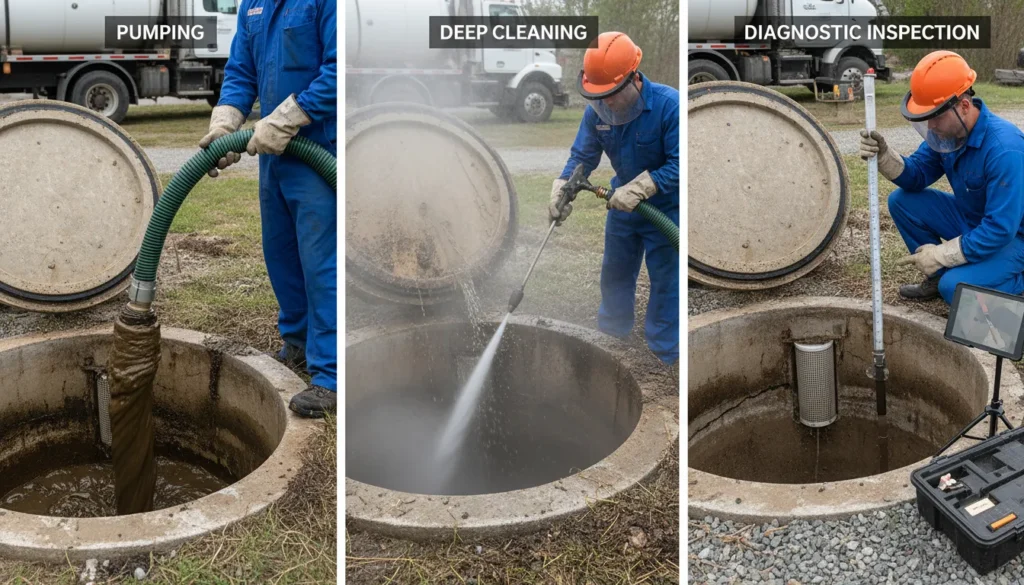
Homeowners often use these terms interchangeably, but in the plumbing world, they mean different things for your system’s health. Understanding the difference can save you from paying for a service you don’t actually need—or missing a critical repair.
1. Septic Tank Pumping The “Standard” Service
This is the routine maintenance most people need every 3 to 5 years. Septic tank pumping involves using a vacuum truck to remove the accumulated sludge and scum layers. The goal is to clear out the solid waste to prevent it from escaping into the drain field. It “resets” the tank’s capacity so it can continue processing wastewater properly.
2. Septic Tank Cleaning The “Deep Clean”
While some people use this term loosely to mean pumping, true septic cleaning is a more intensive process. During a cleaning, the technician doesn’t just vacuum the waste; they may use high-pressure water (hydro-jetting) to scrub the walls of the tank and break up “hardened” sludge that has been sitting for years. This is usually recommended if a tank hasn’t been pumped in a decade or if there is severe root intrusion.
3. Septic Tank Inspection The “Health Check”
An inspection is a diagnostic service. A professional uses cameras or specialized tools to check the structural integrity of the tank, the condition of the baffles, and the health of the drain field.
The Pro Tip: Every quality pumping visit should include a basic “inspection-level” insight. A good technician will naturally check for cracks or backflow while the tank is empty. However, a “Full Point-of-Sale Inspection” (often required when buying or selling a house) is a separate, more detailed legal document.
Simple Septic Maintenance Best Practices

The septic tank pumping process is your system’s “reset button,” but what you do between pump-outs determines how long that reset lasts. If you want to avoid emergency backups and keep your Miami home smelling fresh, follow these gold-standard maintenance tips:
1. Watch What Goes Down the Drain The “No-Fly” List
Your septic tank is not a trash can. To keep your sludge levels low, never flush or drain:
Grease, Fats, and Oils: These solidify in your pipes and create a massive “scum” layer that’s hard to pump.
Flushable Wipes: (Pro Tip: They aren’t actually flushable!). They don’t break down and will clog your inlet baffles.
Sanitary Products & Paper Towels: These take up huge amounts of space and lead to instant blockages.
Coffee Grounds: They don’t decompose easily and sink straight to the bottom, filling your sludge layer quickly.
2. Go Easy on the Chemicals
Your septic system relies on living bacteria to break down waste. Pouring harsh drain cleaners, bleach, or excessive floor cleaners down the sink is like “poisoning” your tank’s natural workers. Use septic-safe or biodegradable cleaning products whenever possible to keep the biological balance healthy.
3. Manage Your “Hydraulic Load”
If you run five loads of laundry, the dishwasher, and three showers all in one morning, you are “flooding” your tank. This excessive water load doesn’t give solids enough time to settle, pushing raw waste straight into your drain field. Spread out your laundry throughout the week and fix leaky fixtures immediately—a dripping faucet can add hundreds of gallons of unnecessary water to your tank every month.
4. Protect the Drain Field No Parking!
The soil above your leach field needs to stay loose and porous to absorb water. Never park a car or drive heavy machinery over your septic tank or drain field. This “soil compaction” can crush your pipes and kill the soil’s ability to filter wastewater, leading to a total system failure.
5. Don’t Plant Trees Over the Tank
Tree roots are “septic seekers”—they love the moisture and nutrients inside your tank. Roots can crack concrete walls and clog pipes. Keep large trees and shrubs at least 10–20 feet away from the entire septic area.
6. Stick to Professional Checks
Even if everything seems fine, have a professional do a quick visual check every year. A 10-minute inspection can catch a cracked lid or a blocked baffle before it becomes a $5,000 emergency.
When to Hire a Professional Septic Pumping Service
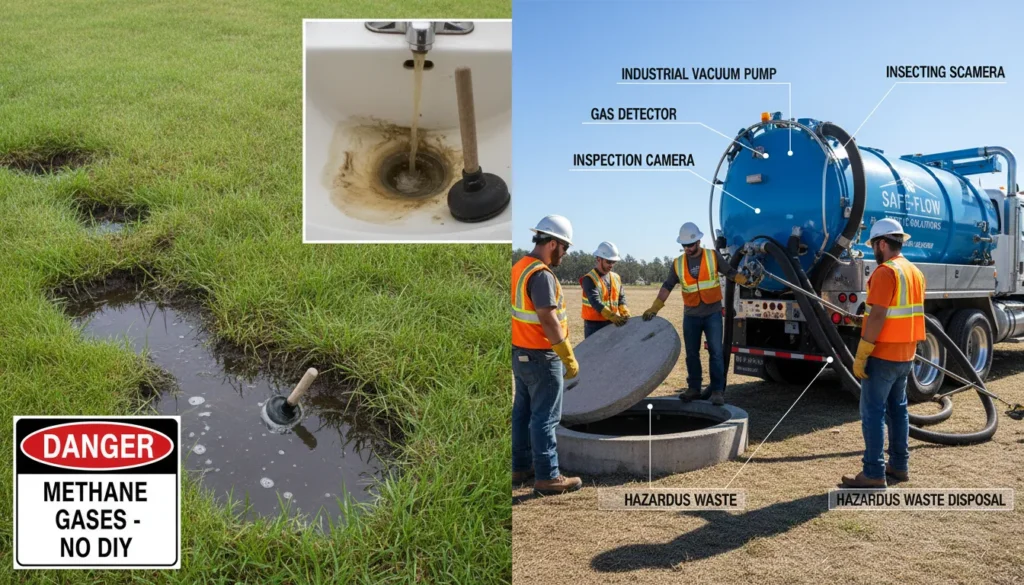
Septic maintenance is not a DIY project. While you can change a lightbulb or fix a leaky faucet, the septic tank pumping process involves biohazards and heavy machinery that require expert handling. You should hire a professional immediately if you experience any of the following:
1. Visible Symptoms & Backups
If your toilets are gurgling, your drains are sluggish, or—worst-case scenario—raw sewage is backing up into your tubs, stop using water and call a pro. These are clear signs that your tank has reached its absolute limit and is failing to process waste.
2. Overdue for Service
If you can’t remember the last time your tank was pumped, you are likely overdue. Most experts recommend a pump-out every 3 to 5 years. Waiting for a “sign” often means waiting for damage to occur. A proactive pump-out is always cheaper than an emergency repair.
3. Foul Odors and Wet Patches
If your backyard smells like a sewer or you notice unexplained wet patches over your leach field, your system is “venting” gases and liquid that should be underground. This indicates a blockage or an overfilled tank that needs professional vacuuming and inspection.
4. Uncertainty About Tank Condition
If you’ve just moved into a new home in Miami and don’t have the service history, don’t guess. A professional can locate the tank, measure the sludge and scum levels, and tell you exactly how much “life” is left before the next pump.
5. The “Safety First” Rule (Why DIY is Dangerous)
Never attempt to open or enter a septic tank yourself. Septic tanks are confined spaces filled with hazardous waste and harmful gases like methane and hydrogen sulfide. These gases can cause immediate unconsciousness or even death. A professional crew has the right safety gear, high-powered vacuum trucks, and a legal way to dispose of waste at an approved facility.
Conclusion: Don’t Wait for a Disaster
The septic tank pumping process might seem like a chore, but it is the single most important thing you can do to protect your home’s value and your family’s health. By spotting the 7 warning signs early and sticking to a regular 3-to-5-year schedule, you can avoid messy backups and save thousands in expensive repairs.
If you’re in the Broward County or Fort Lauderdale area and suspect your tank is full, don’t leave it to chance. A quick professional pump-out today ensures your plumbing stays “Ez” and worry-free for years to come.
Frequently Asked Questions About Septic Tank Pumping
The process involves a professional vacuum truck connecting a high-powered hose to the main access lid of your tank. The technician suctions out all the liquid effluent, the floating scum layer, and the heavy sludge at the bottom. They also perform a visual inspection of the baffles and tank walls to ensure everything is structurally sound.
Yes, various parasites and bacteria, including tapeworms, can live in a septic tank’s untreated sewage. This is why you should never attempt a DIY pump-out or come into direct contact with the waste. Professional waste disposal at a municipal facility is the only safe way to handle these biohazards.
Note: Most US tanks are measured in gallons (1,000 gallons ≈ 3,800 litres). For a small 1,000-litre tank, the cost is usually on the lower end of the scale, but since a pump truck has a flat “trip fee,” you can expect to pay anywhere from $250 to $450 depending on your location and how difficult the tank is to access.
Yes, a professional service should remove 95% to 100% of the contents. However, as soon as you start using your water again (showers, toilets), the tank will begin to refill with liquid. This is normal! The goal of pumping isn’t to keep the tank empty of water, but to keep it empty of solids (sludge).
Technically, it can, but it’s a massive gamble. A tank that hasn’t been pumped in 20 years is almost certainly overflowing with sludge. Even if you don’t have a backup yet, that sludge is likely leaking into your drain field, causing invisible damage that will eventually cost $10,000+ to replace.
The general rule is every 3 to 5 years. However, a family of 2 in a large home might last 5 years, while a family of 6 with a garbage disposal might need a pump-out every 2 years.
Look for the “Big 3” signs: slow drains throughout the house, foul odors (rotten eggs) in the yard, and lush, green, or wet patches of grass directly over the tank or leach field.
In 2026, the national average for a standard 1,000-gallon septic tank pump-out ranges from $300 to $600. Factors like buried lids (requiring digging), emergency “after-hours” calls, and long hose runs can increase this price.
Need Septic Tank Pumping in Miami?
Maintaining a healthy septic system shouldn’t be a guessing game. While understanding the septic tank pumping process is the first step toward being a responsible homeowner, taking action before a crisis is what saves your property’s value.
At Ez Plumbing Repair Services, we believe in proactive maintenance to keep your home’s plumbing running smoothly. If you’re noticing slow drains, sewage odors, or unexplained wet patches in your yard, professional septic pumping may help prevent much bigger, more expensive problems down the road.
Don’t wait for a messy backup to disrupt your life. Whether you are overdue for your 3-year service or simply want a professional health check for your tank, our expert team is here to help.