The Ultimate Guide to Hydro Jetting: Process, Costs, and Pipe Safety
When a sewer line backs up, the first moment is incredibly stressful. However, before understanding the “Hydro Jetting” process, it is essential to know if your issue is a common blockage or a serious emergency that could damage your home’s foundation.
Immediate Red Flags: Signs of Danger
If you notice the following situations in your home, understand that your drainage system is at a “Critical Point”:
Gurgling Sounds: When you flush the toilet or drain water from the sink, “gurgling” noises coming from the pipes are a sign that air and water cannot find a clear path.
Foul Odors (Rotten Egg Smell): If a “Rotten Eggs” smell is coming from the laundry or bathroom, it means Sewer Gas (Methane) is entering your home because a blockage has blocked the P-trap’s path.
Multiple Slow Drains: If more than one drain in the house (such as the shower and kitchen) is draining water slowly, the problem is not in a single pipe, but in your Main Sewer Line.
Emergency Steps: What to Do Immediately?
To prevent a sewer backup from worsening, take these 2 steps immediately:
Shutting Off Water: Turn off the home’s main water supply valve. Until the drainage is clear, using more water (running the dishwasher or washing machine) will cause a flood on your floor.
Locate the Main Clean-Out: In most Miami homes, there is a white PVC cap in the yard called a “Clean-out.” Opening this slowly releases pipe pressure and allows the inflowing dirty water to be redirected outside instead of inside.
The “Miami Factor”: South Florida’s Challenges
In Miami, plumbing doesn’t just fail because it’s old; our environment is also an enemy:
High Humidity & Scaling: Miami’s humidity and mineral-rich water (Hard Water) create a hard layer of “Mineral Scale” inside pipes that a common plumbing snake cannot break.
Sandy Soil & Tree Roots: Our soil is sandy, which causes tree roots to enter sewer line joints in search of water, trapping the “Lint Monster” or other debris.
What is Hydro Jetting?
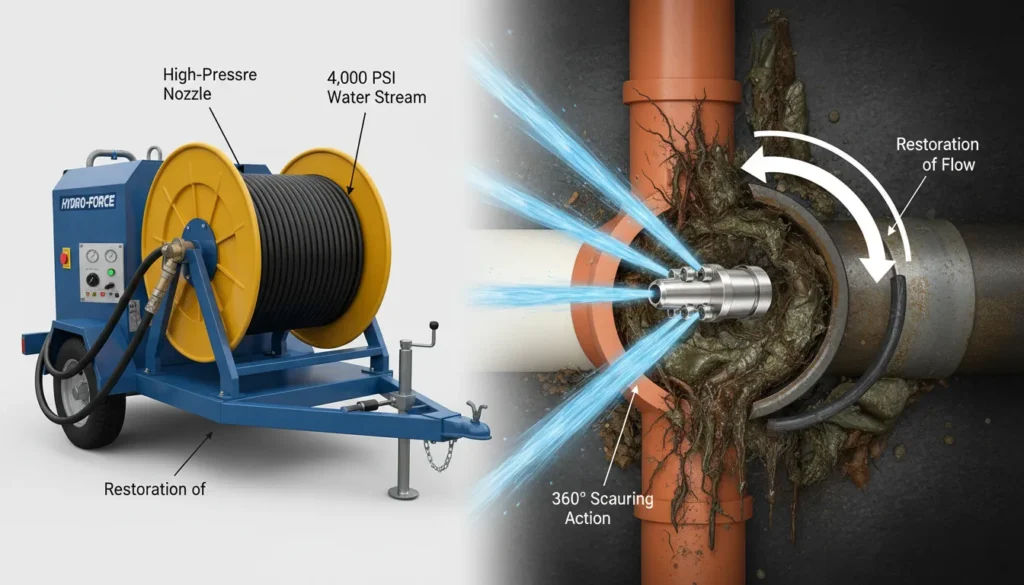
To understand why hydro jetting is the gold standard for sewer maintenance, you have to look beyond simple “drain cleaning.” While a plunger or a hand-snake is a DIY fix for a surface clog, hydro jetting is a heavy-duty engineering solution designed to restore the structural flow of your entire plumbing system.
The Physics of 4,000 PSI: Scouring vs. Mechanical Cutting
Most people are familiar with “snaking,” where a motorized metal cable (auger) spins through the pipe. While effective for punching a small hole through a soft clog, it leaves behind a thick coating of grease and scale on the pipe walls.
Hydro jetting uses a different physical principle:
The Scouring Action: By blasting water at pressures up to 4,000 PSI (pounds per square inch), the jetter creates a high-velocity “curtain” of water. This doesn’t just poke a hole; it scours the pipe walls 360 degrees.
Total Debris Emulsification: The sheer force of the water emulsifies grease (turns it into a liquid) and pulverizes tree roots into fine mulch, flushing them completely out to the city main. It is the difference between poking a hole in a dirty window and using a pressure washer to make it crystal clear.
The Equipment: RIDGID KJ-3100 & Specialized Nozzles
Professional hydro jetting in Miami requires industrial-grade machinery. At the heart of this service is the RIDGID KJ-3100 Water Jetter, a high-capacity unit specifically designed for 2-inch to 10-inch lines.
The secret to its success lies in the Multi-Directional Nozzles:
Forward-Facing Jets: These blast through the initial blockage to clear a path for the hose.
Rear-Facing Propulsion Jets: These spray backward at an angle, providing the thrust needed to pull the hose deep into the sewer line while simultaneously scrubbing the pipe walls as the hose is retracted.
Root-Cutting Heads: Specialized spinning nozzles that act like high-speed saws, powered entirely by water pressure.
Eco-Friendly Advantage: The “Zero Chemicals” Strategy
In the past, many homeowners relied on caustic acids or liquid drain cleaners to “melt” clogs. However, for Miami homes with older Cast Iron or modern PVC pipes, chemicals are a dangerous gamble.
Protecting Your Pipes: Chemicals generate intense heat (exothermic reactions) that can soften PVC joints or accelerate the corrosion of Cast Iron. Hydro jetting uses only water, ensuring your pipes remain structurally sound.
Environmental Impact: Since no toxins are used, there is zero risk of chemicals leaking into the Florida groundwater or damaging the bacterial balance of a septic system. It is the safest, most sustainable method for deep-cleaning a residential or commercial plumbing system.
Hydro Jetting vs. Snaking
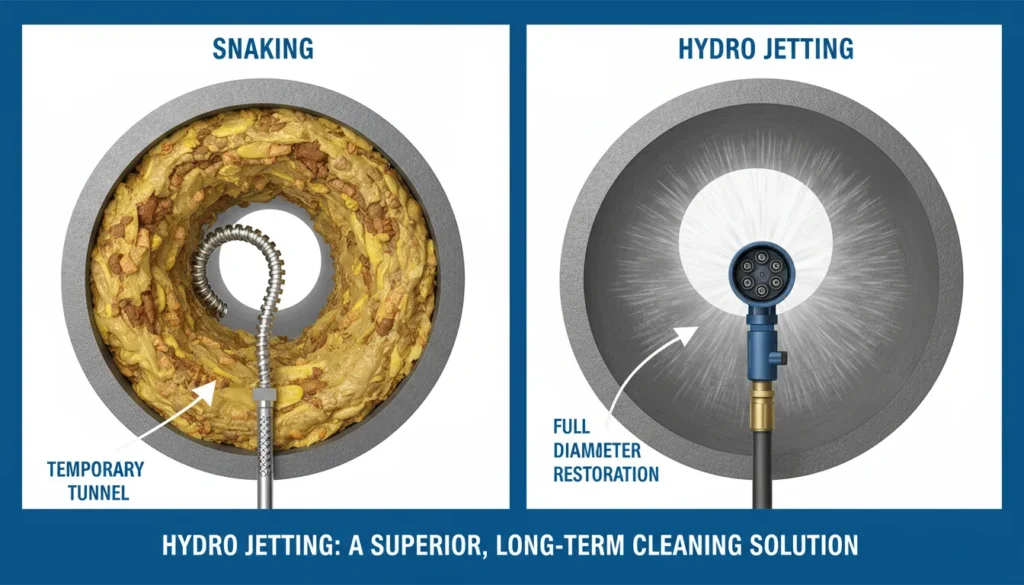
When faced with a clogged sewer line, most homeowners ask: “Should I just snake it or pay for hydro jetting?” While snaking is a classic plumbing technique, it is often a “band-aid” fix for a deeper problem. To help you decide, we have compared the two methods across four critical performance metrics.
Quick Comparison: Which Method is Right for Your Pipes?
| Feature | Traditional Drain Snaking | Professional Hydro Jetting |
| Primary Action | Pokes a hole through the clog. | Scours 360° of the pipe wall. |
| Effectiveness | Best for soft clogs (hair, paper). | Best for grease, scale, and roots. |
| Reach/Depth | Limited to the length of the cable. | Can reach hundreds of feet easily. |
| Longevity | Clogs often return in 3–6 months. | Keeps pipes clean for years. |
| Pipe Safety | Can scratch old cast iron. | Safe for all structurally sound pipes. |
| Average Cost | $150 – $300 (Initial fix). | $350 – $1,000 (Long-term solution). |
The “Snake” Limitation: Why a Cable is Only a Temporary Fix
A plumbing snake (or drain auger) consists of a rotating metal cable with a hook or blade at the end. While it has been the industry standard for decades, it has one major flaw when dealing with Main Sewer Lines:
The “Tunnel” Effect: In a 4-inch sewer pipe filled with grease or sludge, a 1-inch snake head only creates a 1-inch hole. The water starts flowing again, but the thick “grease berg” remains attached to the walls.
The Root Trap: A snake can tear through tree roots, but it leaves the “stubs” behind. These stubs act like a net, catching toilet paper and debris immediately after the plumber leaves, leading to a recurring backup within weeks.
The “Jetter” Superiority: Why Scrubbing the Pipe Wall Prevents Future Backups
Hydro jetting is not just about clearing a path; it is about restoring the diameter of the pipe. By using high-velocity water, the process achieves what a mechanical cable cannot:
Total Emulsification: It turns solidified grease and oil into a liquid slurry that is completely flushed out of your system.
Polishing the Surface: Because the water scours the entire circumference of the pipe, it leaves the interior surface smooth. Debris cannot “snag” on a smooth pipe wall, which is why jetting significantly extends the time between maintenance visits.
Root Pulverization: Instead of just cutting roots, the 4,000 PSI pressure pulverizes them at the entry point, slowing down their regrowth significantly compared to a mechanical cut.
When Do You Need Hydro Jetting? The Warning Signs
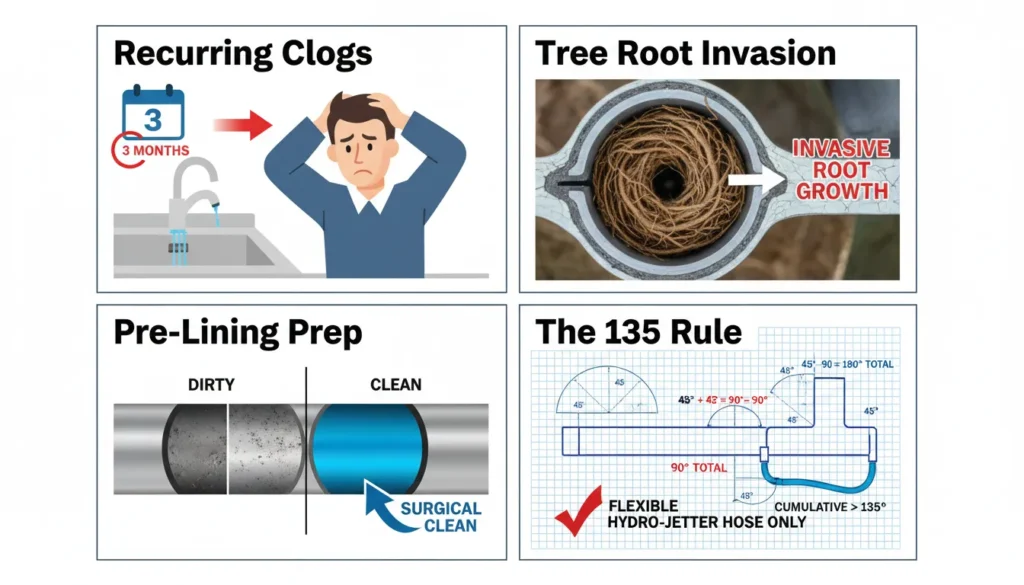
Knowing when to switch from a simple plunger to professional hydro jetting can save you thousands of dollars in emergency repairs. If your Miami home is showing any of the following “red flags,” a standard snake will likely fail, and high-pressure water is the only solution.
Recurring Clogs: The “3-Month Cycle”
If you find yourself calling a plumber to snake your main drain every 3 to 6 months, you aren’t actually fixing the problem—you are just managing a symptom.
The Reality: Recurring clogs are a sign of thick grease buildup or sludge that a mechanical cable cannot grab.
The Solution: Hydro jetting breaks the cycle by scouring the pipe walls clean, ensuring that debris has nothing to “snag” on for years, not just weeks.
Tree Root Invasion: The Miami Landscape Challenge
In South Florida, trees like Ficus, Banyan, and Palms have aggressive, moisture-seeking root systems. Because our soil is sandy, these roots easily find tiny hair-line cracks in your sewer joints.
The “Web” Effect: Once inside, roots grow into a thick “web” that catches toilet paper and waste.
Why Jetting Wins: While a snake might just poke a hole in the roots, hydro jetting pulverizes the root mass at the entry point and flushes the fragments away, significantly slowing down regrowth.
Before Pipe Relining: Preparing for Trenchless Repairs
If you are planning on Trenchless Pipe Lining (CIPP) to fix a cracked sewer, hydro jetting is a mandatory first step.
The 100% Clean Rule: The epoxy liner needs a perfectly smooth surface to bond to the old pipe.
The Risk: If any grease, scale, or roots remain, the liner will fail to seal, leading to an expensive secondary repair. Hydro jetting is the only way to achieve the “surgical” level of cleanliness required for relining.
The “135 Rule” in Plumbing: Navigating Sewer Bends
A technical secret that many homeowners (and amateur plumbers) miss is the 135 Rule. This refers to the total degrees of “change in direction” in a sewer line.
The Geometry: Most sewer lines have multiple 45-degree or 90-degree bends. If your pipe has more than 135 degrees of total turning (e.g., a 90° bend followed by a 45° bend), a mechanical snake cable will lose its torque and “spring” strength, making it impossible to clear the clog effectively.
The Jetter Advantage: Because a hydro jetter uses a flexible, high-pressure hose propelled by water, it can easily “snake” through multiple bends beyond 135 degrees without losing any cleaning power.
Is Hydro Jetting Safe for Your Pipes?
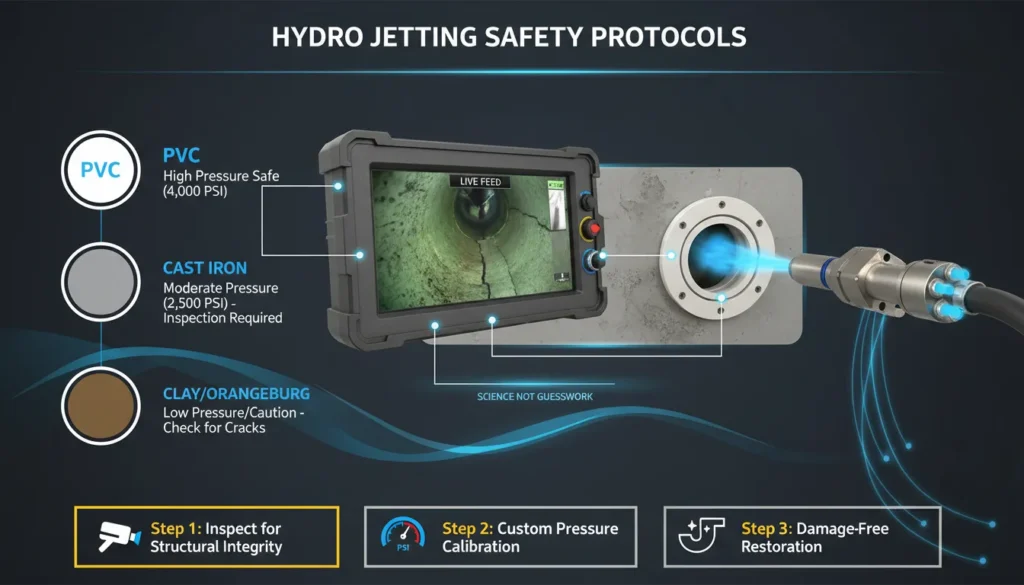
One of the most common questions Miami homeowners ask is: “Will 4,000 PSI of water pressure shatter my old pipes?” The honest answer is that while hydro jetting is incredibly effective, it must be performed with professional precision. A “one-size-fits-all” approach to water pressure can lead to disaster, which is why understanding pipe material is critical.
The Risk Factor: Old Clay and Orangeburg Pipes
Miami’s older neighborhoods often still have original plumbing made of materials that pre-date modern PVC.
Clay Pipes: Common in homes built before the 1970s. These are porous and can become brittle over decades. If a clay pipe is already cracked by tree roots, high-pressure jetting can expand those cracks.
Orangeburg Pipes: Made of wood pulp and tar, these pipes are known to “oval” or flatten over time. Hydro jetting is generally not recommended for Orangeburg pipes that have lost their structural integrity.
Cast Iron: While very strong, old cast iron can suffer from “bottom rot.” A professional will always check the thickness of the pipe before increasing the pressure.
Safety Precautions: Why CCTV Inspection is Non-Negotiable
A true professional will never start a hydro jetter without first performing a CCTV Video Camera Inspection.
The “Blind” Risk: Inserting a jetter into a pipe without seeing inside is like performing surgery with your eyes closed.
The Diagnostic Goal: The camera reveals if the pipe is simply clogged (safe to jet) or structurally collapsed (unsafe to jet). If the pipe is broken, jetting will only wash away the surrounding soil, creating a sinkhole under your home.
Post-Jetting Verification: We also use the camera after the job to ensure 100% of the debris is gone and no damage occurred.
Pressure Management: PSI Customization
A key “Competitor Miss” is failing to explain that PSI (Pounds per Square Inch) must be adjusted based on the pipe’s material and age.
PVC Pipes: Modern plastic pipes can typically handle the full 4,000 PSI to blast away heavy grease.
Cast Iron / Older PVC: We often reduce the pressure to 2,000 – 3,000 PSI to ensure the “scouring” action cleans the walls without stressing the old joints.
Residential vs. Commercial: While commercial 8-inch mains might need maximum power, a 2-inch kitchen line requires a smaller nozzle and lower, controlled pressure to prevent “blowback” into the house.
The Professional Hydro Jetting Process: Step-by-Step
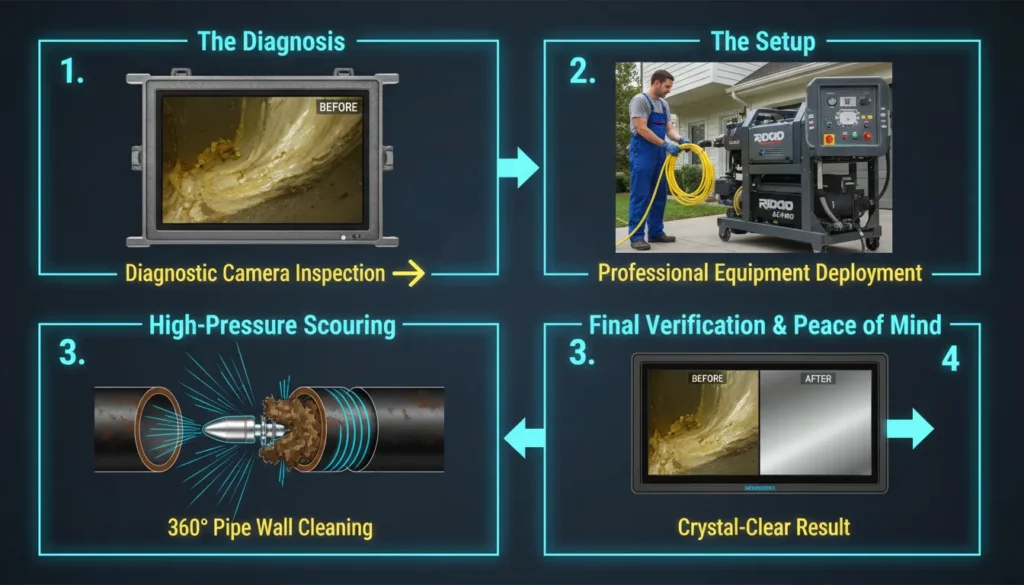
Hydro jetting is a precise, multi-stage engineering process. It is not as simple as sticking a hose into a pipe; it requires a calculated sequence to ensure the blockage is removed without causing a mess in your home. Here is exactly what happens when a professional team arrives at your property.
Phase 1: Diagnostic Camera Inspection (Identifying the “Grease Berg”)
Before any water is sprayed, we perform a high-definition CCTV Sewer Camera Inspection.
The Goal: We need to find the “Enemy.” Is it a solid “Grease Berg” (solidified cooking oils), a “Lint Monster” (buildup from laundry drains), or invasive tree roots?
Structural Check: We verify the pipe’s health. If we see a collapsed section, we stop the process to prevent a sinkhole.
Phase 2: Accessing the Cleanout (Setting Up the Equipment)
We locate the Sewer Cleanout, usually found in the yard or near the foundation of your home.
Specialized Gear: We deploy the Schieffer Thermoplastic Sewer Jetter Hose. This high-grade, flexible hose is designed to navigate tight 90-degree bends without losing pressure or scratching the interior of your pipes.
Pressure Calibration: Based on Phase 1, the technician sets the machine (like the RIDGID KJ-3100) to the exact PSI needed for your specific pipe material.
Phase 3: The 360-Degree Scour (Total Pipe Restoration)
This is where the magic happens. The technician feeds the jetting nozzle into the line.
The Forward Jet: A high-velocity stream blasts through the center of the clog, breaking it into manageable pieces.
The Rear Propulsion Jets: Multiple jets spray backward at a 45-degree angle. These jets do two things: they propel the hose deeper into the line and scour the pipe walls 360 degrees as the hose is slowly retracted.
The Result: The grease is emulsified (liquefied) and the roots are pulverized, sending everything downstream to the municipal sewer main.
Phase 4: Final Verification (The “Like-New” Proof)
We don’t just “assume” the job is done. A professional service always ends with a Final Camera Verification.
The “After” Shot: We send the camera down one last time. You will see a perfectly smooth, dark-grey or white interior wall (depending on your pipe material).
Peace of Mind: This recording serves as proof that your sewer line has been restored to its original flow capacity, giving you years of worry-free drainage.
Cost & Considerations in Miami
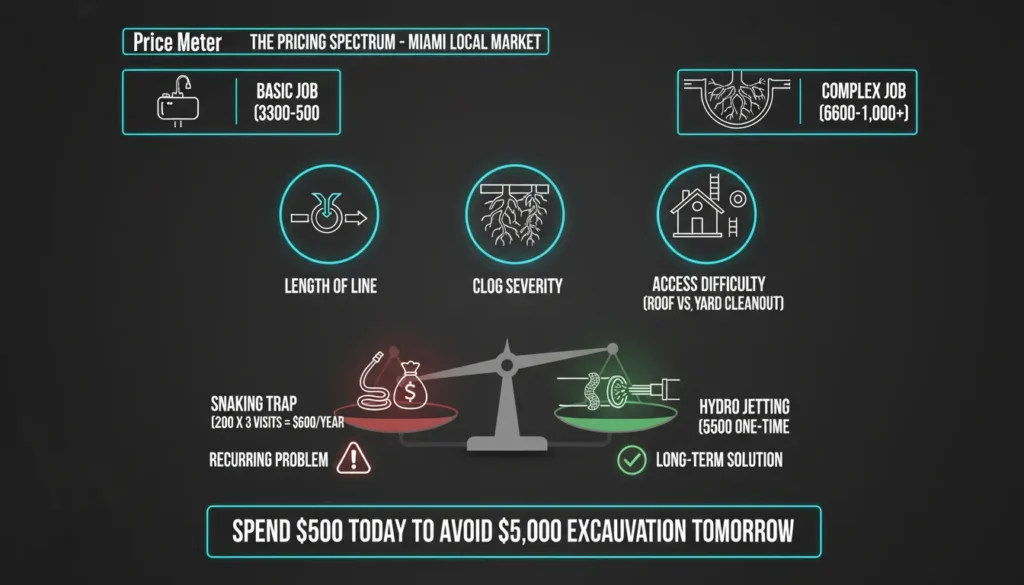
When it comes to sewer line cleaning, every homeowner’s question is: “How much will it cost?” In Miami, the price of Hydro Jetting is not fixed; rather, it depends on the condition of your system. Below we have provided a breakdown so you can make the right decision.
The Pricing Spectrum: Price Estimate
In Miami, residential hydro jetting prices typically range between $300 and $1,000.
Basic Cleaning ($300 – $500): If the problem is just a single kitchen line or a small grease clog that is easily accessible from a cleanout.
Complex Job ($600 – $1,000+): If the entire main sewer line is filled with roots or the blockage is deep inside the house where more effort and heavy equipment are required.
Factors that Change the Price: Why Does the Price Go Up or Down?
Three main things affect your bill:
Pipe Length: The longer the pipe, the more time and “Schieffer Hose” length will be used.
Severity of the Clog: A common grease clog is cleared quickly, but if Miami’s tough Ficus Roots have gripped the pipe, it requires more PSI and repeated scouring to pulverize them.
Ease of Access: If your “Cleanout” is easily found in the outside yard, the job is cheaper. However, if the technician has to remove a toilet or perform jetting from the roof vent, labor costs increase.
Value vs. Expense: Save $500 Today or Spend $5,000 Tomorrow?
Many people are afraid to spend $500 and opt for cheap “Snaking.” However, this is a “Financial Trap”:
The Snaking Trap: You pay $200 for snaking, and the problem returns 3 months later. Snaking 3 times a year wastes $600, and the pipe remains dirty.
The Jetting Value: Hydro jetting makes the pipe like-new. This $500 expense saves you from that $5,000 to $10,000 major expense that occurs when the pipe completely bursts and you have to dig up the entire yard (Excavation) to install a new pipe.
Technical Plumbing Insights The "Pro-Expert" Knowledge
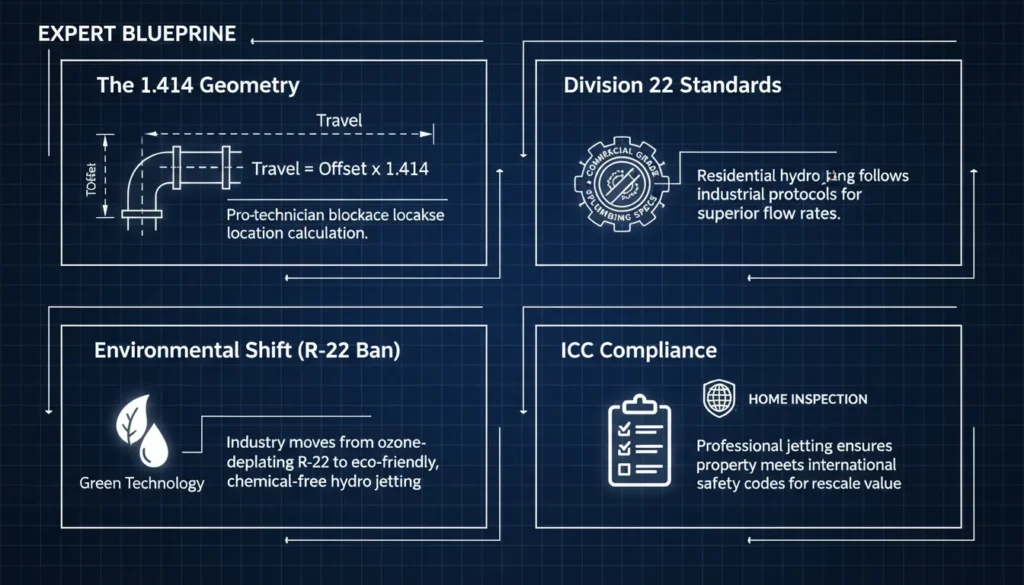
To truly understand a professional hydro jetting service in Miami, you have to look at the engineering and codes that govern your pipes. Plumbing isn’t just about water; it’s about physics, geometry, and strict international standards. Here is the high-level data that separates professional technicians from DIY amateurs.
The 1.414 Rule: Calculating 45-Degree Bends
In a sewer line, pipes rarely run in a perfectly straight line. When a pipe needs to shift horizontally or vertically, we use “offsets.”
The Geometry: When a plumber installs a 45-degree bend, they use the 1.414 multiplier to calculate the “Travel” length of the pipe.
Why it matters for Jetting: If a technician doesn’t understand this math, they won’t know exactly where the jetter head is inside your yard. By calculating the offsets, we can pinpoint exactly where a blockage is located relative to your cleanout, ensuring we don’t put unnecessary stress on the joints.
Division 22 Plumbing: Commercial Standards for Your Home
In the construction world, Division 22 refers to the standardized “MasterFormat” for plumbing specifications.
The Standard: While Division 22 is often used for commercial buildings (like Miami’s high-rises), applying these standards to residential homes ensures a higher quality of work.
The Jetting Connection: Division 22 focuses on “Facility Storm Drainage” and “Sanitary Sewerage.” When we jet a residential line, we follow these commercial-grade protocols to ensure the flow rates and pipe sanitization meet the highest possible industry benchmarks.
Why R-22 was Banned: Environmental Safety in Plumbing
Many homeowners ask about R-22, which was a common refrigerant (Freon). It was banned by the EPA because it depletes the ozone layer.
The Modern Link: The ban on R-22 shifted the entire industry toward Eco-Friendly choices. Just as we moved to safer refrigerants, professional plumbing moved away from Caustic Chemical Drain Cleaners toward Hydro Jetting.
Sustainability: Choosing hydro jetting is the “Green” alternative. It uses zero ozone-depleting chemicals and zero groundwater contaminants, keeping Miami’s coastal ecosystem safe.
The ICC Standard: Your Miami Property’s Safety Code
The International Code Council (ICC) sets the International Plumbing Code (IPC) that most of Florida follows.
Compliance: The ICC mandates how sewer lines must be vented and cleaned. Hydro jetting is a recognized method for maintaining a “Code-Compliant” plumbing system.
Property Value: When you have a professional jetting service performed, you are ensuring your home stays within ICC standards. This is vital for home inspections if you ever decide to sell your Miami property, as it proves the main sewer line is structurally sound and clear.
Prevention & Maintenance: The "No-Flood" Future
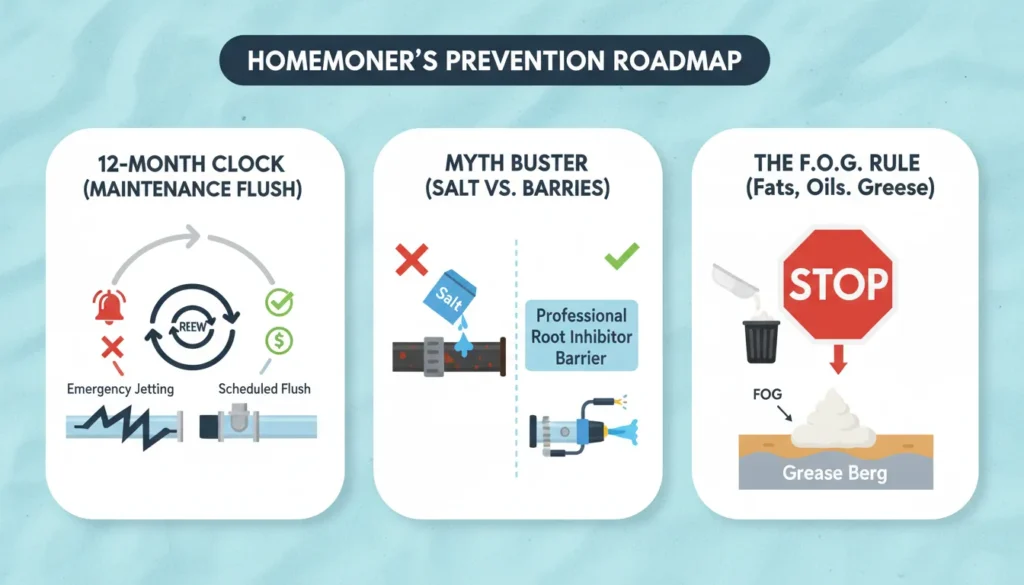
The goal of professional plumbing is not just to fix a flood, but to ensure one never happens. Hydro jetting is the most powerful tool in a “Predictive Maintenance” strategy. By moving away from reactive repairs and toward proactive care, Miami homeowners can virtually eliminate the risk of a sewage backup.
The 12-Month Maintenance Flush: Proactive vs. Reactive
Most people only call a plumber when the water is already rising on their bathroom floor. This is “Emergency Jetting,” and it is always more expensive due to after-hours fees and potential water damage restoration.
The Maintenance Advantage: A “Maintenance Flush” every 12 to 24 months costs significantly less.
The Logic: It removes the thin layer of biofilm and soft grease before it has the chance to crystallize into a “Grease Berg.” Think of it like a professional dental cleaning; it prevents the “cavity” (clog) before it requires “surgery” (excavation).
Salt & Root Control: Myths vs. Real Barriers
In Miami neighborhoods with heavy canopy cover, a common “Old Wives’ Tale” suggests pouring rock salt down the drain to kill tree roots.
The Myth: Salt is supposed to dehydrate roots. In reality, salt rarely stays in contact with the roots long enough to kill them and can actually corrode older cast iron pipes or damage the bacterial balance of septic systems.
The Reality: The only permanent root control is Hydro Jetting followed by a Chemical Root Inhibitor (like RootX) or a structural pipe liner. Jetting clears the path, and a professional inhibitor creates a “barrier” that prevents roots from sensing the moisture inside your pipes.
The F.O.G. Rule: Managing Fats, Oils, and Grease
The #1 enemy of South Florida sewer lines is F.O.G. Even if you have a powerful garbage disposal, your pipes aren’t designed to handle liquid fats.
The Process: Liquid grease enters the drain hot, but as it travels through the underground pipes (which are cooled by the Florida groundwater), it solidifies.
The Rule: Never pour fats, oils, or heavy grease down the sink. Scrape them into a container and dispose of them in the trash. If you have already been “breaking the rule,” a one-time hydro jetting session is required to “reset” your pipes to a zero-grease state.
Frequently Asked Questions
It is a high-pressure cleaning method that uses water (up to 4,000 PSI) to scrub the inside of pipes, removing grease, scale, and debris completely.
With proper maintenance, a professional hydro jetting service can keep your pipes clear for 2 to 5 years, whereas snaking often only lasts a few months.
The average cost ranges from $350 to $1,000. Small residential lines are on the lower end, while main sewer lines with heavy root damage are on the higher end.
If pipes are structurally sound, it is perfectly safe. However, it can damage extremely old, brittle clay pipes or pipes that are already collapsed. A camera inspection is always required first.
Most residential jetting is done between 3,000 and 4,000 PSI. Commercial systems may go higher, but 4,000 PSI is the standard for cleaning tough grease and roots.
Yes. It is more expensive than snaking, but it restores the pipe to “like-new” condition, preventing repeated service calls and expensive emergency backups.
The main hazards include potential “blowback” (water coming up through toilets) if not vented properly, and the risk of cutting through a pipe that is already failing or broken.
Yes. High-pressure water pulverizes tree roots and flushes them away. However, it does not stop them from growing back later; a chemical inhibitor is usually needed for that.